


Site-specific crop management (SSCM) means managing seed, fertiliser, lime and crop protection by the part of the field that needs them, instead of one rate across the whole field. You measure how the field varies, decide whether that variation is worth acting on, apply inputs to match it, and check the result at harvest. In agribusiness the same letters also stand for sustainable supply chain management. This guide covers the field practice first, then where the two meet.
What is site-specific crop management?
Every field has better and worse ground. Soil texture, organic matter, drainage, slope, compaction and old field boundaries all change what the crop can do from one spot to the next.
Uniform management sets one seed rate and one fertiliser rate for the field average. That over-applies where the crop cannot use the input and under-applies where it could. Site-specific crop management treats the field as a set of zones and gives each one the rate and timing it can actually use.
The term is widely used in precision agriculture research, for example at the Precision Agriculture Laboratory at the University of Sydney. Precision agriculture describes the technology: GPS, sensors, rate controllers. SSCM describes the management decision that technology serves.
SSCM in agriculture: crop management or supply chain management?
If you met the acronym in a sourcing, procurement or sustainability context, it most likely meant sustainable supply chain management. The two are easy to tell apart:
- Site-specific crop management is used by farmers, agronomists and ag retailers. The unit is the zone inside a field. The goal is the right input in the right place and a better margin per hectare. The outputs are zone maps, prescriptions and yield maps.
- Sustainable supply chain management is used by food and fibre buyers, processors and their sustainability teams. The unit is the supplier or sourcing region. The goal is lower environmental impact and lower risk across what they buy. The outputs are supplier scorecards, emissions inventories and certifications.
They meet at the field record, which is covered further down.
The site-specific crop management cycle in four steps
SSCM is a loop: each season’s results sharpen the next season’s decisions.
1. Measure the variability
Start with an accurate field boundary, then collect the layers that explain why parts of the field behave differently:
- Yield maps from several seasons, cleaned first. One season mostly records that year’s weather.
- Long-term satellite productivity, which shows which areas perform consistently across years.
- Soil lab results for pH, phosphorus, potassium and organic matter.
- Soil EC scans for texture at high density.
- Elevation, slope and curvature for water movement.
You can explore your own field layers in the browser before committing to anything.
2. Decide whether it is worth managing
This is the step most often skipped. Variability is worth managing when it is large enough to matter, stable across seasons, and tied to a cause you can act on.
If a low zone is low because it sits under water every spring, more nitrogen will not fix it. Less nitrogen might be the right call. Some fields are uniform enough that one rate is still the correct answer, and finding that out is useful too.
3. Act on it with zones and prescriptions
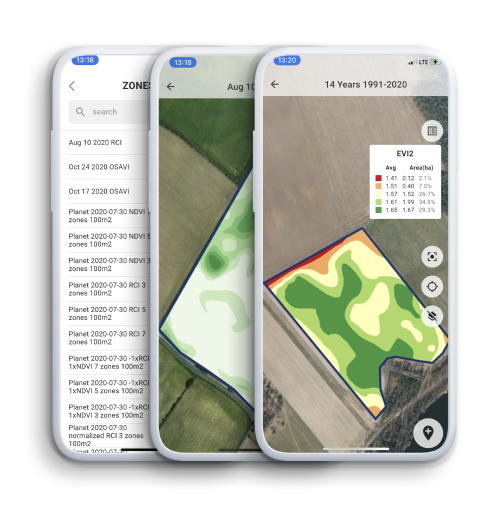
Turn the layers into three to five management zones, check them against what you know on the ground, then assign a rate to each zone. In GeoPard the rate can be a transparent formula, for example lime rate from target pH and the soil test, so anyone can see why a zone got what it got.
Validate rates and formulas with local agronomic knowledge, your soil tests and product labels. Then export the prescription as a shapefile or ISO-XML, or send it through John Deere Operations Center. The step-by-step guide to building a prescription map walks through this part in detail.
4. Evaluate after harvest
Compare the as-applied map with the cleaned yield map, zone by zone. Did the zones that got more return more? Did the zones that got less hold their yield? Start with yield data cleaning, then check whether the prescription paid off. What you learn goes straight into next season’s zones and rates.
When does site-specific crop management pay?
Three conditions decide it:
- The input is expensive per hectare. Nitrogen, seed, lime and phosphorus carry most of the value.
- The variability is strong and stable. Zones that hold their shape across several seasons are worth managing. Zones drawn by one odd year are not.
- You can actually vary the operation. A rate controller that reads a prescription, or at least a plan you can follow by zone.
A simple worked example. Take a 100 ha field where 30 ha have yielded well below the rest for five seasons. If that zone gets 40 kg/ha less nitrogen at $1.20 per kg, the saving is 30 × 40 × 1.20 = $1,440 on the field, or $14.40/ha averaged across it. That is before any yield effect.
The yield effect, from moving input into the zones that respond, is often where the larger return sits. It is also the number to measure rather than assume, which is what step 4 is for. To run the numbers for your own fields, crop and region, use the Variable Rate ROI Calculator.
Where site-specific crop management meets the supply chain
Food companies and processors increasingly report Scope 3 emissions, the emissions in the goods they buy. For an arable supply chain, a large share of those sit on the farm, and fertiliser nitrogen is usually one of the biggest items. The GHG Protocol Scope 3 guidance is the standard most of those reports follow.
To report, buyers ask growers for field-level records: what was applied, where, how much, and what the field produced. Site-specific crop management already generates those records:
- As-applied maps show product, rate and location for every pass.
- Yield maps give output per hectare, so inputs and emissions can be expressed per tonne.
- Zone and prescription maps document why each rate was chosen.
- Soil test results set the baseline for soil health claims.
A grower who manages by zone can answer a sustainability questionnaire from data instead of from memory, and can show nitrogen per tonne of grain coming down over time, which is the figure buyers track. Some sourcing programmes reward documented practice changes.
For ag retailers and agronomists, the same records across many growers turn into portfolio-level reporting. Field benchmarking helps compare fields and growers on the same basis.
How to start site-specific crop management this season
- Get the boundaries right and import what you already have: yield files, soil tests, as-applied data, or a connection to John Deere Operations Center.
- Pick one field and one input, the one with the highest cost and the clearest variability.
- Build zones from multi-year data and check them against what you know about the field.
- Set a rate per zone, validate it locally, and export it to your terminal.
- Keep the as-applied file from the application. It is your evidence.
- Leave a uniform-rate check strip across several zones, so the harvest comparison has a reference.
One field done properly teaches more than ten fields done roughly.
Frequently asked questions
Is site-specific crop management the same as precision agriculture?
Close, but not identical. Precision agriculture is the toolset. Site-specific crop management is the decision to manage by zone, using that toolset. You can own precision equipment and still manage every field at one rate.
Do I need variable-rate equipment to start?
No. Zones already guide soil sampling and scouting. Many sprayers, spreaders and planters accept a prescription, so check what your controller supports before buying anything.
How many seasons of data do I need?
Three or more seasons of yield or satellite history give zones you can trust. With less, lean on soil tests and topography, which change slowly, and treat the first season’s zones as a starting point.
What does SSCM mean in supply chain contexts?
Sustainable supply chain management: how buyers and processors reduce environmental impact and risk across their sourcing. On the farm side, it shows up as requests for field records, which site-specific crop management already produces.
Precision Farming






 English
 German
 Ukrainian
 French
 Kazakh
 Portuguese
 Spanish
 Arabic
 Swedish
 Serbian
 Romanian
 Norwegian
 Finnish
 Lithuanian
 Estonian
 Latvian
 Croatian
 Slovenian
 Slovak
 Japanese
 Polish
