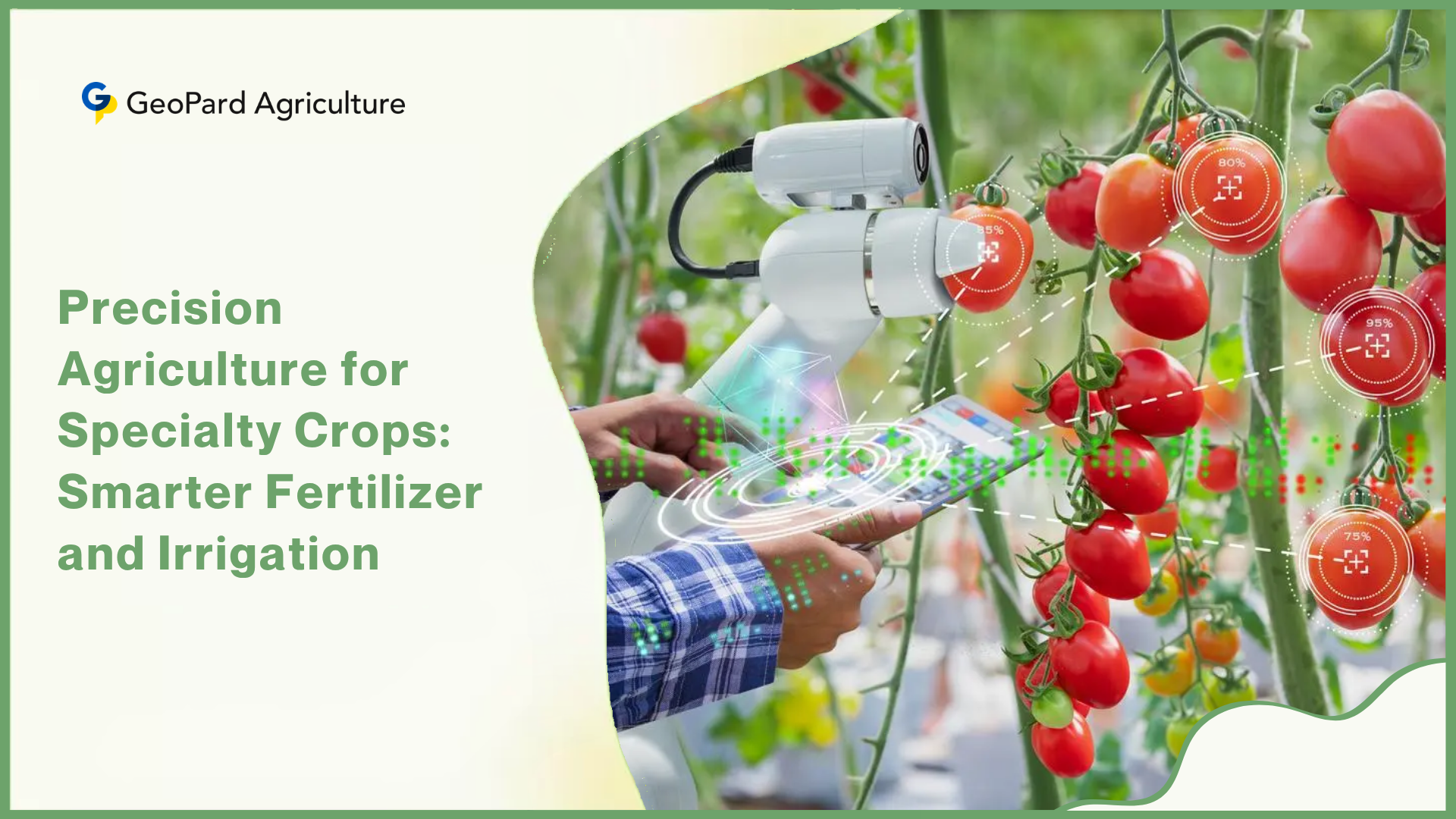
Precision Agriculture for Specialty Crops: Smarter Fertilizer and Irrigation

Specialty crops – including fruits, vegetables, nuts, herbs, and ornamentals – are high-value products whose quality and yield strongly depend on precise water and nutrient supply. In specialty crop production, optimizing fertilizer and irrigation for specialty crops using precision agriculture technologies is crucial to maintain yield, flavor, and quality. Precision agriculture (PA) employs field data and smart equipment (GPS-guided machinery, sensors, imaging, and decision-support software) to apply inputs exactly where and when needed. This data-driven approach can significantly improve fertilizer and water use efficiency compared to traditional blanket applications.

Rapidly rising input costs and growing environmental pressures make efficiency paramount. For example, global fertilizer use efficiency is low (less than 50% of applied nitrogen is taken up by crops), meaning much of the fertilizer applied to specialty crops can be lost to leaching or runoff. Likewise, agriculture already consumes about 70% of global freshwater, and many regions face tightening irrigation restrictions. Precision tools (soil probes, multispectral imaging, variable-rate systems, smart drip controllers, etc.) help match fertilizer and irrigation to plant needs, reducing waste and environmental loss while often raising yields.

The precision agriculture market is growing rapidly – the U.S. precision farming market was about $2.82 billion in 2024 and is forecast to grow at nearly 9.7% CAGR through 2030, while the global market (including hardware, software, and services) was about $11.67 billion in 2024 and may expand at 13.1% CAGR to 2030. These figures reflect strong industry expectation that smarter farming can cut costs and improve sustainability.

Unique Nutrient and Water Challenges in Specialty Crops

Specialty crops pose particularly demanding nutrient and water management needs. First, nutrient requirements vary widely by crop type, growth stage, and cultivar. For example, leafy greens may need very high nitrogen early on, while fruiting trees require balanced N, P, K and often extra micronutrients (e.g. calcium in apples to prevent bitter pit) during flowering and fruit set. The sensitivity to imbalance is acute: even small under- or over-fertilization can reduce fruit size and shelf life. Excessive N, for instance, can cause leafy vegetables to accumulate too much nitrate (a human health and regulatory concern) and can delay fruit ripening in some plants.

Conversely, deficiency symptoms (chlorosis, blossom drop, small fruit) emerge quickly. Similarly, water stress has outsized effects on specialty crops. Drought stress at key stages (e.g. flowering in tomatoes or fruit development in grapes) can slash yields and quality (for example, limiting sugar accumulation and berry size). Another factor is within-field variability, which is often extreme in perennial systems like orchards or vineyards. Soil texture, organic matter and moisture can differ dramatically even a few meters apart. A soil survey in a citrus orchard mapped multiple management zones (loam, sandy loam, clay loam, etc.).

This variability means a uniform fertilizer rate would under-fertilize some high-yield areas and over-fertilize others. In fact, a classic field study in the Pacific Northwest found wheat yields in the same field varying from 30 to 100 bu/acre; applying a single N rate for the field average would short-change the best spots and waste fertilizer on poor spots. The same principle holds in orchards and vegetable fields: site-specific nutrient maps are needed to align inputs with local potential.

A further challenge is environmental loss of inputs. Specialty crop systems often use high fertilizer rates and frequent irrigation, raising the risk of nutrient leaching and runoff. For example, poorly managed water and N in vegetable fields can leach nitrates into groundwater. Integrated management approaches have shown that optimized practices can cut these losses by 20–25% or more.

In North America, states and regions are imposing strict limits on nitrogen and pesticide runoff; specialty growers must adopt precision methods to comply. Water management is similarly regulated: inefficient sprinkler or flood systems can waste 10–30% of water to evaporation, whereas precision drip can reduce losses to near 0%. Specialty growers also face rising costs (fertilizer, water, labor), making any inefficiency expensive. Precision agriculture offers a way to address all these challenges by using technology to sense field conditions in real time and adjust inputs accordingly.

Core Precision Agriculture Technologies for Fertilizer Optimization

Precision nutrient management relies on both soil-based and plant-based sensing, plus robust mapping and prescription tools. These core technologies provide the data needed to apply fertilizer at variable rates (VRT) rather than a one-size-fits-all rate.

A. Soil-Based Technologies

Grid and zone soil sampling: Traditional nutrient management starts with soil testing. Precision methods use systematic grid or zone sampling to map soil fertility. For example, growers might collect samples on a 2–4 acre grid or delineate management zones (MZs) based on soil type or topography. Analysis of these samples yields maps of soil N, P, K, pH, etc. across the field. These fertility maps guide variable-rate fertilizer application: high-fertility areas get less added fertilizer and vice versa. This approach avoids the losses of uniform applications on heterogeneous soils. For instance, in a citrus study, researchers divided trees into canopy-based zones and applied tailored NPK rates, finding higher yields and thicker stems under variable rates than uniform applications.

Real-time soil nutrient sensors: New sensor technologies allow growers to monitor soil nutrients on the fly. One emerging tool is an in-situ ion-selective sensor array for nitrate. In a recent study, researchers built a 3D-printed sensor array with nitrate-selective membranes on electrodes to measure soil nitrate at multiple depths. Each probe uses a polymer-membrane electrode that generates a voltage proportional to nitrate concentration (–81.76 mV per decade change). Such sensors can stream nitrate levels continuously, enabling automatic scheduling of N fertilizer only when and where soil nitrate drops below target. Because less than 50% of applied N is normally taken up by crops, being able to sense soil N in real-time lets growers avoid excess applications that would just leach away.

Soil electrical conductivity (EC) mapping: Apparent soil EC sensors (like Veris or EMI tools) are also widely used. These devices send a small electrical current through the soil and measure conductivity, which correlates with soil texture, moisture, and salinity. By towing an EC sensor across a field, growers generate a soil variability map (higher EC often indicates clay and moisture, lower EC sand). These EC maps help delineate MZs for soil sampling or VRT. For example, an EC survey in an orchard might reveal heavier soil near a pond or fine-textured swales; these zones can be managed with higher fertilizer or water rates. By aligning fertilizer inputs to the EC zones, growers exploit the natural variability to maximize efficiency.

Variable-rate fertilizer application (VRT): The key output of soil sensing is VRT. Modern tractors and spreaders use GPS guidance to apply fertilizer at variable rates along each row. Prescription maps—generated from soil tests, yield history and other data layers—tell the machine how much fertilizer to deposit at each location. Section-control spreaders or fertigation injectors then modulate the dose according to GPS position. This capability translates soil data into action: nutrient-rich zones get little or no extra fertilizer, while low-fertility spots get more, improving overall yield potential and reducing waste. In trials with citrus orchards, VRT decreased total fertilizer use and cost for growers (while boosting fruit counts) compared to a uniform rate.

B. Plant-Based Monitoring

In addition to soil data, precision nutrient management uses plant-based sensors to gauge crop status directly.

Tissue testing and sap analysis: These conventional tools remain useful for precision programs. Tissue tests involve collecting leaf or petiole samples at specific growth stages and analyzing nutrient content in a lab. The results (e.g. leaf N or K concentration) give a snapshot of current crop nutrition. Growers can adjust fertilizer accordingly. Sap analysis (electrical conductivity of xylem sap) is a rapid field test often used in orchards (especially grapes) to approximate total soluble solids or N concentration in the plant.

If sap nitrate is below target, more N can be dripped in; if high, N is withheld. These methods provide ground-truth data to complement soil measurements, especially when spatial variability in uptake occurs. For instance, growers may sample leaves in different orchard zones to fine-tune variable-rate fertilization.

Chlorophyll meters: Handheld chlorophyll meters (like the SPAD or CCM models) measure leaf greenness as a proxy for nitrogen status. A meter clamps onto a leaf and reports an index related to chlorophyll content. Because chlorophyll is closely tied to leaf N, these readings allow quick field estimation of relative N needs. Growers can set threshold values for each crop: below-threshold readings trigger fertilizer application. In precision programs, spatially distributed SPAD readings (or more advanced optical reflectance clips) can create crop-N maps for VRT. Research has shown that SPAD values correlate with biomass and yield; for example, NDVI or SPAD-based N management in cereals consistently outperforms blanket fertilization. While specialty crops have unique leaf pigments, chlorophyll meters and similar optical devices are increasingly calibrated for vegetables and fruits as well.

NDVI and multispectral imagery: Drones, airplanes or satellites can capture multispectral images of crops, including near-infrared (NIR) and red bands. A common vegetation index, NDVI (Normalized Difference Vegetation Index), is computed from NIR and red reflectance and indicates canopy vigor and biomass. Dense, nutrient-rich plant canopies reflect more NIR and less red light, yielding higher NDVI. Growers use NDVI maps to identify nutrient-deficient areas mid-season. In one wheat study, NDVI sensing for N application led to higher grain yield and nitrogen use efficiency than fixed rate programs.

The same concept applies to specialty crops: NDVI or similar indexes (e.g. GNDVI for green biomass) from drone imagery can reveal stressed patches in a berry field or uneven nitrogen uptake in an orchard, guiding spot treatments. Canopy reflectance sensors mounted on tractors (like the Yara N-Sensor) operate on this principle, modulating N fertilizer on the go based on real-time reflectance. By sensing the plant itself, these technologies account for all factors (soil, water, health) affecting nutrient need.

C. GPS and GIS Integration

All the above sensors and data sources are integrated through GPS, GIS and decision-support tools.

Field mapping: Modern tractors and sprayers are equipped with GPS (often with RTK corrections) to record exact field coordinates. As machinery (sprayers, combines, tractors) operates, it creates geo-referenced maps: yield maps from harvesters, application maps from sprayers, and path logs from planners. These maps feed GIS software to visualize in-field variability. Growers can overlay yield data with soil-test maps to see how fertility affects output, or overlay moisture sensor locations with topography to identify dry spots. This spatial awareness is fundamental in specialty cropping, where each tree or vine row might be managed individually.

Prescription maps: Using GIS, the various data layers (soil test results, yield history, sensor data, terrain, crop rotation history) are combined to create prescription maps. For example, a fruit grower might weight late-season soil N and leaf-chlorophyll maps to determine a nitrogen prescription: high-N zones get 0 kg/ha, medium zones get 50 kg/ha, low zones 100 kg/ha. These rate zones are compiled into a GPS-compatible prescription file. Modern tractors or fertigation units then read this map and adjust the application hardware accordingly. This data layering (e.g. “Data layering such as yield, soil and moisture”) is what makes fertilization site-specific.

GPS-guided machinery: Ultimately, GPS controls the machinery. For solid fertilizer, spreaders use section control to turn sections on/off on the fly, matching the prescription rate. For liquid fertilizer or herbicide, variable-rate pumps or sectioned sprayer booms modulate output per nozzle. The same GPS system steers tractors for consistent coverage and auto-guidance reduces overlap. In specialty crops, precision planters and transplanters are also guided to ensure seeds or seedlings are placed in optimal positions relative to trees or irrigation lines. All these GPS/GIS integrations allow precise input placement that matches the underlying field data.

Precision Irrigation Technologies for Specialty Crops

Water optimization in specialty crops uses three core approaches: direct soil moisture sensing, climate-based scheduling, and advanced irrigation hardware. These methods often overlap (e.g. automated drip irrigation uses both soil sensors and weather data).

A. Soil Moisture Monitoring

Soil moisture sensors provide real-time data on the water content in the root zone. Common devices include capacitance sensors and tensiometers. Capacitance (dielectric) sensors, such as Decagon TEROS probes, measure the dielectric constant of the soil between electrodes; because water has a high dielectric constant, the probe voltage changes with water content. These sensors, typically installed at 10–30 cm depth, can report volumetric water content with an accuracy of ±2–3%. Tensiometers consist of a porous ceramic cup connected to a vacuum gauge; they measure the suction (negative pressure) the roots feel, indicating how hard plants must work to extract water. Soil moisture probes are often deployed in a wireless sensor network across the field or orchard (for example, in each irrigation block). Data from these sensors feed irrigation controllers or dashboards.

For example, a grower might install capacitance probes at multiple depths under a citrus tree and wirelessly transmit readings every hour. If the sensor reads 30% VWC when the irrigation threshold is 40%, the controller activates the drip valves until the probe returns to target. This direct feedback loop ensures trees never experience severe stress. Wireless sensor networks (using LoRa or Wi-Fi) enable dozens of probes to talk to a central system. While sensor accuracy varies with soil type, proper calibration yields reliable scheduling decisions. Many companies now offer integrated soil moisture monitoring systems with automated alerts (via mobile app) when irrigation is needed, replacing guesswork with data.

B. Climate-Based Irrigation Scheduling

Rather than reacting to soil data alone, climate-based scheduling uses weather and crop models to predict water needs. This approach relies on evapotranspiration (ET) data and weather station inputs. ET is the sum of evaporation from soil and transpiration by plants; it represents the water lost each day. Growers can obtain local ET data from on-farm weather stations or public sources (e.g. NOAA or NASA). Using a crop coefficient (Kc) for the specific crop and growth stage, they calculate crop evapotranspiration (ETc = Kc × reference ET). For example, alfalfa ET is a common reference; if local weather station data show 5 mm of water loss on a hot day, and the Kc for fully irrigated tomatoes is 1.0, then ETc = 5 mm/day. An irrigation schedule is then set to replace that 5 mm of water (minus any effective rainfall).

Predictive models can also use short-term forecasts. Software such as CROPWAT or commercial platforms ingest daily temperature, humidity, solar radiation and wind to forecast ET and suggest irrigation. For example, modern irrigation controllers can receive forecast data and delay irrigation if rain is expected, or add a fraction of ET if conditions are drying.

This climate-based scheduling can save water: one review noted that smart scheduling based on weather and ET can reduce irrigation by 30–65% compared to flood irrigation while maintaining yields. In practice, many specialty crop farms use on-site weather stations linked to their irrigation system. The weather station records net radiation and other factors; a controller applies irrigation when the calculated soil moisture deficit reaches a set point (often tied to a percentage of plant available water). This method avoids over-irrigation on cloudy days and ensures water is applied just before stress begins.

C. Smart Irrigation Systems

Smart irrigation combines automation with precision hardware. The most common is automated drip irrigation. Drip emitters deliver water directly to the root zone of each plant, minimizing evaporation and runoff. When paired with controllers, drip irrigation can be set to deliver precise amounts at precise times. For example, automated drip lines can apply nutrients (fertigation) and water together in pulses controlled by a timer or a soil sensor input. Variable-rate irrigation (VRI) is another advancement, especially for large field systems (like center pivots or big guns used in some vegetable fields). VRI uses GPS and zone valves to apply different water rates in different field sectors. For instance, a pivot can vary pressure to emit more water over sandy ground and less over clay, all in a single pass. This requires a prescription map for irrigation similar to fertilizer VRT maps.

Remote control is also a feature: many controllers now have cellular or Wi-Fi connectivity, so growers can adjust valves via a smartphone or laptop from anywhere. If a storm is imminent, a farmer can delay irrigation; if midday temperatures spike, extra irrigation pulses can be triggered. These smart systems enhance efficiency.

Netafim, for example, notes that precise drip application can cut evaporation losses to almost 0% (compared to 10–30% loss under sprinklers). It also completely eliminates runoff, since water is applied in small doses directly to the soil. In practice, growers report substantial water savings and yield gains using smart drip. One industry review found that precision irrigation investments can yield benefit-cost ratios over 2.5:1 with 3–5 year payback, reflecting both water savings and higher output.

Integrating Fertigation in Precision Systems

Fertigation – the practice of delivering fertilizer through the irrigation system – is a natural partner to precision irrigation in specialty crops. By linking nutrient delivery to irrigation timing, fertigation enables precise nutrient dosing and better uptake. In a drip fertigation setup, soluble fertilizer tanks or injection systems are connected to the drip line. When irrigation is scheduled (by soil sensor or timer), the system simultaneously injects a calculated dose of nutrients. This ensures that plants receive their fertilizer exactly when water is applied, maximizing root absorption and minimizing leaching.

The advantages of fertigation in a precision framework are significant. First, it allows precision dosing by growth stage. For example, a tomato grower might apply high phosphorus and potassium at flowering to boost fruit set, then switch to higher nitrogen during vegetative growth. By contrast, applying all nutrients at planting (as in traditional methods) is inefficient and can lock nutrients away from roots. Fertigation adjusts doses on the fly: if a mid-season leaf tissue test shows low N, the next irrigation can carry extra N; if the leaf N is high, the system skips or lowers the N injection.

Secondly, fertigation synchronizes water and nutrients to reduce losses. Because most nutrients are delivered to a wetted root zone, there is less chance for them to run off or percolate beyond root reach. For example, a Chinese study of summer maize using IoT-based water-N coordination showed dramatic results: an optimal irrigation+fertilization regime (IoT system B2) increased yield by 41.3% while saving 38.1% of irrigation water and 35.8% of fertilizer compared to a conventional treatment. Although that was maize, it illustrates the principle that precise fertigation can greatly enhance nutrient use efficiency (NUE). Specialty crops, often irrigated frequently, benefit similarly: careful fertigation can reduce the total fertilizer needed while raising output.

Finally, fertigation allows variable-rate nutrient application. Just as drip irrigation can be zoned for water, fertilizer injection pumps can vary doses across zones. Modern controllers accept prescription maps for fertigation: if soil sampling indicates a potassium-deficient corner of a berry field, the system can direct more K there. In multi-line drip systems (common in greenhouses or polytunnels), each line can have its own pump rate. This linked precision of water and nutrients means growers use the right amount at the right place. Overall, integrating fertigation into precision systems dramatically reduces nutrient loss and improves uptake efficiency, while enabling fine-grained control of crop nutrition.

Data Management and Decision Support Systems

All these sensors and controllers generate vast amounts of data. Effective precision farming requires powerful data management. Farm management software (FMS) solutions are now available to aggregate field data and turn it into actionable insights. These platforms (e.g. Granular, Trimble Ag Software, Climate FieldView) integrate yield maps, soil tests, weather logs, sensor readings, and even satellite or drone imagery. Using cloud databases, growers or consultants can layer this data and visualize spatial trends. For instance, by overlaying soil moisture maps with yield data from last season, the FMS might reveal that a slight water deficit in one field section cut carrot yields by 15%.

AI-driven recommendations are an emerging feature. Some systems analyze historical data and weather forecasts to suggest optimum irrigation or fertilizer recipes. For example, machine learning models can be trained on past growing seasons: given input on soil type, weather, and sensor readings, the AI can predict crop response and recommend a nutrient schedule. Early studies have found that AI decision support can improve N scheduling over static rules, though trust and calibration remain challenges. Nevertheless, tools with built-in AI are entering the market, promising to simplify decision-making for growers without precision expertise.

Historical data tracking is another benefit. Every input becomes a record: how much N was applied on June 10 at a certain row, what the sensor reading was, and what yield resulted. This history lets growers fine-tune over seasons. Cloud-based analytics allow consultant teams to remotely monitor multiple farms. In practice, a farm advisor might log into a cloud portal and see alerts for any field running low on moisture or showing nutrient deficiency.

Integration of multi-source data is crucial. Drone or satellite images (multispectral) feed into the system alongside ground sensors. Drones can spot plant stress in near-real-time and the FMS can fuse that with soil probe data. GIS tools within FMS help create the prescription maps mentioned earlier. Connectivity via 4G/5G or LoRa links sensors to the internet, enabling dashboards and apps. In sum, decision-support systems turn raw sensor data into management actions, making precision agriculture tools accessible to specialty crop growers and helping them make data-driven decisions rather than guesswork.

Crop-Specific Applications

Precision nutrient and water management must be tailored to each crop’s physiology and farming system. Below are examples for key specialty crop categories.

A. Tree Fruits and Orchards

In tree fruit orchards (apples, citrus, pears, etc.), zone-based irrigation and fertigation are widely adopted. Each tree row can be a management zone: older or larger trees receive more water and fertilizer, younger ones less. Drip emitter lines typically run one per tree or per two trees; these lines can be controlled by zone valves. For example, a 50-acre apple orchard might be divided into 5 irrigation zones based on tree age and soil. During early season (flowering to fruit set), the system can inject phosphorus and potassium when needed, then switch to nitrogen as fruits develop. Nutrient timing is critical: applying too much N before bloom can delay flowering, so precision systems allow skipping N early and ramping up later.

On the data side, orchardists often use leaf tissue analysis in bloom or mid-season (Petiole analysis) and feed results into the precision program. Also, canopy sensors on tractors can map vigor differences between blocks. Studies have shown that site-specific N management in citrus improved fruit yield and quality. In one trial, citrus trees under variable-rate fertilization had larger stem girth (a proxy for tree vigor) and higher fruit counts per tree than uniformly fertilized trees. This suggests that precision fertigation in orchards not only cuts waste but can boost output and quality.

B. Vineyards

Grapevines are extremely sensitive to water stress and nutrient balance because minor stresses can alter wine quality. Precision irrigation in vineyards often uses deficit irrigation strategies guided by sensors. Growers install soil moisture sensors or use plant-based measures (like midday stem water potential) to apply controlled drought. For instance, they may allow vines to dry to 70% of field capacity before irrigating, which concentrates sugars and flavors. When combined with GPS mapping, differential water can be applied to blocks known to produce low-yield or premium grapes.

Nutrient management in vineyards also uses precision: growers monitor petiole or leaf N at bloom and veraison and apply N through drip lines accordingly. Precision N avoids excessive vegetative growth, which can dilute grape quality. In one case study, targeted nitrogen injections at bloom improved grape yield without over-fertilizing dormant areas. Water stress and nutrient status are often monitored via remote sensing now; multi-spectral drones flying vineyards can detect vine vigor differences row by row. Precision allows vintners to match vine stress to wine style goals (e.g. high-end wines often come from more stressed, lower-yield vines).

C. Vegetables

Vegetable crops (tomatoes, lettuce, peppers, etc.) are highly intensive and have short growth cycles, so nutrient supply must be tightly controlled. Greenhouse and open-field vegetables increasingly use drip fertigation with fully automated schedules. Soil or substrate moisture sensors are placed near the root zone of representative plants. When sensors detect 60–70% soil moisture depletion, the system triggers both water and nutrient injection. This keeps soil moisture within a narrow band optimal for that crop. Excess nutrients are avoided; for example, a precision drip system might cut total N use by 20% while maintaining yield.

Vegetable growers also use handheld sensor tools. Chlorophyll meters are common in tomatoes to judge when to side-dress nitrogen. Handheld EC meters can verify nutrient concentrations in soilless media. In larger fields, yield monitors on harvesters (e.g. for potatoes) create maps of productivity. These feed back into fertilizer zones for the next season. The net result is that precision nutrient monitoring helps achieve consistent vegetable quality (size, color, crunch) and reduces the risk of over-fertilizing leafy greens, where nitrate levels are regulated.

D. Berries and High-Value Specialty Crops

Small berries (strawberry, blueberry, etc.) and herbs often grow on raised beds with drip lines, making them well-suited to precision management. Growers use moisture probes in each bed section to keep rootzone uniformly moist. Because berry size and sweetness depend on consistent watering, precision control (automated on-off valves on micro-irrigation) prevents both drought stress and excess water. For example, strawberry producers report that precise moisture control improves berry firmness and reduces diseases that thrive in overly wet soil.

Fertigation in berries is intense because soils are often marginal. Producers frequently test leaf tissue and can adjust nutrient injection weekly. In blueberries, which require acidic soil, irrigation water may even be acidified via fertigation (injecting sulfuric acid) to maintain pH. Precision drip systems allow this fine control. In high-value crops like cut flowers or herbs, yield and quality (flower size, leaf oil content, etc.) are so crucial that growers will spend for precise dosing of micro-nutrients. In all these cases, precision fertigation and irrigation deliver inputs only as needed per plant, boosting yield and flavor while minimizing fertilizer leaching.

Economic Benefits and ROI

Investing in precision fertilizer and irrigation technology can significantly improve a farm’s bottom line. The most immediate impact is input reduction. By applying fertilizer and water more accurately, farmers use only what the crop needs. Industry studies (AEM data cited in GAO) estimate precision tools can cut fertilizer use by roughly 8% and water use by 5%, while also reducing pesticide and herbicide use. These savings add up: for a 100-acre orchard spending $500/acre on fertilizer, an 8% cut saves $4,000 annually. Water savings have direct cost benefits where irrigation water is billed or energy is consumed (e.g. electric pumps).

Yield improvements are another economic driver. Precision management often increases average yield or quality grade. For example, targeted fertilization can turn marginal zones into productive areas, raising overall output. One trial in citrus showed significantly higher fruit counts under VRT. Increased quality can command premium prices: specialty produce with uniform size or higher sugar content (from optimal water stress) may sell at better rates. Although premium pricing is crop-specific, growers often find the extra revenue justifies the technology investment.

An ROI analysis typically looks favorable for precision investment. The review by Gopal et al. found that precision irrigation systems often achieve benefit-cost ratios over 2.5:1 with payback in 3–5 years. Reduced waste (fertilizer & water), along with yield/quality gains, contribute to that return. A combined figure of merit from multiple studies suggests farms could see an ~8% profit increase just from efficiency gains.

Of course, actual ROI depends on the scale of the operation and local input prices. In high-value specialty crops, even small percentage gains in yield or input efficiency can translate to substantial absolute profit improvements. Growers often pilot a single zone or tool first (for example, adding variable-rate fertigation on one irrigation line) to validate benefits before scaling up.

Environmental and Sustainability Impacts

Beyond farm economics, precision agriculture has clear environmental benefits. The precise delivery of inputs means reduced nutrient runoff and improved water conservation, addressing key sustainability goals. By matching fertilizer to crop uptake, far fewer nutrients escape into waterways. Integrated management approaches in the Corn Belt, for instance, achieved >20% reduction in nitrate leaching and >25% reduction in runoff nitrogen. Precision farming aims for similar gains: if 35% less fertilizer is used (as in the maize example), one would expect a proportional drop in nitrous oxide (N₂O) emissions and nitrate pollution. Given that global agriculture already accounts for a large share of greenhouse gases (agriculture, forestry and land use together emit about 23% of net anthropogenic GHG), cutting fertilizer use directly reduces N₂O and CO₂ equivalents.

Water conservation is equally important. Precision irrigation can slash farm water use by 30–65% as noted above. In regions facing drought or groundwater depletion, this relief is critical. For example, applying water only at the root zone (drip) virtually eliminates evaporation loss, meaning less total water must be pumped. Over-irrigation also causes salinity buildup and soil degradation; precision systems avoid these by giving exactly the water needed.

Regulatory compliance is another angle. Many states now have nutrient management requirements. Precision systems help farmers meet those regulations by demonstrating controlled use. Some programs (like nutrient management plans or water use reports) reward lower runoff and better record-keeping – tasks made easier by precision monitoring. Precision agriculture also aligns with regenerative practices: optimized inputs and localized treatments encourage healthier soil biology (since microbial communities aren’t shocked by excess fertilizer) and allow integration of cover crops and crop rotations (by capturing their benefits in sensor data).

Finally, reducing inputs lowers the carbon footprint of production. Producing synthetic N fertilizer is energy-intensive, so applying less fertilizer means fewer fossil fuels used. Combining this with site-specific cover cropping or composting (often part of precision nutrition regimes) can even sequester more carbon. In sum, precision fertilizer and irrigation management promotes sustainable agriculture by conserving water, cutting pollution, and reducing greenhouse gas emissions, all while maintaining productivity.

Implementation Strategy for Growers

Successful adoption of precision fertilizer and irrigation starts with assessing field variability. Farmers should map their land (using yield maps, soil tests, or EC maps) to identify zones. This may reveal how many distinct fertility or moisture zones exist. Knowing this informs what technologies to deploy first. Often the advice is to start small: implement precision irrigation or VRT on one block or one crop row, measure the results, then expand.

Choosing appropriate technologies depends on the crop and scale. A small orchard might begin with a few soil moisture probes and an automated drip controller. A large vegetable farm might invest in a multi-depth sensor network and drone NDVI services. Extension agents or agri-tech consultants can help select tools – for example, deciding between tensiometers vs capacitance sensors, or choosing a suitable fertigation pump.

Training and technical support are crucial. Farmers need to understand what the data means and how to act on it. Many suppliers offer training, and grower networks (peer groups, cooperatives) share best practices. Government programs sometimes provide grants or advice for precision ag adoption.

Finally, implementation is iterative. After installing sensors and systems, growers must monitor and adjust. Comparing predicted responses (from sensors) with actual results (yield, plant tests) allows calibration. If one zone is still underperforming, inputs there may be tweaked further. Collecting seasonal data builds a feedback loop for continuous optimization. Over time, the system becomes more finely tuned and yields the maximum economic and environmental benefit.

Common Challenges and Limitations

While the potential is great, precision fertilizer and irrigation technologies face several hurdles. High upfront costs are a major barrier. Sensors, controllers, and VRT equipment can be expensive. For example, a variable-rate pump or VRI kit on an irrigation rig can cost tens of thousands of dollars. Many specialty crop farms operate on thin margins or lack access to credit, making large tech investments risky. Partially offsetting this, technology costs continue to fall (e.g. generic IoT soil probes are cheaper now than a decade ago) and leasing or cost-share programs can help.

Data overload and complexity is another challenge. Farmers suddenly have streams of numbers from sensors and satellite imagery to interpret. This requires time and skill that many may not have. Complex software and analytics require either training or external consultants. Misinterpreting data can lead to wrong decisions (e.g. applying fertilizer when sensor drift gives bad readings). Good decision-support and user-friendly interfaces mitigate this, but the learning curve remains.

Connectivity issues in rural areas can limit the use of cloud-based and remote features. As one report notes, broadband internet is often not available on many farm fields, which means real-time data sharing or remote control may fail. In areas without cell service, wireless sensor networks may rely on local data loggers or satellite uplinks. Without reliable connectivity, some benefits of precision are diminished.

Technical knowledge gaps also slow adoption. Precision agriculture is interdisciplinary (agronomy, engineering, IT). Many growers lack familiarity with it, and farm advisors may not have the expertise to guide them. Ongoing education programs are addressing this, but for now the human factor is a limitation.

Finally, sensor calibration and maintenance are practical issues. Soil moisture sensors must be recalibrated for different soil types and may need cleaning or replacement. Flow meters and nozzles for VRT equipment require regular checking. Neglecting maintenance can lead to erroneous data and suboptimal management. Overcoming these challenges typically requires strong technical support and a gradual, well-planned implementation strategy.

Future Trends in Precision Fertilization and Irrigation

The field of precision agriculture continues to evolve rapidly. AI and machine learning will play bigger roles in decision support. We expect more AI-driven systems that can analyze complex data patterns (sensor streams, weather forecasts, satellite images) and predict optimal irrigation or fertilization schedules without human intervention. Autonomous robotics and automation are also emerging: drones or ground robots may soon scout fields automatically, perform spot spraying or localized fertilizing based on detected plant stress.

Satellite-based nutrient diagnostics are improving. Hyperspectral satellites and free imagery (Sentinel, Landsat) may soon provide affordable maps of crop nutrient deficiencies over entire farms. Combined with on-the-ground sensors, this will give unmatched detail on crop needs in real time. Similarly, real-time plant stress detection (using thermal or multispectral imaging) will become more common, so that water and nutrient deficits are spotted before symptoms appear.

Integration with climate resilience is another frontier. Precision systems will increasingly incorporate long-term climate forecasts (drought or heat waves) into irrigation and fertilization plans. For specialty crops sensitive to climate extremes, the ability to adaptively manage water and nutrients in the face of variability will be crucial.

Overall, the trend is toward ever-smarter, more autonomous management tools that let specialty crop growers be predictive rather than reactive. As sensors, AI, and robotics mature, the vision of fully automated, optimized fertilizer and irrigation – tuned to each tree or plant – moves closer to reality. Growers who adopt these trends early will be best positioned for sustainable, profitable production in a changing climate.

Conclusion

Specialty crop production demands both high productivity and resource efficiency. The use of data-driven precision techniques – from soil and plant sensors to GPS-guided applicators – is key to optimizing fertilizer and irrigation for specialty crops using precision agriculture technologies. By tailoring nutrient and water delivery to the specific needs of each crop and field zone, growers can significantly reduce waste of expensive inputs and protect the environment. At the same time, yields and product quality improve, supporting higher revenues. The economic incentives are clear – studies report double-digit yield gains and resource savings (for example, up to 65% water saving and profit gains around 8%). In the long term, precision nutrition and irrigation build farm resilience and sustainability: they reduce nutrient runoff by 20–25% or more, conserve precious freshwater, and cut greenhouse gas emissions by avoiding excess fertilizer.

Integration of Model Predictive Control in Precision Farming Technologies

Precision agriculture is a modern, data-driven approach that uses advanced technologies to tailor farming to specific field conditions. For example, farmers use GPS, IoT sensors, drones, and analytics to monitor soil moisture, weather, and crop health in real time. They then apply the exact amount of water, fertilizer or pesticide needed, at the right place and time. This smart approach improves efficiency and yield while cutting waste; one report notes precision methods have achieved roughly a 4% boost in crop production and a 9% cut in herbicide use. In this context, Model Predictive Control (MPC) has emerged as a powerful control strategy for agriculture.

MPC uses a mathematical model of the farm system to predict future behavior and compute optimal control actions over a moving time horizon. At each step it solves an optimization problem to minimize a cost (for example, deviation from target soil moisture or energy use) subject to constraints on water, equipment limits, etc. Because MPC looks ahead and adapts to changing conditions, it is ideal for managing complex, constrained processes in farming. Control systems like MPC are crucial in modern agriculture, where growers must juggle many variables (soil variability, weather changes, crop growth stages) and operate under strict resource and environmental constraints.

By anticipating future needs (such as an incoming heatwave or a forecast of rain) and automatically adjusting actuators (valves, sprinklers, heaters), MPC enables more adaptive decision-making than manual or simple feedback control. This predictive, optimization-based approach helps farmers conserve water and energy and improve yields – key goals as the world faces tighter resource limits and climate volatility.

Fundamentals of Model Predictive Control

Model Predictive Control (MPC) works by repeatedly forecasting the system’s future states and optimizing control inputs over a finite horizon. It emerged during the 1960s–1970s, was adopted by process industries in the 1980s, and has since progressed through classical, enhanced, modern, and data-driven stages—driven by advances in computational power, improved constraint handling, and growing integration with machine learning and data science. Key elements include:

  • Process model: MPC relies on a mathematical model (physical or data-driven) of the farm process (crop growth, soil water balance, climate dynamics, etc.). This model predicts how the system will evolve given inputs.
  • Prediction horizon: At each control step, the model projects forward a fixed time window (the prediction horizon) using current measurements (e.g. sensor readings) and candidate control actions.
  • Cost function (objective): MPC defines a cost or objective to minimize, such as deviations from desired soil moisture or temperature, plus penalties on resource use.
  • Optimization: The controller solves a constrained optimization problem over the horizon to find the sequence of actions (irrigation rates, heater settings, etc.) that minimize the cost while satisfying constraints.
  • Constraint handling: MPC naturally incorporates constraints on inputs and states – for example pump capacity, valve limits, actuator rates, and environmental limits on water use or nutrient levels. The optimizer ensures actions respect these limits.

Fundamentals of Model Predictive Control

After solving, MPC applies the first control action in the optimized sequence, then waits for the next time step, re-measures the system, and solves a new optimization (this is the “receding horizon” or “rolling optimization” scheme). This feedback gives MPC robustness to disturbances and model errors, since it regularly updates predictions with new data. In contrast to traditional control methods:

1. PID controllers adjust inputs based only on current and past errors (proportional–integral–derivative), without explicitly anticipating future changes or handling constraints. They work well for single-variable systems but struggle with multi-variable optimization or strict limits.

2. Rule-based systems follow pre-set heuristics (e.g. turn on sprinkler if moisture < X). They lack formal optimization and cannot easily balance competing objectives or adapt to new conditions.

By comparison, MPC’s predictive optimization makes it superior for complex farming tasks. It can handle multiple variables simultaneously (temperature, humidity, CO₂, water), meet hard constraints, and adapt to forecasts (e.g. weather forecasts can be fed into the model). The main trade-off is computational: solving an optimization online at each step requires more computing power. However, modern processors and specialized solvers (e.g. OSQP, ACADO) have made real-time MPC feasible even for agriculture applications.

A typical MPC system has three components: a mathematical model (could be physics-based or learned from data), sensors and data sources (providing real-time measurements of soil, weather, crop state), and the MPC controller/optimizer (running on a computer or embedded device). The model might simulate crop growth (for yield optimization), soil water dynamics (for irrigation), or greenhouse climate. Sensors could include soil moisture probes, leaf wetness sensors, temperature/humidity monitors, or remote-sensing imagery. The MPC controller then reads data, predicts future states, and computes control commands (opening valves, steering tractors, adjusting lamps).

Overview of Precision Agriculture Systems

Precision agriculture aims to boost productivity, efficiency, and sustainability by using detailed data about fields and crops. Instead of uniform practices, farmers now tailor actions to local conditions. For example, soil composition and moisture can vary widely even across one field; precision technology lets a farmer know which areas need more fertilizer and which need less. Common key technologies include:

  1. IoT sensors and wireless networks: Soil moisture probes, temperature sensors, EC (soil salinity) probes, and other Internet-of-Things devices continuously measure field conditions. These sensors send data to farm management systems.
  2. GPS and GIS systems: GPS enables precise mapping of fields. Farmers use GIS (Geographic Information Systems) to create soil maps and yield maps. These maps guide variable-rate applications (VRI) of seeds, water, or fertilizer.
  3. Drones and satellite imagery: Aerial imagery (NDVI, thermal, RGB) provides field-level scans of crop health and stress. Drones can also carry sensors (multi-spectral cameras, LiDAR) to monitor plant vigor.
  4. Farm management software: Cloud-based platforms collect and analyze all this data, helping farmers visualize variability and make decisions (e.g. where to irrigate or spray).

These technologies transform decision-making. One industry source explains that by monitoring soil and crop data in real time, growers can make smarter choices and apply inputs only where needed. In practice, precision agriculture has shown large benefits: for example, using variable-rate irrigation and moisture sensors across U.S. farms could save an additional 21% of water. Overall, modern precision farms can achieve higher yields, faster growth, and lower input costs by data-driven decision-making.

For example, automating irrigation and fertilization based on sensor data means less waste and more efficient use of resources. Notably, precision practices also cut environmental impact: a recent analysis found precision techniques reduced herbicide use by 9% and water use by 4% on average. By optimizing inputs, precision agriculture minimizes runoff and emissions, helping farms become more sustainable.

Integration and Key Applications of MPC in Precision Agriculture

Model Predictive Control fits naturally into a smart farming system as the “brain” that turns data into actions. In a typical flow, IoT sensors and external data (like weather forecasts) feed into a digital model of the farm process (crop growth, soil water balance, greenhouse climate, etc.). The MPC controller then uses this model to predict future states and compute optimal controls. The loop is: sensing → modeling/prediction → optimization → actuation.

For example, soil moisture sensors and weather forecasts flow into a soil-water model. The MPC optimizer uses this to plan irrigation over the next day or week, given forecasts of rain and temperature. It then sends commands to irrigation valves or pumps. At each interval, measurements update the model and the optimization repeats. This enables real-time, adaptive control that continuously accounts for new information.

MPC can be run online (real-time) on farm computers or controllers. For slower processes (like seasonal irrigation plans), it may do off-line planning and then implement the schedule. The distinction is that real-time MPC uses current data at each step, whereas off-line MPC uses a fixed plan updated daily or weekly. A cutting-edge concept is the digital twin of a farm or greenhouse – a virtual replica of the agricultural system.

A digital twin integrates models of soil, crops, climate, and equipment. Farmers can test control strategies on the twin (simulations) before applying them to the real farm. MPC uses the twin to forecast and optimize in a risk-free way. In the future, advances in cloud computing and 5G may enable powerful digital twin simulations on the fly, while edge computing (local controllers) executes fast MPC for robots or machinery on-site. Some of the key applications of MPC in Precision farming are:

1. Irrigation Management: MPC is widely used to control irrigation efficiently. By using a soil-moisture model and weather forecast, MPC predicts crop water needs and schedules watering. It ensures target soil moisture is met while minimizing water use and respecting pump or water-supply limits. For example, an MPC controller might reduce irrigation before forecast rain or adjust watering during a heat wave.

In practice, predictive irrigation control can cut water use dramatically – one report notes AI-driven irrigation cut water usage by up to 35% while boosting yields by 15–30%. MPC can also implement deficit irrigation strategies (intentionally mild water stress) to improve crop quality (e.g. in vineyards). By balancing yield vs. water savings, multi-objective MPC finds optimal trade-offs under field constraints.

Integration and Key Applications of MPC in Precision Agriculture

2. Climate Control in Greenhouses: Controlled-environment agriculture benefits greatly from MPC. Greenhouses have many interrelated variables: temperature, humidity, CO₂, light, etc. MPC can manage all actuators (heaters, vents, fans, lights, CO₂ injectors) simultaneously to maintain ideal growth conditions efficiently.

For instance, one study on an integrated rooftop greenhouse showed that a nonlinear MPC strategy reduced energy use (heating/cooling) by 15.2% on average compared to traditional control. By anticipating external weather changes and plant needs, MPC keeps climate tight and energy cost low. It can decide, say, how much to open vents or run a heater in advance of a predicted cold snap. Overall, MPC yields significant energy and CO₂ savings while ensuring maximum plant comfort.

3. Fertilizer and Nutrient Management: MPC can precisely dose fertilizers and nutrients (in soil or hydroponics) based on growth models. Using sensor data on nutrient levels and crop growth stages, MPC plans nutrient supply to meet plant demand without excess. This precision dosing reduces fertilizer runoff and waste. Controllers can also manage pH and electrical conductivity in hydroponic solutions. For example, an MPC scheme might ensure target nutrient concentration while minimizing overall usage, directly optimizing the “right rate, right time, right place” of the 4R principles. Precise nutrient control has the double benefit of boosting yield and reducing chemical pollution. In fact, the AEM study noted precision practices improve fertilizer placement efficiency by around 7%.

4. Crop Growth Optimization: Beyond single processes, MPC can operate on crop growth models to optimize yield and quality. Dynamic models (e.g. DSSAT, AquaCrop) describe how a crop grows under given irrigation, nutrients, and climate. MPC can integrate these to decide optimal schedules for watering, fertilizing, and possibly pest interventions throughout a season.

For instance, it may delay irrigation to induce desired stress for quality or apply extra fertilizer during critical growth windows. The MPC controller thus becomes a growth optimizer that shifts farming inputs in real time to maximize output. Research reviews highlight crop growth and yield optimization as a key MPC application
. MPC is also used for stress management – for example, to regulate canopy humidity to limit fungal diseases while maintaining growth.

5. Autonomous Farming Equipment: Modern tractors, sprayers, and robots use MPC for path planning and control. For example, an autonomous spraying drone or tractor can use MPC to plan its trajectory and implement precise field operations. The figure above shows a drone flying over a field – its flight path and spray rate could be optimized by MPC based on GPS mapping and obstacle sensors. MPC can handle the vehicle dynamics, wind disturbances, and battery constraints to keep the robot on course.

In practice, MPC-based planners allow equipment to cover fields with minimal overlap, avoid obstacles, and adjust speed in real time. This results in resource-efficient operations (e.g. less fuel, more uniform spraying) and safer navigation. Indeed, MPC is known for robust handling of constraints and real-time optimization in robotics. Modern driverless tractors and robotic harvesters often incorporate MPC or similar model-based controllers for navigation and task execution.

Benefits of Model Predictive Control in Precision Agriculture

Resource Efficiency: MPC’s predictive optimization leads to major savings. Studies show it conserves water and energy by scheduling irrigation and climate control only when needed, often saving 20–35% of water compared to naive scheduling. It also enables more precise fertilizer and pesticide use, cutting chemical usage (AEM reports about 9% less pesticide use with precision practices). In short, MPC helps farmers “use less to grow more” by leveraging the right amount of inputs under varying conditions.

Higher Yield and Quality: By anticipating stress and adjusting inputs proactively, MPC can improve crop yields and quality. Maintaining optimal conditions (soil moisture, temperature, nutrients) throughout the season directly boosts plant growth. For example, in many trials MPC-based climate control in greenhouses has increased vegetable yields while saving energy. The MPC review highlights improved produce quality and economic gains as key benefits.

Reduced Environmental Impact: More efficient use of water, fertilizers, and chemicals means a smaller ecological footprint. Precision methods as a whole have led to millions of acres of land effectively “saved” by getting more from existing fields. MPC’s contribution to this is clear: by lowering unnecessary water runoff and excess fertilizer, it cuts nitrate leaching and chemical pollution. AEM’s analysis notes that broader adoption of precision tech (including MPC-like controls) could avoid 10.1 million metric tons of CO₂-equivalent emissions already, thanks to land and fuel savings.

Handling Constraints and Uncertainty: Unlike fixed controllers, MPC can natively obey constraints (pump capacity, valve limits, environmental regulations) and can optimize even with constraints on resources. It can also incorporate forecast uncertainty (e.g. via stochastic MPC) to remain robust against weather forecast errors. This ability to anticipate and adapt to uncertainty is a major strength.

Automation and Scalability: MPC enables greater automation. It takes routine decision-making off the farmer’s shoulders, which saves labor and allows scaling up. Once set up, an MPC system continuously adjusts controls with minimal intervention. This scalability means MPC can be applied on anything from a small greenhouse to a large farm (subject to investment) and expanded with more sensors and actuators over time.

Challenges and Limitations of MPC

Computational Demand: MPC requires solving an optimization problem at each control step. For large-scale farms or fast processes, this can be computationally heavy. Real-time MPC needs high-speed processors or simplified models. Advances in solvers and hardware (including edge devices) are reducing this burden, but it remains a challenge, especially for smaller, low-cost systems. The 2024 MPC review specifically notes computational complexity as a key challenge.

Model Accuracy: MPC’s performance hinges on the accuracy of the underlying model. Developing a reliable model for biological systems (crops, soil, greenhouse) is difficult. Model uncertainty (mismatch between model and reality) can degrade control. Researchers address this via adaptive MPC (updating models online) or data-driven models (machine learning models). Nevertheless, getting a good model often requires significant domain expertise and data.

Data Quality and Availability: MPC needs high-quality sensor data and possibly weather forecasts. In agriculture, sensors can be sparse or noisy, wireless coverage may be weak, and forecasts imperfect. Missing or inaccurate data can lead to suboptimal or unsafe control actions. Effective MPC deployments must include robust state estimation or fault detection (e.g. Kalman filters) to handle sensor errors.

Cost and Complexity: Implementing MPC involves costs (sensors, computers, software) and requires technical know-how. Small farms may find the upfront investment high. There is also complexity in configuring MPC (tuning horizons, weights, etc.). Adoption can be hindered by lack of familiarity: farmers may prefer simpler systems unless benefits clearly outweigh the cost. Ongoing work in agriculture extension and user-friendly platforms aims to lower these barriers.

Farmer Adoption: Finally, adoption of advanced control like MPC depends on farmers trusting and understanding it. Training and demonstration projects are crucial. Some farmers may be skeptical of “black-box” optimization. Transparency (e.g. MPC interfaces that explain decisions) and field trials that demonstrate ROI can help build trust.

Case Studies and Real-World Implementations

Several pilot projects and research studies demonstrate MPC’s promise in agriculture. In greenhouse farming, a nonlinear MPC controller was tested on a New York rooftop greenhouse. It successfully regulated temperature, humidity, and CO₂ while optimizing energy use, achieving about 15.2% average energy savings over standard control strategies. This shows MPC’s potential for urban and high-tech greenhouses.

Case Studies and Real-World Implementations of MPC

In irrigation, while specific MPC field trials are still emerging, related technologies have shown gains. For example, intelligent irrigation controllers (often AI-based) have been deployed commercially, with reports of 30–35% water savings and significant yield increases. Some research farms are integrating MPC with moisture sensors and weather stations; these trials report better water-use efficiency compared to timer-based systems.

Smart tractors and robotics using MPC are also in development. For instance, autonomous sprayers equipped with predictive path planners (an MPC application) are being tested on large farms. Early reports from manufacturers suggest precise coverage and reduced overlap, translating to lower fuel and chemical use. Lessons from these deployments highlight the importance of reliable communications, robust sensor networks, and user-friendly dashboards, but overall they confirm that MPC can work well outside the lab.

Lessons Learned: Field implementations stress that accurate soil and climate models make a big difference. In greenhouses, for example, calibrating the thermal model to the specific glasshouse structure was key to reaping full energy savings. In irrigation, ensuring sensors remain well-maintained (to avoid drift) is vital so the MPC has good data. Also, gradually integrating MPC—starting with higher-level scheduling rather than critical real-time loops—helps farmers build confidence.

Emerging Trends and Comparison with Other Control Techniques

Future developments promise to enhance MPC’s role in farming. One trend is AI-enhanced MPC: machine learning can improve the models or even replace them (learned dynamics) to capture complex plant behavior. Hybrid approaches combine physics models with neural nets for more accuracy. Researchers are exploring Reinforcement Learning (RL) combined with MPC (RL-MPC) for some tasks.

Big Data and Cloud Integration: As farms amass more data (soil maps, multi-year yields), MPC controllers can exploit long-term trends. Cloud-based platforms may run heavy-duty optimization (long horizons) while edge devices run faster local MPC. Digital twins will become more powerful, allowing farmers to simulate MPC strategies under future climate scenarios.

Edge Computing and IoT Advances: New microcontrollers and IoT chips can now run moderate MPC solvers on battery power. This means even small automated irrigation valves or tractors can have onboard predictive controllers. Faster networks (5G) and satellite IoT (like Starlink or specialized Low-Power Wide-Area Networks) make real-time data flow more reliable.

Climate Resilience: With climate change, MPC can play a role in resilience. For example, controllers might include carbon or water footprint objectives, or integrate weather extremes forecasts to protect crops. Autonomous farms—where planting to harvesting is fully automated—are on the horizon; MPC (or more generally optimization-based control) will be central to such systems, coordinating robotics fleets and resource flows.

Compared to PID control, MPC offers explicit prediction and optimization. A PID loop reacts to current error (e.g. soil too dry triggers irrigation). MPC, by contrast, anticipates where moisture will be given wind, evapotranspiration and plans watering ahead. PID might overshoot or chattering under constraints, whereas MPC respects limits by design. MPC also handles multiple inputs/outputs (MIMO) natively, whereas PID is inherently single-loop (one sensor, one actuator).

Against rule-based systems, MPC is more flexible. A rule system might say “if moisture < threshold and no rain forecast, irrigate 10 units.” MPC will instead optimize the exact irrigation schedule that best balances future rain, plant needs, and water costs. MPC generally yields better performance in complex, changing environments. The trade-off is that rules are simpler to implement; MPC requires a model and solver. However, in large-scale or high-value crops, MPC’s advantages become significant.

Tools, Software, and Platforms for Model Predictive Control

Practitioners can build and test MPC using various tools. Common simulation environments include MATLAB/Simulink (with the MPC Toolbox) and Python libraries like GEKKO, do-mpc, or CasADi for optimal control. These allow developers to create and tune MPC models in software. For deployment, specialized controllers or PLCs can run the MPC algorithms at field speed.

On the farm-tech side, some IoT platforms and APIs support MPC. For example, smart irrigation systems may allow users to upload custom control algorithms. Companies like John Deere, Trimble, and small startups offer farm-management systems with predictive features (though often proprietary). Open-source frameworks (e.g. FarmOS, OpenAg) enable DIY integration of MPC for hobbyists and researchers.

Commercial digital twin and IoT platforms (Azure FarmBeats, AWS IoT, or Google’s Sunrise) can host the MPC core in the cloud while edge devices handle sensing. Some new edge AI chips and smart sensors even include onboard optimization capabilities. Farmers can choose full turn-key solutions (e.g. greenhouse climate controllers with built-in MPC) or mix-and-match: use MATLAB or Python for initial design, then implement on devices using e.g. FPGAs or microcontrollers. No single standard dominates yet; the field is evolving. Many practitioners start with open tools (MATLAB or Python) for simulation, then port to more robust hardware for field operation.

Conclusion

Model Predictive Control is poised to play a key role in the future of precision agriculture. By using models and forecasts to optimize farming actions, MPC helps farms use water, energy, and chemicals more efficiently while boosting yields and product quality. Its ability to handle multiple inputs, constraints, and uncertainty makes it well-suited to complex agricultural systems. As farming becomes more technology-driven, MPC provides the “brain” for smart decision-making. In practice, MPC-driven systems have already shown impressive benefits – energy savings in greenhouses, water savings in fields, and lower input costs.

The benefits go hand-in-hand with broader sustainability goals. Analysts note that precision methods like MPC allow us to “use less to grow more,” reducing the environmental footprint of agriculture. While challenges remain (cost, modeling, data), ongoing advances in AI, sensors, and computing are making MPC more accessible. In sum, MPC is an enabling technology for sustainable, high-tech farming, helping agriculture meet the growing demand for food under tighter constraints. With continued innovation and adoption, fully autonomous farms – guided by predictive controllers – may well be the next step in precision agriculture.

Frequently Asked Questions (FAQs)

1. What is MPC in simple terms?
MPC is like a smart autopilot for farming. It uses a model of the farm and forecasts (like weather) to plan actions (irrigation, feeding, etc.) ahead of time. Instead of reacting only to current conditions, it “looks ahead” over the next hours or days and finds the best plan to achieve your goals (e.g. healthy crops) while using minimal resources.

2. Is MPC expensive for farmers?
MPC does require technology (sensors, computers, software), so there is an upfront cost. However, the cost of computation has fallen, and cheaper IoT sensors are widely available. Many modern tractors and equipment already come sensor-equipped. Also, cloud and open-source tools make MPC more affordable. Crucially, the efficiency gains (less water, fertilizer, energy waste) and higher yields can pay back the investment over time.

3. Can MPC work on small farms?
Yes. MPC algorithms can be scaled to any size system. A small greenhouse or garden can use a simple MPC setup (even a laptop or Raspberry Pi). Many remote-sensing apps let smallholders try out model-based decisions via smartphone. The key is to match the system complexity to the farm’s size. Small farms may not need very long horizons or huge models. Even basic MPC with one or two sensors can help a small farm become more efficient.

4. How accurate are MPC models and predictions?
The accuracy depends on data quality and model design. Simple linear models can be reasonably accurate for some systems. More complex models (like neural nets) can capture tricky plant or soil behavior. In practice, MPC is designed to be robust: it re-calibrates plans regularly based on new measurements, so even if predictions aren’t perfect, it corrects itself over time. Model errors and disturbances are handled by feedback. With good sensors and tuning, modern MPC can achieve high accuracy in control tasks.

How New Incentives Could Boost Precision Agriculture Adoption in the UK?

Precision agriculture (PA) refers to using modern tools – GPS-guided machinery, soil sensors, drones, data analytics and even robots – to manage each part of a farm field in the most efficient way. Instead of treating an entire field uniformly, farmers can test soil and crop health in small zones and apply water, fertiliser or pesticides exactly where they are needed. This approach boosts yields and cuts waste: for example, on many farms precision techniques can cut fertiliser use by 15–20% while raising yields 5–20%. Smart sprayers using cameras can reduce herbicide use by up to 14%.

In the UK, precision farming also means meeting climate and nature goals while keeping farms profitable. However, adoption has been slower than hoped. Costs are high and many farmers lack the training or proof of value needed to invest. Now the government has unveiled a major package of incentives in 2026 – bigger farm support payments (SFI26) plus grants for equipment. The core question is: can these new incentives really shift farmer behaviour at scale? The evidence suggests yes, if they are well-targeted and combined with other support.

The timing is urgent. UK farms face rising costs for fuel, fertiliser and labour, and at the same time must cut greenhouse gases and protect wildlife. Precision tools can help on both fronts. A recent market study found the UK precision farming market was about $307 million in 2024 and is projected to grow to $710 million by 2033 at ~9.8% annual growth. This growth indicates strong interest in the technology.

Yet on-farm take-up remains uneven. Large arable farms (especially in East Anglia) are already using GPS steering and soil sensors, but many smaller family farms are still “paper plans” rather than data-driven. Industry surveys show around 45% of farmers cite unclear returns on investment and high upfront costs as key barriers. Only about one in five farmers have so far invested in agri-tech. Without help, switching every farm to precision methods could take a decade or more. That is why the new 2026 incentives – simplified subsidy schemes plus targeted grants – aim to tilt the economics and risk in farmers’ favour.

The Current State of Precision Agriculture in the UK

Precision farming use is growing but still far from universal. The Adoption of specific technologies varies widely by farm type and region. For example, GPS automatic steering and field mapping are common on large arable holdings, but less so on small mixed or livestock farms. In a recent UK farm survey, farmers said they plan to boost precision ag by 2026, but actual uptake lags. One report noted “around half of farmers surveyed cited high costs and uncertain returns as barriers”. Another found about 20% of farms had adopted any agri-tech, reflecting that many smaller farms cannot yet afford or integrate these tools.

The Current State of Precision Agriculture in the UK

Size matters. Larger farms (hundreds of hectares) are far more likely to have yield monitors, variable-rate spreaders, soil probes and drones. These farms already use data for decisions – one industry leader noted that 75% of large farms now use some data tools. By contrast, on smaller farms (under 50 ha) adoption is much lower: often less than 20–30%. Regional differences appear too: highly mechanized areas like East Anglia and Lincolnshire see more precision use, whereas smaller mixed farms in Wales, Scotland or hilly regions stick to traditional methods.

The types of technology also vary. GPS auto-steer is one of the most common tools, but even that may be on only a quarter of tractors on small farms. Sensors (soil and weather stations) are still rare outside trials. Satellite or drone imagery is growing (many farmers now reference free NDVI maps), but active drone spraying or robotic weeding is still uncommon. In the UK, variable-rate fertiliser application and precision sprayers have been pioneered on some cereal farms, but penetration remains modest. Overall, most farmers are aware of precision options, but many are waiting for clear evidence or support to invest.

Barriers Limiting Adoption Without Strong Incentives

Several interlocking barriers have held UK farmers back from precision ag, especially smaller and medium-sized farms. The biggest hurdle is cost. New equipment like robot weeders, drones or advanced seed drills can cost tens of thousands of pounds. Many farms cannot make that investment without help – especially after years of low profits, floods or high energy prices. Surveys repeatedly find that a lack of affordable financing and unclear payback is a top reason cited by farmers.

One UK agri-tech report noted nearly half of farmers said unclear return on investment was a key barrier. In practice, a new precision sprayer or variable-rate spreader must save enough in fertiliser or labour to cover its own cost, and on marginal crop margins that is risky without a subsidy.

Skills and knowledge gaps also slow adoption. Precision tools generate lots of digital data: mapping fields, analysing satellite images, or running smartphone apps. Many farmers (especially older ones) find this new digital farming approach daunting. Training and advice lag behind the technologies. There is no single “plug-and-play” solution: a farmer needs to know how to interpret yield maps or calibrate sensors. Studies of UK farmers find that lack of digital skills and support is a key reason to stick with tried-and-true methods.

Barriers Limiting Adoption Without Strong Incentives

Connectivity issues make digital farming harder in the countryside. Good internet and mobile coverage is often needed for cloud-based agronomy apps and real-time data feeds. But rural connectivity is patchy. A 2025 NFU survey reported only 22% of farmers have reliable mobile signal across their whole farm, and about one in five farms still have less than 10 Mbps broadband. This means a drone or sensor that needs an online data link can be frustrating or impossible on many farms. Poor Wi-Fi or 4G signals leave some farmers unwilling to rely on apps or real-time weather data – a fundamental hurdle that farm incentives alone can’t fix.

Other issues include risk aversion and culture. Farming tends to value consistency. Trying a new system that can fail (say, robot weeding not working) can scare farmers who cannot afford a crop loss. There are also data trust and ownership concerns. Who owns the field data – the farmer, the equipment maker or an app provider? Without clear standards, some farmers worry about giving away their crop data or being locked into one company’s platform. This adds a layer of hesitation, since “getting on the wrong tractor” or software could lead to costly headaches.

Existing UK Incentives and Policy Framework

Historically, UK farm support was mainly through direct payments tied to land area (the old EU Basic Payment Scheme). Since Brexit, these are being phased out and replaced by more conditional schemes. The flagship is Environmental Land Management (ELM) payments run by DEFRA. ELM has multiple strands (Sustainable Farming Incentive, Countryside Stewardship, Landscape Recovery) rewarding farmers for environmental benefits. The idea is to pay farmers for outcomes like better soil health, cleaner water or more wildlife. Precision agriculture can help achieve those outcomes, but only if farmers adopt the tools – hence the interest in linking incentives.

Until 2024, the Sustainable Farming Incentive (SFI) had dozens of possible actions (cover crops, hedges, etc) that farmers could sign up for. Many of these actions generate data (like cover crop photos, soil tests). But the link to technology was indirect. Farmers might get paid per hectare for doing an action but had little extra support to invest in new machines. That meant SFI alone didn’t give a big boost to buying sensors or drones – it mainly encouraged land use changes.

There were some precision-friendly actions (e.g. measuring nutrient levels) but no direct equipment grants. Meanwhile, DEFRA has run small grant pilots (the Farming Innovation Programme etc) to test new tech on farms, but uptake was limited without scaling.

Recent UK policy has explicitly recognized these gaps. In 2024-25 the government assembled a £345 million investment package for farming productivity and innovation. Within that, some ELM funding is earmarked for tech adoption. Key elements include:

1. A revamped Sustainable Farming Incentive (SFI26) to start mid-2026. This new scheme is much simpler: only 71 actions instead of 102, with a £100,000 per-farm cap to spread money more evenly. Crucially, SFI26 keeps three direct precision-farming actions with clear per-hectare payments. For example, it pays £27/ha for variable-rate nutrient application (applying fertiliser based on soil maps) and £43/ha for targeted spraying using camera or sensors.

The most generous is £150/ha for robotic mechanical weeding (removing weeds by machine rather than spraying). These payments effectively reward farmers each year for using precision methods. In addition, the SFI26 focus is on “doing and documenting” outcomes – meaning farmers using tech (drones, photos, sensors) can more easily prove their work and get paid.

2. Equipment grants. The Farming Equipment and Technology Fund (FETF) offers £50 million in capital grants (rounds in 2026) specifically for precision tools: GPS systems, robotic planters, drone sprayers, smart slurry mixers, etc. Farmers apply for a share of this to buy new machines.

3. ELM Capital Grants open in mid-2026 with £225 million for broader investments (water tanks, storage, low-emission equipment) that often complement precision tech. Together, these grants directly lower the upfront cost of precision gear, while SFI payments give a recurring income boost for using it.

4. Innovation and advisory support. A £70m Farming Innovation Programme is accelerating lab research into farm-ready tools. And Defra is offering new advice services and a free nutrient-management app to help farmers learn precision techniques. These non-cash incentives aim to build skills and create markets, making technology adoption less daunting.

What “New Incentives” Could Look Like

New incentives can be both financial (grants, payments, tax breaks) and technical (data, training, networks). The recent policy moves already cover much ground, but ongoing debate suggests broadening support beyond single-year payments: moving toward rewarding actual environmental and efficiency outcomes, and building the digital backbone (connectivity, data systems, skills) that makes precision tools usable.

1. More targeted capital grants or loans. The FETF and ELM grants are a good start, but some farmers want even larger or longer-term financing. Proposals include tax incentives (e.g. accelerated depreciation on ag-tech purchases) or low-interest green loans for precision equipment. For instance, government could allow 100% first-year depreciation on ag-tech assets for tax purposes. This would lower the effective cost of machines for farms with profit taxes.

What “New Incentives” Could Look Like

2. Outcome-based payments linked to efficiency or sustainability targets. Instead of flat per-hectare rates, farmers could earn bonuses for measured gains. For example, a payment for reducing fertiliser use by X% while maintaining yield, or for cutting carbon emissions on the farm. A move toward these “results” payments would make precision tools more attractive, as the better the tech works, the more subsidy the farmer gets. In effect, this would be a pay-for-performance scheme requiring data logs (which only precision ag provides easily).

3. Data platforms and interoperability support. A common complaint is that different machines and software don’t talk to each other. The government or industry consortia could fund open data platforms or standards so that a drone map can feed any farm app, or results from one tool can integrate with another. Grants or vouchers for subscribing to farm-management software could also be offered. This lowers the “soft cost” of adoption by making it easier to use multiple technologies together.

4. Skills and training incentives. Training grants for farmers (like voucher-funded courses on digital farming) and subsidies for advisory services could be expanded. Some experts propose mobile “precision farms” or demo days where farmers earn credit for visiting. Putting graduate agronomists or engineers on farms (funded partly by government) would give on-the-ground help to test and learn new tech.

5. Collaborative or co-investment models. Encouraging farms to pool investments or lease equipment could spread costs. For example, a scheme where farmers share a drone service, or co-own a robot, with initial capital subsidized by grant. The UK’s Agri-EPI Centre already runs leasing trials. New incentives might explicitly support co-ops buying AI or robotics for groups of farms.

Lessons from Other Countries and Sectors

Other nations’ experiences show how incentives can move the needle, and what pitfalls to avoid:

1. United States:
The US Farm Bill and conservation programs now explicitly cover precision farming. For example, recent US legislation added precision equipment and data analysis under the Environmental Quality Incentives Program (EQIP) and Conservation Stewardship Program (CSP), with cost-share rates up to 90% for technology adoption. In practice, American farmers can apply for huge rebates on precision seeders or variable-rate applicators, offsetting the high cost.

The US also funds ag-tech R&D aggressively, creating spin-outs that benefit farmers. These policies have boosted US tech adoption rates, especially on larger farms. However, even in the US, uptake on small farms is less than ideal unless incentives are well-targeted.

2. European Union:
The EU’s Common Agricultural Policy (CAP) now includes “eco-schemes” and innovation funds that reward precision farming in the context of sustainability goals. For example, French and German farmers can get CAP payments for precision watering or biodiversity monitoring using smart tools. EU initiatives also fund data sharing projects (like the European Agricultural Data Space) to make digital tools more accessible.

The lesson is that tying tech adoption to climate and biodiversity goals can justify public money to farmers, as seen in CAP’s “green architecture”. However, uniform EU rules also mean member states must ensure small farms aren’t left behind by big machines, a balance UK policy can emulate with its £100k cap.

Lessons from Other Countries and Sectors

3. Australia:
The Australian government and states have supported precision farming through research grants and tax incentives. Agencies like the Cooperative Research Centres (CRC) and Rural R&D Corporations have poured funds into agri-tech, benefiting tools tailored to Australian crops. Farmers can often get rebates for adopting water-saving precision irrigation or drones.

Even though Australia’s conditions differ (e.g. more arid land, larger farms), the key lesson is the combination of R&D funding and on-farm trials. Programs that help transition a prototype into a commercial product on real farms have accelerated adoption there.

Other sectors:
We can draw analogies to sectors like electric vehicles or renewable energy, where government incentives (grants, tax credits) drastically raised adoption. In the EV space, subsidies quickly pushed sales from niche to mainstream. A similar idea in farming is “get the first movers on board with generous support, then the rest follow”. Public-private partnerships have worked in fields like water-efficient irrigation, and could work for precision ag.

For instance, telecom companies sometimes team with governments to upgrade rural broadband; similarly, there could be joint schemes with private tech firms to deploy agri-tech. Across these examples, effective incentive design often means:

  1. High cost-share early on for new tech (like the US 90% cost-share) to overcome initial skepticism.
  2. Clear outcome metrics tied to payments (so farmers see exactly what they gain by doing X technology).
  3. Focus on smaller farmers and “late adopters” with dedicated windows or higher rates, to avoid widening the farm-size gap.
  4. Non-financial supports (extension services, interoperability standards) alongside the money.

Potential Impacts of Stronger Incentives

With well-designed incentives, the potential upside is large: more efficient, sustainable farming with a solid data backbone for the future. But this assumes the incentives are targeted carefully (to smaller farms and outcome metrics), and that supports like training keep pace. If not, the risk is new incentives mainly boosting the biggest operators and adding admin burden to small farms with little gain. If new incentives succeed in accelerating adoption, the impacts could be significant:

Productivity and profitability gains. Farmers who use precision tools often report better yields or lower input costs. For example, trials of variable-rate fertiliser and no-till in the UK have shown as much as 15% lower fertiliser use with stable or higher yields.

With new incentives, industry experts project an arable farm using cover crops, no-till and variable-rate nutrients could gain £45,000+ per year in SFI payments alone. Over time, these efficiency gains could boost overall farm margins. Smaller farms would especially benefit from the £100k cap ensuring they get a share of these gains.

Environmental benefits. Precision ag is often touted as “grow more with less”. Less wasted fertiliser and pesticide means lower nutrient runoff and water pollution. Early adopters in East Anglia using government-supported variable-rate spreading reported 15% less fertiliser use and healthier soils.

Robots instead of herbicides reduce chemical load in fields. By 2030, more precision farms could help the UK meet targets like cutting agricultural nitrogen pollution and methane. Additionally, detailed field data from sensors and drones can improve on-farm monitoring of wildlife habitats or soil carbon – something large food buyers are beginning to demand.

Better data for national goals. Incentivised precision farming will generate a wealth of geospatial data (soil maps, yield records, greenhouse gas estimates). This data can feed into national efforts on food security and climate reporting.

For example, if many farmers map their soil organic matter, the UK could have far better national estimates of soil carbon. And tracking pesticide use by field helps verify compliance with environmental regulations. In effect, precision adoption could turn farmers into precise “data providers” who help shape agricultural policy.

Structural effects – both positive and cautionary. On the one hand, stronger incentives may accelerate mechanisation and favor larger or well-financed farms that can handle complex tech. This could risk widening the gap between big and small farms unless carefully managed (hence the cap and small-farm window in SFI26). We might see a consolidation of farm management systems, with fewer farmers controlling larger precision-enabled farms.

On the other hand, better-funded smaller farms could survive in a tightening market. As agriculture becomes more data-driven, there is a chance that smaller farmers who leverage tech might actually compete better (through better yields or targeted niche markets).

Cultural shift and innovation spillover. If technology becomes the norm on farms, we may see younger or more tech-savvy people enter farming. The private agri-tech sector might also boom: equipment suppliers and software companies will have a bigger market. Lessons learned in UK could spill overseas (British precision startups might export to other countries’ farms, for instance). Moreover, farmers who become accustomed to precise farming may be quicker to adopt other innovations (like digital livestock sensors or even genetic tools).

Role of the Private Sector and Supply Chains

Private investment and supply-chain programs can amplify government incentives. If retailers require data-backed farming practices, that creates a business incentive to adopt precision tools, often matching or exceeding public funds. Conversely, without private sector buy-in, even generous public grants may not reach every farmer (as seen in schemes where uptake was lower than expected).

The ideal scenario is a virtuous cycle: government incentives kick-start adoption, which makes the business case clearer, which then attracts more private financing and market demand for precision outputs. Government money is one piece of the puzzle – private industry and supply chains are the others. In practice, adoption will likely depend on a mix of public and private incentives:

1. Agri-tech companies and financiers. Companies that develop precision tools have a big stake. Many are offering creative financing: tractor manufacturers (John Deere, CLAAS, etc) now bundle GPS and telematics options into leases, making them more affordable. Agri-tech startups and equipment dealers may partner with banks or leasing firms to spread costs. In fact, the Angloscottish article noted a surge in farmers using finance to buy new tech.

Role of the Private Sector and Supply Chains in incentives of precision agriclture

New incentives like grants can make it easier for these companies to demonstrate ROI to farmers, which in turn can boost sales. We may also see more co-investment models, where an equipment maker or retailer shares the cost or risk of deploying a new technology on a demo farm.

2. Food processors and retailers. The supply chain can strongly influence what happens on farms. Large buyers often set sourcing standards. For example, major UK retailers and processors increasingly demand proof of low carbon or low pesticide residues. Some are now explicitly rewarding sustainable practices – for instance, offering premiums to farms that show environmental monitoring data.

Marks & Spencer’s recent “Plan A for Farming” initiative is a case in point. M&S has committed £14m to sustainable farming and innovation, and is investing in a program where 50 British farmers receive free soil, biodiversity and carbon monitoring tools to meet retailer standards. By helping farmers afford sensors and data collection, M&S (and others) essentially act as co-funders of precision ag. Similarly, food processors might pay more for inputs from farms that can prove efficient water and chemical use.

3. Industry groups and partnerships. Bodies like the Agri-Tech Centre, InnovateUK and supply-chain alliances can help match farms with technology. Grant programs (like Innovate UK’s Agri-Tech Catalyst) often require collaboration between farmers, tech firms and universities. These partnerships can reduce risk by pooling knowledge. Trade groups can also negotiate bulk discounts for members: for instance, a farmers’ co-op might organize a single purchase of a drone or weather station platform for all its members, with some subsidy.

4. Financial sector innovation. Agricultural banks and insurers have a role too. Insurance products might reward farms that use precision controls (lower risk, lower premiums). Banks and fintech firms could offer loans tied to grant eligibility (e.g. a loan forgiven if matched by a grant). We already see some fintech offerings for equipment leasing; new incentives might encourage more competition in that space.

Measuring Success: How to Know if Incentives Are Working

To judge whether new incentives truly accelerate precision farming, we need clear metrics. By combining these indicators, policymakers and industry can gauge effectiveness. Ultimately, success means not just more equipment on farms, but verifiable environmental gains and improved farm finances. It will likely take several years of data (2026–2030) to see the full picture of impact. Ongoing monitoring and evaluation will be key, with a willingness to adjust incentives if certain goals aren’t being met. Possible measures include:

1. Adoption rates and usage: These could include the percentage of farms reporting use of specific technologies (e.g. % of fields managed with variable-rate equipment, % of farms using yield mapping or drones). Government surveys (like those done by Defra or industry bodies) should track these over time. But raw adoption counts can be misleading if farms only tick a box without real change. So it’s important to measure meaningful use – for example, not just owning a GPS system, but using it to cut input rates.

2. Farm productivity and cost metrics: Changes in average input usage per hectare, yields, profits or labor hours could indicate impact. If farmers on average need 20% less fertiliser per tonne of crop, that suggests precision tools are making a difference. These figures could be reported via annual statistics or pilot program results. One could track, say, reductions in fertilizer bought per farm per year, or improvements in profit per hectare, though many factors influence these.

3. Environmental and sustainability indicators: Since one goal is greener farming, measuring things like nitrogen runoff, pesticide usage, soil organic carbon or greenhouse gas emissions on participating farms would show if precision tools help meet targets. For example, Defra might compare nitrate levels in water catchments where many farms adopt variable-rate spreading versus others.

4. Economic ROI and farmer satisfaction: Surveys of farmers in the schemes could assess whether the financial incentives outweigh costs. A key measure is whether farmers who adopted precision under incentive schemes actually renew their investments later. If a year after SFI26 some farms drop the tech (because it didn’t help enough), that would be a red flag. On the other hand, positive case studies (farmers saying “we saved X and cut our fertiliser bill”) help justify the incentives.

5. Equity of access: Another measure is who benefits. For example, statistics on how many small vs large farms applied for and received grants or actions would indicate if the cap and windows are working as intended. If small farms remain under-represented, that suggests tweaks are needed.

6. Administrative and training uptake: The success of support measures (like new training programs or data platforms) can be tracked too. Metrics could include number of farmers trained in digital skills, or percentage of farms using the new nutrient planning app (since DEFRA launched a free nutrient-management tool for variable-rate inputs).

Conclusion

The new 2026 incentives address the core adoption barriers and put precision tools at the heart of farming payments. Early indicators are positive: many farms are enrolling in SFI26 and asking for tech grants, showing that the system is steering behavior. If these policies remain stable and adaptable, and if follow-through supports the digital transition, we can expect a step-change in how UK farming operates. Widespread precision agriculture adoption may not happen overnight, but the trajectory is set. With the right mix of incentives, collaboration and oversight, the answer to whether incentives can accelerate adoption appears to be yes – especially when paired with continued private and industry support.

How A New AI Hybrid Model is Making Precision Farming More Sustainable

Agriculture is becoming more difficult every year. The world population is increasing fast, but the amount of land available for farming is not increasing. At the same time, climate change is affecting rainfall, temperature, and soil conditions. Farmers now face many problems such as water shortage, poor soil quality, unpredictable weather, and rising input costs. To meet future food demand, food production must increase by a large amount. Studies suggest that global food production may need to increase by 25 to 70 percent by the year 2050. This is a very big challenge, especially for developing countries.

In recent years, data-driven agriculture has emerged as a strong solution to these problems. Modern farms generate large amounts of data from many sources. These include soil tests, weather records, satellite images, crop yield data, and economic data. When this data is properly analyzed, it can help farmers make better decisions. It can help them choose the right crops, use water more efficiently, reduce fertilizer waste, and improve overall productivity.

However, many farmers still rely on traditional farming methods. Even when advanced technologies such as machine learning are used, the results are often difficult to understand. Most machine learning models work like a “black box.” They give predictions, but they do not clearly explain why those predictions are made. This makes it hard for farmers and policymakers to trust and use the results.

Why Data and Knowledge Discovery Matter in Agriculture

Modern agriculture produces a huge amount of data. This data alone is not useful unless it is properly processed and analyzed. The process of turning raw data into useful information is called Knowledge Discovery in Databases, often shortened as KDD. This process involves several steps, including data selection, cleaning, transformation, analysis, and interpretation.

Why Data and Knowledge Discovery Matter in Agriculture

Machine learning plays a very important role in knowledge discovery. It helps identify patterns that humans may not easily see. For example, machine learning can find relationships between rainfall and crop yield or between soil type and fertilizer needs. These patterns can help farmers make better decisions.

There are different types of machine learning methods. Supervised learning uses labeled data to make predictions. Unsupervised learning works with unlabeled data and helps find natural groupings or patterns. Each type has its strengths and weaknesses. In agriculture, data is often complex and comes from many different sources. This makes it hard for a single method to work well on its own.

Another challenge is that agricultural data is very diverse. It includes numbers, maps, images, and text data. Traditional machine learning models often struggle to combine all these data types in a meaningful way. This is where the idea of combining machine learning with knowledge graphs becomes important.

Machine Learning Methods Used in the Study

The proposed model uses two main machine learning techniques: K-Means clustering and Naive Bayes classification. Each method serves a different purpose in the system.

K-Means clustering is an unsupervised learning method. It groups data into clusters based on similarity. In this study, K-Means is used to divide agricultural regions into different agro-climatic zones. These zones are created using data such as rainfall, soil moisture, and temperature. Regions with similar environmental conditions are grouped together. This helps in understanding how different areas behave in terms of agriculture.

Naive Bayes is a supervised learning method used for classification. It predicts categories based on probability. In this study, Naive Bayes is used to classify crop productivity into different levels such as low, medium, and high. It uses features like crop history, fertilizer use, and environmental conditions.

The key idea in this research is that the output of K-Means clustering is not used separately. Instead, the cluster information is added as an input feature to the Naive Bayes classifier. This creates a strong connection between the two methods. As a result, the classification becomes more accurate because it now considers both local environmental zones and crop-specific data.

The Role of Knowledge Graphs in Agriculture

A knowledge graph is a way of organizing information using nodes and relationships. Nodes represent things such as crops, soil types, climate zones, and farming inputs. Relationships show how these things are connected. For example, a relationship can show that a certain crop is suitable for a particular soil type or that rainfall affects crop yield.

In agriculture, knowledge graphs are very useful because farming systems are highly interconnected. Soil affects crops, climate affects soil, and farming practices affect both. A knowledge graph helps represent all these connections in a clear and structured way.

The Role of Knowledge Graphs in Agriculture

In this study, the researchers used Neo4j, a popular graph database, to build the knowledge graph. The results from the machine learning models are stored in the knowledge graph. This allows users to ask meaningful questions such as which crops are best for a specific zone or how much fertilizer is needed for a crop under certain conditions.

The knowledge graph also improves interpretability. Instead of just showing a prediction, the system can show how that prediction is connected to soil, climate, and crop data. This makes it easier for farmers and decision-makers to trust and use the recommendations.

Data Collection and Preparation

The study used a large amount of data collected from different reliable sources. Crop production data, fertilizer use data, trade data, and food supply data were obtained from FAOSTAT. Climate data such as rainfall patterns came from CHIRPS, while soil moisture data was obtained from satellite imagery.

The data covered many years and multiple regions. This helped ensure that the model could handle different agricultural conditions. Before using the data, the researchers carefully cleaned and processed it. Missing values were filled using reliable statistical methods. Outliers were removed to avoid errors. The data was also normalized so that different variables could be compared fairly.

Some new indicators were created from the raw data. These included rainfall variability index, drought stress index, and productivity stability index. These indicators helped capture long-term trends rather than short-term changes.

Both structured data, such as numbers and tables, and unstructured data, such as satellite images, were included. This made the dataset very rich and realistic.

Development of the Hybrid Model

The hybrid model was built step by step. First, K-Means clustering was applied to environmental data. This divided the regions into three main agro-climatic zones. The number of zones was selected using a standard method that checks how well the clusters are separated.

Development of the Hybrid Model

Next, Naive Bayes classification was applied. The classifier predicted crop productivity levels. The important difference here is that the agro-climatic zone information from K-Means was included as an input feature. This allowed the classifier to understand not only the crop data but also the environmental context.

The hybrid model performed better than individual models. The classification accuracy reached 89 percent. This was higher than the accuracy of standalone Naive Bayes and Random Forest models. This improvement shows that combining unsupervised and supervised learning can lead to better results.

Integration with the Knowledge Graph

Once the machine learning results were ready, they were added to the knowledge graph. Agro-climatic zones became nodes in the graph. Crops, soil types, and inputs such as fertilizers were also represented as nodes. Relationships were created to show how these elements are connected.

For example, a relationship could show that a certain zone is suitable for maize with a high probability of good yield. Another relationship could show that low soil pH requires lime application. These relationships were based on both model outputs and expert knowledge.

Because everything is stored in a graph structure, users can easily explore the information. They can run queries to find the best crop for a region or understand the risks related to climate and soil conditions.

Validation and Results

The researchers tested the model using both statistical measures and simulations. The clustering results were very strong, showing clear separation between zones. The classification results were also reliable, with good precision and recall values for all productivity classes.

The knowledge graph performed well in terms of speed and structure. Queries were answered very quickly, and most required relationships were present in the graph. This shows that the system is efficient and well-designed.

Because large-scale field experiments are expensive and time-consuming, the researchers used simulations to test resource efficiency. They compared traditional farming methods with farming guided by the hybrid model.

The results were very encouraging. Farms using the model’s recommendations used 22 percent less water. Fertilizer waste was reduced by 18 percent. These improvements are very important because water and fertilizer are costly and limited resources.

Importance for Sustainable Agriculture And Limitations

The findings of this study have strong implications for sustainable agriculture. By using data more intelligently, farmers can produce more food while using fewer resources. This helps protect the environment and reduces farming costs.

Another important benefit is interpretability. The use of a knowledge graph makes the system easier to understand. Farmers and policymakers can see why certain recommendations are made. This increases trust and encourages adoption of new technologies.

The system is also scalable. Although the study focused on certain regions, the framework can be applied to other countries and crops. With more data and real-time sensors, the system can become even more powerful.

While the results are promising, the study has some limitations. Most of the validation was done using simulations. Real field trials are needed to confirm the results under actual farming conditions. The system also does not yet include real-time data from sensors.

Future research can focus on adding real-time weather and soil data. Economic analysis can also be included to study cost benefits for farmers. Developing simple mobile or web applications can help farmers easily use the system.

Conclusion

This research presents a strong and practical approach to precision agriculture. By combining K-Means clustering, Naive Bayes classification, and knowledge graphs, the authors created a system that is accurate, interpretable, and useful. The hybrid model improves prediction accuracy and helps reduce water and fertilizer use.

Most importantly, the knowledge graph makes the results easy to understand and apply. This is a big step toward making advanced agricultural technologies accessible to farmers and decision-makers. With further development and real-world testing, this approach has great potential to support sustainable agriculture and global food security.

Reference: Njama-Abang, O., Oladimeji, S., Eteng, I. E., & Emanuel, E. A. (2026). Synergistic intelligence: a novel hybrid model for precision agriculture using k-means, naive Bayes, and knowledge graphs. Journal of the Nigerian Society of Physical Sciences, 2929-2929.

Factors Affecting Precision Agriculture Adoption Rates

Feeding nearly 10 billion people by 2050 demands a radical transformation in agriculture. With global food needs projected to surge by 70%, the pressure on our food systems is immense, compounded by agriculture’s significant environmental footprint – responsible for roughly 40% of global land use and major contributions to habitat loss, pollution, and climate change.

Precision Agriculture Technologies (PATs) – encompassing tools like GPS-guided tractors, drones, soil sensors, yield monitors, and data analytics software – offer a beacon of hope.

By enabling farmers to apply water, fertilizer, pesticides, and seeds with pinpoint accuracy, PATs promise greater efficiency, higher yields, reduced environmental harm, and improved profitability. It’s a potential win-win for food security and sustainability.

However, a critical disconnect exists. In the United States, over 88% of farms are classified as small-scale (grossing less than $250,000 annually). Kentucky exemplifies this, boasting 69,425 farms with an average size of just 179 acres (significantly below the national average of 463 acres).

Crucially, 63% of Kentucky farms have annual sales under $10,000, and 97% are smaller than 1,000 acres. Despite numerous initiatives promoting PATs, adoption among these vital small-scale operations remains stubbornly low.

Why? A comprehensive study by researchers at Kentucky State University, involving 98 small-scale Kentucky farmers, employed rigorous methods to uncover the precise factors influencing PAT adoption, yielding actionable insights backed by concrete data.

Small Farm Landscape and Precision Agriculture Adoption Rate

A detailed study by Kentucky State University researchers set out to uncover the real reasons behind low PAT use. They surveyed 98 small-scale Kentucky farmers using a mix of methods: mailed questionnaires, in-person talks, and group discussions.

This thorough approach revealed a clear picture of the adoption problem. First, the findings showed that only 24% of these farmers used any PATs. That means a significant 76% had not adopted these technologies.

Small Farm Landscape and Precision Agriculture Adoption Rate

Among those who did adopt, basic GPS guidance for tractors was the most common tool. The study actually listed 17 different PATs available, including yield monitors, soil mapping, drones, and satellite imagery, but use beyond basic GPS was rare.

Understanding the farmers themselves is important. The average age of those surveyed was 62 years, older than the national farmer average of 57.5 years.

Most were male (70%) and surprisingly well-educated, with 77% having college degrees or higher. Their farms averaged 137.6 acres, and they had been farming for about 27 years on average.

Regarding income, 58% reported household earnings between $50,000 and $99,999. This background helps explain the adoption patterns uncovered by the researchers’ statistical analysis.

Key Drivers of Precision Agriculture Adoption

The researchers used a powerful statistical method called binary logistic regression. This technique is excellent for figuring out which factors most influence a yes-or-no decision – like adopting PATs or not.

Their model proved very reliable. It identified three factors that significantly impacted whether a small farmer used PATs:

1. Farm Size (Acres Owned/Managed)

This was a strong positive driver. Simply put, larger farms were more likely to use PATs. For example, 54% of farmers with over 100 acres adopted PATs, compared to only 28% of non-adopters who had farms that size.

Tellingly, none of the adopters had farms between 21-50 acres, a size where 19% of non-adopters operated. Statistically, the model showed that for every single additional acre of farm size, the odds of adopting PATs increased by 3% (Odds Ratio = 1.03).

This makes sense because larger farms can spread the high upfront cost of PATs over more land, making the investment more worthwhile.

2. Farmer’s Age

Age was a major negative factor, highly significant in the model. Younger farmers were much more likely to adopt. While 42% of farmers aged 25-50 used PATs, only 12% of those aged 50 or above did (conversely, 88% of farmers 50+ were non-adopters).

Key Drivers of Precision Agriculture Adoption

The statistics were striking: each additional year of age decreased the odds of adopting PATs by 8% (Odds Ratio = 0.93).

Older farmers might find the technology intimidating, doubt its benefits for their situation, or feel they have less time to recoup the investment costs.

3. Years of Farming Experience

Interestingly, more experience actually increased the likelihood of adoption, despite the negative effect of age. Farmers deeply rooted in agriculture saw the potential value.

Half (50%) of those with over 30 years of experience adopted PATs, compared to just 26% of non-adopters with that much experience. Each extra year of farming experience boosted the odds of adoption by 4% (Odds Ratio = 1.04).

This suggests that deep practical knowledge helps farmers recognize inefficiencies that PATs could solve and appreciate the long-term benefits.

Surprising Non-Drivers For Precision Technologies Adoption

Interestingly, the study also found that several factors often assumed to drive adoption did not have a statistically significant impact in this specific context:

1. Gender: While 79% of adopters were male versus 72% of non-adopters, this difference wasn’t big enough in the statistical model to be considered a primary driver. Gender wasn’t a key deciding factor here.

2. Household Income: Income levels didn’t significantly predict adoption. Though 42% of adopters earned over $99,999 compared to 24% of non-adopters, and fewer adopters (13%) were in the lowest income bracket (<$50,000) than non-adopters (18%), income itself wasn’t a major force in the model.

3. Education Level: Education also lacked significance. While a higher percentage of adopters (88%) had college degrees or more compared to non-adopters (77%), this difference didn’t translate to a strong statistical effect on the adoption decision.

4. Related Expertise: Having skills in areas like agronomy or machinery wasn’t a significant independent driver either, even though 54% of adopters reported such expertise versus only 27% of non-adopters.

Beyond the statistics, the farmers themselves clearly voiced the hurdles they face:

1. Overwhelming Cost: Nearly 20% identified high cost as the top barrier. One farmer summed it up: “Funds are limited. Technology is great if it is affordable for all.” The price of hardware (drones, sensors) and software is simply too steep for small operations.

2. Complexity: Roughly 15% found PATs “too complex.” Farmers worried about difficult interfaces, steep learning curves, and the time needed to master new systems. They need tools that are easy to use and fit smoothly into their work.

Surprising Non-Drivers For Precision Technologies Adoption

3. Uncertain Profitability: About 12% doubted the return on investment (“Not profitable”). Small, diverse farms struggle to see how PAT benefits proven on large corn and soybean fields apply to their mix of vegetables, livestock, or orchards. One farmer explained their limited PAT use was confined to a high tunnel garden due to the small, varied plots.

4. Time Constraints: Around 10% felt PATs were “too time-consuming.” Learning new tech, managing data, and maintaining equipment adds hours they don’t have.

5. Trust Gap: Concerns about uncertain benefits (~10%) and lack of confidence (~10%) highlight that farmers need solid proof PATs will work on their specific farm before investing precious time and money. Privacy/data security worries were also noted by about 10%.

6. Other Issues: The fast pace of tech change (~10%), geographic issues like poor internet (<5%), general mistrust (<5%), and risk perception (<5%) were less common but still present barriers.

Practical Solutions for Increasing PAT Adoption Rate

The study’s clear findings point directly toward actions that can make a real difference in increasing PAT adoption among Kentucky’s small farms.

Target Younger Farmers & Reduce Costs

First and foremost, policies must specifically target younger farmers while aggressively addressing the cost barrier.

Since the research shows each additional year of age decreases adoption odds by 8%, programs should focus on farmers under 50 through start-up grants, substantial cost-share programs covering 50-75% of PAT expenses, and low-interest long-term loans tailored for technology investment.

This proactive approach helps overcome the natural resistance seen in older demographics while supporting the incoming generation of farmers.

Develop Truly Small-Farm PAT Solutions

Equally important is developing technology that actually fits small farm realities. Currently, most PATs are designed for large operations, putting small farms at a disadvantage.

Industry and researchers must prioritize developing affordable solutions specifically for farms under 200 acres. This means creating low-cost sensors, simple subscription-based software without large upfront fees, and modular systems that allow farmers to start small and expand later.

Multi-purpose tools that work across diverse small farm operations – from vegetable plots to orchards to livestock – are essential rather than systems only suited for large row crop operations.

The cost barrier, identified by 20% of farmers as their primary obstacle, demands particularly creative solutions. Beyond traditional cost-share programs, we should look to successful models from Europe where small farmers pool resources through cooperatives to jointly purchase or lease expensive equipment.

Establishing similar farmer-led equipment pools in Kentucky could make technologies like drones or advanced soil mapping services accessible to those who couldn’t afford them individually.

Universities and Extension services play a crucial role here by generating and widely sharing concrete, localized data showing exactly how specific PATs save money or increase profits on small, diverse Kentucky farms – this hard evidence helps farmers justify the investment.

Revolutionize Training and Support

Training and support systems need complete transformation to overcome complexity and confidence barriers. Current classroom-based approaches often miss the mark. Instead,

Extension should prioritize on-farm demonstrations using actual small, diverse operations as living classrooms. Building peer-to-peer networks where experienced PAT users mentor newcomers can be particularly effective, as farmers often trust fellow producers more than outside experts.

Training must become intensely practical – think hands-on sessions like “Using a Soil Moisture Sensor” or “Setting Up Auto-Steer on Small Tractors” rather than theoretical lectures.

Just as crucial is providing ongoing, easily accessible local support through hotlines and farm visits, as relying on YouTube videos or online forums leaves many farmers stranded when problems arise.

Foster Strong Collaboration

Ultimately, success will require unprecedented collaboration across the entire agricultural ecosystem. Government agencies, universities, Extension services, technology companies, lenders, and farmer organizations must break out of their silos and work together strategically.

This means co-developing appropriate technologies, co-delivering training programs, creating innovative financing packages, and establishing clear standards for data privacy and security that farmers can trust.

Only through this kind of coordinated, multi-stakeholder effort can we overcome the complex web of barriers identified in the research and truly bring the benefits of precision agriculture to Kentucky’s small farm operations.

Conclusion

The Kentucky State University study delivers a powerful, data-driven snapshot of the PAT adoption challenge. It conclusively shows that farm size, farmer age, and years of experience are the dominant forces shaping adoption decisions for small-scale operations, while gender, income, and education play surprisingly minor roles.

The reality is stark: only 24% adoption among the vast majority of Kentucky farms. The barriers are loud and clear: high cost (20%), complexity (15%), and uncertain profits (12%), amplified by small-scale economics and an aging farmer population.

Ignoring these small farms isn’t an option. Getting PATs into their hands is essential for growing more food sustainably. Success depends on targeted policies that support younger farmers and slash costs, innovative technology built for small-acreage reality, and a complete overhaul of training and support towards practical, local, hands-on help delivered through strong partnerships.

Reference: Pandeya, S., Gyawali, B. R., & Upadhaya, S. (2025). Factors influencing precision agriculture technology adoption among small-scale farmers in Kentucky and their implications for policy and practice. Agriculture, 15(2), 177. https://doi.org/10.3390/agriculture15020177

Satellite Farming Revolutionizes Global Food Security With Space Data

Demographers confirm Earth’s population will reach 10 billion this century, creating immense pressure on global food systems, especially in developing nations. Alarmingly, only 3.5% of the planet’s land is suitable for unrestricted crop cultivation according to UN FAO data.

Compounding this challenge, agriculture itself contributes significantly to climate change; deforestation accounts for 18% of global emissions while soil erosion and intensive farming further increase atmospheric carbon levels.

What is Satellite Farming?

Satellite farming has emerged as a critical solution for sustainable agriculture. This space-powered technology operates on a powerful principle: observe, compute, and respond. By harnessing GPS, GNSS, and remote sensing capabilities, satellites detect field variations down to square-meter precision.

This capability enables advanced drought prediction months in advance, millimeter-accurate soil moisture mapping, hyper-localized irrigation planning, and early pest detection systems.

For instance, in Mali’s challenging agricultural environment where failed rains in 2017-2018 caused cereal prices to spike and widespread hunger, NASA Harvest provides smallholders with satellite-derived crop stress alerts through Lutheran World Relief, enabling life-saving early interventions.

What is Satellite Farming

Essentially, these orbiting tools transform agricultural guesswork into precise action for farmers worldwide facing climate uncertainty.

Major Organizations Advancing Agricultural Space Technology

Leading this agricultural technology revolution are prominent international organizations bridging space innovation and farming needs. The Food and Agriculture Organization (FAO) strategically combines its Collect Earth Online platform with SEPAL tools for real-time land and forest monitoring, which proves crucial for global climate action initiatives.

Meanwhile, NASA’s SMAP soil moisture missions provide water resource managers with vital hydrological data, while its specialized Harvest program delivers targeted support to small-scale farmers in vulnerable regions like Mali.

Across the Atlantic, the European Space Agency deploys its advanced Copernicus Sentinel satellites and the SMOS mission to monitor continental-scale crop health across Europe, with the upcoming FLEX satellite poised to significantly advance these capabilities.

India’s space agency ISRO contributes substantially through satellites like Cartosat and Resourcesat, which generate high-precision crop acreage estimates and enable accurate assessment of drought or flood damage across the subcontinent.

Simultaneously, Japan’s JAXA operates the sophisticated GOSAT series for greenhouse gas tracking and ALOS-2 with its unique PALSAR-2 radar technology that penetrates cloud cover for reliable day/night crop monitoring.

Furthermore, the World Meteorological Organization delivers critical forecasting services for agriculture, water management, and disaster response through its comprehensive global climate application network. Together, these institutions form an indispensable technological safety net supporting global food production systems.

Global Satellite Farming Adoption Patterns

Different nations adopt distinct approaches to satellite-enabled agriculture, with varying levels of implementation success. Israel stands as a global pioneer in full-scale precision agriculture, leveraging satellite data to manage water and nutrients down to individual plants in its arid environment, effectively transforming challenging landscapes into productive farms—a model desperately needed in water-scarce regions worldwide.

Global Satellite Farming Adoption Patterns

Germany excels in smart farming integration, combining artificial intelligence with satellite imagery for early plant disease diagnosis while connecting farmers directly to markets through innovative digital platforms.

Meanwhile, Brazil implements an ambitious low-carbon incentive system, integrating crops, livestock, and forests while using satellite monitoring to slash agricultural emissions by 160 million tonnes annually. The United States employs satellite optimization within its industrial-scale monoculture systems, particularly in states like California where almond growers achieved 20% water reduction during droughts using NASA data.

However, comprehensive research reveals only Israel and Germany currently practice fully integrated satellite farming systems. Major food producers like China, India, and Brazil utilize elements of the technology but lack complete adoption across their agricultural sectors.

Crucially, developing nations in Africa, Asia, and Latin America urgently need these advanced systems but face significant implementation barriers including technology costs and technical training gaps.

This adoption disparity remains particularly alarming since studies indicate satellite farming could boost yields by up to 70% in food-insecure regions through optimized resource management.

Satellite Monitoring of Agricultural Environmental Impact

Advanced satellites play an increasingly vital role in combating agriculture’s substantial environmental footprint, which includes significant soil, water, and air pollution.

Industrial runoff and unsustainable farming practices deposit dangerous contaminants like chromium, cadmium, and pesticides into agricultural soils worldwide, while fertilizer combustion releases harmful nitrogen oxides and particulate matter into the atmosphere. Agricultural runoff further contaminates water systems with nitrates, mercury, and coliform bacteria, creating public health hazards.

Moreover, agriculture generates staggering greenhouse gas emissions: land clearing and deforestation produce 76% of agricultural CO₂ emissions, livestock and rice cultivation contribute 16% of global methane (which traps 84 times more heat than CO₂ in the short-term), and fertilizer overuse accounts for 6% of nitrous oxide emissions.

Fortunately, specialized pollution-monitoring satellites now track these invisible threats with unprecedented precision. Japan’s GOSAT-2 satellite maps CO₂ and methane concentrations across 56,000 global locations with greater than 0.3% accuracy, providing invaluable climate data.

Europe’s Copernicus Sentinel-5P, currently the world’s most advanced pollution satellite, revealed that 75% of global air pollution originates from human activities, driving immediate environmental policy changes.

Satellite Monitoring of Agricultural Environmental Impact

India’s HySIS satellite monitors industrial pollution sources through sophisticated hyperspectral imaging, while the upcoming French-German MERLIN mission will deploy cutting-edge lidar technology to pinpoint methane “super-emitters” like intensive feedlots and rice fields.

These orbital sentinels increasingly hold industries and agricultural operations accountable, transforming global environmental enforcement capabilities.

Overcoming Satellite Farming Implementation Challenges

Despite its proven benefits for sustainable agriculture, significant barriers hinder global satellite farming adoption, particularly in developing regions. Smallholder farmers, who grow approximately 70% of the world’s food, often lack reliable internet access or technical training to interpret complex geospatial data.

The substantial cost of technology remains prohibitive; a single advanced soil sensor can cost $500—far beyond financial reach for most farmers in developing economies. In countries like Pakistan and Kenya, valuable agrometeorological data rarely reaches field workers due to persistent infrastructure gaps and technical limitations.

Cultural resistance also presents adoption challenges; many farmers traditionally trust generational wisdom over algorithmic recommendations, while others reasonably fear data misuse by insurers or government agencies. To address these multifaceted challenges, agricultural researchers propose concrete implementation solutions.

National governments must fund mobile training workshops that teach farmers to interpret satellite alerts, directly modeled on Mali’s successful Lutheran World Relief program. Financial support mechanisms should subsidize affordable monitoring tools like AgriBORA’s $10 soil sensors specifically designed for African smallholders.

Additionally, a WMO-coordinated global knowledge-sharing network could democratize access to critical crop forecasts and pollution data across borders.

Emission reduction incentives, similar to Brazil’s innovative ABC Program offering low-interest loans for climate-smart farming, would significantly accelerate sustainable technology adoption.

Ultimately, enhanced worldwide cooperation remains essential; when Indian and European satellites shared real-time data during the 2020 locust swarm crisis, East African farmers successfully saved 40% of threatened crops through timely interventions. Scaling such collaborative models could prevent future agricultural disasters across vulnerable food systems.

Conclusion

Looking toward the future, satellite farming represents humanity’s most promising approach for balancing urgent food security needs with responsible environmental stewardship. Developing nations must prioritize implementing proven Israeli and German precision agriculture models to boost yields sustainably amid climate challenges.

Expanding methane-monitoring satellite capabilities like MERLIN’s technology proves particularly critical, given methane’s disproportionate climate impact potential. The compelling statistics underscore the opportunity: research indicates optimized satellite use could increase developing-world agricultural yields by 70% while simultaneously reducing water consumption and fertilizer use by 50%.

As climate volatility intensifies and global populations expand, these orbiting guardians offer our clearest pathway to nourish 10 billion people without sacrificing planetary health. The ultimate harvest? A food-secure future where agriculture actively heals rather than harms our precious Earth.

Barley Farming Gets a Boost With Lightweight YOLOv5 Detection

Highland barley, a resilient cereal crop grown in the high-altitude regions of China’s Qinghai-Tibet Plateau, plays a critical role in local food security and economic stability. Known scientifically as Hordeum vulgare L., this crop thrives in extreme conditions—thin air, low oxygen levels, and an average annual temperature of 6.3°C—making it indispensable for communities in harsh environments.

With over 270,000 hectares dedicated to its cultivation in China, primarily in the Xizang Autonomous Region, highland barley accounts for more than half of the region’s planted area and over 70% of its total grain production. Accurate monitoring of barley density—the number of plants or spikes per unit area—is essential for optimizing agricultural practices, such as irrigation and fertilization, and predicting yields.

However, traditional methods like manual sampling or satellite imaging have proven inefficient, labor-intensive, or insufficiently detailed. To address these challenges, researchers from Fujian Agriculture and Forestry University and Chengdu University of Technology developed an innovative AI model based on YOLOv5, a cutting-edge object-detection algorithm.

Their work, published in Plant Methods (2025), achieved remarkable results, including a 93.1% mean average precision (mAP)—a metric measuring overall detection accuracy—and a 75.6% reduction in computational costs, making it suitable for real-time drone deployments.

Challenges and Innovations in Crop Monitoring

The importance of highland barley extends beyond its role as a food source. In 2022 alone, Rikaze City, a major barley-producing region, harvested 408,900 tons of barley across 60,000 hectares, contributing nearly half of Tibet’s total grain output.

Despite its cultural and economic significance, estimating barley yields has long been challenging. Traditional methods, such as manual counting or satellite imagery, are either too labor-intensive or lack the resolution needed to detect individual barley spikes—the grain-bearing part of the plant, which are often just 2–3 centimeters wide.

Manual sampling requires farmers to physically inspect sections of a field—a process that is slow, subjective, and impractical for large-scale farms. Satellite imagery, while useful for broad observations, struggles with low resolution (often 10–30 meters per pixel) and frequent weather disruptions, such as cloud cover in mountainous regions like Tibet.

To overcome these limitations, researchers turned to unmanned aerial vehicles (UAVs), or drones, equipped with 20-megapixel cameras. These drones captured 501 high-resolution images of barley fields in Rikaze City during two critical growth stages: the growth stage in August 2022, characterized by green, developing spikes, and the maturation stage in August 2023, marked by golden-yellow, harvest-ready spikes.

Drone-Based Barley Field Monitoring in Rikaze City

However, analyzing these images posed challenges, including blurred edges caused by drone motion, the small size of barley spikes in aerial views, and overlapping spikes in densely planted fields.

To address these issues, researchers preprocessed the images by splitting each high-resolution image into 35 smaller sub-images and filtering out blurry edges, resulting in 2,970 high-quality sub-images for training. This preprocessing step ensured the model focused on clear, actionable data, avoiding distractions from low-quality regions.

Technical Advancements in Object Detection

Central to this research is the YOLOv5 algorithm (You Only Look Once version 5), a one-stage object-detection model known for its speed and modular design. Unlike older two-stage models like Faster R-CNN, which first identify regions of interest and then classify objects, YOLOv5 performs detection in a single pass, making it significantly faster.

The baseline YOLOv5n model, with 1.76 million parameters (configurable components of the AI model) and 4.1 billion FLOPs (floating-point operations, a measure of computational complexity), was already efficient. However, detecting tiny, overlapping barley spikes required further optimization.

The research team introduced three key enhancements to the model: depthwise separable convolution (DSConv), ghost convolution (GhostConv), and a convolutional block attention module (CBAM).

Depthwise separable convolution (DSConv) reduces computational costs by splitting the standard convolution process—a mathematical operation that extracts features from images—into two steps. First, depthwise convolution applies filters to individual color channels (e.g., red, green, blue), analyzing each channel separately.

This is followed by pointwise convolution, which combines results across channels using 1×1 kernels. This approach slashes parameter counts by up to 75%.

Parameter Reduction in Depthwise Separable Convolution

For example, a traditional 3×3 convolution with 64 input and 128 output channels requires 73,728 parameters, while DSConv reduces this to just 8,768—an 88% reduction. This efficiency is critical for deploying models on drones or mobile devices with limited processing power.

Ghost convolution (GhostConv) further lightens the model by generating additional feature maps—simplified representations of image patterns—through simple linear operations, such as rotation or scaling, instead of resource-heavy convolutions.

Traditional convolution layers produce redundant features, wasting computational resources. GhostConv addresses this by creating “ghost” features from existing ones, effectively halving the parameters in certain layers.

For instance, a layer with 64 input and 128 output channels would traditionally require 73,728 parameters, but GhostConv reduces this to 36,864 while maintaining accuracy. This technique is especially useful for detecting small objects like barley spikes, where computational efficiency is paramount.

The convolutional block attention module (CBAM) was integrated to help the model focus on critical features, even in cluttered environments. Attention mechanisms, inspired by human visual systems, allow AI models to prioritize important parts of an image.

CBAM employs two types of attention: channel attention, which identifies important color channels (e.g., green for growing spikes), and spatial attention, which highlights key regions within an image (e.g., clusters of spikes). By replacing standard modules with DSConv and GhostConv and incorporating CBAM, the researchers created a leaner, more precise model tailored for barley detection.

Implementation and Results

To train the model, researchers manually labeled 135 original images using bounding boxes—rectangular frames marking the location of barley spikes—categorizing spikes into growth and maturation stages. Data augmentation techniques—including rotation, noise injection, occlusion, and sharpening—expanded the dataset to 2,970 images, improving the model’s ability to generalize across diverse field conditions.

For example, rotating images by 90°, 180°, or 270° helped the model recognize spikes from different angles, while adding noise simulated real-world imperfections like dust or shadows. The dataset was split into a training set (80%) and a validation set (20%), ensuring robust evaluation.

Training took place on a high-performance system with an AMD Ryzen 7 CPU, NVIDIA RTX 4060 GPU, and 64GB RAM, using the PyTorch framework—a popular tool for deep learning. Over 300 training epochs (complete passes through the dataset), the model’s precision (accuracy of correct detections), recall (ability to find all relevant spikes), and loss (error rate) were meticulously tracked.

The results were striking. The improved YOLOv5 model achieved a precision of 92.2% (up from 89.1% in the baseline) and a recall of 86.2% (up from 83.1%), outperforming the baseline YOLOv5n by 3.1% in both metrics. Its mean average precision (mAP)—a comprehensive metric averaging detection accuracy across all categories—reached 93.1%, with individual scores of 92.7% for growth-stage spikes and 93.5% for maturation-stage spikes.

YOLOv5 Model Training Results

Equally impressive was its computational efficiency: the model’s parameters dropped by 70.6% to 1.2 million, and FLOPs decreased by 75.6% to 3.1 billion. Comparative analyses with leading models like Faster R-CNN and YOLOv8n highlighted its superiority.

While YOLOv8n achieved a slightly higher mAP (93.8%), its parameters (3.0 million) and FLOPs (8.1 billion) were 2.5x and 2.6x higher, respectively, making the proposed model far more efficient for real-time applications.

Visual comparisons underscored these advancements. In growth-stage images, the improved model detected 41 spikes compared to the baseline’s 28. During maturation, it identified 3 spikes versus the baseline’s 2, with fewer missed detections (marked by orange arrows) and false positives (marked by purple arrows).

These improvements are vital for farmers relying on accurate data to predict yields and optimize resources. For instance, precise spike counts enable better estimates of grain production, informing decisions about harvest timing, storage, and market planning.

Future Directions and Practical Implications

Despite its success, the study acknowledged limitations. Performance dipped under extreme lighting conditions, such as harsh midday glare or heavy shadows, which can obscure spike details. Additionally, rectangular bounding boxes sometimes failed to fit irregularly shaped spikes, introducing minor inaccuracies.

The model also excluded blurry edges from UAV images, requiring manual preprocessing—a step that adds time and complexity.

Future work aims to address these issues by expanding the dataset to include images captured at dawn, noon, and dusk, experimenting with polygon-shaped annotations (flexible shapes that better fit irregular objects), and developing algorithms to better handle blurry regions without manual intervention.

The implications of this research are profound. For farmers in regions like Tibet, the model offers real-time yield estimation, replacing labor-intensive manual counts with drone-based automation. Distinguishing between growth stages enables precise harvest planning, reducing losses from premature or delayed harvesting.

Detailed data on spike density—such as identifying underpopulated or overcrowded areas—can inform irrigation and fertilization strategies, reducing water and chemical waste. Beyond barley, the lightweight architecture holds promise for other crops, such as wheat, rice, or fruits, paving the way for broader applications in precision agriculture.

Conclusion

In conclusion, this study exemplifies the transformative potential of AI in addressing agricultural challenges. By refining YOLOv5 with innovative lightweight techniques, the researchers have created a tool that balances accuracy and efficiency—critical for real-world deployment in resource-constrained environments.

Terms like mAP, FLOPs, and attention mechanisms may seem technical, but their impact is deeply practical: they enable farmers to make data-driven decisions, conserve resources, and maximize yields. As climate change and population growth intensify pressure on global food systems, such advancements will be indispensable.

For the farmers of Tibet and beyond, this technology represents not just a leap in agricultural efficiency, but a beacon of hope for sustainable food security in an uncertain future.

Reference: Cai, M., Deng, H., Cai, J. et al. Lightweight highland barley detection based on improved YOLOv5. Plant Methods 21, 42 (2025). https://doi.org/10.1186/s13007-025-01353-0

CMTNet Redefines Precision Agriculture By Outperforming Traditional Crop Classification

Accurate crop classification is essential for modern precision agriculture, enabling farmers to monitor crop health, predict yields, and allocate resources efficiently. Traditional methods, however, often struggle with the complexity of agricultural environments, where crops vary widely in type, growth stages, and spectral signatures.

What is Hyperspectral Imaging And CMTNet Framework?

Hyperspectral imaging (HSI), a technology that captures data across hundreds of narrow, contiguous wavelength bands, has emerged as a game-changer in this field. Unlike standard RGB cameras or multispectral sensors, which collect data in a few broad bands, HSI provides a detailed “spectral fingerprint” for each pixel.

For example, healthy vegetation strongly reflects near-infrared light due to chlorophyll activity, while stressed crops show distinct absorption patterns. By recording these subtle variations (from 400 to 1,000 nanometers) at high spatial resolutions (as fine as 0.043 meters), HSI enables precise differentiation of crop species, disease detection, and soil analysis.

Despite these advantages, existing techniques face challenges in balancing local details, like leaf texture or soil patterns, with global patterns, such as large-scale crop distribution. This limitation becomes especially apparent in noisy or imbalanced datasets, where subtle spectral differences between crops can lead to misclassifications.

To address these challenges, researchers developed CMTNet (Convolutional Meets Transformer Network), a novel deep learning framework that combines the strengths of convolutional neural networks (CNNs) and Transformers. CNNs are a class of neural networks designed to process grid-like data, such as images, using layers of filters that detect spatial hierarchies (e.g., edges, textures).

CMTNet Architecture and Performance

Transformers, originally developed for natural language processing, use self-attention mechanisms to model long-range dependencies in data, making them adept at capturing global patterns. Unlike earlier models that process local and global features sequentially, CMTNet uses a parallel architecture to extract both types of information simultaneously.

This approach has proven highly effective, achieving state-of-the-art accuracy on three major UAV-based HSI datasets. For instance, on the WHU-Hi-LongKou dataset, CMTNet reached an overall accuracy (OA) of 99.58%, outperforming the previous best model by 0.19%.

Challenges of Traditional Hyperspectral Imaging in Agricultural Classification

Early methods for analyzing hyperspectral data often focused on either spectral or spatial features, leading to incomplete results. Spectral techniques, such as principal component analysis (PCA), reduced the complexity of data by focusing on wavelength information but ignored spatial relationships between pixels.

PCA, for example, transforms high-dimensional spectral data into fewer components that explain the most variance, simplifying analysis. However, this approach discards spatial context, such as the arrangement of crops in a field. Conversely, spatial methods, like mathematical morphology operators, highlighted patterns in the physical layout of crops but overlooked critical spectral details.

Mathematical morphology uses operations like dilation and erosion to extract shapes and structures from images, such as the boundaries between fields. Over time, convolutional neural networks (CNNs) improved classification by processing both types of data.

However, their fixed receptive fields—the area of an image a network can “see” at once—limited their ability to capture long-range dependencies. For example, a 3D-CNN might struggle to distinguish between two soybean varieties with similar spectral profiles but different growth patterns across a large field.

Transformers, a type of neural network originally designed for natural language processing, offered a solution to this problem. By using self-attention mechanisms, Transformers excel at modeling global relationships in data. Self-attention allows the model to weigh the importance of different parts of an input sequence, enabling it to focus on relevant regions (e.g., a cluster of diseased plants) while ignoring noise (e.g., cloud shadows).

Yet, they often miss fine-grained local details, such as the edges of leaves or soil cracks. Hybrid models like CTMixer attempted to combine CNNs and Transformers but did so sequentially, processing local features first and global features later. This approach led to inefficient fusion of information and suboptimal performance in complex agricultural environments.

How CMTNet Works: Bridging Local and Global Features

CMTNet overcomes these limitations through a unique three-part architecture designed to extract and fuse spectral-spatial, local, and global features effectively.

1. The first component, the spectral-spatial feature extraction module, processes raw HSI data using 3D and 2D convolutional layers.

The 3D convolutional layers analyze both spatial (height × width) and spectral (wavelength) dimensions simultaneously, capturing patterns like the reflectance of specific wavelengths across a crop canopy. For example, a 3D kernel might detect that healthy corn reflects more near-infrared light in its upper leaves compared to lower ones.

The 2D layers then refine these features, focusing on spatial details like the arrangement of plants in a field. This two-step process ensures that both spectral diversity (e.g., chlorophyll content) and spatial context (e.g., row spacing) are preserved.

2. The second component, the local-global feature extraction module, operates in parallel. One branch uses CNNs to focus on local details, such as the texture of individual leaves or the shape of soil patches. These features are critical for identifying species with similar spectral profiles, such as different soybean varieties.

The other branch employs Transformers to model global relationships, such as how crops are distributed across large areas or how shadows from nearby trees affect spectral readings. By processing these features simultaneously rather than sequentially, CMTNet avoids the information loss that plagues earlier hybrid models.

For instance, while the CNN branch identifies the jagged edges of cotton leaves, the Transformer branch recognizes that these leaves are part of a larger cotton field bordered by sesame plants.

3. The third component, the multi-output constraint module, ensures balanced learning across local, global, and fused features. During training, separate loss functions are applied to each type of feature, forcing the network to refine all aspects of its understanding.

A loss function quantifies the difference between predicted and actual values, guiding the model’s adjustments. For example, the loss for local features might penalize the model for misclassifying leaf edges, while the global loss corrects errors in large-scale crop distribution.

These losses are combined using weights optimized through a random search—a technique that tests various weight combinations to maximize accuracy. This process results in a robust and adaptable model capable of handling diverse agricultural scenarios.

Evaluating CMTNet Performance on UAV Hyperspectral Datasets

To evaluate CMTNet, researchers tested it on three UAV-acquired hyperspectral datasets from Wuhan University. These datasets are widely used benchmarks in remote sensing due to their high quality and diversity:

  1. WHU-Hi-LongKou: This dataset covers 550 × 400 pixels with 270 spectral bands and a spatial resolution of 0.463 meters. A spatial resolution of 0.463 meters means each pixel represents a 0.463m × 0.463m area on the ground, allowing the identification of individual plants. It includes nine crop types, such as corn, cotton, and rice, with 1,019 training samples and 203,523 test samples.
  2. WHU-Hi-HanChuan: Capturing 1,217 × 303 pixels at 0.109-meter resolution, this dataset features 16 land cover types, including strawberries, soybeans, and plastic sheets. The higher resolution (0.109m) enables finer details, such as the distinction between young and mature soybean plants. Training and test samples totaled 1,289 and 256,241, respectively.
  3. WHU-Hi-HongHu: With 940 × 475 pixels and 270 bands, this high-resolution (0.043 meters) dataset includes 22 classes, such as cotton, rape, and garlic sprouts. At 0.043m resolution, individual leaves and soil cracks are visible, making it ideal for fine-grained classification. It contains 1,925 training samples and 384,678 test samples.

Comparison of High-Resolution Remote Sensing Datasets

The model was trained on NVIDIA TITAN Xp GPUs using PyTorch, with a learning rate of 0.001 and a batch size of 100. A learning rate determines how much the model adjusts its parameters during training—too high, and it may overshoot optimal values; too low, and training becomes sluggish.

Each experiment was repeated ten times to ensure reliability, and input patches—small segments of the full image—were optimized to 13 × 13 pixels through grid search, a method that tests different patch sizes to find the most effective.

CMTNet Achieves State-of-the-Art Accuracy in Crop Classification

CMTNet achieved remarkable results across all datasets, outperforming existing methods in both overall accuracy (OA) and class-specific performance. OA measures the percentage of correctly classified pixels across all classes, while average accuracy (AA) calculates the mean accuracy per class, addressing imbalances.

On the WHU-Hi-LongKou dataset, CMTNet achieved an OA of 99.58%, surpassing CTMixer by 0.19%. For challenging classes with limited training data, such as cotton (41 samples), CMTNet still reached 99.53% accuracy. Similarly, on the WHU-Hi-HanChuan dataset, it improved accuracy for watermelon (22 samples) from 82.42% to 96.11%, demonstrating its ability to handle imbalanced data through effective feature fusion.

Visual comparisons of classification maps revealed fewer fragmented patches and smoother boundaries between fields compared to models like 3D-CNN and Vision Transformer (ViT). For example, in the shadow-prone WHU-Hi-HanChuan dataset, CMTNet minimized errors caused by low sun angles, whereas ResNet misclassified soybeans as gray rooftops.

Performance of CMTNet on Various Datasets

Shadows pose a unique challenge because they alter spectral signatures—a soybean plant in shadow might reflect less near-infrared light, resembling non-vegetation. By leveraging global context, CMTNet recognized that these shadowed plants were part of a larger soybean field, reducing errors.

On the WHU-Hi-HongHu dataset, the model excelled in distinguishing spectrally similar crops, such as different brassica varieties, achieving 96.54% accuracy for Brassica parachinensis.

Ablation studies—experiments that remove components to assess their impact—confirmed the importance of each module. Adding the multi-output constraint module alone boosted OA by 1.52% on WHU-Hi-HongHu, highlighting its role in refining feature fusion. Without this module, local and global features were combined haphazardly, leading to inconsistent classifications.

Computational Trade-offs and Practical Considerations

While CMTNet’s accuracy is unmatched, its computational cost is higher than traditional methods. Training on the WHU-Hi-HongHu dataset took 1,885 seconds, compared to 74 seconds for Random Forest (RF), a machine learning algorithm that builds decision trees during training.

However, this trade-off is justified in precision agriculture, where accuracy directly impacts yield predictions and resource allocation. For example, misclassifying a diseased crop as healthy could lead to unchecked pest outbreaks, devastating entire fields.

For real-time applications, future work could explore model compression techniques, such as pruning redundant neurons or quantizing weights (reducing numerical precision), to reduce runtime without sacrificing performance. Pruning removes less important connections from the neural network, akin to trimming branches from a tree to improve its shape, while quantization simplifies numerical calculations, speeding up processing.

Future of Hyperspectral Crop Classification with CMTNet

Despite its success, CMTNet faces limitations. Performance dips slightly in heavily shadowed regions, as seen in the WHU-Hi-HanChuan dataset (97.29% OA vs. 99.58% in well-lit LongKou). Shadows complicate classification because they reduce the intensity of reflected light, altering spectral profiles.

Additionally, classes with extremely small training samples, like narrow-leaf soybean (20 samples), lag behind those with abundant data. Small sample sizes limit the model’s ability to learn diverse variations, such as differences in leaf shape due to soil quality.

Future research could integrate multimodal data, such as LiDAR elevation maps or thermal imaging, to improve resilience to shadows and occlusions. LiDAR (Light Detection and Ranging) uses laser pulses to create 3D terrain models, which could help distinguish crops from shadows by analyzing height differences.

Moreover, thermal imaging captures heat signatures, providing additional clues about plant health—stressed crops often have higher canopy temperatures due to reduced transpiration. Semi-supervised learning techniques, which leverage unlabeled data (e.g., UAV images without manual annotations), might also enhance performance for rare crop types.

By using consistency regularization—training the model to produce stable predictions across slightly altered versions of the same image—researchers can exploit unlabeled data to improve generalization.

Finally, deploying CMTNet on edge devices, like drones equipped with onboard GPUs, could enable real-time monitoring in remote fields. Edge deployment reduces reliance on cloud computing, minimizing latency and data transmission costs. However, this requires optimizing the model for limited memory and processing power, potentially through lightweight architectures like MobileNet or knowledge distillation, where a smaller “student” model mimics a larger “teacher” model.

Conclusion

CMTNet represents a significant leap forward in hyperspectral crop classification. By harmonizing CNNs and Transformers, it addresses long-standing challenges in feature extraction and fusion, offering farmers and agronomists a powerful tool for precision agriculture.

Applications range from real-time disease detection to optimizing irrigation schedules, all of which are critical for sustainable farming amid climate change and population growth. As UAV technology becomes more accessible, models like CMTNet will play a pivotal role in global food security.

Future advancements, such as lighter-weight architectures and multimodal data fusion, could further enhance their practicality. With continued innovation, CMTNet could become a cornerstone of smart farming systems worldwide, ensuring efficient land use and resilient food production for generations to come.

Reference: Guo, X., Feng, Q. & Guo, F. CMTNet: a hybrid CNN-transformer network for UAV-based hyperspectral crop classification in precision agriculture. Sci Rep 15, 12383 (2025). https://doi.org/10.1038/s41598-025-97052-w

How YOLOv8-Based Multi-Weed Detection Boosts Cotton Precision Agriculture?

Cotton farming is a vital part of agriculture in the United States, contributing significantly to the economy. In 2021 alone, farmers harvested over 10 million acres of cotton, producing more than 18 million bales valued at nearly 7.5billion. Despite its economic importance, cotton cultivation faces a major challenge: weeds.

Weeds, which are unwanted plants growing along side crops, compete with cotton plants for essential resources like water, nutrients, and sunlight. If left uncontrolled, they can reduce crop yields by upto 50Beyond financial strain, excessive herbicide use raises environmental concerns, contaminating soil and water sources.

To address these challenges, researchers are turning to precision agriculture technologies—a farming approach that uses data-driven tools to optimize field-level management. One groundbreaking solution is the YOLOv8 model—a cutting-edge AI tool for real-time weed detection.

The Rise of Herbicide Resistance and Its Impact

The widespread adoption of herbicide-resistant (HR) cotton seeds since 1996 has transformed farming practices. HR crops are genetically modified to survive specific herbicides, allowing farmers to spray chemicals like glyphosate directly over crops without harming them.

By 2020, 96% of U.S. cotton acreage used HR varieties, creating a cycle of dependency on herbicides. Initially, this approach was effective, but over time, weeds evolved resistance through natural selection.

Today, herbicide-resistant weeds infest 70% of U.S. farms, forcing farmers to use 30% more chemicals than a decade ago. For example, Palmer Amaranth, a fast-growing weed with a high reproductive rate, can reduce cotton yields by 79% if not controlled early.

Impact of Herbicide Resistance on U.S. Farms

The financial burden is immense: managing resistant weeds costs farmers billions annually, while herbicide runoff contaminates 41% of freshwater sources near farmland. These challenges highlight the urgent need for innovative solutions that reduce reliance on chemicals while maintaining crop productivity.

Machine Vision: A Sustainable Alternative for Weed Management

In response to the herbicide resistance crisis, researchers are developing machine vision systems—technologies that combine cameras, sensors, and AI algorithms—to detect and classify weeds accurately. Machine vision mimics human visual perception but with greater speed and precision, enabling automated decision-making.

These systems enable targeted interventions, such as robotic weeders that remove plants mechanically or smart sprayers that apply herbicides only where needed. Early versions of these technologies struggled with accuracy, often misidentifying crops as weeds or failing to detect small plants.

However, advancements in deep learning—a subset of machine learning that uses neural networks with multiple layers to analyze data—have dramatically improved performance. Convolutional Neural Networks (CNNs), a type of deep learning model optimized for image analysis, excel at recognizing patterns in visual data.

The You Only Look Once (YOLO) family of models, known for their speed and accuracy in object detection, has become particularly popular in agriculture. The latest iteration, YOLOv8, achieves over 90% accuracy in weed detection, making it a game-changer for precision agriculture.

The CottonWeedDet12 Dataset: A Foundation for Success

Training reliable AI models requires high-quality data, and the CottonWeedDet12 dataset is a critical resource for weed detection research. A dataset is a structured collection of data used to train and test machine learning models.

Collected from research farms at Mississippi State University, this dataset includes 5,648 high-resolution images of cotton fields, annotated with 9,370 bounding boxes identifying 12 common weed species. Bounding boxes are rectangular frames drawn around objects of interest (e.g., weeds) in images, providing precise locations for training AI models. Key features include:

  • 12 weed classes: Waterhemp (most frequent), Morningglory, Palmer Amaranth, Spotted Spurge, and others.
  • 9,370 bounding box annotations: Expertly labeled using the VGG Image Annotator (VIA).
  • Diverse conditions: Images captured under varying light (sunny, overcast), growth stages, and soil backgrounds

CottonWeedDet12 Dataset

The weeds range from Waterhemp (the most frequent) to Morningglory, Palmer Amaranth, and Spotted Spurge. To ensure the dataset reflects real-world conditions, images were captured under varying lighting (sunny, overcast) and at different growth stages.

For example, some weeds appear as small seedlings, while others are fully grown. Additionally, the dataset includes diverse soil backgrounds and plant arrangements, mimicking the complexity of actual cotton fields.

Before training the YOLOv8 model, researchers preprocessed the data to enhance its robustness. Preprocessing involves modifying raw data to improve its suitability for AI training. Techniques like Mosaic augmentation—which combines four images into one—helped simulate dense weed populations.

Other methods, such as random scaling and flipping, prepared the model to handle variations in plant size and orientation.

  • Scaling (±50%), shearing (±30°), and flipping to mimic real-world variability.

A visualization technique called t-SNE (t-Distributed Stochastic Neighbor Embedding)—a machine learning algorithm that reduces data dimensions to create visual clusters—revealed distinct groupings for each weed class, confirming the dataset’s suitability for training models to recognize subtle differences between species.

YOLOv8: Technical Innovations and Architectural Advancements

YOLOv8 builds on the success of earlier YOLO models with architectural upgrades tailored for agricultural applications. At its core is CSPDarknet53, a neural network backbone designed to extract hierarchical features from images. A neural network backbone is the primary component of a model responsible for processing input data and extracting relevant features.

CSPDarknet53 uses Cross Stage Partial (CSP) connections—a design that splits the network’s feature maps into two parts, processes them separately, and merges them later—to improve gradient flow during training.

Gradient flow refers to how effectively a neural network updates its parameters to minimize errors, and enhancing it ensures the model learns efficiently. The architecture also integrates a Feature Pyramid Network (FPN) and a Path Aggregation Network (PAN), which work together to detect weeds at multiple scales.

  • FPN: Detects multi-scale objects (e.g., small seedlings vs. mature weeds).
  • PAN: Enhances localization accuracy by fusing features across network layers.

The FPN is a structure that combines high-resolution features (for detecting small objects) with semantically rich features (for recognizing large objects), while the PAN refines localization accuracy by fusing features across network layers. For instance, the FPN identifies small seedlings, while the PAN refines the localization of mature weeds.

YOLOv8 Technical Innovations and Architectural Advancements

Unlike older models that rely on predefined anchor boxes—pre-set bounding box shapes used to predict object locations—YOLOv8 uses anchor-free detection heads. These heads predict the centers of objects directly, eliminating complex calculations and reducing false positives.

This innovation not only boosts accuracy but also speeds up processing, with YOLOv8 analyzing an image in just 6.3 milliseconds on an NVIDIA T4 GPU—a high-performance graphics processing unit optimized for AI tasks.

The model’s loss function—a mathematical formula that measures how well the model’s predictions match the actual data—combines CloU loss for bounding box accuracy, cross-entropy loss for classification, and distribution focal loss to handle imbalanced data. CloU (Complete Intersection over Union) loss improves bounding box alignment by considering the overlap area, center distance, and aspect ratio between predicted and actual boxes.

Mathematically, the total loss is: L(θ)=7.5⋅Lbox+0.5⋅Lcls+0.375⋅Ldfl+Regularization

Cross-entropy loss evaluates classification accuracy by comparing predicted probabilities to true labels, while distribution focal loss addresses class imbalance by penalizing the model more for misclassifying rare weeds.

When compared to previous YOLO versions, YOLOv8 outperforms them all. For example, YOLOv4 achieved a mean Average Precision (mAP) of 95.22% at 50% bounding box overlap, while YOLOv8 reached 96.10%. mAP is a metric that averages precision scores across all categories, with higher values indicating better detection accuracy.

Similarly, YOLOv8’s mAP across multiple overlap thresholds (0.5 to 0.95) was 93.20%, surpassing YOLOv4’s 89.48%. These improvements make YOLOv8 the most accurate and efficient model for weed detection in cotton fields.

Training the Model: Methodology and Results

To train YOLOv8, researchers used transfer learning—a technique where a pre-trained model (already trained on a large dataset) is fine-tuned on new data. Transfer learning reduces training time and improves accuracy by leveraging knowledge gained from previous tasks.

The model processed images in batches of 32, using the AdamW optimizer—a variant of the Adam optimization algorithm that incorporates weight decay to prevent overfitting—with a learning rate of 0.001.

Over 100 epochs (training cycles), the model learned to distinguish weeds from cotton plants with remarkable precision. Data augmentation strategies, such as randomly flipping images and adjusting their brightness, ensured the model could handle real-world variability.

To train YOLOv8, researchers used transfer learning—a technique

The results were impressive. Within the first 20 epochs, the model achieved over 90% accuracy, demonstrating rapid learning. By the end of training, YOLOv8 detected large weeds with 94.40% accuracy.

However, smaller weeds proved more challenging, with accuracy dropping to 11.90%. This discrepancy stems from the dataset’s imbalance: large weeds were overrepresented, while small seedlings were rare. Despite this limitation, YOLOv8’s overall performance marks a significant leap forward.

Challenges and Future Directions

While YOLOv8 shows immense promise, challenges remain. Detecting small weeds is critical for early intervention, as seedlings are easier to manage.

To address this, researchers propose using generative adversarial networks (GANs)—a class of AI models where two neural networks (a generator and a discriminator) compete to create realistic synthetic data—to generate artificial images of small weeds, balancing the dataset.

Another solution involves integrating multi-spectral imaging, which captures data beyond visible light (e.g., near-infrared) to enhance contrast between crops and weeds. Near-infrared sensors detect chlorophyll content, making plants appear brighter and easier to distinguish from soil.

Future versions of YOLO, such as YOLOv9 and YOLOv10, may further improve accuracy. These models are expected to incorporate transformer layers—a type of neural network architecture that processes data in parallel, capturing long-range dependencies more effectively than traditional CNNs—and dynamic feature pyramids that adapt to object sizes. Such advancements could help detect small weeds more reliably.

For farmers, the next step is field testing. Autonomous weeders equipped with YOLOv8 and cameras could navigate rows of cotton, removing weeds mechanically. Similarly, drones with AI-powered sprayers might target herbicides precisely, reducing chemical use by up to 90%.

These technologies not only cut costs but also protect ecosystems, aligning with the goals of sustainable agriculture—a farming philosophy that prioritizes environmental health, economic profitability, and social equity.

Conclusion

The rise of herbicide-resistant weeds has forced agriculture to innovate, and YOLOv8 represents a breakthrough in precision weed management. By achieving 96.10% accuracy in real-time detection, this model empowers farmers to reduce herbicide use, lower costs, and protect the environment.

While challenges like detecting small weeds persist, ongoing advancements in AI and sensor technology offer solutions. As these tools evolve, they promise to transform cotton farming into a more sustainable and efficient practice. In the coming years, integrating YOLOv8 into autonomous systems could revolutionize agriculture.

Farmers may rely on smart robots and drones to manage weeds, freeing time and resources for other tasks. This shift toward data-driven farming not only safeguards crop yields but also ensures a healthier planet for future generations. By embracing technologies like YOLOv8, the agricultural industry can overcome the challenges of herbicide resistance and pave the way for a greener, more productive future.

Reference: Khan, A. T., Jensen, S. M., & Khan, A. R. (2025). Advancing precision agriculture: A comparative analysis of YOLOv8 for multi-class weed detection in cotton cultivation. Artificial Intelligence in Agriculture, 15, 182-191. https://doi.org/10.1016/j.aiia.2025.01.013

Optimizing Soy Protein Practices for Higher Nutrient Efficiency in Poultry Supply Chains

The U.S. soybean industry stands at a crossroads, caught between the economics of commodity production and the untapped potential of value-added soy protein products.

While the global market for soybean meal continues to grow—projected to reach $157.8 billion by 2034—an oversupply of conventional soybean meal has driven prices down, creating a systemic barrier to adopting nutritionally superior, high-efficiency soy protein concentrates.

These value-added products, proven to improve Feed Conversion Ratios (FCR) in poultry by up to 5%, offer significant economic and sustainability benefits, yet struggle to compete in a market structured around bulk commodity trading.

However, the key challenge lies in redesigning supply chain incentives to make value-added soy protein economically viable for farmers, processors, and poultry producers. Meanwhile, technology plays a pivotal role in this transition.

Precision agriculture tools, such as GeoPard’s protein analysis and Nitrogen Use Efficiency (NUE) modules, enable farmers to optimize crop quality while meeting the precise nutritional demands of poultry feed.

Introduction to Value-Added Soy Protein

In an era where sustainability and efficiency are reshaping global agriculture, value-added soy protein products have emerged as a transformative solution for poultry production. With global poultry meat demand projected to grow at a 4.3% compound annual growth rate (CAGR) from 2024 to 2030, optimizing feed efficiency has become paramount.

Conventional soybean meal, a byproduct of oil extraction containing 45–48% protein, is increasingly overshadowed by advanced alternatives like soy protein concentrates (SPC) and modified soy protein concentrates (MSPC).

These value-added products undergo specialized processing—such as aqueous alcohol washing or enzymatic treatments—to achieve protein levels of 60–70%, while eliminating anti-nutritional factors like oligosaccharides.

Introduction to Value-Added Soy Protein

Recent innovations, including new enzyme blends (e.g., protease-lipase combinations) now reduce processing costs by 15–20% while improving protein solubility.

And companies like Novozymes are deploying machine learning to tailor enzyme treatments for specific poultry growth stages, maximizing nutrient absorption and boosting digestibility and amino acid availability. The benefits for Value-Added Soy Protein poultry feed are transformative:

1. Improved Feed Conversion Ratio (FCR):

FCR, a measure of how efficiently livestock convert feed into body mass, is critical for profitability and sustainability.

Studies demonstrate that replacing 10% of regular soybean meal with MSPC reduces FCR from 1.566 to 1.488—a 5% improvement—meaning less feed is required to produce the same amount of meat. This translates to lower costs and reduced environmental footprints.

2. Sustainability Gains:

Enhanced FCR reduces land, water, and energy use per kilogram of poultry produced. For example, a 5% FCR improvement in a mid-sized US poultry farm (producing 1 million birds annually) could save ~750 tons of feed yearly.

Beyond cost savings, the environmental benefits are significant: a 5% FCR improvement saves 1,200 acres of soybean cultivation annually per farm, easing pressure on land use and deforestation.

3. Animal Health Benefits:

Animal health outcomes further bolster the case for value-added soy. Trials in Brazil (2023) revealed that MSPC-fed broilers had 30% lower Enterobacteriaceae loads in their guts exhibiting stronger immunity, reducing diarrhea incidence and reliance on antibiotics—a critical advantage as regions like the EU tighten regulations on livestock antimicrobials.

European farms using MSPC reported a 22% decline in prophylactic antibiotic use in 2024, aligning with consumer demands for safer, more sustainable meat production.

Value-Added Soy Protein Market Dynamics & Challenges

Despite these advantages, value-added soy products face fierce headwinds in a market dominated by cheap, commoditized soybean meal. The US soybean meal market being valued at $98.6 billion in 2024 and projected to grow at a 4.8% CAGR to $157.8 billion by 2034.

Factor betweem Conventional Soybean Meal and Value-Added Soy Protein

However, this growth is underpinned by oversupply dynamics and cost-centric industry that depress prices and stifle innovation.

  • Global soybean meal production hit a record 250 million tons in 2024, driven by booming harvests in the U.S. and Brazil.
  • Prices plummeted to $313/ton in 2023 (USDA), making conventional meal irresistibly cheap for cost-sensitive poultry producers.
  • Conventional soybean meal, which constitutes over 65% of US animal feed ingredients, remains the default choice despite its nutritional limitations.

1. The Oversupply Problem

The U.S. soybean meal market is mired in a paradox of oversupply and missed opportunities. Despite producing a record 47.7 million metric tons (MMT) of soybean meal in 2023—a 4% increase from 2022—prices remain depressed, averaging $350–380/MT, still 20% below pre-2020 levels. This surplus stems from two key drivers:

i). Expanded Domestic Crushing: This glut stems from aggressive domestic crushing, driven by soaring demand for soybean oil (up 12% year-over-year for biofuels and food processing), which floods the market with meal byproduct. Stockpiles, though slightly reduced to 8.5 MMT in 2023 from 10.8 million in 2021, remain 30% above the decade average.

ii). Export Competition: Meanwhile, global competitors like Brazil and Argentina exacerbate the imbalance: Brazil’s 2023/24 soybean crop hit 155 MMT, with meal exports priced 10–15% below U.S. equivalents due to lower production costs, while Argentina’s meal exports rebounded 40% to 28 MMT post-drought, intensifying price pressures.

For value-added soy protein products, this oversupply is a double-edged sword. While conventional soybean meal becomes cheaper, processing costs for value-added variants like soy protein concentrate (SPC) remain stubbornly high.

2. Structural Barriers

Beyond cyclical oversupply, systemic flaws in the U.S. agricultural framework stifle innovation in value-added soy products. These barriers are entrenched in policy, market structures, and cultural practices, creating a self-reinforcing cycle that prioritizes volume over nutritional quality.

i). Outdated USDA Grading Standards

The USDA’s grading system for soybeans, last updated in 1994, remains fixated on physical traits like test weight (minimum 56 lbs/bushel for #1 grade) and moisture content, while ignoring nutritional metrics such as protein concentration or amino acid balance.

Value-Added Soy Protein Market Dynamics & Challenges

Without protein-based pricing, U.S. farmers lose 1.2–1.8 billion annually in potential premiums, as per a 2024 United Soybean Board analysis. This disconnect has tangible consequences:

  • Protein Variability: U.S. soybeans average 35–38% protein, but newer varieties (e.g., Pioneer’s XF53-15) can reach 42–45%—a difference erased in commodity markets where all soybeans are priced equally.
  • Farmer Disincentives: A 2023 Purdue University study found that 68% of Midwest soybean growers would adopt high-protein varieties if premiums existed. Currently, only 12% do so, citing lack of market rewards.
  • Global Contrast: The EU’s Common Agricultural Policy (CAP) allocates €58.7 billion annually (2023–2027), with 15% tied to sustainability and quality benchmarks. Dutch farmers, for example, receive subsidies for soybeans with protein content above 40%, driving adoption of nutrient-dense crops.

ii). The Commodity Trap

Soybean meal is traded as a bulk commodity, with feed mills and poultry integrators prioritizing cost per ton over cost per gram of digestible protein. This mindset is reinforced by:

  • Contract Farming: Long-term agreements between poultry giants and feed suppliers often lock in low-cost, standardized meal specifications.
  • Lack of Transparency: Without standardized nutritional labeling, buyers cannot easily compare protein quality across suppliers.

A 2023 National Chicken Council report revealed that 83% of U.S. broiler production is governed by contracts mandating “lowest-cost” feed formulations. Tyson Foods, for instance, saved $120 million annually by switching to generic soybean meal in 2022, despite a 4.8% FCR deterioration in its poultry flocks.

Furthermore, with soybean meal prices at 380–400/ton (July 2024), even a $50/ton premium for high-protein concentrates makes them nonviable for cost-driven buyers.

One Iowa feed mill manager noted:

“Our clients care about cost per ton, not cost per gram of protein. Until that changes, premium products won’t gain traction.”

Meanwhile, Only 22% of U.S. soybean meal sellers disclose protein digestibility scores (PDIAAS), compared to 89% in the EU, as per a 2024 International Feed Industry Federation survey.

poultry farms using premium soy proteins

A 2023 University of Arkansas trial showed poultry farms using 60% soy protein concentrate achieved 1.45 FCR vs. 1.62 for standard meal—but without labeling, buyers cannot verify claims. Moreover, a study by the National Oilseed Processors Association (NOPA) found that 87% of U.S. soybean farmers would grow high-protein varieties if grading standards rewarded them.

Meanwhile, feed trials in Brazil show that poultry farms using premium soy proteins achieve $1.50/ton savings in feed costs due to improved FCR—a case for recalibrating cost-benefit analyses industry-wide. This creates a vicious cycle of:

  • Farmers prioritize high-yield, low-protein soybeans to maximize bushels per acre.
  • Processors focus on volume-driven crushing, not niche value-added lines.
  • Poultry Producers opt for cheaper meal, perpetuating reliance on inefficient feed.

Breaking this cycle requires dismantling structural barriers—a challenge that demands policy reforms, market reeducation, and technological innovation.

Strategies for Incentive Redesign F0r Value-Added Soy Protein

To shift the U.S. soybean market toward high-protein, value-added production, a multi-stakeholder incentive framework is needed. Below are proven strategies, backed by 2024 market data, policy insights, and technological innovations, to drive adoption of premium soy protein in poultry feed.

1. Quality Grading Systems

The USDA’s Federal Grain Inspection Service (FGIS) grading system remains anchored to physical traits like test weight (minimum 54 lbs/bushel) and foreign material limits (≤1%), with no consideration for nutritional value. To incentivize value-added soy protein, reforms must prioritize nutritional quality:

a. Protein Content: Current U.S. soybeans average 35–40% protein, while high-value varieties (e.g., Prolina®) reach 45–48%. A 1% increase in protein content can raise soybean meal value by 2–4/ton, translating to 20–40M annually for U.S. farmers (USDA-ERS, 2023).

b. Amino Acid Profiles: Lysine and methionine are critical for poultry FCR. Modern hybrids like Pioneer® A-Series soybeans offer 10–15% higher lysine content. Research shows diets with optimized amino acids improve broiler FCR by 3–5% (University of Illinois, 2023).

c. Digestibility: Standardized methods like in vitro ileal digestibility assays (IVID) are gaining traction. For example, soy protein concentrate (SPC) achieves 85–90% digestibility vs. 75–80% for conventional meal (Journal of Animal Science, 2024).

value-added soy protein Quality Grading Systems

In 2013, Brazil restructured tax credits to favor soy meal and oil exports over raw beans, boosting value-added exports by 22% within two years. The U.S. could replicate this via tax rebates for farmers growing high-protein soy, estimated to boost producer margins by 50–70/acre.

2. Technological Enablers: GeoPard’s Precision Tools

GeoPard’s agricultural software offers real-time protein analysis modules, using hyperspectral imaging and machine learning to map protein variability across fields. Hyperspectral sensors analyze crop canopy reflectance to predict protein content with 95% accuracy.

  • In a 2023 Illinois pilot, farmers using GeoPard’s insights increased protein yields by 8% through optimized planting density and nitrogen timing.
  • A Nebraska cooperative achieved 12% higher protein soybeans in 2024 by integrating GeoPard’s zoning maps with variable-rate seeding (GeoPard Case Study).
  • Furthermore, GeoPard’s NUE algorithms reduced nitrogen waste by 20% in a 2024 Iowa pilot, while maintaining protein levels. This aligns with USDA’s goal to cut ag-related nitrogen runoff by 30% by 2030.

Redesigning U.S. soybean grading around nutritional metrics—supported by GeoPard’s precision tools and global policy models—can unlock 500M–700M in annual value-added revenue by 2030.

By aligning incentives with poultry industry needs, farmers gain premium pricing, processors secure quality inputs, and the environment benefits from efficient resource use. The time for a protein-centric revolution in soy grading is now.

3. Certification & Premium Markets

The U.S. soy market lacks a standardized certification for nutritional quality, despite clear demand from poultry producers for higher-protein, digestible soybean meal. While USDA Organic and Non-GMO Project Verified labels address production methods, a “High-Protein Soy” certification could fill this gap by ensuring:

  1. Minimum Protein Thresholds (≥45% crude protein, with premium tiers for ≥50%).
  2. Amino Acid Profiles (Lysine ≥2.8%, Methionine ≥0.7%) to meet poultry feed formulations.
  3. Sustainability Benchmarks (Nitrogen Use Efficiency ≥60%, verified via tools like GeoPard).

In 2024, the EU allocated €185.9 million to promote sustainable agri-food products, emphasizing protein-rich crops to reduce reliance on imported soy (European Commission). Similarly, the U.S. could channel Farm Bill funds into marketing campaigns for certified high-protein soy, targeting poultry integrators like Tyson Foods and Pilgrim’s Pride. Certifications already drive premiums:

  • Certified non-GMO soybeans already command a 4 per bushel premium (USDA AMS, 2023).
  • A “High-Protein” label could add another 3 premium, incentivizing farmers to adopt precision farming tools like GeoPard.

4. Government & Policy Levers

The USDA’s Value-Added Producer Grant (VAPG) program is a critical tool for incentivizing high-value soy protein production. In 2024, $31 million was allocated, with grants offering:

  1. Up to $250,000 for feasibility studies and working capital.
  2. Up to $75,000 for business planning (USDA Rural Development, 2024).

For example, a Missouri farmer cooperative secured a $200,000 VAPG grant in 2023 to establish a soy protein concentrate (SPC) processing facility. By shifting from commodity soybean meal to SPC (65% protein vs. 48%), local poultry farms reported:

  • 12% reduction in feed costs due to improved FCR (1.50 → 1.35).
  • 18% higher profit margins per bird.

Meanwhile, the 2023 Farm Bill earmarked $3 billion for climate-smart commodities, creating a direct pathway to subsidize:

  • Precision nitrogen management (via GeoPard’s NUE modules)
  • High-protein soy cultivation (rewarding >50% protein content)

A groundbreaking 2024 initiative involving 200 Iowa farms demonstrated the transformative potential of integrating GeoPard’s precision agriculture tools into soybean production. By adopting the company’s protein mapping and Nitrogen Use Efficiency (NUE) analytics, participating farmers achieved remarkable outcomes that underscore the economic viability of value-added soy production:

  • $78/acre savings on fertilizer costs
  • 6.2% higher protein content in soybeans (vs. regional avg.)
  • $2.50/bushel premium from poultry feed buyers (Iowa Soybean Association Report, 2024)

The EU’s CAP Eco-Schemes pay farmers €120/ha for protein crop cultivation. The US could replicate this via the Farm Bill’s “Protein Crop Incentive Program”. Furthermore, Brazil’s 2024 tax overhaul now offers 8% export tax rebates for soy protein (vs. 12% for raw beans).

Similarly, the US Soy Innovation Tax Credit (SITC), proposed in Illinois (2024), would give 5% state tax credits for SPC production. Moreover, Minnesota’s Ag Innovation Zone Program (2023) funded $4.2 million in soy processing upgrades, leading to:

  • 9% more SPC output
  • $11 million in new poultry contracts (MN Dept. of Ag, 2024)

5. Stakeholder Education And Economic Analysis: Quality vs. Commodity Soy

The adoption of value-added soy protein in poultry feed hinges on educating stakeholders—farmers, processors, and feed mills—about its long-term economic and environmental benefits. Recent initiatives and research underscore the transformative potential of targeted education programs, particularly when paired with precision agriculture tools like GeoPard’s modules.

1. Midwest Case Study: The American Soybean Association’s 2023 workshops demonstrated how high-protein soy could yield 70 more per acre despite higher input costs. Farmers using GeoPard’s modules reported 15% lower nitrogen waste, offsetting expenses.

2. Digital Resources: Platforms like the Soybean Research & Information Network (SRIN) provide free webinars on optimizing protein content through precision agriculture. it hosted 15 webinars in 2023–2024, reaching 3,500+ farmers, with 68% reporting improved understanding of protein optimization techniques.

3. Iowa State University: Researchers developed a feed efficiency model showing that a 1% improvement in FCR (e.g., from 1.5 to 1.485) saves poultry producers $0.25 per bird (ISU Study, 2023). Partnering with GeoPard, they now offer training on linking soy protein metrics to FCR outcomes.

4. Purdue University: Trials with modified soy protein concentrates (MSPC) showed 7% faster broiler growth rates, providing data to persuade feed mills to reformulate rations (Poultry Science, 2024). Feed mills that reformulated rations with MSPC reported 12% higher profit margins due to reduced feed waste and premium pricing for “efficiency-optimized” poultry products.

6. Value-Added Soy Protein Economic Viability & Implementation

The adoption of value-added soy protein products hinges on their economic viability compared to conventional soybean meal. However, value-added soy products cost more to produce, their poultry feed advantages deliver long-term savings.

Soybean Meal Types Cost and Nutritional Metrics

Data sources: USDA ERS, GeoPard Analytics, 2024.

  • A farm raising 1 million broilers annually saves $23,400 in feed costs with SPC.
  • Over 5 years, this offsets the $200/ton premium for SPC, justifying upfront investment.

A 2023 Iowa State University trial found that replacing 10% of regular soybean meal with SPC in broiler diets reduced feed costs by $1.25 per bird over six weeks, driven by faster growth rates and lower mortality.

  1. Protein Efficiency: While SPC costs 30–40% more per ton, its higher protein content (60–70%) narrows the gap in cost per kg of protein.
  2. FCR Savings: A 5% FCR improvement reduces feed intake by 120–150 kg per 1,000 birds, saving 70 per ton of meat (assuming feed costs of $0.30/kg).
  3. Break-Even Point: At current prices, poultry producers break even on SPC adoption if FCR improves by ≥4%, underscoring its viability for large-scale operations.

Global Case Studies: Lessons in Incentivizing Value-Added Soy Production

From Brazil’s export tax reforms to the EU’s precision agriculture subsidies, these case studies demonstrate that shifting to value-added soy production is not just possible, but economically imperative in an era of volatile feed markets and tightening sustainability standards.

1. Brazil: Tax Incentives for Value-Added Exports

In 2013, Brazil overhauled its tax policies to prioritize exports of processed soy products over raw beans, aiming to capture higher value in global markets.

The government eliminated domestic tax credits for soybean processors and reallocated them to exporters of soy meal and oil. This policy shift was designed to compete with Argentina, then the world’s largest soy meal exporter. Some key impact of this policy are:

  • Export Surge: By 2023, Brazil’s soy meal exports reached 18.5 million metric tons (MMT), a 72% increase from 2013 levels (10.7 MMT). Soy oil exports also grew by 48% over the same period (USDA FAS).
  • Market Dominance: Brazil now supplies 25% of global soy meal exports, rivaling Argentina (30%) and the U.S. (15%) (Oil World Annual 2024).
  • Domestic Growth: Tax incentives spurred investments in processing infrastructure. Crushing capacity expanded by 40% between 2013–2023, with 23 new plants added (ABIOVE).

Furthermore, in Mato Grosso, Brazil’s top soy-producing state, processors like Amaggi and Bunge capitalized on tax breaks to build integrated facilities. These plants now produce high-protein soy meal (48–50% protein) for poultry feed in Southeast Asia, generating $1.2 billion in annual revenue for the state (Mato Grosso Agricultural Institute).

Hence, Brazil’s model demonstrates how targeted tax policies can shift market behavior. The U.S. could adopt similar incentives, such as tax credits for soy protein concentrate (SPC) production, to counter commodity oversupply.

2. EU: CAP & Quality-Driven Farming

The EU’s Common Agricultural Policy (CAP) has long prioritized sustainability and quality over sheer volume. The 2023–2027 CAP reforms tie €387 billion in subsidies to eco-schemes, including protein crop cultivation and nitrogen efficiency. Some of the key mechanism are:

Impact of EU Agricultural Policies on Soy and Sustainability

1. Protein Crop Premiums

Under the EU’s 2023–2027 Common Agricultural Policy (CAP), farmers growing protein-rich crops like soybeans or legumes (e.g., peas, lentils) receive €250–€350 per hectare in direct payments, compared to €190/ha for conventional crops like wheat or corn. This premium, funded through the CAP’s €387 billion budget, aims to:

  • Reduce reliance on imported soy (80% of EU soy is imported, mostly GM from South America).
  • Improve soil health: Legumes fix nitrogen naturally, cutting synthetic fertilizer use by 20–30% (EU Commission, 2024).
  • Boost protein self-sufficiency: EU soy production rose by 31% since 2020 (Eurostat).

The financial gap between protein crops (€250–350/ha) and cereals (€190/ha) incentivizes farmers to switch. For example, a 100-hectare farm growing soy earns €25,000–€35,000 annually vs. €19,000 for cereals—a 32–84% premium.

2. Sustainability-Linked Payments:

30% of direct payments are contingent on practices like crop rotation and reduced synthetic fertilizers. €185.9 million allocated in 2024 to promote “sustainable EU soy” in animal feed (EU Agri-Food Promotion Policy).

  • Synthetic fertilizer use in EU soy farming dropped by 18% since 2021.
  • Poultry feed trials using CAP-compliant soy showed 4.2% better FCR.

3. France’s Soy Excellence Initiative

France’s Soy Excellence Initiative, spearheaded by agricultural cooperatives like Terres Univia (representing 300,000 farmers), has redefined soy production by prioritizing protein quality. The program introduced a protein-based grading system, requiring a minimum of 42% protein content for soybeans destined for poultry feed—surpassing the EU average of 38–40%.

Farmers meeting this standard earn a €50/ton premium (€600/ton vs. €550/ton for standard soy), creating a direct financial incentive to adopt advanced practices like precision nitrogen management and high-protein seed varieties. The results, tracked from 2021 to 2024, have been transformative:

  • Protein yields surged by 12%, while domestic soy production grew by 18%, rising from 440,000 tons in 2020 to 520,000 tons in 2023.
  • This growth displaced 200,000 tons of GM soy imports, reducing reliance on volatile global markets.
  • The poultry sector also benefited, with feed costs dropping by €8–10/ton due to improved Feed Conversion Ratios (FCR), as reported by the French Poultry Association.

For the U.S., this France’s model offers a blueprint to shift from commodity-driven systems to value-added agriculture.

By replicating this approach—through protein-based USDA contracts (e.g., 10–15/ton premiums for soy exceeding 45% protein) and policies to curb reliance on GM imports (the U.S. poultry sector imports 6.5 million tons annually)—farmers could align production with poultry nutrition needs while stabilizing costs and enhancing sustainability.

3. Germany: GeoPard’s NUE in Action

Precision agriculture tools like GeoPard’s Nitrogen Use Efficiency (NUE) modules are revolutionizing soy quality optimization. A 2023 pilot with John Deere dealership LVA (Germany) demonstrated how data-driven farming can enhance protein yields while cutting costs.

  • GeoPard’s software analyzed satellite imagery, soil sensors, and historical yield data to create variable-rate nitrogen maps.
  • 22% reduction in nitrogen use (from 80 kg/ha to 62 kg/ha).
  • Protein content increased by 4% (from 40% to 41.6%) due to optimized nutrient uptake.
  • €37/ha in fertilizer costs, with no yield loss (LVA-John Deere Report).

Precision agriculture tools like GeoPard’s Nitrogen Use Efficiency (NUE) modules

Moreover, GeoPard’s NUE tool is now used on 15,000+ hectares of German soy farms, improving compliance with EU sustainability standards. In the U.S., similar adoption could help farmers meet emerging “low-carbon feed” demands from poultry giants like Tyson and Pilgrim’s Pride.

Synergy Between Tech and Trends: Role of GeoPard’s Precision Tools

The success of value-added soy protein production hinges on precise agricultural management – a challenge perfectly addressed by GeoPard’s cutting-edge precision farming technology. The company’s advanced analytics platform provides farmers with two game-changing capabilities for protein optimization:

1. Protein Content Analysis: Sensor-Driven Insights for Premium Soy

Modern agriculture demands precision, and GeoPard’s protein analysis tools are revolutionizing how farmers cultivate high-protein soybeans. By integrating satellite imagery, drone-mounted sensors, and Near-Infrared (NIR) spectroscopy, GeoPard provides real-time insights into crop health and protein levels pre-harvest.

i. NDVI & Multispectral Imaging:

  • Monitors plant vigor and nitrogen uptake, correlating with protein synthesis.
  • Example: Trials in Iowa (2023) showed a 12% increase in protein content by adjusting irrigation and fertilization based on GeoPard’s NDVI maps.

ii. NIR Spectroscopy:

  • Non-destructive, in-field protein measurement (accuracy: ±1.5%).
  • Farmers can segment fields into zones, harvesting high-protein soy separately for value-added markets.

iii. Predictive Analytics:

  • Machine learning models forecast protein levels 6–8 weeks pre-harvest, enabling mid-season corrections.
  • Case Study: An Illinois cooperative used GeoPard’s alerts to optimize sulfur application, boosting protein from 43% to 47% in 2023.

2. Nitrogen Use Efficiency (NUE): Cutting Waste, Boosting Quality

GeoPard’s NUE modules tackle one of agriculture’s biggest challenges: balancing crop nutrition with environmental stewardship. Here are some of its key features to improve crop monitoring and value addition:

i. Variable Rate Application (VRA):

  • GPS-guided equipment applies nitrogen only where needed, reducing overuse.
  • Example: A John Deere dealer in Germany (LVA) achieved 20% less nitrogen use while maintaining yields, as per GeoPard’s NUE case study.

ii. Soil Health Monitoring:

  • Sensors track organic matter and microbial activity, optimizing fertilizer schedules.

iii. Certification Readiness:

  • GeoPard’s dashboards generate compliance reports for sustainability certifications (e.g., USDA Climate-Smart, EU Green Deal).

GeoPard’s precision agriculture technology delivers significant environmental and economic benefits for farmers. By optimizing nitrogen application through its advanced analytics platform, the system achieves a 15–25% reduction in nitrogen runoff, directly contributing to compliance with EPA water quality standards.

On the financial side, farmers realize substantial cost savings of $12–18 per acre on fertilizer expenditures, while the return on investment for GeoPard subscriptions typically occurs within just 1–2 growing seasons.

Furthermore, a cooperative in Nebraska used GeoPard’s protein mapping to segregate high-protein (50%+) soybeans for value-added processing. This generated $50/ton premiums compared to commodity prices.

3. The Synergy Between Tech and Trends

While commodity markets still dominate, the quiet rise of tech-savvy farmers and eco-conscious consumers is rewriting the rules. As one Iowa farmer noted: “GeoPard isn’t just about cutting costs—it’s about growing what the future market wants.”

The convergence of GeoPard’s ag-tech innovations and shifting consumer preferences creates a rare opportunity:

Farm-to-Fork Traceability: GeoPard’s blockchain-integrated modules allow poultry producers to verify soy protein content and nitrogen efficiency, enabling “farm-to-feed” transparency. Pilgrim’s Pride recently piloted this system, boosting sales of its “Net-Zero Chicken” line by 34% (WattPoultry, 2024).

Policy Momentum: The 2024 Farm Bill includes a $500 million fund for precision agriculture adoption, with GeoPard-style tools eligible for subsidies (Senate Agriculture Committee, 2024).

Consumer Trends: The Silent Driver of “Climate-Smart” Poultry

While farmers and processors navigate complex supply chain economics, shifting consumer preferences are quietly reshaping the poultry industry. According to a 2024 McKinsey report, 64% of U.S. consumers now prioritize sustainability labels when purchasing poultry, with terms like “climate-smart” emerging as a powerful differentiator.

This trend is fueling a surge in demand for poultry raised on high-efficiency, low-carbon feed, creating new opportunities—and pressures—for producers to adopt value-added soy protein.

1. The Rise of Carbon-Conscious Chickens

The market for poultry marketed as “low-carbon” or “sustainably fed” grew by 28% year-over-year in 2023, far outpacing conventional poultry (Nielsen, 2024). Major brands like Perdue and Tyson now sell “climate-smart” chicken at 15–20% price premiums, explicitly highlighting feed efficiency (FCR) as a key sustainability metric (Institute of Food Technologists, 2024).

  • Tyson Foods has pledged to cut its supply chain emissions by 30% by 2030, with improved FCR through high-protein soy feeds playing a central role (Tyson Sustainability Report, 2023).
  • McDonald’s committed to sourcing 100% of its poultry from farms using verified sustainable feeds by 2025, a move that could reshape the entire feed industry (QSR Magazine, 2024).

1. The Rise of Carbon-Conscious Chickens

The USDA’s Partnership for Climate-Smart Commodities has allocated $2.8 billion to projects that connect sustainable farming practices to consumer markets—including initiatives that promote soy-based, low-carbon poultry feed (USDA, 2024).

2. The Hidden Role of Feed in Carbon Labeling

The shift toward high-protein soy concentrates isn’t just about efficiency—it’s also a climate solution. Research from the World Resources Institute (2023) shows that switching from conventional soybean meal (45% protein) to concentrated soy protein (60% protein) can reduce feed-related emissions by 12% per broiler, thanks to lower land use and nitrogen runoff.

Furthermore, consumer awareness of this connection is growing rapidly. A 2024 Environmental Defense Fund survey found that 41% of shoppers now understand the link between animal feed and climate impact—up from just 18% in 2020.

This trend suggests that “climate-smart” poultry isn’t just a niche market—it’s becoming a mainstream expectation, forcing the industry to rethink how feed is sourced, labeled, and marketed.

Conclusion

The widespread adoption of value-added soy protein products in poultry feed faces significant challenges due to commodity market dynamics, but strategic supply chain redesign can overcome these barriers. As demonstrated by Brazil’s export tax incentives and the EU’s quality-based subsidy programs, targeted policy interventions can effectively shift production toward higher-value soy products. The U.S. can leverage similar approaches through USDA grading reforms and Farm Bill provisions that reward protein content and sustainability.

Technological solutions like GeoPard’s precision agriculture tools offer a practical pathway for farmers to improve soy quality while maintaining profitability, with proven results including 8% protein increases in European trials.

These innovations become increasingly valuable as consumer demand grows for sustainably-produced poultry, with the climate-smart poultry market expanding by 28% annually. This transformation would create new revenue streams for farmers, improve efficiency for poultry producers, and reduce the environmental impact of animal agriculture – a true win-win scenario for all stakeholders in the agricultural value chain.

wpChatIcon
wpChatIcon

    Request Free GeoPard Demo / Consultation


    By clicking the button you agree our Privacy Policy. We need it to reply to your request.

      Subscribe


      By clicking the button you agree our Privacy Policy

        Send us information


        By clicking the button you agree our Privacy Policy