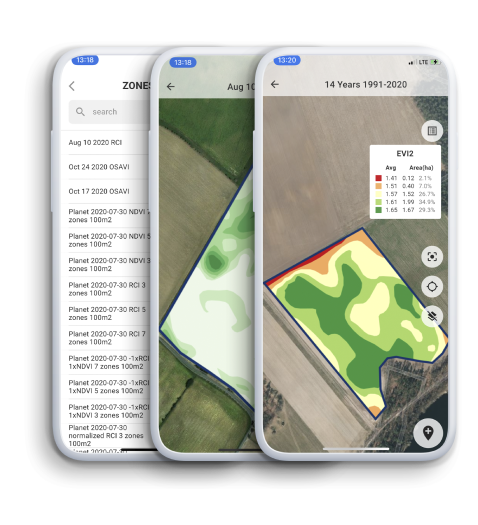
- Mapping out fields in preparation for planting and harvesting.
- Monitoring crop growth during different seasons.
- Comparing crop growth with previous years.
- Minimizing risks of crop damage from bugs, pests, and diseases.
- Plant and soil analysis.
- Soil moisture mapping with drone.
- Irrigation system analysis.
What is drone?
A drone is an unmanned aerial vehicle (UAV) that can fly autonomously or be remotely controlled by a human operator. They come in different sizes, shapes, and configurations, and can be equipped with various sensors, cameras, and other types of equipment depending on their intended use. They are commonly powered by electric motors and rechargeable batteries, and they can fly at different speeds and altitudes, depending on their design and purpose. Moreover, they work by using a combination of hardware and software components that allow them to take off, fly, and land safely. They typically have a flight controller that regulates their movements and behavior, as well as GPS sensors that provide location data for navigation. Sometimes, they also have cameras, obstacle avoidance sensors, and other types of sensors that allow them to capture images, detect obstacles, and avoid collisions.What is drone mapping? How does drone surveying work?
Drone mapping is the use of a drone to create a 3D representation of an area. It is also the use of unmanned aerial vehicles (UAVs) to capture high-quality imagery and data. Drone imaging are often used for surveying and mapping construction sites, but they can also be used to capture images of other areas, such as farmland, forests, or even cities. The drone uses various sensors to create a more accurate image than a satellite or aerial survey would be able to create. The images are then analyzed and processed by software to create the 3D model. Drone imaging can be used for a variety of purposes:- Landscape architecture – Drone imaging is often used in landscape architecture to design public parks and gardens.
- Urban planning – Drones can take aerial photographs and video footage of cities to help urban planners plan future developments.
- Architecture – Architects can capture detailed 3D models of buildings before they go up using this technology.
- The use of drones for mapping offers several advantages over traditional methods such as satellite images or ground surveys.
- Drone imaging provide high-resolution data which can be used to create accurate maps. This technology is particularly useful when it comes to surveying difficult terrains such as water bodies or forested areas where it can be difficult to access on foot or by car.
 Here is how drone mapping works: a drone is mounted with sensors such as cameras and laser scanners that fly over an area capturing images or scanning it with lasers at various altitudes and angles. The collected data is then processed into 3D maps which can be viewed on a computer or smartphone screen.
The function of drones for agriculture
Here are some of the functions of drones for agriculture: 1. Mapping with drone for Farm Planning One major advantage that drone survey provide to farmers is accurate mapping information. This helps them plan their crops better and achieve higher yields through proper crop rotation. The main benefit of drones is that they allow farmers to save time by helping them plan out so many things from their harvests to their fertilization schedules. There are many uses for mapping with drones and some of the most common ones are:- Finding crop stressors like pests, weeds, and diseases.
- Mapping fields for irrigation or fertilizer use.
- Checking for drainage issues or erosion.
Innovative use of 3D drone mapping and imaging in modern agriculture
1. Terrain and Soil NDVI Mapping with drone Agriculture Drone mapping allows you to measure salinity, soil type, and health in a matter of minutes. The elevations are visible in the accurate 3D maps that it can generate, which aid in soil research and seed and crop placement planning ahead of time. The data generated by the drone’s soil analysis report will show the status of the substrate and its requirements throughout the growing season, including individual water requirements and nitrogen management. 2. Prescription maps for fertilizers, herbicides, and pesticides with drone survey
Just one strategy is out of date, as it not only wastes resources, but it can also affect the health and vitality of crops. Too much water, for example, can kill an otherwise healthy crop by preventing its roots from absorbing oxygen, so even watering isn’t the best approach to growing flawless crops.
The same is true for fertilizers; using the correct amount is critical for growth, as using too many causes burnt roots, which can destroy otherwise healthy plants.
Drone mapping allows sprays to be splattered only where the problem exists, reducing waste of resources and the risk of harming healthy crops that do not require the same treatment. While humans would be unable to recognize the unique requirements of each plant in their crop, drone survey technology can do it in minutes.
3. Crop assessment
At the touch of a button, scouting missions are launched; the drone departs the weatherproof charging station, collects data, and uploads it. The findings of the drone, as well as a study of its plant stress detection and the efficacy of any current treatments or amendments, can be used to adapt automated irrigation systems. With on-site scouting drones, constant health checks are possible.
4. Plant population count
With the drone’s powerful AI technology, any variety of plants may be identified. This allows the entire production and total loss to be determined at the start and conclusion of each season, increasing precision and awareness of the growing season’s success.
5. Automatic classifications with drone imaging
The drone imaging can tell what type of agricultural land it’s flying over, whether it’s arable, pastoral, or mixed. Drones may count the number of crops and livestock, as shown above, to verify that records are current and that any losses are noted.
6. Tracking crops
Crop health isn’t predetermined because environmental factors might influence development. Temperature, humidity, nutritional and trace mineral content, insect and disease presence, water availability, and amounts of sun exposure are all elements to consider.
All of these may be tracked using the drones’ different payloads, and many of these intangible variables can be handled by applying water or sprays directly to the needed regions.
The healthier the crop’s surroundings, the stronger its immune system gets, and thus the healthier it becomes — with a far greater ability to ward off pests and diseases.
2. Prescription maps for fertilizers, herbicides, and pesticides with drone survey
Just one strategy is out of date, as it not only wastes resources, but it can also affect the health and vitality of crops. Too much water, for example, can kill an otherwise healthy crop by preventing its roots from absorbing oxygen, so even watering isn’t the best approach to growing flawless crops.
The same is true for fertilizers; using the correct amount is critical for growth, as using too many causes burnt roots, which can destroy otherwise healthy plants.
Drone mapping allows sprays to be splattered only where the problem exists, reducing waste of resources and the risk of harming healthy crops that do not require the same treatment. While humans would be unable to recognize the unique requirements of each plant in their crop, drone survey technology can do it in minutes.
3. Crop assessment
At the touch of a button, scouting missions are launched; the drone departs the weatherproof charging station, collects data, and uploads it. The findings of the drone, as well as a study of its plant stress detection and the efficacy of any current treatments or amendments, can be used to adapt automated irrigation systems. With on-site scouting drones, constant health checks are possible.
4. Plant population count
With the drone’s powerful AI technology, any variety of plants may be identified. This allows the entire production and total loss to be determined at the start and conclusion of each season, increasing precision and awareness of the growing season’s success.
5. Automatic classifications with drone imaging
The drone imaging can tell what type of agricultural land it’s flying over, whether it’s arable, pastoral, or mixed. Drones may count the number of crops and livestock, as shown above, to verify that records are current and that any losses are noted.
6. Tracking crops
Crop health isn’t predetermined because environmental factors might influence development. Temperature, humidity, nutritional and trace mineral content, insect and disease presence, water availability, and amounts of sun exposure are all elements to consider.
All of these may be tracked using the drones’ different payloads, and many of these intangible variables can be handled by applying water or sprays directly to the needed regions.
The healthier the crop’s surroundings, the stronger its immune system gets, and thus the healthier it becomes — with a far greater ability to ward off pests and diseases.
How to make a 3d map?
GeoPard can help in creating 3d maps for agricultural aims. It is a unique software that allows you to create your 3D models from any existing geographic data or scratch. GeoPard has all the functions necessary to create 3D maps from satellite images and other sources of aerial photography. The software allows you to classify this data according to different criteria, including color, texture, shape, and height. GeoPard also allows users to control the placement of objects on a map or in an image with great accuracy. This means that users can move objects on a map by simply moving them on their computer screen. The program also comes with integrated tools for editing images and photogrammetry processing features. These features let users do things like changing the scale or orientation of an image or combining multiple images into one large photo. Users can also create new textures by adding details like shadows or noise effects to existing photos. GeoPard can be used by farmers, agronomists, ecologists, geographers, engineers, and all others who need to create 3D maps for agricultural aims. Farmers can use GeoPard to plan crop rotation and fertilization, determine areas with low fertility or high salinity, study soil erosion and landslides, and locate wells and water channels to avoid their contamination by pesticides.Frequently Asked Questions
1. How much area can a drone survey? The area that a drone can survey depends on various factors, including flight time, battery capacity, and regulatory restrictions. Generally, drones can cover several acres of land in a single flight, ranging from a few acres to hundreds of acres. The exact coverage area also depends on the altitude at which the drone is flown and the desired level of detail required for the survey. Advanced drones equipped with longer flight times and larger batteries can cover larger areas in a single flight, while smaller drones may require multiple flights to cover the same area. 2. What season do they fly the drones to analyze the crops? Drones can be flown to analyze crops throughout the growing season, but the timing may vary depending on the specific objectives. Generally, drones are flown during the vegetative stage, flowering stage, and maturation stage of the crops. Each stage provides different insights into crop health, growth patterns, and potential issues. For instance, early-season flights can help assess emergence and uniformity, while mid-season flights can detect nutrient deficiencies or pest infestations. Late-season flights can provide information on yield potential and harvest timing. Therefore, drone flights are conducted at various stages to capture a comprehensive understanding of the crop’s condition. 3. How to make money with a drone in the agriculture industry? There are several ways to make money with a drone in the agriculture industry. One option is to offer aerial imaging and mapping services, providing farmers with detailed aerial data for crop monitoring, field analysis, and yield estimation. Another avenue is to provide crop health assessment services, using specialized sensors to identify issues such as nutrient deficiencies, pest infestations, or irrigation problems. Additionally, offering drone-based spraying services for precision application of fertilizers or pesticides can be lucrative. Lastly, offering drone training and consultancy services to help farmers integrate drones into their operations can also be a profitable venture. 4. How much to charge for drone mapping? The pricing for drone mapping services varies depending on several factors. These include the size and complexity of the area to be mapped, the resolution and level of detail required, and the specific deliverables needed. It is common for drone mapping services to be priced per acre or per hour, with rates typically ranging from $100 to $500 per hour. However, it is best to consult with professional drone mapping service providers to obtain accurate and tailored pricing information for your specific project. 5. What is geomapping? Geomapping, also known as geographic mapping or spatial mapping, is the process of visualizing and representing geographic data on a map. It involves collecting, analyzing, and displaying various types of information such as locations, boundaries, terrain features, and infrastructure. Geomapping allows us to understand and explore relationships between different data points in a spatial context, enabling better decision-making and planning in areas like urban development, environmental management, and navigation. It is a powerful tool used in various fields including cartography, geography, urban planning, and resource management. 6. How to survey land with smartphone? Surveying land with a smartphone can be achieved using various apps and techniques. Firstly, download a reliable surveying app that utilizes the phone’s built-in GPS capabilities. Next, ensure the phone has a stable internet connection and enable location services. With the app open, follow the on-screen instructions to mark specific points, measure distances, and record relevant data. It is important to maintain accuracy by using additional tools like tripods or external GPS receivers if necessary. Always refer to professional surveyors for complex or legal surveying requirements. Agriculture Mapping