Ukrainian agricultural leader VitAgro implements GeoPard precision farming software for integrated farm management across 85,000 hectares

COLOGNE, GERMANY and KYIV, UKRAINE, July, 2025

VitAgro, one of Ukraine’s leading agricultural producers farming 85,000 hectares (210,000 acres), has implemented GeoPard precision agriculture software as an end-to-end decision support system for the entire growing season. The platform supports workflows from pre-season preparation, including planning and soil analytics, through in-field operations across the full vegetation period.

As a top-15 agricultural company in Ukraine, VitAgro integrated GeoPard into its operations to improve soil management, implement variable rate (VRA) fertilizer strategies, and quantify the financial impact of precision ag practices through data-driven field trials.

“GeoPard has transformed how fields are managed by turning complex data into practical, actionable recommendations. The platform helps build targeted soil sampling strategies that pinpoint specific field zones requiring attention, enabling zone-specific management instead of uniform application across entire fields.” said Oleh Bilan, Chief Technologist at VitAgro.

Карта потенціалу зон на основі глибоких історичних даних, які демонструють неоднорідність у межах поля

Field potential zoning map based on deep historical data, showing within-field variability

With GeoPard in place, VitAgro can systematically:

  • Create accurate soil sampling plans based on field variability
  • Generate zone-specific application maps for fertilizers and crop protection products
  • Monitor actual applied rates versus planned prescriptions
  • Calculate clear ROI metrics for precision ag initiatives
  • Make data-backed decisions for future yield and input management strategies

“GeoPard continues to be an important tool for crop producers in Ukraine,” said Dmitry Dementiev, CEO of GeoPard. “Precision agriculture is no longer optional for businesses planning for the future. It enables higher-quality grain production with optimized costs and more sustainable practices, strengthening food security.”

Implementation was supported in collaboration with Agrismart, an agricultural consulting company working with both VitAgro and GeoPard to align agronomic methodology and rollout across operations.

The partnership highlights how digital agronomy can improve productivity while supporting environmental responsibility. By building VRA recommendations from field potential zones, VitAgro applies inputs only where needed and at appropriate rates, reducing losses and environmental impact.

WHY MEASURE WITHIN-FIELD VARIABILITY

Productivity zones created in GeoPard make it easy to see performance differences within a single field, often driven by soil type variability. GeoPard automatically generates both management zones and sampling points for an agrochemical plan.

План відбору проб ґрунту, що показує точки відбору проб на основі зон поля

Soil sampling plan showing sampling points based on field zones

Відбор проб ґрунту на основі на основі рекомендацій GeoPard

Soil sampling based on GeoPard recommendations

SOIL SAMPLING AND ZONE-BASED RECOMMENDATIONS

VitAgro collects soil samples at the recommended points and sends them to laboratories. Based on multi-layer analytics and validated scientific formulas, the team then generates VRA maps for variable seeding and fertilizer application per zone.

After analyzing each zone, distinct agronomic indicators become visible, enabling more accurate and cost-effective input use that reflects real field heterogeneity.

Зоны продуктивности от GeoPard - При візуальному огляду  ділянок одного поля  з різними зонами в основі якого лежать різни Типи грунтів - Після проведення Аналізу в кожній зоні продуктивності отримуємо різні показники.

Productivity Zones from GeoPard – When visually inspecting sections of the same field with different zones based on different soil types – After conducting the analysis in each productivity zone, we obtain different indicators.

“Thanks to the wide range of options in GeoPard, which fully meets our needs, soil agrochemical work within our company has become much more efficient and the results are more accurate,” said Oleksandr Perederiy, Agrochemist at VitAgro. “Technology is moving fast, and it is important to keep up. Belief remains that the effort to move forward and improve, even in a difficult time for the country, will bring good results. Those who sow through hardship will later harvest with joy.” (Psalm 126:5-6)

INTEGRATION WITH JOHN DEERE OPS CENTER

An automated integration with John Deere Ops Center allows VitAgro to:

  • Build smart VRA recommendations in GeoPard using field potential maps, soil lab analytics, and equation-based calculations
  • Send prescriptions to John Deere as Work Plans, including different zone geometries for seeding and fertilizer application
  • Pull actual as-applied data back into GeoPard for seasonal performance analytics

After each field operation, data returns automatically to GeoPard, making it possible to evaluate execution accuracy and the effectiveness of each agronomic action.

PRACTICAL VARIABLE RATE EXECUTION IN THE FIELD

Field execution is supported through seamless equipment integration. Operators access GeoPard-generated prescription maps directly in the cab displays, enabling accurate implementation of agronomic plans.

VitAgro is also building its own soil sampling laboratory and plans to expand services by providing decision-support tools and fertilizer recommendations to other agricultural producers across Ukraine. This expansion is a meaningful step toward broader adoption of precision agriculture practices in the country.

Planning VRA rates using the Smart Doses tool, the system automatically allocates rates and immediately shows savings per product.

Вигляд із кабіни машини, де показано карту VRA, що відображається на моніторі. Розкидач: Amazone ZA-TS 4200. Розкидач, яким проводилось диференційоване внесення.

In-cab view of a VRA map on the display. Spreader: Amazone ZA-TS 4200, used for variable rate application.

INTEGRATION IMPACT

According to preliminary estimates, the integrated digital management model enables VitAgro to achieve already in the 2025 season:

  • 15-25% reduction in mineral fertilizer costs
  • 5-8% yield increase in key crops
  • Reduced carbon footprint of operations

The resulting data will serve as a foundation for scaling precision agriculture practices across all acreage and strengthening VitAgro’s internal expertise.

ABOUT THE COMPANIES

VitAgro is one of Ukraine’s leading agricultural producers, farming 85,000 hectares (210,000 acres). As a top-15 producer in Ukraine, VitAgro focuses on sustainable farming practices, technology innovation, and operational efficiency. The company grows a range of crops, including grains and oilseeds, combining productivity goals with environmental responsibility. In February 2025, VitAgro also completed the first export of Ukrainian biomethane to the EU, delivering a batch of 68,000 m³ (720 MWh) to Germany, becoming the first supplier of biomethane from Ukraine to the European market. vitagro.com.ua

GeoPard provides advanced precision agriculture software designed to optimize farm management and agricultural operations. The platform integrates soil data, satellite imagery, machine data, and agronomic expertise to deliver actionable recommendations for farmers and agribusinesses. geopard.tech

Automated AI Framework for SMEs. Grant from the state of North Rhine-Westphalia.

We are glad to announce that GeoPard Agriculture, in partnership with Hamm-Lippstadt University of Applied Sciences, received a grant notification from the North Rhine-Westphalia Ministry of Economic Affairs for the project Automated AI Framework for SMEs (AKI4KMU). This initiative aims to simplify the use and integration of artificial intelligence into existing processes, with a focus on geospatial analytics.

About the Project
The AKI4KMU project, led by a consortium including Hochschule Hamm-Lippstadt, FlyPard Analytics GmbH, and Pfeifer & Langen GmbH & Co. KG, focuses on harnessing artificial intelligence (AI) and modern communication technologies to drive innovation and sustainability, particularly in the agricultural sector. Small and medium-sized enterprises (SMEs) often face challenges in data collection, evaluation, and AI implementation. This project aims to overcome these hurdles by advancing automated AI processes and integrating them with Digital Twins and 5G technology.

with project partner Prof. Dr. Stefan Henkler

Key Objectives

  • Optimizing Agricultural Efficiency: By leveraging precision agriculture, AI-driven analysis, and digital simulations, the project aims to enhance farming efficiency and sustainability.
  • Reducing Resource Consumption: AI-powered insights help minimize the use of water and fertilizers, lowering operational costs for farmers.
  • Enhancing Decision-Making: AI improves crop planning, pest detection, and yield optimization, boosting productivity and competitiveness.
  • Realistic AI Simulations: Digital Twins enable real-world scenario testing without expensive physical experiments.

Impact on the Region
The project, conducted in North Rhine-Westphalia, Germany, aligns with regional innovation strategies and contributes to the development of an advanced technology ecosystem for agriculture. Through AI-powered automation and sustainable digital solutions, the project empowers SMEs to unlock AI’s full potential, creating long-term value for businesses and society.

Supported by the Ministry of Economic Affairs, Industry, Climate Action and Energy of the State of North Rhine-Westphalia. Co-funded by the European Union. Grant number EFRE-20800498.

LfL Leverages GeoPard Platform for Its Future Crop Farming Project

Agriculture today faces major challenges. It has to produce high-quality food and raw materials, but increasingly it also has to take into account requirements for the protection of soil, water, climate, and biodiversity.

The Bavarian State Research Center for Agriculture (LfL) has long been conducting research on these challenges and is now testing the GeoPard precision agriculture platform for its Future Crop Farming project.

Dmitry Dementiev, CEO and Co-Founder of GeoPard: “Traditional crop farming methods often face challenges such as inefficient resource management and limited access to real-time data. These factors can lead to suboptimal crop yields, increased costs, and environmental strain.”

GeoPard’s platform provides LfL with a centralized platform to visualize and analyze critical farming data. The platform’s user-friendly interface permits the combination of satellite data and experimental data from the field trial, simplifying complex data interpretation and empowering users to make informed choices that optimize productivity and sustainability.

The field was divided into sections to showcase a specific setup for the trial: LfL has implemented a strip intercropping system, i.e., the simultaneous cultivation of multiple crops in parallel strips in the same field.

These strips can subsequently be employed separately in equations for inputs (such as fertilizer and plant protection) and yield results, enabling the computation of overall field

profit. Moreover, the profits generated by individual crops and the possible impacts at the edges between strips can be assessed.

The collaboration between LfL and GeoPard through the Future Crop Farming project can move forward analysis tools for unconventional field structures.

By leveraging GeoPard’s advanced platform, it can complement its research results and create valuable visualizations for communicating insights from the project to the public.

With a focus on precision farming, productivity, and environmental stewardship, the innovative LfL project showcases the potential for a more sustainable future in crop farming.

PD Dr. Markus Gandorfer, Head of Digitalization and Project Lead at LfL: “It is a pleasure for us to work with the enthusiastic GeoPard team. Deeper insights into our strip-intercropping data enabled by the GeoPard tool are very valuable to us.”

About

Bavarian State Research Center for Agriculture (LfL) The Bavarian State Research Center for Agriculture (LfL) is the knowledge and service center for agriculture in Bavaria. The applied research of the LfL takes up issues of agricultural practice and provides applicable solutions for agricultural enterprises in various ways.

The interdisciplinary Future Crop Farming project is located in Ruhstorf a.d. Rott in southeastern Bavaria. More information about the project can be found on the project website: http://www.future-crop-farming.de

GeoPard Agriculture is a leading provider of precision farming software. The company was founded in 2019 in Cologne, Germany, and is represented globally. The company offers a range of solutions that help farmers to optimize their operations and increase yields.

With a focus on sustainability and regenerative economics, GeoPard Agriculture aims to promote precision farming practices around the world.

The company’s partners include such well-known brands as John Deere, Corteva Agriscience, ICL, Pfeifer & Langen, IOWA Soybean Association, Kernel, MHP, SureGrowth, and many others.

Introducing GeoPard’s Profit Maps: A Step Forward in Precision Agriculture

The profit map from the example in the screenshot takes into account the as-applied datasets of fertilization, seeding, two times of crop protection application, and harvesting. Other expenses can be added to the calculation, such as land preparation, miscellaneous activities as well.

Precision agriculture is a data-driven approach that seeks to increase efficiency and profitability. GeoPard, a leading provider of precision agriculture solutions, is enhancing its data analysis capabilities with the introduction of Profit Maps.

This feature provides a visual representation of profitability at the subfield level, enabling more informed decision-making and resource allocation. You’ll be able to see at a glance where your fields are making you money and where the costs of inputs and changes aren´t paying off.

Profit Maps are generated by integrating various data layers, including as-applied seeding, crop protection application, fertilizer usage, and harvesting data. This information is sourced directly from agricultural equipment and the John Deere Operations Center.

GeoPard then applies a custom equation, factoring in the cost of each input, to calculate zone-level profitability. These profit maps provide a comprehensive view of the profit spread across different field zones.

One of the key features of GeoPard’s Profit Maps is the ability to display the spread in profit across different zones of a field. This is calculated in dollars/euros/any currency and provides a clear indication of how much profit a farmer is making in each specific area.

By having this information at their fingertips, farmers can make more informed decisions about where and how to use their agricultural inputs.

For instance, they might choose to invest more in areas with higher profitability or reconsider their strategies in zones with lower returns. This granularity level in data analysis sets GeoPard’s Profit Maps apart.

Vladimir Klinkov, Managing Director of GeoPard, emphasizes the transformative potential of this tool, stating, “These maps allow farmers to make more informed decisions about resource distribution and costs on each hectare of the field and plan their business more effectively.”

The practical application of Profit Maps is already being demonstrated in real-world scenarios. Eurasia Group Kazakhstan, an official John Deere dealer, has been leveraging this feature to optimize its operations.

Evgeniy Chesnokov, Director of Agricultural Management at Eurasia Group Kazakhstan LLP, shares his experience: “With the help of GeoPard Agriculture’s Profit Map, we were able to gain a deeper understanding of the profitability of our partners’ fields.

This allowed our farmers to make more strategic decisions on the allocation of resources, which ultimately increased operational efficiency and improved bottom line indicators.”

GeoPard’s Profit Maps represent a significant advancement in precision agriculture, providing farmers with the insights they need to optimize their operations and maximize profitability. As the industry continues to evolve, tools like these will play an increasingly important role in shaping the future of farming.

For more insights into the development and application of profitability maps in precision agriculture, you can explore these resources: Kansas State University, ASPEXIT, Chilean Journal of Agricultural Research, USDA, and ResearchGate.

Stay tuned for more updates as GeoPard continues to innovate and push the boundaries of what’s possible in precision agriculture.

About the companies:

GeoPard is a leading provider of precision farming software. The company was founded in 2019 in Cologne, Germany, and is represented globally. The company offers a range of solutions that help farmers optimize their operations and increase yields.

With a focus on sustainability and regenerative economics, GeoPard aims to promote precision farming practices around the world.

The company’s partners include such well-known brands as John Deere, Corteva Agriscience, ICL, Pfeifer & Langen, IOWA Soybean Association, Kernel, MHP, SureGrowth, and many others.

Eurasia Group Kazakhstan is the Kazakh representative office of Swiss company Eurasia Group AG, an official dealer of John Deere in the Republic of Kazakhstan and Kyrgyzstan since 2002. The company delivers solutions for agriculture from leading world manufacturers like JCB, Väderstad, GRIMME, and Lindsay, covering all areas of crop and horticulture.

Eurasia Group Kazakhstan pays great attention during all its activity to the technologies of precise agriculture, completing the line of machinery with products of digitalization of agriculture.

Eurasia Group Kazakhstan has an extensive regional network – 14 regional offices in Kazakhstan and one in Kyrgyzstan, more than 550 employees, of which almost half – after-sales service employees, its own department of agricultural management and digitalization.

Over the years, more than 13,000 units of equipment have been supplied to Kazakhstan and 4.4 million hectares of land have been digitized. This year the company celebrates its 25th anniversary.

GeoPard’s Crop Development Graphs for Precision Agriculture

Today’s agricultural industry requires not only hard work and understanding of the land, but also the smart application of technology. I am thrilled to share an insight into one of the tools making a significant difference in sustainable farming practices: GeoPard’s Crop Development Graphs.

Our Crop Development Graphs offer a comprehensive, user-friendly display of crop growth data since 1988. Automatically generated for any field, these graphs are designed to ensure precision and accuracy.

The data is calculated solely for the cloud and shadow-free area of the field. A simple hover reveals the average NDVI (Normalized Difference Vegetation Index) value, providing an instant snapshot of crop health.

But what sets our tool apart? The capability to switch views. GeoPard’s interface allows users to alternate between Yearly and Monthly views. This level of detail ensures you are equipped with the essential data to make well-informed decisions about crop management, harvest timing, and yield prediction.

In the hands of a farmer, this precise insight can guide field management strategies, helping to detect the optimal harvest time, monitor crops at scale, and overall, optimize productivity and sustainability.

This is an exciting step forward in precision farming, a path that leads not only to improved yields but also to more sustainable practices that consider our environmental footprint.

Stay tuned for more updates as we continue to develop and refine our tools to serve the agricultural community better. We’re on a journey to make precision farming more accessible and efficient, and we’re thrilled to have you join us. Together, let’s redefine the future of farming!

GeoPard Cooperation with Eurasia Group Kazakhstan

In April 2023, Eurasia Group Kazakhstan and GeoPard Agriculture entered into a partnership agreement to bring the new GeoPard Agriculture solution to the markets of Kazakhstan and Kyrgyzstan.

The two companies share a common goal: to contribute to the sustainable development of agriculture in Kazakhstan by introducing precision farming solutions and optimizing crop production throughout the agricultural year.

The cooperation is aimed to support farmers who are looking for new and practical ways to optimize and automate crop production processes, increase the profitability of their business, and reduce  environmental footprint.

Vladimir Klinkov, Managing Director and Co-founder of GeoPard Agriculture: “We are very excited to launch our solution for precision and sustainable agriculture in the Kazakh market. GeoPard Agriculture utilizes cutting-edge technologies, including cloud computing for processing vast volumes of geospatial data, artificial intelligence, and analyzes field data from all possible sources. The GeoPard team has been working in the field of agriculture and developing digital solutions since 2012, and now it has brought its expertise to the lands of Kazakhstan. We automate precision farming expertise and offer a solution at the most reasonable price with the best quality.”

Customers can manage productivity and analyze factors affecting field heterogeneity and yield, identify locations for soil sampling based on productivity zones, perform field monitoring and scouting, create variable rate application (VRA) maps for seeding, fertilizing, crop protection products, and growth regulators applications.

“The GeoPard Agriculture solution is unique in that it provides comprehensive analytics across a large number of data layers, relying on yield maps, soil analysis, air moisture and vegetation moisture indicators over a multi-year period. The software is based on 35 years of NDVI satellite image data for each specific field, and then, at his discretion, the farmer can load other indicators into it with our help. The program will analyze the data and productivity of the field areas, making prescriptions for further differentiated application of seeds and fertilizers. This, above all, will lead to savings in seeds and fertilizers, and increase the yield and efficiency of the agricultural business,” commented Evgeny Chesnokov, Director of Agricultural Management Division of Eurasia Group Kazakhstan.

The GeoPard Agriculture solution was tested in the fields of Kazakhstan this year and is already actively used by Kazakh farmers.

About the companies:

GeoPard Agriculture is a leading provider of precision farming software. The company was founded in 2019 in Cologne, Germany and is represented globally. The company offers a range of solutions that help farmers optimize their operations and increase yields.

With a focus on sustainability and regenerative economics, GeoPard Agriculture aims to promote precision farming practices around the world.

The company’s clients and partners include such well-known brands as John Deere, Corteva Agriscience, ICL, Pfeifer & Langen, IOWA Soybean Association, Kernel, MHP, SureGrowth and many others.

Eurasia Group Kazakhstan is the Kazakh representative office of Swiss company Eurasia Group AG, an official dealer of John Deere in the Republic of Kazakhstan and Kyrgyzstan since 2002. The company delivers solutions for agriculture from leading world manufacturers like JCB, Väderstad , GRIMME, Lindsay, covering all areas of crop and horticulture.

Eurasia Group Kazakhstan pays great attention during all its activity to the technologies of precise agriculture, completing the line of machinery with products of digitalization of agriculture.

Eurasia Group Kazakhstan has an extensive regional network – 14 regional offices in Kazakhstan and one in Kyrgyzstan, more than 550 employees, of which almost half – after-sales service employees, its own department of agricultural management and digitalization.

Over the years, more than 13,000 units of equipment have been supplied to Kazakhstan and 4.4 million hectares of land have been digitized. This year the company celebrates its 25th anniversary.

GeoPard Agriculture Participated in Smart Farming Days Exhibition

I had a great time at the Smart Farming Days exhibition where GeoPard Agriculture, as a member of the Agrirouter association DKE Data GmbH & Co. KG, had a stand. It was an excellent opportunity to connect (and reconnect) with #AgTech enthusiasts and learn about the latest industry advancements, particularly in machinery data exchange and usage.

Here are some key insights from the event:

Agrirouter is gaining recognition as a standard in the agricultural industry. More machinery producers are supporting it by default and displaying the “ready for agrirouter” label. In short, Agrirouter is an open data exchange platform that enables seamless data transfer and integration between different agricultural machinery and software solutions.

When discussing trends in agricultural machinery, I would like to highlight:

  • Versatility, where machines can perform multiple operations in one pass to reduce the number of field visits. For example, the PRIOS 404 exhibited by GRIMME combines soil cultivation, potato planting, fertilizing, seed dressing, and ridge shaping.
  • Real-time calculations on agricultural machinery, such as spot spraying based on computer vision. This approach reduces overall chemical use by targeting specific areas on the run. Check out the exhibited Ecorobotix ARA.
  • Autonomy in agricultural machinery.
  • Open data connectivity.


AgTech from technical universities

I was especially pleased to see the great interest in the development of AgTech from technical universities to keep up to date with new developments and share knowledge with students, future AgTech innovators. Regards to Simon Grebner and Maximilian Treiber from the Technical University of Munich.

Marc Favier from RPTU Kaiserslautern-Landau is leveraging digital farming software to organize a workshop that aims to educate farmers about precision farming technologies.

It was exciting also to see more farmers adopting #PrecisionAg tech. I was asked about high-density soil scanners to prepare VR irrigation and fertilizing. Companies like geo-konzept GmbH and Geoprospectors GmbH offer soil scanning services, and GeoPard Agriculture is a handy tool for transforming the data into actionable VRA strategies.

Reporting Ag inputs applications for regulatory purposes is getting attention as well. Farmers need to record field operations, and machinery data about executed operations simplifies the process. There were solutions presented specifically targeting this topic. At GeoPard Agriculture, we are adding the possibility to generate PDF reports from as-applied maps and other analytics.

Fruitful discussion

I also had the opportunity to discuss various topics with industry experts and business partners:

  • The “Digital Label Compliance” initiative, expertly explained by Martin Herchenbach, aims to use standardized digital labels for crop protection. The labels contain information from authorities and manufacturers on how to use the product. Farmers can access the information by scanning a code on the packaging or directly in the Farm Management Systems, which connects to a centralized database.
  • Spot spraying was a hot topic, and I had an insightful conversation with Dr. Robin Mink, co-founder of SAM-DIMENSION precision farming start-up. Their service involves flying a drone over a field (just 30 minutes for a 40ha field), running weed detection in the cloud, and creating a spraying map. The spraying is then done by a tractor on the same day (could be even 2-3 hours after flight). It allows for optimizing herbicide usage and avoiding visiting non-weed areas. Since the model is cloud-based it can be easily adjusted and retrained based on the new datasets.
  • Nicole Bartelds highlighted the reporting for regulations topic and the importance of knowing historical field operations for better planning. I am looking forward to her training program for farmers, agronomists, and ag consultants on Precision Ag!
  • Gottfried Pessl emphasized the value of real-time weather and soil moisture data for agricultural operations, yield prediction, and historical weather data for land assessments, particularly in vineyards.
  • The importance of integrating machinery data into digital farming solutions through platforms like Agrirouter and JD Operation Center was discussed with Thomas Schilling
  • With Nikola Strah we explored the synergies between high spatial and temporal resolution Planet remote sensing data and ground-level data for agricultural insights.
  • With Tamme van der Wal and Matthias Lautenschläger we delved into the market readiness for precision agriculture adoption topic, emphasizing the need for reliable, affordable, and easy-to-use technologies for farmers. Separately touched on the use of drones for spraying and authorization challenges in Germany and the Netherlands. Tamme, I hope you write the “30 Years of Precision Ag” book someday!

With former colleagues from Bayer Crop Science, Xarvio

Attending AgTech exhibitions is always an enriching experience. By working collaboratively, we can drive positive change and make farming more sustainable and efficient.

Calculating Difference Between Target Rx and As-Applied Maps

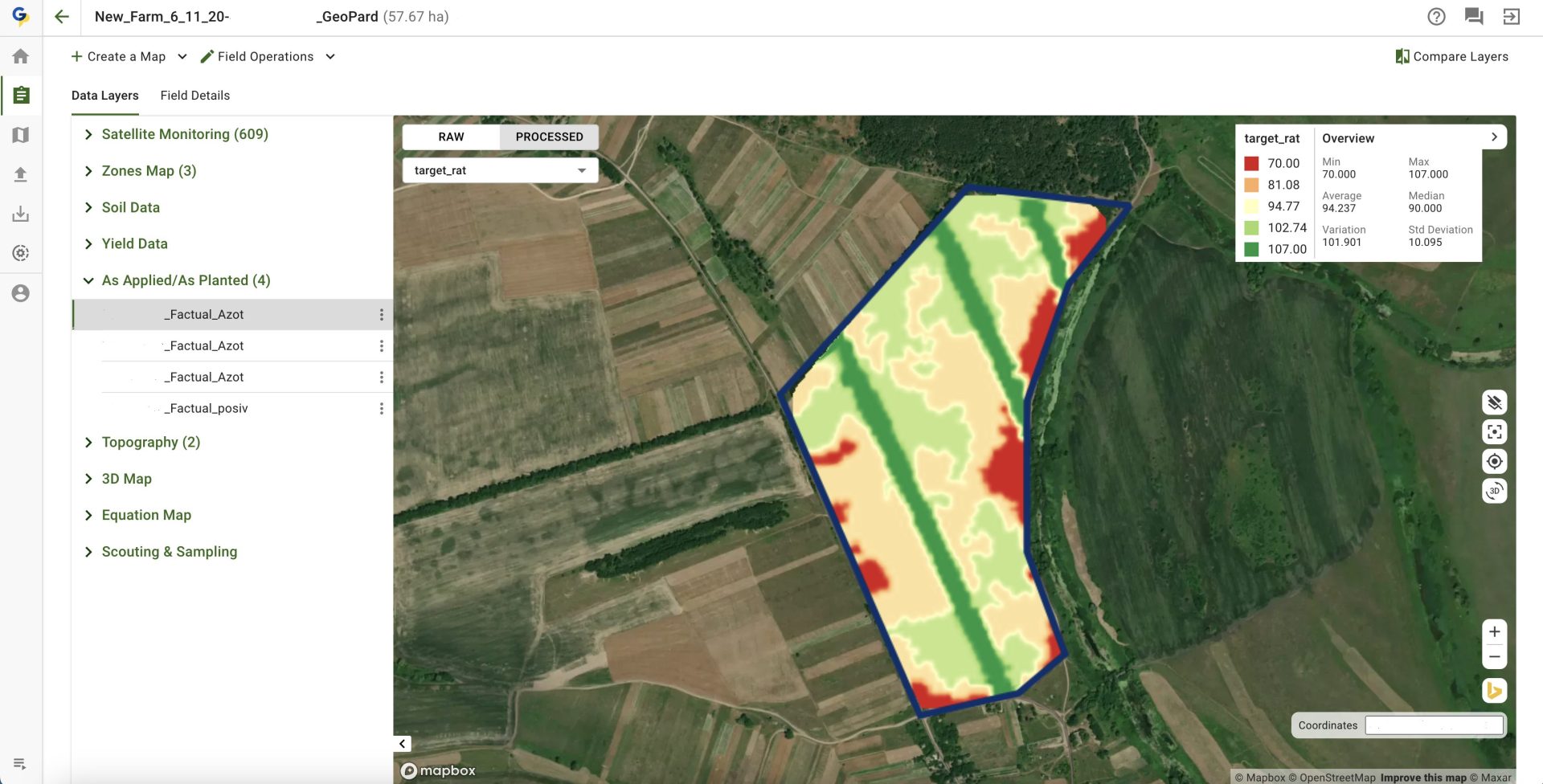
In precision agriculture, one of the common challenges is ensuring the application of seeds, fertilizers, or crop protection agents as per the prescribed rate (Target Rx).

Variations between the target prescription and what is actually applied on the field (As-Applied) could lead to inefficient use of resources and impact crop performance.

By leveraging GeoPard’s powerful analytics, you can calculate and visualize the differences between your Target Rx and As-Applied maps.

This difference analysis can serve as an important tool to quickly identify issues with equipment, application timing, or the actual application itself.

Let’s take a deeper look into this:

  • Visualizing Differences: GeoPard’s platform allows you to generate a “difference map”, overlaying your Target Rx and As-Applied data. This visual representation of variance provides a quick and intuitive way to spot areas where the actual application didn’t match the target.
  • Identifying Problems: By comparing the difference map against your original Rx and As-Applied maps, you can pinpoint specific areas or trends that might indicate equipment malfunction, sub-optimal application timing, or issues with the applied product itself.
  • Improving Efficiency: This analysis can help you optimize resource usage by addressing the identified issues, thus aligning your As-Applied rates closer to your Target Rx for future applications.
  • Enhancing Crop Performance: By ensuring that your field receives the right amount of inputs at the right time, you can boost crop health and potentially increase yield.

Remember, precision agriculture is all about making more informed and accurate decisions. By integrating this feature into your regular farm management practices, you can ensure you’re getting the most out of your inputs and drive your farm towards greater productivity and profitability.

Application prefix contains the operations related to the applied application some of them are:

1. Application Applied Rate – original applied map from the machinery (how was the product applied)

Application_AppliedRate.png - original applied map from the machinery (how was the product applied)

2. Application Target Rate – original target from the machinery (how has the product to be applied)

Application_TargetRate.png - original target from the machinery (how has the product to be applied)

3. Application Accuracy Clusterization – clusterization of the results: 0 – no data (machine did not visit these spots), 1 – applied below the target and not in the acceptable range (+-5% from the target)t, 2 – applied in the acceptable range ( +-5% from target), 3 – applied above the target and not in the acceptable range (+-5% from the target)

Application_AccuracyClusterization.png - clusterization of the results: 0 - no data (machine did not visit these spots), 1 - applied below the target and not in the acceptable range (+-5% from the target)t, 2 - applied in the acceptable range ( +-5% from target), 3 - applied above the target and not in the acceptable range (+-5% from the target)

4. Application Rate Difference – difference between applied and target rates in absolute numbers (l/ha units)

Application_RateDifference.png - difference between applied and target rates in absolute numbers (l/ha units)


Seeding prefix contains the operations related to the seeding some of them are:

1. Seeding Applied Rate – original applied from the planter (how many seeds were seeded)

Seeding_AppliedRate.png - original applied from the planter (how many seeds were seeded)

2. Seeding Target Rate – original target from the planter (how many seeds have to be seeded)

Seeding_TargetRate.png - original target from the planter (how many seeds have to be seeded)

3. Seeding Accuracy Clusterization – same clusterization rules, BUT the acceptable range is +-1% from the target

Seeding_AccuracyClusterization.png - same clusterization rules, BUT the acceptable range is +-1% from the target

4. Seeding Accuracy Clusterization Zoomed – same as Seeding Accuracy Clusterization but zoomed to show same area as Seeding Target Rate and Seeding Applied Rate

Seeding_AccuracyClusterizationZoomed.png - same as Seeding_AccuracyClusterization.png but zoomed to show same area as Seeding_TargetRate.png and Seeding_AppliedRate.png

5. Seeding Rate Difference – the difference between applied and target rates in absolute numbers (seeds/ha units)

5. Seeding Rate Difference - the difference between applied and target rates in absolute numbers (seeds/ha units)

What is target prescription (Target Rx) in agriculture?

In agriculture, the target prescription refers to the recommended or desired set of practices or inputs prescribed for optimal crop growth, health, and yield. It serves as a guideline or plan for farmers to follow in order to achieve specific agricultural objectives.

The target prescription takes into account various factors such as crop type, growth stage, soil conditions, climate, pest and disease pressures, and nutrient requirements.

It provides instructions on the application of fertilizers, pesticides, irrigation, crop rotation, seed selection, planting density, and other essential agricultural practices.

The purpose of a target prescription is to provide farmers with scientifically backed recommendations based on research, agronomic knowledge, and local conditions. It aims to optimize resource utilization, minimize crop losses, and enhance overall agricultural productivity.

Target prescriptions are often developed by agricultural experts, agronomists, agricultural extension services, or research institutions.

They may be specific to different crops, regions, or even individual fields, taking into account the unique characteristics and challenges of each farming context.

Farmers use target prescriptions as a reference point to guide their decision-making and management practices.

By following the recommended guidelines, farmers aim to maximize crop health, yield, and quality while minimizing the negative impact on the environment.

It is important to note that target prescriptions should be flexible and adaptable to account for variations in local conditions and the need for sustainable farming practices.

Farmers may need to make adjustments based on real-time observations, on-farm experiences, and continuous monitoring to ensure the best possible outcomes for their specific agricultural operations.

What is applied on the field (As-Applied)?

As-applied agriculture encompasses the process of accurately and precisely applying inputs, such as fertilizers, pesticides, and irrigation, to crops based on real-time data and site-specific conditions.

It involves the integration of various technologies, including GPS (Global Positioning System), GIS (Geographic Information System), sensors, and variable rate application equipment.

What is Variations between them?

In agriculture, variations between the target prescription and the actual application on the field refer to the differences or deviations between the recommended or desired agricultural practices and the real-world implementation.

These variations can manifest in various aspects, including the use of fertilizers, pesticides, irrigation, cultivation techniques, and more.

Factors Influencing Variations

Several factors contribute to variations between the target prescription and actual field application in agriculture:

  • Environmental Factors: Agricultural practices are influenced by dynamic environmental conditions, including soil composition, climate patterns, and water availability. Variations may arise due to unexpected changes in these factors, affecting the feasibility and effectiveness of prescribed practices.
  • Human Factors: The knowledge, skills, and expertise of farmers play a crucial role in implementing prescribed practices accurately. Variations can occur when farmers encounter challenges in understanding or interpreting the prescribed instructions, leading to deviations during the application.
  • Technological Limitations: Agricultural technology, while advanced, may not always be accessible or affordable to all farmers. Variations can arise when farmers do not have access to the latest equipment, precision farming tools, or real-time data, impacting the accuracy of field applications.
  • Timing and Logistics: Agriculture is time-sensitive, with specific windows for planting, harvesting, and applying agrochemicals. Variations may occur if farmers face logistical constraints, such as delays in procuring inputs or adverse weather conditions that disrupt the timely application of prescribed practices.

Conclusion

Variations between the target prescription and actual field application in agriculture present challenges that need to be addressed for sustainable and efficient farming practices. Understanding the factors contributing to these variations and their impact on agricultural outcomes is crucial.

GeoPard Joins EIT Food Accelerator for Agtech Innovation

GeoPard is thrilled to announce their participation in the EIT Food Accelerator Network program. This program is aimed at accelerating the technology revolution in agriculture and food systems.

GeoPard is excited to collaborate with other agtech and foodtech startups from all over Europe and is looking forward to taking part in the upcoming cohort, which is set to start this week.

The EIT Food Accelerator Network is a European network of support programs for startups, which aims to foster innovation and entrepreneurship in the agrifood sector.

The program provides training, mentorship, and resources to help startups accelerate their tech validation and business growth towards successful market adoption.

As a participant in the EIT Food Accelerator Network program, GeoPard Agriculture will have access to a wide range of resources and support, including expert mentorship, investment opportunities, and networking events.

GeoPard Joins EIT Food

This will enable the company to accelerate its development and growth, and to bring its innovative solutions to the market more quickly.

GeoPard Agriculture is a technology company that specializes in precision agriculture. The company’s solutions help farmers optimize their crop management by providing real-time data and analytics on soil moisture, temperature, and other key factors.

By using GeoPard’s technology, farmers can make more informed decisions about irrigation, fertilization, and other important aspects of crop management, which can ultimately lead to higher yields and better quality crops.

The company’s participation in the EIT Food Accelerator Network program is an important step in its growth trajectory.

By collaborating with other startups and receiving support from the program, GeoPard Agriculture will be able to accelerate its development and bring its innovative solutions to market more quickly.

The program’s focus on the technology revolution in agriculture and food systems is also in line with GeoPard’s mission to make agriculture more sustainable and efficient.

GeoPard and Strube collaboration

GeoPard Agriculture is proud to announce that Strube D&S GmbH, known worldwide for the great diversity of high-quality seeds, has joined the GeoPard partner program.

Customers of Strube BeetControl app (the precise analysis and prognosis of leaf diseases) will now be able to streamline their workflow with GeoPard powerhouse analytics including monitoring, scouting and adoption of precision agriculture practices.

GeoPard is used to determine exact location where nematodes are potentially present on sugar beet fields. Nematode damage detection is based on a remote sensing and historical development of the field. Soil samples are analysed for nematodes at the Strube laboratory, followed by advice from a cultivation consultant.

wpChatIcon
wpChatIcon

    Request Free GeoPard Demo / Consultation


    By clicking the button you agree our Privacy Policy. We need it to reply to your request.

      Subscribe


      By clicking the button you agree our Privacy Policy

        Send us information


        By clicking the button you agree our Privacy Policy