


Precision agriculture is a modern, data-driven approach that uses advanced technologies to tailor farming to specific field conditions. For example, farmers use GPS, IoT sensors, drones, and analytics to monitor soil moisture, weather, and crop health in real time. They then apply the exact amount of water, fertilizer or pesticide needed, at the right place and time. This smart approach improves efficiency and yield while cutting waste; one report notes precision methods have achieved roughly a 4% boost in crop production and a 9% cut in herbicide use. In this context, Model Predictive Control (MPC) has emerged as a powerful control strategy for agriculture.
MPC uses a mathematical model of the farm system to predict future behavior and compute optimal control actions over a moving time horizon. At each step it solves an optimization problem to minimize a cost (for example, deviation from target soil moisture or energy use) subject to constraints on water, equipment limits, etc. Because MPC looks ahead and adapts to changing conditions, it is ideal for managing complex, constrained processes in farming. Control systems like MPC are crucial in modern agriculture, where growers must juggle many variables (soil variability, weather changes, crop growth stages) and operate under strict resource and environmental constraints.
By anticipating future needs (such as an incoming heatwave or a forecast of rain) and automatically adjusting actuators (valves, sprinklers, heaters), MPC enables more adaptive decision-making than manual or simple feedback control. This predictive, optimization-based approach helps farmers conserve water and energy and improve yields – key goals as the world faces tighter resource limits and climate volatility.
Fundamentals of Model Predictive Control
Model Predictive Control (MPC) works by repeatedly forecasting the system’s future states and optimizing control inputs over a finite horizon. It emerged during the 1960s–1970s, was adopted by process industries in the 1980s, and has since progressed through classical, enhanced, modern, and data-driven stages—driven by advances in computational power, improved constraint handling, and growing integration with machine learning and data science. Key elements include:
- Process model: MPC relies on a mathematical model (physical or data-driven) of the farm process (crop growth, soil water balance, climate dynamics, etc.). This model predicts how the system will evolve given inputs.
- Prediction horizon: At each control step, the model projects forward a fixed time window (the prediction horizon) using current measurements (e.g. sensor readings) and candidate control actions.
- Cost function (objective): MPC defines a cost or objective to minimize, such as deviations from desired soil moisture or temperature, plus penalties on resource use.
- Optimization: The controller solves a constrained optimization problem over the horizon to find the sequence of actions (irrigation rates, heater settings, etc.) that minimize the cost while satisfying constraints.
- Constraint handling: MPC naturally incorporates constraints on inputs and states – for example pump capacity, valve limits, actuator rates, and environmental limits on water use or nutrient levels. The optimizer ensures actions respect these limits.
After solving, MPC applies the first control action in the optimized sequence, then waits for the next time step, re-measures the system, and solves a new optimization (this is the “receding horizon” or “rolling optimization” scheme). This feedback gives MPC robustness to disturbances and model errors, since it regularly updates predictions with new data. In contrast to traditional control methods:
1. PID controllers adjust inputs based only on current and past errors (proportional–integral–derivative), without explicitly anticipating future changes or handling constraints. They work well for single-variable systems but struggle with multi-variable optimization or strict limits.
2. Rule-based systems follow pre-set heuristics (e.g. turn on sprinkler if moisture < X). They lack formal optimization and cannot easily balance competing objectives or adapt to new conditions.
By comparison, MPC’s predictive optimization makes it superior for complex farming tasks. It can handle multiple variables simultaneously (temperature, humidity, CO₂, water), meet hard constraints, and adapt to forecasts (e.g. weather forecasts can be fed into the model). The main trade-off is computational: solving an optimization online at each step requires more computing power. However, modern processors and specialized solvers (e.g. OSQP, ACADO) have made real-time MPC feasible even for agriculture applications.
A typical MPC system has three components: a mathematical model (could be physics-based or learned from data), sensors and data sources (providing real-time measurements of soil, weather, crop state), and the MPC controller/optimizer (running on a computer or embedded device). The model might simulate crop growth (for yield optimization), soil water dynamics (for irrigation), or greenhouse climate. Sensors could include soil moisture probes, leaf wetness sensors, temperature/humidity monitors, or remote-sensing imagery. The MPC controller then reads data, predicts future states, and computes control commands (opening valves, steering tractors, adjusting lamps).
Overview of Precision Agriculture Systems
Precision agriculture aims to boost productivity, efficiency, and sustainability by using detailed data about fields and crops. Instead of uniform practices, farmers now tailor actions to local conditions. For example, soil composition and moisture can vary widely even across one field; precision technology lets a farmer know which areas need more fertilizer and which need less. Common key technologies include:
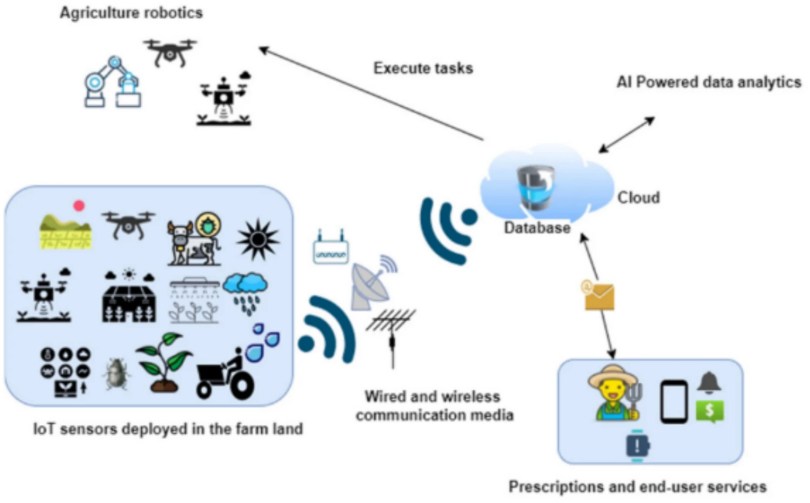
- IoT sensors and wireless networks: Soil moisture probes, temperature sensors, EC (soil salinity) probes, and other Internet-of-Things devices continuously measure field conditions. These sensors send data to farm management systems.
- GPS and GIS systems: GPS enables precise mapping of fields. Farmers use GIS (Geographic Information Systems) to create soil maps and yield maps. These maps guide variable-rate applications (VRI) of seeds, water, or fertilizer.
- Drones and satellite imagery: Aerial imagery (NDVI, thermal, RGB) provides field-level scans of crop health and stress. Drones can also carry sensors (multi-spectral cameras, LiDAR) to monitor plant vigor.
- Farm management software: Cloud-based platforms collect and analyze all this data, helping farmers visualize variability and make decisions (e.g. where to irrigate or spray).
These technologies transform decision-making. One industry source explains that by monitoring soil and crop data in real time, growers can make smarter choices and apply inputs only where needed. In practice, precision agriculture has shown large benefits: for example, using variable-rate irrigation and moisture sensors across U.S. farms could save an additional 21% of water. Overall, modern precision farms can achieve higher yields, faster growth, and lower input costs by data-driven decision-making.
For example, automating irrigation and fertilization based on sensor data means less waste and more efficient use of resources. Notably, precision practices also cut environmental impact: a recent analysis found precision techniques reduced herbicide use by 9% and water use by 4% on average. By optimizing inputs, precision agriculture minimizes runoff and emissions, helping farms become more sustainable.
Integration and Key Applications of MPC in Precision Agriculture
Model Predictive Control fits naturally into a smart farming system as the “brain” that turns data into actions. In a typical flow, IoT sensors and external data (like weather forecasts) feed into a digital model of the farm process (crop growth, soil water balance, greenhouse climate, etc.). The MPC controller then uses this model to predict future states and compute optimal controls. The loop is: sensing → modeling/prediction → optimization → actuation.
For example, soil moisture sensors and weather forecasts flow into a soil-water model. The MPC optimizer uses this to plan irrigation over the next day or week, given forecasts of rain and temperature. It then sends commands to irrigation valves or pumps. At each interval, measurements update the model and the optimization repeats. This enables real-time, adaptive control that continuously accounts for new information.
MPC can be run online (real-time) on farm computers or controllers. For slower processes (like seasonal irrigation plans), it may do off-line planning and then implement the schedule. The distinction is that real-time MPC uses current data at each step, whereas off-line MPC uses a fixed plan updated daily or weekly. A cutting-edge concept is the digital twin of a farm or greenhouse – a virtual replica of the agricultural system.
A digital twin integrates models of soil, crops, climate, and equipment. Farmers can test control strategies on the twin (simulations) before applying them to the real farm. MPC uses the twin to forecast and optimize in a risk-free way. In the future, advances in cloud computing and 5G may enable powerful digital twin simulations on the fly, while edge computing (local controllers) executes fast MPC for robots or machinery on-site. Some of the key applications of MPC in Precision farming are:
1. Irrigation Management: MPC is widely used to control irrigation efficiently. By using a soil-moisture model and weather forecast, MPC predicts crop water needs and schedules watering. It ensures target soil moisture is met while minimizing water use and respecting pump or water-supply limits. For example, an MPC controller might reduce irrigation before forecast rain or adjust watering during a heat wave. In practice, predictive irrigation control can cut water use dramatically – one report notes AI-driven irrigation cut water usage by up to 35% while boosting yields by 15–30%. MPC can also implement deficit irrigation strategies (intentionally mild water stress) to improve crop quality (e.g. in vineyards). By balancing yield vs. water savings, multi-objective MPC finds optimal trade-offs under field constraints.
2. Climate Control in Greenhouses: Controlled-environment agriculture benefits greatly from MPC. Greenhouses have many interrelated variables: temperature, humidity, CO₂, light, etc. MPC can manage all actuators (heaters, vents, fans, lights, CO₂ injectors) simultaneously to maintain ideal growth conditions efficiently. For instance, one study on an integrated rooftop greenhouse showed that a nonlinear MPC strategy reduced energy use (heating/cooling) by 15.2% on average compared to traditional control. By anticipating external weather changes and plant needs, MPC keeps climate tight and energy cost low. It can decide, say, how much to open vents or run a heater in advance of a predicted cold snap. Overall, MPC yields significant energy and CO₂ savings while ensuring maximum plant comfort.
3. Fertilizer and Nutrient Management: MPC can precisely dose fertilizers and nutrients (in soil or hydroponics) based on growth models. Using sensor data on nutrient levels and crop growth stages, MPC plans nutrient supply to meet plant demand without excess. This precision dosing reduces fertilizer runoff and waste. Controllers can also manage pH and electrical conductivity in hydroponic solutions. For example, an MPC scheme might ensure target nutrient concentration while minimizing overall usage, directly optimizing the “right rate, right time, right place” of the 4R principles. Precise nutrient control has the double benefit of boosting yield and reducing chemical pollution. In fact, the AEM study noted precision practices improve fertilizer placement efficiency by around 7%.
4. Crop Growth Optimization: Beyond single processes, MPC can operate on crop growth models to optimize yield and quality. Dynamic models (e.g. DSSAT, AquaCrop) describe how a crop grows under given irrigation, nutrients, and climate. MPC can integrate these to decide optimal schedules for watering, fertilizing, and possibly pest interventions throughout a season. For instance, it may delay irrigation to induce desired stress for quality or apply extra fertilizer during critical growth windows. The MPC controller thus becomes a growth optimizer that shifts farming inputs in real time to maximize output. Research reviews highlight crop growth and yield optimization as a key MPC application
. MPC is also used for stress management – for example, to regulate canopy humidity to limit fungal diseases while maintaining growth.
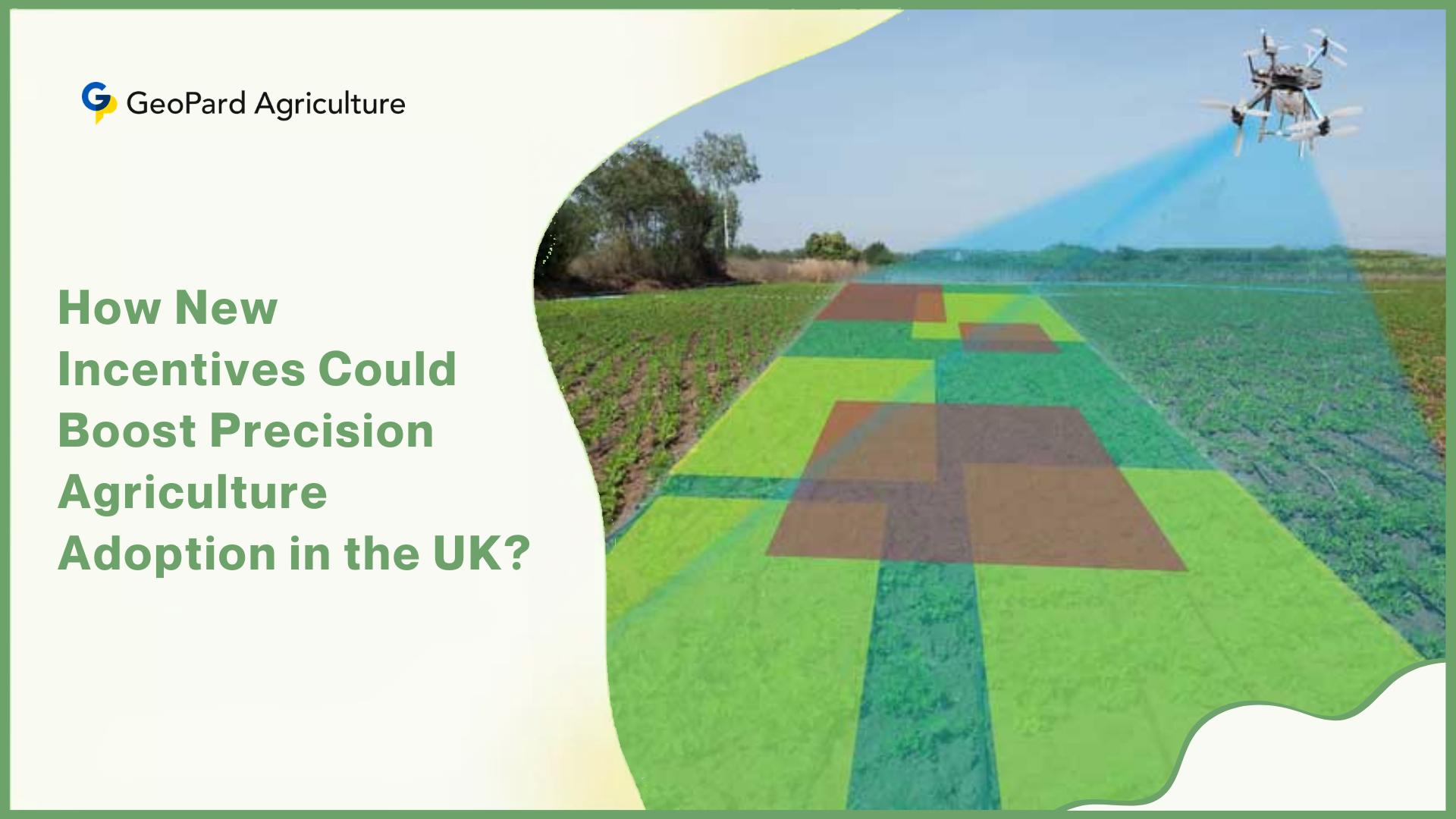
5. Autonomous Farming Equipment: Modern tractors, sprayers, and robots use MPC for path planning and control. For example, an autonomous spraying drone or tractor can use MPC to plan its trajectory and implement precise field operations. The figure above shows a drone flying over a field – its flight path and spray rate could be optimized by MPC based on GPS mapping and obstacle sensors. MPC can handle the vehicle dynamics, wind disturbances, and battery constraints to keep the robot on course. In practice, MPC-based planners allow equipment to cover fields with minimal overlap, avoid obstacles, and adjust speed in real time. This results in resource-efficient operations (e.g. less fuel, more uniform spraying) and safer navigation. Indeed, MPC is known for robust handling of constraints and real-time optimization in robotics. Modern driverless tractors and robotic harvesters often incorporate MPC or similar model-based controllers for navigation and task execution.
Benefits of Model Predictive Control in Precision Agriculture
Resource Efficiency: MPC’s predictive optimization leads to major savings. Studies show it conserves water and energy by scheduling irrigation and climate control only when needed, often saving 20–35% of water compared to naive scheduling. It also enables more precise fertilizer and pesticide use, cutting chemical usage (AEM reports about 9% less pesticide use with precision practices). In short, MPC helps farmers “use less to grow more” by leveraging the right amount of inputs under varying conditions.
Higher Yield and Quality: By anticipating stress and adjusting inputs proactively, MPC can improve crop yields and quality. Maintaining optimal conditions (soil moisture, temperature, nutrients) throughout the season directly boosts plant growth. For example, in many trials MPC-based climate control in greenhouses has increased vegetable yields while saving energy. The MPC review highlights improved produce quality and economic gains as key benefits.
Minskad miljöpåverkan: More efficient use of water, fertilizers, and chemicals means a smaller ecological footprint. Precision methods as a whole have led to millions of acres of land effectively “saved” by getting more from existing fields. MPC’s contribution to this is clear: by lowering unnecessary water runoff and excess fertilizer, it cuts nitrate leaching and chemical pollution. AEM’s analysis notes that broader adoption of precision tech (including MPC-like controls) could avoid 10.1 million metric tons of CO₂-equivalent emissions already, thanks to land and fuel savings.
Handling Constraints and Uncertainty: Unlike fixed controllers, MPC can natively obey constraints (pump capacity, valve limits, environmental regulations) and can optimize even with constraints on resources. It can also incorporate forecast uncertainty (e.g. via stochastic MPC) to remain robust against weather forecast errors. This ability to anticipate and adapt to uncertainty is a major strength.
Automation and Scalability: MPC enables greater automation. It takes routine decision-making off the farmer’s shoulders, which saves labor and allows scaling up. Once set up, an MPC system continuously adjusts controls with minimal intervention. This scalability means MPC can be applied on anything from a small greenhouse to a large farm (subject to investment) and expanded with more sensors and actuators over time.
Challenges and Limitations of MPC
Computational Demand: MPC requires solving an optimization problem at each control step. For large-scale farms or fast processes, this can be computationally heavy. Real-time MPC needs high-speed processors or simplified models. Advances in solvers and hardware (including edge devices) are reducing this burden, but it remains a challenge, especially for smaller, low-cost systems. The 2024 MPC review specifically notes computational complexity as a key challenge.
Modellnoggrannhet: MPC’s performance hinges on the accuracy of the underlying model. Developing a reliable model for biological systems (crops, soil, greenhouse) is difficult. Model uncertainty (mismatch between model and reality) can degrade control. Researchers address this via adaptive MPC (updating models online) or data-driven models (machine learning models). Nevertheless, getting a good model often requires significant domain expertise and data.
Data Quality and Availability: MPC needs high-quality sensor data and possibly weather forecasts. In agriculture, sensors can be sparse or noisy, wireless coverage may be weak, and forecasts imperfect. Missing or inaccurate data can lead to suboptimal or unsafe control actions. Effective MPC deployments must include robust state estimation or fault detection (e.g. Kalman filters) to handle sensor errors.
Cost and Complexity: Implementing MPC involves costs (sensors, computers, software) and requires technical know-how. Small farms may find the upfront investment high. There is also complexity in configuring MPC (tuning horizons, weights, etc.). Adoption can be hindered by lack of familiarity: farmers may prefer simpler systems unless benefits clearly outweigh the cost. Ongoing work in agriculture extension and user-friendly platforms aims to lower these barriers.
Farmer Adoption: Finally, adoption of advanced control like MPC depends on farmers trusting and understanding it. Training and demonstration projects are crucial. Some farmers may be skeptical of “black-box” optimization. Transparency (e.g. MPC interfaces that explain decisions) and field trials that demonstrate ROI can help build trust.
Case Studies and Real-World Implementations
Several pilot projects and research studies demonstrate MPC’s promise in agriculture. In greenhouse farming, a nonlinear MPC controller was tested on a New York rooftop greenhouse. It successfully regulated temperature, humidity, and CO₂ while optimizing energy use, achieving about 15.2% average energy savings over standard control strategies. This shows MPC’s potential for urban and high-tech greenhouses.
In irrigation, while specific MPC field trials are still emerging, related technologies have shown gains. For example, intelligent irrigation controllers (often AI-based) have been deployed commercially, with reports of 30–35% water savings and significant yield increases. Some research farms are integrating MPC with moisture sensors and weather stations; these trials report better water-use efficiency compared to timer-based systems.
Smart tractors and robotics using MPC are also in development. For instance, autonomous sprayers equipped with predictive path planners (an MPC application) are being tested on large farms. Early reports from manufacturers suggest precise coverage and reduced overlap, translating to lower fuel and chemical use. Lessons from these deployments highlight the importance of reliable communications, robust sensor networks, and user-friendly dashboards, but overall they confirm that MPC can work well outside the lab.
Lessons Learned: Field implementations stress that accurate soil and climate models make a big difference. In greenhouses, for example, calibrating the thermal model to the specific glasshouse structure was key to reaping full energy savings. In irrigation, ensuring sensors remain well-maintained (to avoid drift) is vital so the MPC has good data. Also, gradually integrating MPC—starting with higher-level scheduling rather than critical real-time loops—helps farmers build confidence.
Emerging Trends and Comparison with Other Control Techniques
Future developments promise to enhance MPC’s role in farming. One trend is AI-enhanced MPC: machine learning can improve the models or even replace them (learned dynamics) to capture complex plant behavior. Hybrid approaches combine physics models with neural nets for more accuracy. Researchers are exploring Reinforcement Learning (RL) combined with MPC (RL-MPC) for some tasks.
Big Data and Cloud Integration: As farms amass more data (soil maps, multi-year yields), MPC controllers can exploit long-term trends. Cloud-based platforms may run heavy-duty optimization (long horizons) while edge devices run faster local MPC. Digital twins will become more powerful, allowing farmers to simulate MPC strategies under future climate scenarios.
Edge Computing and IoT Advances: New microcontrollers and IoT chips can now run moderate MPC solvers on battery power. This means even small automated irrigation valves or tractors can have onboard predictive controllers. Faster networks (5G) and satellite IoT (like Starlink or specialized Low-Power Wide-Area Networks) make real-time data flow more reliable.
Climate Resilience: With climate change, MPC can play a role in resilience. For example, controllers might include carbon or water footprint objectives, or integrate weather extremes forecasts to protect crops. Autonomous farms—where planting to harvesting is fully automated—are on the horizon; MPC (or more generally optimization-based control) will be central to such systems, coordinating robotics fleets and resource flows.
Compared to PID control, MPC offers explicit prediction and optimization. A PID loop reacts to current error (e.g. soil too dry triggers irrigation). MPC, by contrast, anticipates where moisture will be given wind, evapotranspiration and plans watering ahead. PID might overshoot or chattering under constraints, whereas MPC respects limits by design. MPC also handles multiple inputs/outputs (MIMO) natively, whereas PID is inherently single-loop (one sensor, one actuator).
Against rule-based systems, MPC is more flexible. A rule system might say “if moisture < threshold and no rain forecast, irrigate 10 units.” MPC will instead optimize the exact irrigation schedule that best balances future rain, plant needs, and water costs. MPC generally yields better performance in complex, changing environments. The trade-off is that rules are simpler to implement; MPC requires a model and solver. However, in large-scale or high-value crops, MPC’s advantages become significant.
Tools, Software, and Platforms for Model Predictive Control
Practitioners can build and test MPC using various tools. Common simulation environments include MATLAB/Simulink (with the MPC Toolbox) and Python libraries like GEKKO, do-mpc, or CasADi for optimal control. These allow developers to create and tune MPC models in software. For deployment, specialized controllers or PLCs can run the MPC algorithms at field speed.
On the farm-tech side, some IoT platforms and APIs support MPC. For example, smart irrigation systems may allow users to upload custom control algorithms. Companies like John Deere, Trimble, and small startups offer farm-management systems with predictive features (though often proprietary). Open-source frameworks (e.g. FarmOS, OpenAg) enable DIY integration of MPC for hobbyists and researchers.
Commercial digital twin and IoT platforms (Azure FarmBeats, AWS IoT, or Google’s Sunrise) can host the MPC core in the cloud while edge devices handle sensing. Some new edge AI chips and smart sensors even include onboard optimization capabilities. Farmers can choose full turn-key solutions (e.g. greenhouse climate controllers with built-in MPC) or mix-and-match: use MATLAB or Python for initial design, then implement on devices using e.g. FPGAs or microcontrollers. No single standard dominates yet; the field is evolving. Many practitioners start with open tools (MATLAB or Python) for simulation, then port to more robust hardware for field operation.
Slutsats
Model Predictive Control is poised to play a key role in the future of precision agriculture. By using models and forecasts to optimize farming actions, MPC helps farms use water, energy, and chemicals more efficiently while boosting yields and product quality. Its ability to handle multiple inputs, constraints, and uncertainty makes it well-suited to complex agricultural systems. As farming becomes more technology-driven, MPC provides the “brain” for smart decision-making. In practice, MPC-driven systems have already shown impressive benefits – energy savings in greenhouses, water savings in fields, and lower input costs.
The benefits go hand-in-hand with broader sustainability goals. Analysts note that precision methods like MPC allow us to “use less to grow more,” reducing the environmental footprint of agriculture. While challenges remain (cost, modeling, data), ongoing advances in AI, sensors, and computing are making MPC more accessible. In sum, MPC is an enabling technology for sustainable, high-tech farming, helping agriculture meet the growing demand for food under tighter constraints. With continued innovation and adoption, fully autonomous farms – guided by predictive controllers – may well be the next step in precision agriculture.
Frequently Asked Questions (FAQs)
1. What is MPC in simple terms?
MPC is like a smart autopilot for farming. It uses a model of the farm and forecasts (like weather) to plan actions (irrigation, feeding, etc.) ahead of time. Instead of reacting only to current conditions, it “looks ahead” over the next hours or days and finds the best plan to achieve your goals (e.g. healthy crops) while using minimal resources.
2. Is MPC expensive for farmers?
MPC does require technology (sensors, computers, software), so there is an upfront cost. However, the cost of computation has fallen, and cheaper IoT sensors are widely available. Many modern tractors and equipment already come sensor-equipped. Also, cloud and open-source tools make MPC more affordable. Crucially, the efficiency gains (less water, fertilizer, energy waste) and higher yields can pay back the investment over time.
3. Can MPC work on small farms?
Yes. MPC algorithms can be scaled to any size system. A small greenhouse or garden can use a simple MPC setup (even a laptop or Raspberry Pi). Many remote-sensing apps let smallholders try out model-based decisions via smartphone. The key is to match the system complexity to the farm’s size. Small farms may not need very long horizons or huge models. Even basic MPC with one or two sensors can help a small farm become more efficient.
4. How accurate are MPC models and predictions?
The accuracy depends on data quality and model design. Simple linear models can be reasonably accurate for some systems. More complex models (like neural nets) can capture tricky plant or soil behavior. In practice, MPC is designed to be robust: it re-calibrates plans regularly based on new measurements, so even if predictions aren’t perfect, it corrects itself over time. Model errors and disturbances are handled by feedback. With good sensors and tuning, modern MPC can achieve high accuracy in control tasks.











 English
  German
  Ukrainian
  French
  Kazakh
  Portuguese
  Spanish
  Arabic
  Swedish
  Serbian
  Romanian
  Norwegian
  Finnish
  Lithuanian
  Estonian
  Latvian
  Croatian
  Slovenian
  Slovak
  Japanese
  Polish