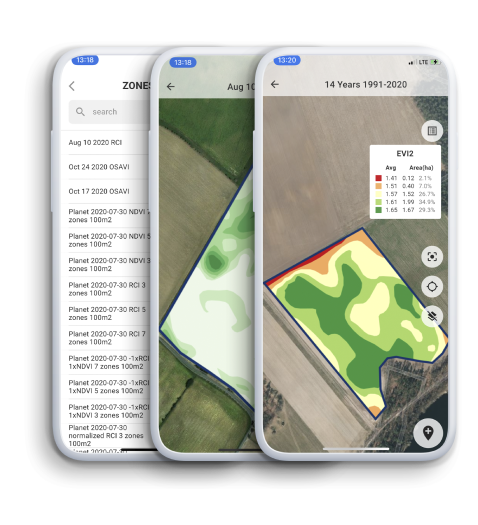
During multiyear analysis, researchers have tested if management zone maps based on soil conditions, topography, or other landscape features can reliably predict which parts of a cornfield will benefit most from increased seeding rates or nitrogen application.
The study revealed that, contrary to common assumptions, crop-plot responses to the same inputs vary significantly from year to year. The most unpredictable factor, the weather, seemed to have the biggest impact on how the crops responded to these inputs. However, farmers can still take steps to manage the impacts of weather on their crops.
Management zone mapping came about due to a rise in interest in digital agriculture – the use of new data-gathering and analysis technologies to better understand the interplay of factors affecting crop yields, explained University of Illinois Urbana-Champaign crop sciences professor Nicolas Martin, who conducted the analysis with former postdoctoral researcher Carlos Agustin Alesso.
These methods involve using field-based sensors, satellite data, and other digital tools to track how crops respond to local conditions, fertilizer, seed rates, and other inputs. The aim is to minimize wasteful or destructive practices while maximizing yield, Martin added.
The recent study employed a unique method to validate the predictions of management zone maps.
“We utilized our farm machinery as a printer, generating a patchwork of inputs akin to a quilt with various colors,” explained Martin. “We implemented our experiment across multiple sites, employing a completely randomized design.”
The researchers carried out their study on seven typical non-irrigated corn production sites in Illinois. Each site was divided into numerous plots. Different rates of corn seeding and nitrogen application were randomly assigned to each plot.
Additionally, the researchers measured the soil composition, topography, and other landscape features specific to each site. They standardized all variables except for weather conditions across the fields. This study was conducted from 2016 to 2021.
The researchers gauged the yield of each plot at harvest time over several years. This helped them identify which plots responded best to various inputs each year. They employed an advanced random-forest algorithm to ascertain which factors – like weather conditions, soil characteristics, or slope – most accurately predicted whether increasing nitrogen application or using a higher seeding rate would boost yields.
Martin explained that weather variables are the primary factors influencing the spatial patterns of response to nitrogen or seed rates, with landscape and soil attributes following closely. Additionally, he noted that these responses vary annually due to weather effects, resulting in inconsistency, at least in the fields we examined.
“This means that a plot which responds well to a higher nitrogen rate one year might not respond as well the next time it is planted with corn,” he said. “This makes the management zone mapping concept an unreliable predictor of crop responses to inputs.”
“We believe that these findings can partially explain why precision agriculture technologies have not been uniformly adopted by farmers,” Martin said.
The researchers believe that gathering more data over multiple years and using better tools for on-site analysis could enhance the accuracy of management zone mapping.
This research was supported by the U.S. Department of Agriculture’s Natural Resources Conservation Service and National Institute of Food and Agriculture.
News