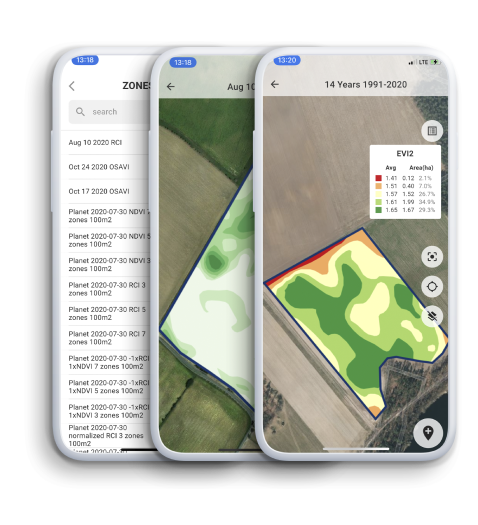
The Soil Brightness Index (SBI) is a valuable tool that can be used to do an express analysis of your soils, and is calculated by GeoPard based on satellite imagery. It is the fifteenth index on the GeoPard platform, it improves accessibility to soil analyses for those users who do not have access to soil sampling or electrical conductivity data, as it is collected via remote sensing.

Soil brightness works as a proxy for soil organic matter, sands, and salinity areas, and is becoming an increasingly important index for studying changes in soil conditions over time.
This is particularly relevant in measuring and monitoring soil degradation and soil erosion patterns, which are both critical environmental concerns around the world.
A major goal of precision agriculture is to foster and contribute to more sustainable agricultural land management, and remote sensing is becoming an increasingly valuable technology with the resolution of satellite images improving so rapidly over time.
Soil degradation and erosion are global issues, but also impact the longevity of individual agricultural operations and local environments. The most productive tier of a soil system is the topsoil, and when it becomes eroded farmers often need to increase production costs to maintain the same yields.
Once topsoil has disappeared from a given area of land, erosion continues to degrade the stripped soil in a positive feedback cycle that creates an uneven land surface afflicted with rills and gullies, making efficient crop cultivation even more challenging.
The Soil Color index can be used in multi-layer analysis with other indices to monitor changes in soils, like erosion patterns, which in turn can tell us vital information about crop productivity.
Agronomists, growers and agribusinesses alike should appreciate how the information relayed by the SBI takes on the most value when it is used to inform decision-making about sustainable soil management and mitigate practices that may hinder it.
What is The Correlation Between The Soil Brightness Index (SBI) And Soil Organic Matter, Soil Moisture, And Salty Soils?
The Soil Brightness Index (SBI) has distinct correlations with soil organic matter, soil moisture, and the presence of salts in the soil. Each of these factors affects soil reflectance, which is what SBI measures. Here’s how they are generally related:
1. Soil Organic Matter:
Soil organic matter (SOM) is vital for soil fertility and overall soil health. It consists of decomposed plant and animal residues, and its presence enhances soil structure, water retention, and nutrient availability.
- Correlation: Inverse
- Explanation: Soils rich in organic matter tend to be darker due to the organic material’s dark color. This results in a lower SBI, as darker soils absorb more light and reflect less. Conversely, soils with lower organic matter content are brighter and have a higher SBI.

2. Soil Moisture:
Soil moisture plays a critical role in plant growth and crop productivity. It affects various soil processes, including nutrient uptake, microbial activity, and soil erosion. Studies have demonstrated a relationship between SBI and soil moisture content.
Darker soils, characterized by lower SBI values, often retain more moisture compared to brighter soils. This correlation underscores the importance of SBI in assessing soil moisture dynamics and irrigation management.
- Correlation: Inverse
- Explanation: Wet soils typically appear darker because they absorb more light, leading to a lower SBI. On the other hand, dry soils reflect more light, resulting in a higher SBI. The moisture content can significantly affect the SBI, as the presence of water changes the soil’s optical properties.
3. Salty Soils:
Salty soils, also known as saline soils, pose significant challenges to agriculture due to their high salt content. Excess salts can adversely affect plant growth by hindering water uptake and causing ion toxicity. Monitoring SBI can thus serve as a useful tool for identifying and managing saline soil areas.
- Correlation: Positive
- Explanation: Soils with high salt content can appear brighter, especially if a salt crust forms on the surface. This increased reflectance results in a higher SBI. Saline soils, particularly in arid or semi-arid regions, can exhibit this characteristic, reflecting more light and hence showing a higher SBI.

What Factors Affect SBI Correlations?
It’s important to note that these correlations can be influenced by various factors:
1. Soil Texture and Type:
Soil texture refers to the relative proportions of sand, silt, and clay particles in the soil. Each soil type has unique physical and chemical properties that influence its color and brightness.
For example, sandy soils tend to have lighter colors and higher reflectance due to their coarse texture, while clayey soils may appear darker and have lower reflectance.
Therefore, the correlation between Soil Brightness Index (SBI) and soil properties such as organic matter, moisture, and salinity may vary depending on the soil type. Understanding the inherent color variations of different soil textures is essential for interpreting SBI data accurately.
2. Environmental Conditions
Environmental factors play a significant role in influencing soil reflectance measurements. Lighting conditions, including the angle and intensity of sunlight, can impact the perceived brightness of the soil surface.
For instance, soil surfaces may appear brighter under direct sunlight and darker in shaded areas or during overcast weather. Additionally, the time of day at which measurements are taken can affect SBI values, with variations observed between morning, noon, and evening readings.
Cloud cover and atmospheric conditions also influence light penetration and scattering, further complicating reflectance measurements.
3. Surface Characteristics
The physical condition of the soil surface, including surface roughness, crust formation, and the presence of residues, can influence its reflectance properties independently of soil composition.
Soil crusts, formed by the compaction of surface particles, may alter light reflection and absorption patterns, leading to deviations in SBI values. Similarly, the presence of crop residues or vegetation cover can modify soil brightness by attenuating incident light and casting shadows.
Additionally, surface roughness resulting from tillage practices or soil erosion can affect light scattering and alter reflectance measurements.
In practice, while SBI provides valuable insights into these soil characteristics, it’s often used alongside other methods for a comprehensive assessment. For instance, remote sensing data for SBI might be calibrated with ground-based measurements of soil organic matter, moisture, and salinity to enhance accuracy and interpretation.
What are the examples of using SBI in precision ag for management zones?
In precision agriculture, the Soil Brightness Index (SBI) is particularly useful for delineating management zones. These zones are areas within a field that exhibit similar characteristics and therefore can be managed in a similar way.
Here are some examples of how SBI can be used in precision agriculture to create and manage these zones, especially in the context of Variable Rate Application (VRA) for seeding and fertilizing:
1. Variable Rate Seeding:
Variable rate seeding (VRS) is an advanced agricultural practice that involves adjusting the seeding rate of crops based on site-specific conditions within a field. Instead of using a uniform seeding rate across the entire field, VRS technology allows farmers to customize seeding rates according to variations in soil properties, topography, historical yield data, and other factors.

The primary goal of variable rate seeding is to optimize plant populations to maximize crop yields while minimizing input costs and environmental impact. For instance,
- Soil Texture and Moisture Zones: SBI can help identify areas with different soil textures and moisture levels. Seeds can be planted at variable rates in these zones to optimize germination and growth. For instance, in areas with higher moisture (indicated by a lower SBI), a lower seed rate might be used to prevent overcrowding and disease, while drier areas (higher SBI) might require a higher seeding rate.
- Tailoring to Soil Conditions: Different soil types support plant growth in varying ways. By using SBI data to identify these soil types, seeding rates can be adjusted to match the soil’s capacity to support crops.
2. Variable Rate Fertilizing:
Variable Rate Fertilizing (VRF) is a smart farming technique. It changes the amount of fertilizer for different spots in a field. This is not like the old way, where every part of the field gets the same fertilizer. With VRF, each area gets just what it needs. This method is better because it helps plants grow more and uses less fertilizer. For instance,
- Organic Matter and Fertility Zones: Since organic matter content is inversely related to SBI, this index can guide the creation of fertility management zones. Areas with lower SBI (higher organic matter) might require less fertilizer, while areas with higher SBI might need more.
- Salinity Management: In areas where salinity is a concern, SBI can identify saline patches. Fertilizer application in these zones can be adjusted to account for the impact of salinity on nutrient availability and uptake.
3. Soil Salinity Management:
Managing soil salinity is key for keeping soil health in check and ensuring crops grow properly. Soil salinity is about having too much salt in the soil, which can harm plant growth, affect the soil’s structure, and hurt microbial life. Therefore, finding effective ways to deal with soil salinity is crucial to keep agricultural production up and running.
- Identifying Saline Zones: Soil salinity is measured by the electrical conductivity (EC) of the soil solution, which reflects the total amount of soluble salts. A higher EC indicates greater salinity and potential problems for crop growth.
- This is where Soil Biomass Index (SBI) comes into play. SBI can help pinpoint areas with high soil salinity. These zones might require different crop selections or specific soil treatments. By analyzing soil biomass, which is the living component of soil organic matter, SBI provides insights into the biological activity and fertility of the soil.
4. Integrated Management Practices:
Integrated Management Practices (IMP) is a comprehensive approach to managing agricultural systems, blending various farming techniques and principles to achieve effective, sustainable, and fruitful farming.
This method aims to balance the economic, environmental, and social aspects of agriculture, ensuring its long-term viability and success. IMP encompasses a variety of practices, including integrated pest management, soil health management, water conservation, and crop diversification.

- Combining with Other Data: SBI can be integrated with other data sources, like yield maps, soil nutrient levels, and topography, to create comprehensive management zones. This multi-layered approach allows for more precise and effective management decisions.
- For instance, a study on the integration of organics in nutrient management for finger millet under rainfed Alfisols in Southern India showed that substituting chemical fertilizers with organic manures improved soil properties and increased yields by up to 22.6%.
5. Efficient Resource Use:
Optimizing Input Application: By using SBI to create management zones, inputs like seeds and fertilizers can be applied more efficiently, reducing waste and environmental impact, while maximizing crop yields.
In all these applications, the goal of using SBI in precision agriculture is to tailor farming practices to the specific needs of different areas within a field. This not only optimizes resource use but also supports the sustainability of agricultural operations by reducing over-application of inputs and enhancing crop productivity. The use of technology such as GPS, GIS, and specialized software is key in implementing these precision agriculture strategies effectively.
Conclusion
In conclusion, the Soil Brightness Index (SBI) offers valuable insights into soil properties and can help farmers make informed decisions regarding soil management practices. The correlation between SBI and soil organic matter, soil moisture, and salty soils highlights its importance in assessing soil health, fertility, and productivity. By understanding these relationships, farmers can optimize their agricultural practices and promote sustainable land management for future generations.
Soil Data