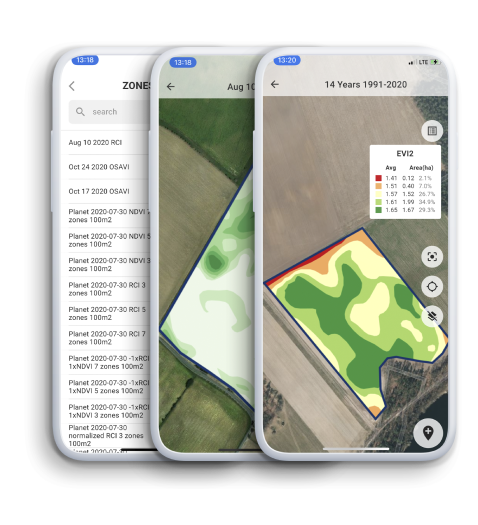
Crop imaging is like giving farmers a super-powered set of eyes. It means using cameras – often on drones, satellites, tractors, or even handheld devices – to capture pictures and data from fields. But it’s not just regular photos; these tools can see things our eyes can’t, like plant health hidden in infrared light or water stress invisible to us.
Introduction To Vision of Crop Imaging
What is Crop Imaging? It is the science and technology of capturing detailed visual and non-visual data from agricultural fields using specialized sensors. This includes specific wavelengths of light (like near-infrared and thermal) that reveal hidden details about plant physiology.
The core purpose of crop imaging is simple yet powerful: to measure how crops are really doing without harming them. It tells farmers exactly where plants are healthy, growing well, or struggling from things like disease, lack of water, or poor nutrition.
Most importantly, it gives an early estimate of how much crop might be harvested (yield potential). All of this is done non-destructively, meaning plants aren’t cut or damaged during the process.
Why does this matter? Traditional farming often relies on estimates, manual field scouting (which is time-consuming and subjective), and uniform treatment of entire fields. Digital crop images replaces this guesswork with objective, spatially explicit data.
It is the foundational tool enabling precision agriculture. By creating detailed maps of field variability, crop imaging allows farmers to make data-driven decisions, such as applying water, fertilizer, or pesticides only where and when they are needed.
This targeted approach is crucial for sustainable intensification: recent studies (e.g., FAO 2023, PrecisionAg Institute 2024) indicate that farms adopting imaging-guided precision practices can achieve yield increases of 10-20% while simultaneously reducing water and chemical inputs by 15-30%.

In an era demanding more efficient and environmentally responsible food production, Digital crop images are no longer optional – it’s essential for the future of farming. Some of the key benefits of digital crop imaging are:
- Increased Efficiency: Replaces manual scouting: Drones/satellites cover 500+ acres per hour vs. 10–20 acres/day by foot. Reduces labor/fuel costs by up to 85% (ASABE, 2023).
- Improved Yields & Quality: Detects crop stress early (nutrient/water gaps, disease): Boosts yields by 5–25% (USDA, 2024). Optimizes harvest timing for higher-grade produce.
- Reduced Input Costs: Enables precision application (VRA): Cuts fertilizer use by 10–30%, water by 20–25%, and pesticides by 30–70% (Penn State Extension, 2023).
- Enhanced Sustainability: Lowers carbon footprint by reducing tractor passes. Minimizes chemical runoff into soil/water: Supports regenerative farming goals.
- Objective, Quantifiable Data: Generates metrics like NDVI (plant health scores) for data-driven decisions. Tracks field changes via cloud analytics.
- Early Problem Detection: Identifies pests/disease 2–3 weeks before visible symptoms (multispectral imaging). Prevents ~15% crop loss (FAO, 2023).
Spectrum of Crop Imaging Technologies
Imagine if farmers could see exactly how their crops were feeling – not just if they look green, but if they’re thirsty, hungry, or getting sick before any visible signs appear. Thanks to Digital crop images, this superpower is now a reality!
By using special sensors mounted on drones, tractors, or even satellites, farmers can capture detailed pictures far beyond what our eyes can see. Here are some of different “eyes” in the crop imaging toolbox and what they reveal:
1. The Familiar Eye: RGB (Visible Light) Imaging
Think of this as taking a standard color photograph from the sky. RGB cameras capture red, green, and blue light, just like your phone camera. While it seems basic, it’s incredibly useful.
Farmers use RGB images to count how many plants have emerged after planting, see how much ground is covered by leaves (canopy cover), spot troublesome weed patches, and do general field scouting.
- It’s a fast and affordable way to get a crop overview.
2. The Plant Health Detective: Multispectral Imaging
This technology goes deeper. Multispectral sensors capture light reflected by plants in specific, key color bands, including ones invisible to us like Near-Infrared (NIR) and Red Edge. Healthy plants reflect a lot of NIR light.
By comparing the amount of red light (absorbed by healthy chlorophyll) to NIR light, these sensors calculate powerful Vegetation Indices like the NDVI (Normalized Difference Vegetation Index).

These indices act like a “health score,” revealing chlorophyll content, plant vigor (strength), and total biomass. This allows farmers to spot areas lacking nutrients, suffering from drought stress, or showing the very earliest signs of disease or pest damage – often before the human eye can see anything wrong.
- It’s the most widely used crop imaging tech, making up over 35% of the precision agriculture sensors market as of 2023.
3. The Super-Detailed Scientist: Hyperspectral Imaging
Hyperspectral takes multispectral to the extreme. Instead of just a few bands, it captures reflectance across hundreds of very narrow, contiguous bands. This creates a detailed spectral “fingerprint” for every pixel in the image.
Why is this powerful? Different plant stresses (like specific nutrient deficiencies – nitrogen vs. potassium) or diseases cause unique changes in this fingerprint. Hyperspectral imaging allows for incredibly precise identification of the exact problem and can even analyze biochemical traits within the plant.
- While more complex and expensive, its use in advanced diagnostics is growing rapidly, with the global market projected to expand at over 12.8% annually (CAGR) from 2024 to 2030.
4. The Thirst Meter: Thermal Imaging
Thermal cameras don’t see light; they see heat. They measure the temperature of the plant canopy. When plants are water-stressed, they close their pores (stomata) to conserve water. This reduces evaporative cooling, causing their leaves to heat up significantly compared to well-watered plants.
- By spotting these “hot spots” in a field, thermal imaging is a direct way to monitor drought stress.
Farmers use this vital information to target their irrigation precisely, saving water and energy, and ensuring crops get the right amount at the right time.
5. The Photosynthesis Gauge: Fluorescence Imaging
This advanced technique measures the faint glow (fluorescence) emitted by chlorophyll molecules after they absorb sunlight. The amount and type of this glow change depending on how efficiently the plant is photosynthesizing.

When a plant is under stress (even very early stress), its photosynthetic machinery is often the first thing affected, altering its fluorescence signature. This makes it an incredibly sensitive tool for detecting stress before other symptoms show and for deep research into plant physiology.
- It’s crucial for high-throughput phenotyping (measuring plant traits automatically).
6. The Shape Measurer: 3D Imaging / LiDAR
These sensors (like LiDAR – Light Detection and Ranging) use lasers or sophisticated cameras to measure the distance to the plant canopy thousands of times per second.
- This builds a detailed 3D map showing plant height, the density and structure of leaves and stems, and the overall shape (architecture) of the canopy.
By taking these measurements over time, farmers can accurately track growth rates and estimate the volume of biomass (total plant material) in a field, which is a key indicator of yield potential.
What Technologies Used To Get Digital Crop Images?
Crop imaging – using cameras and sensors to take pictures of fields from above or within – is transforming farming. But how do we actually get those images? Different platforms are used, each with its own strengths and weaknesses.
1. Ground-Based Systems
Imagine walking through a field with a special camera or attaching sensors directly to a tractor. That’s ground-based imaging. This includes handheld devices like cameras and smartphones for spot checks, sensors mounted on tractors as they drive through fields, and even larger phenotyping platforms (like sensor carts or booms) designed for research plots.
Pros: These systems get you the sharpest detail (high resolution). You can focus on specific plants or small areas very precisely. They’re great for targeted measurements on individual leaves or stems.
Cons: Covering a large field this way takes a lot of time and labor. Their view is limited, making them impractical for big farms. Tractor-mounted systems can also potentially compact soil.
2. UAVs (Drones)
Drones (UAVs) have become the most popular tool for capturing crop images over entire fields. Equipped with regular or specialized cameras (like those seeing plant health via near-infrared light), they fly automated missions over crops.
Pros: Drones offer fantastic flexibility – you can fly them whenever needed. They capture highly detailed images, cover fields quickly, and are generally more affordable than planes or high-res satellites. They are ideal for weekly checks on medium-sized farms.
Cons: A typical drone flight lasts only 20-45 minutes per battery, limiting how much ground you can cover in one go. Rules and regulations (like needing a license in many places) must be followed.
Flying also depends heavily on good weather – no rain or strong winds. Drone use is booming, with the agricultural drone market expected to reach $8.9 billion globally by 2028.
3. Manned Aircraft
For truly huge fields or entire ranches, planes or helicopters equipped with imaging sensors are sometimes used.
Pros: They can cover much larger areas in a single flight than drones can. This makes them efficient for massive farms or regional surveys.
Cons: Hiring a plane is significantly more expensive than using drones. The images taken from higher altitudes usually have less fine detail (lower resolution) than drone photos. Scheduling flights is also less flexible and depends on aircraft and pilot availability.
4. Satellites
Earth observation satellites orbiting high above us constantly take pictures of the entire planet, including farm fields.
Pros: Satellites offer global coverage, meaning they can image any farm, anywhere. They fly on strict schedules, providing consistent images at regular intervals (e.g., every few days or weeks).
Crucially, they often have archives of images going back years or decades, allowing farmers to compare current fields with past seasons.
Cons: While constantly improving, most satellite images still have lower resolution than drones or planes – you might see whole fields clearly, but not individual plants. Clouds are a major problem, blocking the satellite’s view.
Farmers also have no control over exactly when a satellite passes overhead. Newer satellite constellations (like Planet Labs) now offer daily imaging and resolutions down to 3 meters per pixel, but ultra-high detail (needed to see individual plants) still typically requires drones or aircraft.
The best platform for crop imaging depends on the job. Often, farmers use a combination of these tools – like using satellites for broad monitoring and sending drones to investigate specific problem spots they spot. This multi-level view gives farmers unprecedented insight into their crops, helping them grow more food more efficiently.
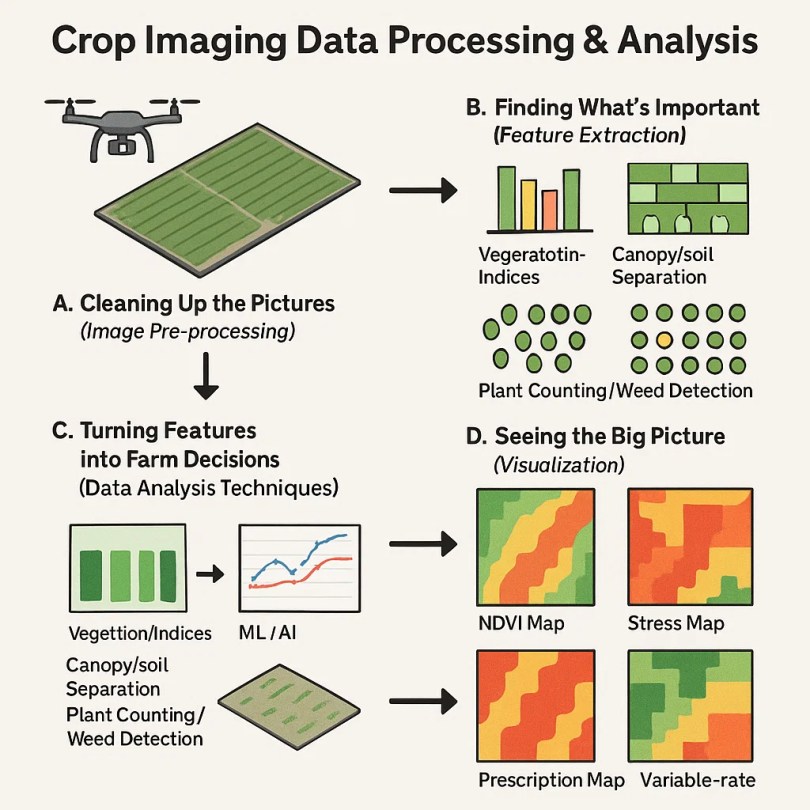
Crop Imaging Data Processing & Analysis
So, you’ve captured amazing pictures of your fields using drones or satellites. That’s step one! But those millions of colorful pixels (the tiny dots making up the image) don’t automatically tell you how your crops are doing.
Step two is data processing and analysis – turning those raw pictures into useful farming knowledge. Here’s how it works:
A. Cleaning Up the Pictures (Image Pre-processing)
Think of this like getting your photos ready for serious study. Raw images often have small errors. Special software fixes these:
- Georeferencing pins each pixel to a GPS location.
- Orthomosaicking stitches images into one seamless map.
- Radiometric calibration adjusts for lighting changes (e.g., morning vs. noon sun).
Without this step, maps could mislead.
B. Finding What’s Important (Feature Extraction)
Now, we start looking for specific things in the cleaned-up images:
- Vegetation indices (like NDVI) use plant light reflection to measure health. Low NDVI often signals stress.
- Canopy/soil separation distinguishes crops from bare ground.
- Plant counting/weed detection automates scouting.
Latest Context: Farmers increasingly rely on these indices. For example, studies show using NDVI can improve nitrogen application efficiency by 10-25%, reducing waste and cost.
C. Turning Features into Farm Decisions (Data Analysis Techniques)
This is where the magic happens – finding meaning in the numbers and shapes:
Comparing the vegetation index values from the images with actual measurements taken on the ground (like leaf samples or yield at harvest). This confirms, “Yes, low NDVI here really did mean less nitrogen.”
Machine Learning (ML) & AI: This is exploding in agriculture! Computers learn from massive amounts of past data (images + ground truth) to spot complex patterns humans might miss:
- Disease classification (spotting sick plants early).
- Yield prediction (over 90% accuracy in trials).
- Weed/insect detection.
Latest Stats & Facts: The global market for AI in agriculture is booming, projected to reach over $4 billion by 2028 (source: Statista, 2023).
A 2023 FAO report highlighted ML’s growing role in early pest/disease detection, potentially reducing crop losses significantly. Yield prediction models using crop imaging data are now achieving over 90% accuracy in some trials.
D. Seeing the Big Picture (Visualization)
All this analysis is most powerful when it’s easy to see. The final output is often a colorful map overlaid on your field:
- NDVI Maps: Show health zones (green = healthy, red/yellow = stressed).
- Stress Maps: Highlight areas likely suffering from drought, nutrient deficiency, or disease.
- Prescription Maps: The ultimate goal! These maps tell variable-rate applicators exactly where to put more seed, fertilizer, or water, and where to use less, based on the image analysis. This is precision farming in action.
Why it matters: A clear map lets a farmer instantly grasp problems, track changes over time, and make confident, targeted management decisions.
Core Applications of Digital Crop Images
Using cameras mounted on drones, satellites, tractors, and even handheld devices, this technology takes detailed pictures of fields. But it’s more than just photos – special sensors capture light invisible to the human eye, revealing the hidden health of plants. Here’s why crop imaging is quickly becoming essential on modern farms:
A. Precision Nutrient Management
Digital crop images shows tiny differences in plant color and growth that signal where nutrients (like nitrogen) are lacking. Instead of blanketing the whole field with fertilizer, farmers can create maps and apply it only where needed.
- Studies show this variable-rate application can cut fertilizer use by 15-30%, saving farmers money and reducing environmental impact.
B. Precision Irrigation Management
Specialized cameras detect subtle changes in leaf temperature and color that indicate water stress long before plants visibly wilt. By pinpointing exactly which zones in a field are thirsty, farmers can direct water precisely.
- Farms using imaging for irrigation report water savings of 20-50%, crucial as droughts become more common.
C. Pest & Disease Management
Crop imaging spots the early warning signs of pests or disease – unusual color patterns, leaf damage, or stunted growth – often missed by the human eye during routine checks. This allows for targeted scouting and precise spraying only on affected areas.

- Early detection can prevent yield losses of 10-30%, and targeted spraying reduces pesticide use significantly.
D. Weed Management
High-resolution imaging, especially from drones, creates detailed “weed maps” showing exactly where invasive plants are taking hold. Farmers can then use this map to guide spot-spraying robots or precise herbicide applicators.
- Targeted weed control based on imaging can reduce herbicide volumes by up to 90% in some cases, lowering costs and chemical exposure.
E. Yield Prediction & Forecasting
By analyzing crop health and biomass throughout the season using imaging data, sophisticated models can predict yield potential field-by-field, or even zone-by-zone.
- Major grain companies increasingly use satellite imaging for regional forecasts, with accuracy rates reaching 85-95% weeks before harvest, aiding logistics and marketing.
F. Crop Scouting & Monitoring
Instead of walking fields for hours, farmers can deploy drones with imaging cameras to get a bird’s-eye view of the entire farm quickly. They can spot problems like flooding, poor emergence, or equipment damage efficiently
- Drones can scout 100 acres in less than 30 minutes, a task taking humans days, freeing up valuable time.
G. Plant Phenotyping
For scientists developing new seed varieties, imaging is revolutionary. It automates the measurement of key traits (height, leaf area, flowering time, stress response) on thousands of plants in field trials.
- This allows breeders to analyze vastly more plants and select the best performers much faster, accelerating the development of more resilient, higher-yielding crops.
Challenges And Future of Crop Imaging
Getting started with crop imaging isn’t always simple or cheap. The initial cost can be significant. Some of the key challenges are:
- Cost: Getting started is expensive. A basic drone imaging setup costs $2,000-$10,000, while advanced systems with hyperspectral sensors can reach $30,000+. Software subscriptions add ongoing costs.
- Data Overload: Farms generate massive image data daily – easily gigabytes or terabytes per flight or scan. Storing, managing, and processing this requires significant computing power and cloud storage, which can be costly and complex.
- Expertise Needed: Turning colorful image maps into useful farming actions requires skills in remote sensing, agronomy, and data science. Many farmers lack this specialized knowledge.
- Complex Interpretation: Translating a plant’s unique “light signature” (spectral data) into clear actions (e.g., “add fertilizer here”) remains challenging and prone to error without experience.
- Environmental Hurdles: Clouds block satellite views. Wind disrupts drone flights and image clarity. Changing sun angles and soil color affect sensor readings.
- Regulations: Drone flights face strict airspace rules, requiring licenses and operational limits, adding complexity.
Despite the challenges, the future of crop imaging is incredibly promising, driven by rapid technological advancements. We’ll see much deeper integration with other data sources.
Imagine combining crop images seamlessly with real-time soil moisture readings from ground sensors, weather forecasts, and historical yield maps. This creates a complete picture of field health.
Artificial Intelligence (AI) and Machine Learning (ML) are game-changers, automating the analysis of huge image datasets. This means faster, even real-time or near-real-time processing, giving farmers actionable insights within hours or minutes, not days.
- Better, Cheaper Sensors: Sensors, especially powerful hyperspectral ones (capturing hundreds of light bands for ultra-detailed analysis), are getting smaller, lighter, and more affordable, making advanced imaging more accessible.
- Easier-to-Use Tools: Tech companies are building simpler analytics platforms and apps. Farmers will get clear, actionable recommendations directly on tablets or phones, no PhD needed.
- Prediction & Prescription: The focus shifts from seeing problems to preventing them. AI will forecast issues (e.g., pest outbreaks, yield potential) weeks in advance using imaging trends and other data.
Conclusion
Crop imaging has become a powerful tool, fundamentally changing how we grow our food. By giving farmers “eyes in the sky” and “eyes in the field” using technologies like drones, satellites, and special ground sensors, it provides incredibly detailed pictures of crop health, soil conditions, and potential problems. This ability to see what’s happening across vast fields in near real-time is at the heart of modernizing agriculture.
Satellite Imagery