

The relentless pursuit of increased yield, optimized resource use, and sustainable practices defines modern agriculture. Amidst this quest, a powerful, yet often unseen, ally has emerged: the Chlorophyll Index (CI). This sophisticated vegetation index, derived from the subtle language of light reflected by plants, provides an unprecedented window into the very engine of plant growth – chlorophyll content.
As we navigate an era demanding precision and environmental responsibility, understanding and harnessing the Chlorophyll Index is no longer a niche advantage but a fundamental tool for progressive farming, agribusiness, and environmental stewardship.
The latest statistics underscore that farms adopting CI-guided management consistently report input savings of 10-25%, water use reductions of 15-30%, and yield increases of 5-15% through optimized health and reduced losses. The Chlorophyll Index is not just a tool for observing plant health; it is a catalyst for cultivating a more sustainable agricultural future.
What is Chlorophyll Index?
The chlorophyll index (CI) is applied to calculate the total amount of chlorophyll in plants. To grasp the profound significance of the Chlorophyll Index, we must first appreciate its subject: chlorophyll itself. Chlorophyll is the vital green pigment residing within plant chloroplasts. It acts as nature’s solar panel, capturing light energy from the sun.
This captured energy fuels photosynthesis, the miraculous biochemical process where carbon dioxide and water are transformed into life-sustaining sugars and oxygen. Essentially, chlorophyll is the cornerstone of plant growth and productivity.
Its concentration within plant leaves is directly and dynamically linked to the plant’s health, nutritional status, photosynthetic efficiency, and ultimately, its yield potential. Traditionally, assessing chlorophyll meant labor-intensive, destructive lab tests on leaf samples – a process too slow and sparse for effective field-scale management. This is where remote sensing and the Chlorophyll Index revolutionize the game.
Plants interact uniquely with sunlight. While chlorophyll strongly absorbs light in the blue and red regions of the spectrum for photosynthesis, it reflects a significant portion of near-infrared (NIR) light and shows characteristic responses in the green and “red-edge” regions.
The Chlorophyll Index capitalizes on these specific reflectance patterns. By measuring the ratio of reflectance in carefully selected spectral bands using sensors mounted on satellites, drones, aircraft, or ground equipment, the CI provides a reliable, non-invasive, and scalable estimate of the actual chlorophyll concentration within the plant canopy.

In essence, it translates the plant’s optical fingerprint into a quantifiable measure of its internal health and metabolic activity. The implications for agriculture are immense. The Chlorophyll Index acts as a real-time diagnostic tool, offering insights far beyond what the naked eye can perceive.
A declining CI can signal the onset of nutrient deficiency, particularly nitrogen – the building block of chlorophyll molecules – days or even weeks before visual symptoms like yellowing (chlorosis) appear. It can reveal water stress impacting photosynthetic machinery, detect early stages of disease altering plant metabolism, and indicate overall plant vigor.
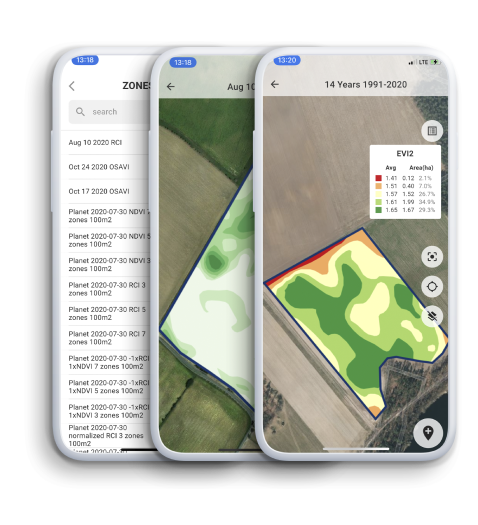
Interpreted correctly, this continuous stream of data empowers farmers and agronomists to make proactive, targeted decisions. Rather than treating entire fields uniformly based on averages or delayed observations, interventions can be precisely tailored to the specific needs of different zones within a field.
This shift from reactive to predictive management is the essence of precision agriculture, and the Chlorophyll Index is a key enabler. The applications extend far beyond the farm gate. Input suppliers leverage CI data to demonstrate the efficacy of their fertilizers or crop protection products in real-world conditions, moving beyond controlled trial plots.
Insurance companies increasingly utilize CI-derived yield predictions for risk assessment and to structure parametric insurance products, where payouts are triggered by objective, satellite-verified indices of crop stress rather than subjective loss assessments.
Agricultural cooperatives managing thousands of hectares use CI maps to coordinate fertilizer application plans efficiently across vast geographies. Environmental agencies monitor the impact of agricultural practices on ecosystem health by tracking chlorophyll levels as a proxy for plant stress and potential nutrient runoff.
The versatility and objectivity of the Chlorophyll Index make it a cornerstone technology across the agricultural value chain and environmental monitoring.
Key Chlorophyll Index Spectrums
The term “Chlorophyll Index” encompasses several specific formulations, each fine-tuned to extract chlorophyll information under varying conditions and with different sensor capabilities. Understanding these variants is crucial for selecting the right tool for the job.
1. Green Chlorophyll Index (CIgreen or GCI)
The Green Chlorophyll Index (CIgreen or GCI) is renowned for its broad applicability across diverse plant species. Its strength lies in leveraging the green reflectance peak exhibited by healthy vegetation.
As chlorophyll concentration increases, absorption in the red and blue increases, but reflectance in the green band (around 550 nm) remains relatively stable or increases slightly, while NIR reflectance (around 730-850 nm) consistently rises due to the scattering effect of healthy leaf cell structures. The GCI formula capitalizes on this relationship:
CIgreen = (ρNIR / ρgreen) – 1.
Commonly, bands like 730 nm for NIR and 530-550 nm for green are used, resulting in CIgreen = (ρ730 / ρ530) – 1. A higher CIgreen value directly correlates with higher chlorophyll content. Its robustness across species makes it a widely adopted general-purpose chlorophyll indicator in precision agriculture platforms.

2. Red-Edge Chlorophyll Index (CIred-edge or RCI)
The Red-Edge Chlorophyll Index (CIred-edge or RCI) exploits a critical spectral region known as the “red edge.” This is the sharp transition zone between the strong red light absorption by chlorophyll (around 670-680 nm) and the high reflectance in the NIR (beyond 700 nm) caused by leaf scattering.
The exact position and slope of this red-edge shift are highly sensitive to chlorophyll concentration. As chlorophyll increases, the red edge shifts towards longer wavelengths.
The RCI specifically uses a narrow band positioned within this dynamic red-edge region (typically around 700-750 nm, often 730 nm) and compares it to a NIR band (often 780-850 nm, commonly 850 nm):
CIred-edge = (ρNIR / ρred-edge) – 1, or specifically CIred-edge = (ρ850 / ρ730) – 1.
This index is exceptionally sensitive to moderate-to-high chlorophyll levels and is less prone to saturation effects compared to indices like NDVI when canopies are dense and lush.
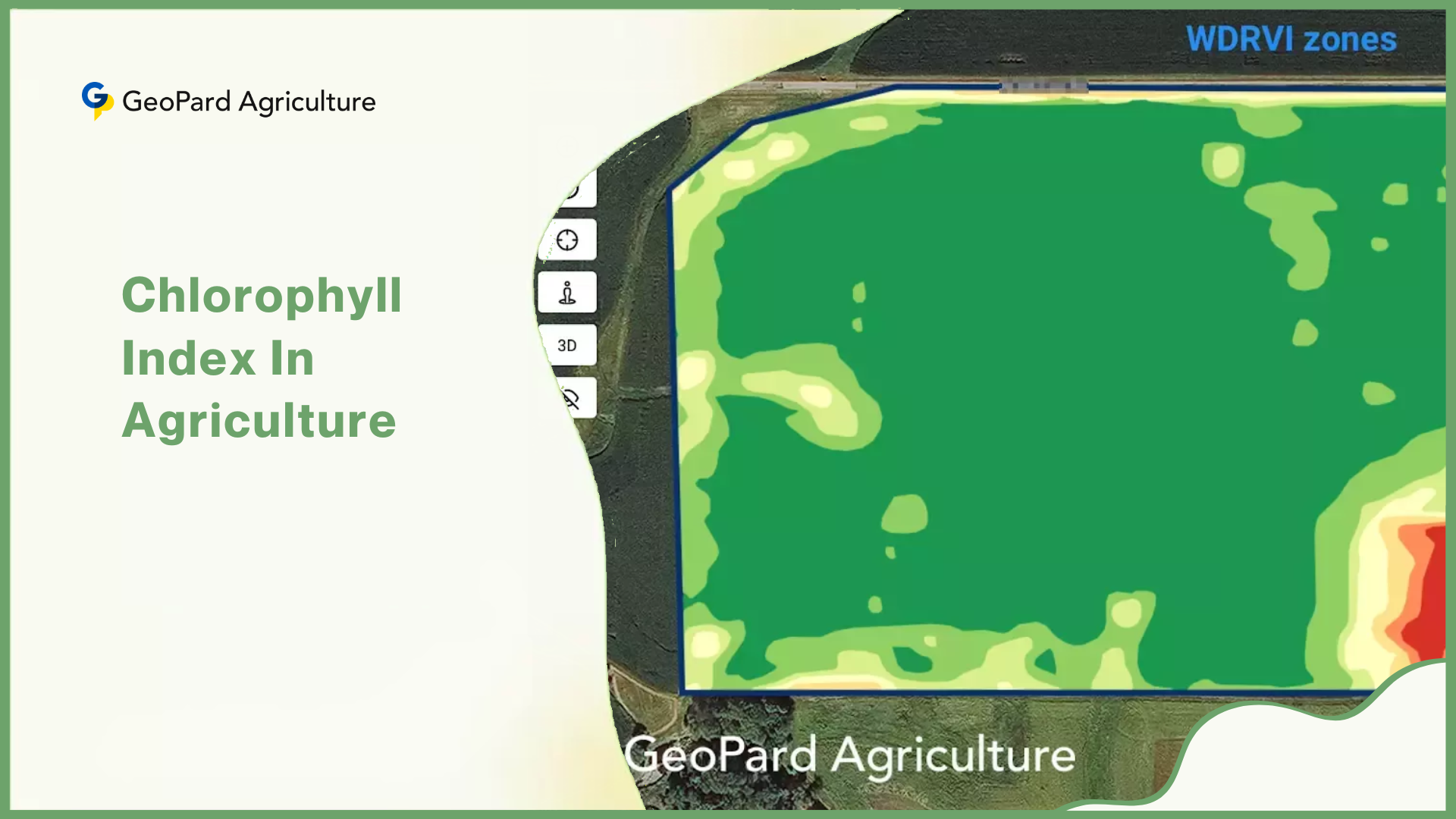
This makes the RCI particularly valuable later in the season or for crops with high biomass, where other indices lose sensitivity. Its precision makes it ideal for generating highly accurate Vegetation Index maps used in Variable Rate Application (VRA) of nutrients, especially nitrogen.
3. MERIS Terrestrial Chlorophyll Index (MTCI)
The MERIS Terrestrial Chlorophyll Index (MTCI) was originally developed for data from the MERIS (Medium Resolution Imaging Spectrometer) sensor on the Envisat satellite. It utilizes three very specific bands: one in the red absorption trough (681.25 nm), one in the red-edge region (708.75 nm), and one in the NIR plateau (753.75 nm). Its formula is:
MTCI = (ρ754 – ρ709) / (ρ709 – ρ681).
The MTCI is explicitly designed to be sensitive to high chlorophyll concentrations, a range where indices like NDVI typically saturate and become unresponsive. It effectively stretches the chlorophyll sensitivity range upwards.
While sensor-specific in origin, the concept and band positions inform the use of similar three-band approaches with modern hyperspectral sensors. Its relative simplicity and effectiveness at detecting subtle variations in high-chlorophyll canopies justify its continued relevance and adaptation in precision agriculture analytics.
4. Modified Chlorophyll Absorption in Reflectance Index (MCARI)
The Modified Chlorophyll Absorption in Reflectance Index (MCARI) takes a different approach, specifically designed to minimize the confounding influence of non-photosynthetic background materials like soil, senescing vegetation, or residue, while still being sensitive to chlorophyll. Its formula is:
MCARI = [(ρ850 – ρ710) – 0.2 * (ρ850 – ρ570)] * (ρ850 / ρ710).
This complexity serves a purpose. The term (ρ850 – ρ710) captures the contrast between NIR and red-edge reflectance, sensitive to chlorophyll. The subtraction 0.2 * (ρ850 – ρ570) helps correct for variations in background brightness and some atmospheric effects (using the green band at 570 nm).
The final ratio (ρ850 / ρ710) further normalizes the signal. MCARI excels in situations with incomplete canopy cover (low Leaf Area Index – LAI) or where soil is highly visible, such as early growth stages or orchards/vineyards.
However, its sensitivity to background means it often performs best when combined with other indices like NDVI or directly measured LAI data to isolate the true chlorophyll signal from the background noise, leading to more robust plant health assessments, especially in heterogeneous fields.
Practical Applications of Chlorophyll Index
The true power of the Chlorophyll Index is realized in its practical implementation across diverse agricultural scenarios. Its ability to provide spatially explicit, timely data on plant physiological status unlocks numerous applications:
Precision Nitrogen Management
Nitrogen is intrinsically linked to chlorophyll synthesis. CI maps, particularly CIred-edge and MTCI, are highly correlated with plant nitrogen status. This allows for precise Variable Rate Application (VRA) of nitrogen fertilizer.
Instead of uniform spreading, applicators adjust rates in real-time based on CI maps, applying more where chlorophyll (and hence N) is deficient and less where it is sufficient. A 2023 study published in Precision Agriculture demonstrated that CI-guided VRA reduced nitrogen use by 15-25% while maintaining or even increasing yields compared to conventional practices across corn fields in the US Midwest.
This translates to significant cost savings for farmers (estimated $15-$40 per acre) and substantially reduces the risk of nitrogen leaching into groundwater or contributing to greenhouse gas emissions like nitrous oxide. The European Union’s Farm to Fork strategy, aiming for a 20% reduction in fertilizer use by 2030, explicitly promotes such precision nutrient management tools.

Early Stress Detection and Diagnosis
Chlorophyll degradation is a common early response to various abiotic and biotic stresses. Water stress, salinity, micronutrient deficiencies (like magnesium, which is central to the chlorophyll molecule), pest infestation, and disease infection all impact chlorophyll concentration long before visible symptoms manifest.
Regular CI monitoring acts as an early warning system. For instance, a sudden localized drop in CI within a field could indicate a developing pest hotspot or a soil compaction issue limiting water uptake.
A 2024 report by the World Resources Institute highlighted that CI-based early detection systems used in Indian wheat belts helped reduce yield losses from unexpected heat stress by enabling preemptive irrigation adjustments, safeguarding an estimated 2 million tons of grain. This proactive approach minimizes crop damage and allows for more effective and targeted remediation strategies.
Yield Prediction and Harvest Planning
Seasonal chlorophyll dynamics, especially during critical growth stages like flowering and grain filling, are strong predictors of final yield. By building models that correlate historical CI patterns with actual harvested yields, and integrating current season CI data with weather forecasts, highly accurate yield predictions can be generated weeks or even months before harvest.
A consortium of major grain traders reported in early 2024 that incorporating high-resolution CIred-edge data from satellites and drones improved their regional soybean yield forecasts in Brazil by an average of 7% accuracy compared to traditional methods.
This level of predictability is invaluable for supply chain management, commodity trading, food security planning, and informing policy decisions. Farmers gain leverage in negotiating forward contracts and optimizing harvest logistics.
Optimizing Input Efficiency and Sustainability
Beyond nitrogen, CI maps inform the efficient use of other inputs. By identifying zones of optimal health (high, stable CI) versus stress (declining or low CI), farmers can prioritize pesticide or fungicide applications only where truly needed, reducing chemical usage and associated costs and environmental impacts.
Irrigation scheduling can also be refined; zones showing early signs of water stress via CI can receive targeted watering, improving water use efficiency – a critical factor as agricultural water demand intensifies globally.
The Food and Agriculture Organization (FAO) estimates that precision agriculture technologies, including vegetation indices like CI, can improve water use efficiency by 20-30% in irrigated systems. Furthermore, by maximizing yield per unit of input, CI-guided management inherently reduces the carbon footprint of crop production.
Breeding and Research Applications
Plant breeders leverage high-throughput phenotyping using CI derived from drones or ground sensors to rapidly screen thousands of plant lines for chlorophyll retention under stress (drought, heat, nutrient limitation), photosynthetic efficiency, and overall vigor.
This accelerates the development of more resilient and productive crop varieties. Agronomists use CI to objectively evaluate the performance of different management practices, seed treatments, or new products across trial plots and commercial fields, providing data-driven recommendations.
Overcoming Challenges To Transform Agricultural Landscape
While powerful, the effective use of Chlorophyll Indices requires careful consideration. Sensor choice is paramount. While multispectral sensors (capturing broad bands like green, red, red-edge, NIR) are common and cost-effective, hyperspectral sensors (capturing hundreds of narrow contiguous bands) offer the highest precision for chlorophyll retrieval but at greater cost and complexity.
Calibration and atmospheric correction of raw sensor data are essential to ensure accurate reflectance values before CI calculation. Cloud cover remains a limitation for satellite-based monitoring, though constellations offering frequent revisits (daily or better) and drone deployments mitigate this.
Interpreting CI maps requires agronomic knowledge. A low CI value could indicate nitrogen deficiency, water stress, disease, or simply an early growth stage. Integrating CI data with other sources – soil maps, weather data, topographic information, scouting reports, and other vegetation indices like NDVI (for structure) or NDRE (another red-edge index) – provides the context needed for accurate diagnosis.
Artificial Intelligence (AI) and machine learning are playing an increasingly vital role here, analyzing vast, multi-layered datasets to provide farmers with clear, actionable recommendations rather than just complex maps.
The future trajectory of the Chlorophyll Index is incredibly promising. Integration with real-time, on-the-go sensor systems mounted on tractors or sprayers is enabling true dynamic VRA, adjusting input rates instantly based on the CI reading directly in front of the machinery.
The fusion of satellite, drone, and ground sensor data is creating multi-scale monitoring systems offering both broad coverage and field-level detail. Advances in sensor technology, particularly miniaturized hyperspectral sensors for drones, are making high-fidelity chlorophyll mapping more accessible.
AI-driven analytics platforms are transforming raw CI data into intuitive dashboards and automated alerts, democratizing access to this powerful information for farmers of all scales.
Conclusion
The Chlorophyll Index represents far more than a technical metric; it embodies a fundamental shift in how we understand and manage agricultural ecosystems. By tapping into the “green pulse” of plants – their chlorophyll content – we gain an objective, quantifiable, and spatially explicit measure of their health and productivity.
From enabling precision nitrogen management that boosts efficiency and protects water resources, to providing early warnings of stress that save crops and inputs, to generating accurate yield forecasts that stabilize markets, the applications are transforming the agricultural landscape.
NDVI