Mapping World’s Salted Soils Using Remote Sensing Technologies

A team of researchers has created a technique that measures the soil salt content across the globe with impressive precision, down to 10 meters. This improvement meets the critical need for accurate soil salinity evaluations, a major issue that affects agricultural productivity and soil health worldwide.

Soil salinity, a kind of land degradation, affects over 1 billion hectares across the globe, harming agricultural productivity and the health of the environment. Previous efforts to map soil salinity faced challenges due to the low detail of available datasets and difficulties in showing the continuous changes in soil salinity levels.

Acknowledging these challenges, the research team set out to create a model that uses Sentinel-1/2 images, climate data, terrain information, and advanced machine learning algorithms. Their aim was to estimate soil salt content in five climate regions.

The results were shared in a paper published on March 28, 2024, in the Journal of Remote Sensing. This research introduces an innovation that effectively combines angled spiral channels with periodic contraction-expansion arrays.

Global Soil Salinity Estimation at 10 m Using Multi-Source Remote Sensing

At the core of this effort lies the integration of data from various remote sensing technologies, notably the sophisticated Sentinel-1/2 satellites, coupled with the strategic utilization of machine learning algorithms. This approach has led to the development of an advanced model capable of accurately mapping soil salinity with remarkable precision—a resolution of 10 meters, even across diverse climates.

This groundbreaking method takes us far beyond the limitations of previous efforts, which were restricted by their lower resolution and narrower focus on analyzing soil saltiness. Our committed research team has compiled a vast dataset, encompassing global climate patterns, precise measurements of soil salinity at ground level, and a comprehensive array of geospatial variables.

By employing the Random Forest algorithm, the model excels not only in predicting soil salinity with remarkable accuracy but also sheds light on the pivotal roles that climate, groundwater levels, and salinity indices play in the formation of soil salinity landscapes. This advance marks a step forward in our ability to monitor and manage soil health on a global scale.

Professor Zhou Shi, the principal investigator, expressed, “This study represents a significant advancement in our capacity to assess and address soil salinity on a global scale. By integrating satellite imagery with machine learning, we can now pinpoint saline soils with unparalleled accuracy and granularity, providing invaluable insights for sustainable land and agricultural practices.”

The latest research has produced a high-resolution global soil salinity map. This map is a valuable tool for scientists, policymakers, and farmers alike. It helps them effectively tackle soil salinity issues. By pinpointing areas with high salinity, they can take targeted actions to restore soil health.

Additionally, it supports the implementation of sustainable agricultural practices and aids in planning resource management strategies. Moreover, the methodology employed in this research sets a new standard for environmental monitoring, with potential applications in other assessments of land degradation.


More information: Nan Wang et al, Global Soil Salinity Estimation at 10 m Using Multi-Source Remote Sensing, Journal of Remote Sensing (2024). DOI: 10.34133/remotesensing.0130

Automatiserad rengöring och kalibrering av avkastningsdata

Automated Yield Data Cleaning and Calibration (AYDCC) is a process that uses algorithms and models to detect and correct errors in yield data, such as outliers, gaps, or biases. AYDCC can improve the quality and reliability of yield data, which can lead to better insights and recommendations for farmers.

Introduction to Yield Data

Yield data is one of the most important sources of information for farmers in the 21st century. It refers to the data collected from various farm machinery, such as combines, planters, and harvesters, that measure the quantity and quality of crops produced in a given field or area.

It holds immense importance for several reasons. Firstly, it aids farmers in making informed decisions. Armed with detailed yield data, farmers can fine-tune their practices to maximize productivity.

For instance, if a specific field consistently produces lower yields, farmers can investigate the underlying causes, such as soil health or irrigation issues, and take corrective measures.

Furthermore, it enables precision agriculture. By mapping variations in crop performance across their fields, farmers can tailor their input applications, such as fertilizers and pesticides, to specific areas. This targeted approach not only optimizes resource use but also reduces environmental impacts.

According to the Food and Agriculture Organization (FAO), global agricultural production needs to increase by 60% by 2050 to meet the growing demand for food. Yield data, through its role in enhancing crop productivity, is instrumental in achieving this target.
Furthermore, in Brazil, a soybean farmer used yield data along with soil sampling data to create variable-rate fertilizer maps for his fields. He applied different rates of fertilizer according to the soil fertility and yield potential of each zone.

He also used yield data to compare different soybean varieties and select the best ones for his conditions. As a result, he increased his average yield by 12% and reduced his fertilizer costs by 15%.

Similarly, in India, a rice farmer also used yield datasets along with weather data to adjust his irrigation schedule for his fields. He monitored the soil moisture levels and rainfall patterns using sensors and satellite imagery.

understanding and utilization of yield data

He also used it to compare different rice varieties and select the best ones for his conditions. As a result, he increased his average yield by 10% and reduced his water use by 20%.

Despite its benefits, yield data still faces some challenges in terms of its development and adoption. Some of these challenges are:

  • Data quality: Its accuracy and reliability depends on the quality of the sensors, the calibration of the machinery, the data collection methods, and the data processing and analysis techniques. Poor data quality can lead to errors, biases, or inconsistencies that can affect the validity and usefulness of the data.
  • Data access: The availability and affordability of yield data depend on the access to and ownership of the farm machinery, the sensors, the data storage devices, and the data platforms. Lack of access or ownership can limit the ability of farmers to collect, store, share, or use their own data.
  • Data privacy: Its security and confidentiality depends on the protection and regulation of the data by the farmers, the machinery manufacturers, the data providers, and the data users. Lack of protection or regulation can expose the data to unauthorized or unethical use, such as theft, manipulation, or exploitation.
  • Data literacy: The understanding and utilization of yield data depend on the skills and knowledge of the farmers, the extension agents, the advisors, and the researchers. Lack of skills or knowledge can hinder the ability of these actors to interpret, communicate, or apply the data effectively.
gathering datasets using farm machines like harvesters

Therefore, to overcome these challenges and realize the full potential of yield data, it is important to cleaning and calibrate the yield data.

Introduction to yield data cleaning and calibration

Yield data are valuable sources of information for farmers and researchers who want to analyze crop performance, identify management zones, and optimize decision-making. However, it often require cleaning and calibration to ensure their reliability and accuracy.

Calibrating the “YieldDataset” is a functionality that corrects the distribution of values in alignment with mathematical principles, enhancing the overall integrity of the data. It bolsters the quality of decision-making and renders the dataset valuable for further in-depth analysis.

GeoPard Yield Clean-Calibration Module

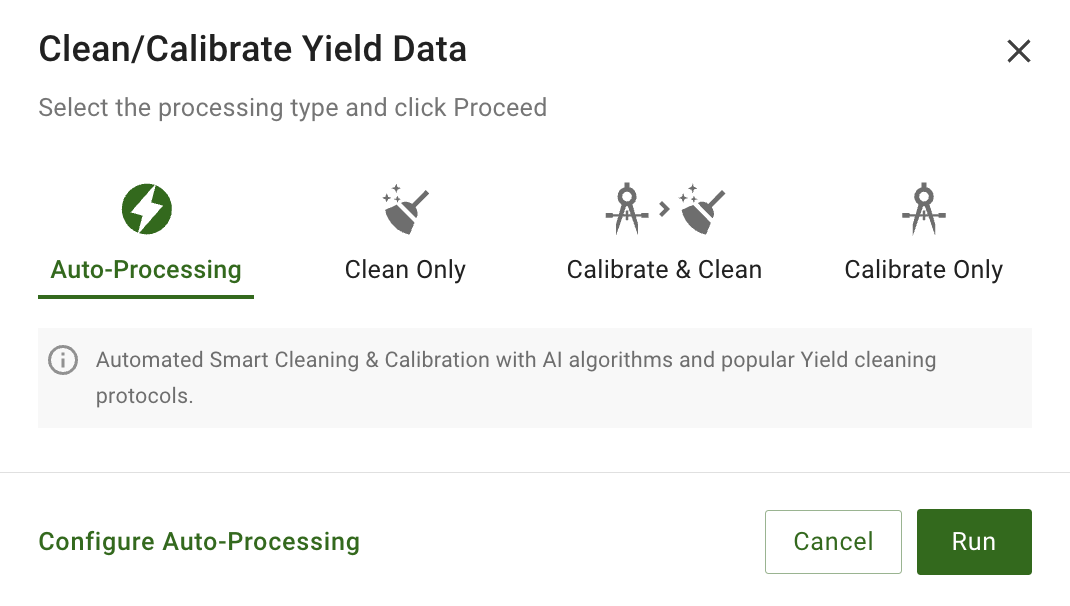
GeoPard made it possible to clean and correct yield datasets using its Yield Clean-Calibration module.

We’ve made it easier than ever to enhance the quality of your yield datasets, empowering farmers to make data-driven decisions that you can rely on.

GeoPard - Yield Cleaning & Calibration, similar to Field Potential zones

After calibration and cleaning, the resulting yield dataset becomes homogeneous, without outliers or abrupt changes between neighboring geometries.

With our new module, you can:

Select an option to proceed
  • Remove corrupted, overlapped, and subnormal data points
  • Calibrate yield values across multiple machines
  • Start calibration with just a few clicks (simplifying your user experience) or execute the associated GeoPad API endpoint

Some of the most common use cases of automated yield data cleaning and calibration include:

  • Synchronizing data when multiple harvesters have worked either simultaneously or over several days, ensuring consistency.
  • Making the dataset more homogeneous and accurate by smoothing out variations.
  • Removing data noise and extraneous information that can cloud insights.
  • Eliminating turnarounds or abnormal geometries, which may distort the actual patterns and trends in the field.

In the picture below, you can see a field where 15 harvesters worked at the same time. It shows how the original yield dataset and the improved dataset after calibration with GeoPard yield clean-calibration module look quite different and easy to understand.

difference between the original and improved yield datasets with GeoPard's Calibration Module

Why is it important to clean and calibrate?

Yield data are collected by yield monitors and sensors that are attached to harvesters. These devices measure the mass flow rate and moisture content of the harvested crop, and use GPS coordinates to georeference the data.

However, these measurements are not always accurate or consistent, due to various factors that can affect the performance of the equipment or the crop conditions. Some of these factors are:

1. Equipment variations: Farm machinery, such as combines and harvesters, often have inherent variations that can lead to discrepancies in data collection. These variations might include differences in sensor sensitivity or machinery calibration.

For example, some yield monitors may use a linear relationship between voltage and mass flow rate, while others may use a nonlinear one. Some sensors may be more sensitive to dust or dirt than others. These variations can cause discrepancies in yield data across different machines or fields.

Example 1 U-turns, Stops, Half Equipment Width Used
Example 2 U-turns, Stops, Half Equipment Width Used

2. Environmental factors: Weather conditions, soil types, and topography play significant roles in crop yields. If not accounted for, these environmental factors can introduce noise and inaccuracies into yield data.

For instance, sandy soils or steep slopes may cause lower yields than loamy soils or flat terrains. Likewise, areas with higher crop density may have higher yields than areas with lower density.

3. Sensor inaccuracies: Sensors, despite their precision, are not infallible. They may drift over time, providing inaccurate readings if not regularly calibrated.

For example, a faulty load cell or a loose wiring may cause inaccurate mass flow rate readings. A dirty or damaged moisture sensor may give erroneous moisture content values. A wrong field name or ID entered by the operator may assign yield data to the wrong field file.

These factors can result in yield datasets that are noisy, erroneous, or inconsistent. If these data are not cleaned and calibrated properly, they can lead to misleading conclusions or decisions.

For example, using uncleaned yield data to create yield maps may result in false identification of high- or low-yielding areas within a field.

Why is it important to clean and calibrate yield dataset

Using uncalibrated yield datasets to compare yields across fields or years may result in unfair or inaccurate comparisons. Using uncleaned or uncalibrated yield data to calculate nutrient balances or crop inputs may result in over- or under-application of fertilizers or pesticides.

Therefore, it is essential to perform yield data cleaning and calibration before using them for any analysis or decision-making purpose. Yield datasets cleaning is the process of removing or correcting any errors or noise in the raw yield data collected by the yield monitors and sensors.

Automated methods for cleaning and calibrating yield data

This is where automated data cleaning techniques come in handy. Automated data cleaning techniques are methods that can perform data cleaning tasks without or with minimal human intervention.

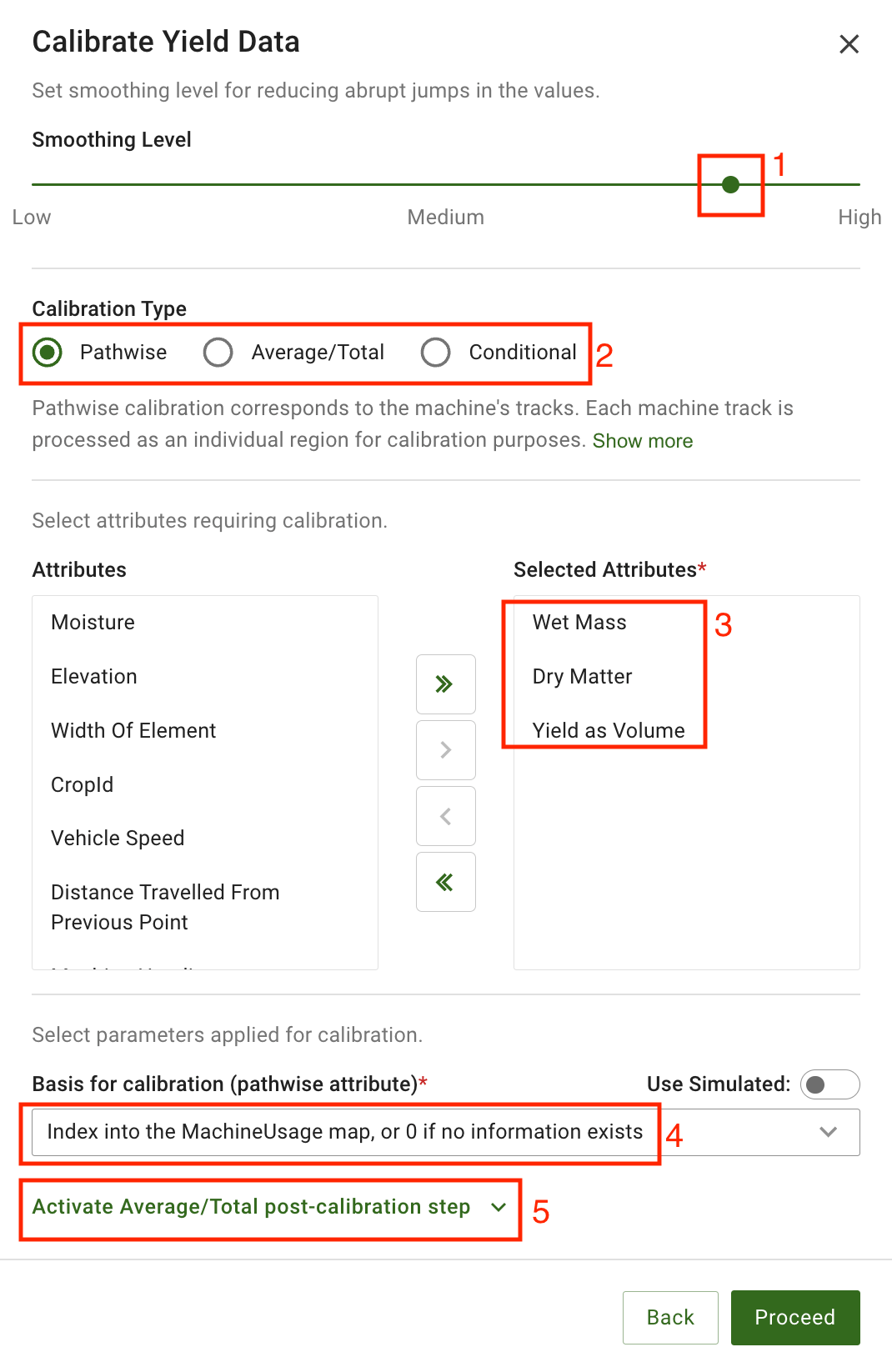
Configure the Calibrate step
Automated methods for cleaning and calibrating

Automated data cleaning techniques can save time and resources, reduce human errors, and enhance the scalability and efficiency of data cleaning. Some of the common automated data cleaning techniques for yield data are:

1. Outlier Detection: Outliers are data points that deviate significantly from the norm. Automated algorithms can identify these anomalies by comparing data points to statistical measures such as mean, median, and standard deviation.

For example, if a yield dataset shows an exceptionally high harvest yield for a particular field, an outlier detection algorithm can flag it for further investigation.

2. Noise Reduction: Noise in yield data can arise from various sources, including environmental factors and sensor inaccuracies.

Automated noise reduction techniques, such as smoothing algorithms, filter out erratic fluctuations, making the data more stable and reliable. This helps in identifying true trends and patterns in the data.

3. Data Imputation: Missing data is a common issue in yield data sets. Data imputation techniques automatically estimate and fill in missing values based on patterns and relationships within the data.

For instance, if a sensor fails to record data for a specific time period, imputation methods can estimate the missing values based on adjacent data points.

Hence, automated data cleaning techniques serve as the gatekeepers of data quality, ensuring that yield datasets remain a reliable and valuable asset for farmers worldwide.

Furthermore, there are lots of handy tools and computer programs that can automatically clean and adjust yield data, and GeoPard is one of them. The GeoPard Yield Clean-Calibration Module, along with similar solutions, is super important for making sure the data is accurate and reliable.

GeoPard - Yield Cleaning & Calibration - 3 harvesters

Slutsats

Automated Yield Data Cleaning and Calibration (AYDCC) is essential in precision agriculture. It ensures the accuracy of crop data by removing errors and enhancing quality, enabling farmers to make informed decisions. AYDCC addresses data challenges and utilizes automated techniques for trustworthy results. Tools like GeoPard’s Yield Clean-Calibration Module simplify this process for farmers, contributing to efficient and productive farming practices.

Tillämpningar av (GIS) Geoinformatik inom jordbruket

Geoinformatics (GIS) bridges the gap between spatial data and agriculture decision-making, allowing farmers to optimize resource utilization while minimizing environmental impact. This technology-driven approach helps tailor precision agriculture practices to specific field conditions, thus increasing productivity and efficiency.

Geoinformatics in Agriculture

By analyzing precise spatial information, such as soil variability, moisture content, and pest distribution, farmers can make well-informed choices, ensuring that each area of their land receives the exact treatment it requires.

Recent data shows that this technology is widely used, with over 70% of farms using it in some capacity. Geospatial data integration is becoming a standard practice in decision-making processes across a range of industries, from small-scale subsistence farming to major commercial operations.

Farmers are able to keep an eye on their crops in real time using satellite photography and ground sensors. With less waste and a smaller negative influence on the environment, they may use this to apply water, fertilizer, and pesticides precisely where and when they are needed.

The CottonMap project in Australia uses geoinformatics to monitor water use, resulting in a 40% decrease in water consumption. Enhanced resource management minimizes environmental impact by reducing chemical runoff and over-irrigation.

geoinformatics in agriculture

Increased productivity aids global food security. By optimizing planting patterns using spatial data, farmers can achieve higher crop yields without expanding agricultural land.

What is Geoinformatics?

Geoinformatics, also known as geographic information science (GIScience), is a multidisciplinary field that combines elements of geography, cartography, remote sensing, computer science, and information technology to gather, analyze, interpret, and visualize geographical and spatial data.

It focuses on capturing, storing, managing, analyzing, and presenting spatial information in digital forms, contributing to a better understanding of the Earth’s surface and the relationships between various geographic features. It is a powerful tool that can be used for a variety of purposes, including:

1. Precision agriculture: It can be used to collect data on a variety of factors, such as soil type, crop yield, and pest infestation. This data can then be analyzed to identify areas of variability within a field. Once these areas have been identified, farmers can use GIS to develop customized management plans for each area.

2. Environmental monitoring: It can be used to monitor changes in the environment, such as deforestation, land use change, and water quality. This data can then be used to track the progress of environmental policies and to identify areas that need further protection.

3. Urban planning: Geoinformatics can be used to plan and manage urban areas. This data can be used to identify areas that are in need of development, to plan transportation networks, and to manage infrastructure.

4. Disaster management: It can be used to manage disasters, such as floods, earthquakes, and wildfires. This data can be used to track the progress of a disaster, to identify areas that have been affected, and to coordinate relief efforts.

what is Geoinformatics? Components of Geoinformatics

Components of Geoinformatics

These components work together to provide insights into various aspects of the Earth’s surface and its relationships. Here are the main components of geoinformatics:

  • Geographic Information Systems (GIS): GIS involves the use of software and hardware to collect, store, manipulate, analyze, and visualize geographic data. This data is organized into layers, allowing users to create maps, conduct spatial analysis, and make informed decisions based on spatial relationships.
  • Fjärranalys: Remote sensing involves the collection of information about the Earth’s surface from a distance, typically using satellites, aircraft, or drones. Remote sensing data, often in the form of imagery, can provide insights into land cover, vegetation health, climate patterns, and more.
  • Global Positioning Systems (GPS): GPS technology enables accurate positioning and navigation through a network of satellites. In GIS, GPS is used to collect precise location data, which is crucial for mapping, navigation, and spatial analysis.
  • Spatial Analysis: It enables the application of various spatial analysis techniques to understand patterns, relationships, and trends within geographic data. These techniques include proximity analysis, interpolation, overlay analysis, and network analysis.
  • Cartography: Cartography involves the creation of maps and visual representations of geographic data. It provides tools and methods to design informative and visually appealing maps that effectively communicate spatial information.
  • Geodatabases: Geodatabases are structured databases designed to store and manage geographic data. They provide a framework for organizing spatial data, allowing for efficient storage, retrieval, and analysis.
  • Web Mapping and Geospatial Applications: Geoinformatics has expanded into web-based mapping and applications, allowing users to access and interact with geographic data through online platforms. This has led to the development of various location-based services and tools.
  • Geospatial Modeling: Geospatial modeling involves the creation of computational models to simulate real-world geographic processes. These models help predict outcomes, simulate scenarios, and aid decision-making in various fields.

8 Applications and Uses of Geoinformatics in Agriculture

Here are some of the key applications and uses of GIS in agriculture:

1. Precision Farming

Precision Agriculture harnesses the power of Geographic Information Systems (GIS) to provide farmers with intricate insights into their fields. These insights range from detailed vegetation and productivity maps to crop-specific information.

The heart of this approach lies in data-driven decision-making, empowering farmers to optimize their practices for maximum yield and efficiency.

Uses of Geoinformatics in Agriculture

Through the generation of productivity maps, GeoPard Crop Monitoring provides a crucial solution for Precision Agriculture. These maps make use of historical information from prior years, enabling farmers to identify productivity patterns throughout their farms. Farmers can identify fruitful and unproductive locations by using these information.

2. Crop Health Monitoring

The significance of monitoring crop health cannot be overstated. The well-being of crops directly impacts yields, resource management, and the overall health of the agricultural ecosystem.

Traditionally, manual inspection of crops across expansive fields was arduous and time-consuming. However, with the advent of advanced technologies like GIS and remote sensing, a transformative shift has occurred, enabling precision monitoring on an unprecedented scale.

Geoinformatics aids in the early detection of potential issues affecting crop health. By analyzing remote sensing data and satellite imagery, farmers can identify stressors like nutrient deficiencies or disease outbreaks, allowing for targeted interventions.

3. Crop Yield Prediction

By integrating historical data, soil composition, weather patterns, and other variables, It enables farmers to predict crop yields with remarkable accuracy. This information empowers them to make informed decisions regarding planting, resource allocation, and marketing strategies.

zoner 2019 avkastningsdatakarta

In the field of predicting crop yields, GeoPard has become a leading innovator. GeoPard has developed a trustworthy method that claims an excellent accuracy rate of over 90% by combining historical and current crop data obtained from satellites. This innovative approach is proof of how technology may revolutionize contemporary agriculture.

4. Livestock Monitoring With Geoinformatics

Spatial data from GPS trackers on livestock offers insights into animal movements and behavior. These tools empower farmers to pinpoint the exact location of livestock within the farm, ensuring efficient management and care.

Beyond location tracking, GIS agriculture tools provide a comprehensive view of livestock health, growth patterns, fertility cycles, and nutritional requirements.

The global market for precision agriculture, which includes livestock monitoring, is projected to reach a substantial valuation by the coming years. This trend underscores the transformative potential of GIS in optimizing livestock management.

5. Insect and Pest Control

Traditional methods, such as manual scouting of large fields, have proven both time-consuming and inefficient. However, the convergence of technology, specifically deep learning algorithms and satellite data, has brought about a revolution in pest detection and management.

Geoinformatics helps in creating pest distribution maps, enabling precise application of pesticides. By targeting specific areas, farmers can minimize chemical usage, reduce environmental impact, and protect beneficial insects.

GeoPard Crop Monitoring is an effective method for spotting a variety of threats, such as weed infestations and crop diseases. Potential issue regions are detected by the study of field-collected vegetation indices.

For example, a low vegetation index value in a particular location may be a sign of potential pests or diseases. This realization simplifies the procedure and eliminates the need for time-consuming manual reconnaissance of large fields.

6. Irrigation Control

GIS-driven data provides valuable insights into soil moisture levels, helping farmers make informed decisions regarding irrigation scheduling. This ensures water efficiency and prevents overwatering or drought stress.

Vikten av variabel bevattning

GIS technology for agriculture provides a potent toolbox for spotting crops that are under water stress. Farmers can learn more about the water state of their crops by using indices like the Normalized Difference Water Index (NDWI) or the Normalized Difference Moisture Index (NDMI).

The default component of GeoPard Crop Monitoring, the NDMI index, offers a scale from -1 to 1. Water shortages are indicated by negative values around -1, but waterlogging may be indicated by positive values close to 1.

7. Flooding, Erosion, and Drought Control

Flooding, erosion, and drought represent formidable adversaries that can inflict substantial damage on agricultural landscapes. Beyond physical destruction, these challenges disrupt water availability, soil health, and overall crop productivity. Effectively managing these threats is pivotal to ensuring food security, preserving natural resources, and fostering sustainable farming practices.

Geoinformatics aids in assessing landscape vulnerabilities to flooding, erosion, and drought. By analyzing topographical data, rainfall patterns, and soil characteristics, farmers can implement strategies to mitigate these risks.

8. GIS in Farming Automation

Geographic Information Systems (GIS) have transcended their traditional role as mapping tools to emerge as critical enablers in guiding automated machinery. This technology empowers various agricultural equipment, such as tractors and drones, with spatial data and precision navigation systems.

As a result, tasks that range from planting to spraying and harvesting can be executed with unprecedented accuracy and minimal human intervention.

GIS in Farming Automation

Imagine a scenario where a tractor is tasked with planting crops across a vast field. Equipped with a GPS system and GIS technology, the tractor utilizes spatial data to navigate along predetermined routes, ensuring consistent seed placement and optimal spacing. This precision not only enhances crop yield but also minimizes resource wastage.

Role of Geoinformatics in Precision Agriculture

It plays a critical role in precision agriculture by providing farmers with the data and tools they need to make informed decisions about crop management. It can be used to collect data on a variety of factors, such as soil type, crop yield, and pest infestation.

This data can then be analyzed to identify areas of variability within a field. Once these areas have been identified, farmers can use GIS to develop customized management plans for each area.

The use of geoinformatics in precision agriculture is growing rapidly around the world. In the United States, for example, the use of precision agriculture has increased by more than 50% in the past five years. And in China, the use of precision agriculture is expected to grow by more than 20% per year in the coming years.

Studies have revealed that precision application of inputs through Geoinformatics techniques can lead to yield increases of up to 15% while reducing input costs by 10-30%.

Furthermore, a study published in the journal Nature in 2020 found that using GIS to manage water irrigation in a wheat field resulted in a 20% increase in crop yield. Another study, published in the journal Science in 2021, found that using GIS to apply fertilizer more precisely in a corn field resulted in a 15% increase in crop yield.

It can also be used to create maps of crop yield. These maps can be used to identify areas of low yield, which can then be investigated to determine the cause of the problem. Once the cause of the problem has been identified, farmers can take corrective action to improve yields in those areas.

Role of Geoinformatics in Precision Agriculture

For example, farmers can use it to create maps of soil type and fertility. These maps can then be used to target fertilizer applications more precisely, which can help to improve crop yields and reduce the amount of fertilizer that is applied unnecessarily.

In addition to collecting and analyzing data, it can also be used to visualize spatial data. This can be helpful for farmers to see how different factors, such as soil type and crop yield, are distributed across a field. Visualization tools can also be used to help farmers communicate their findings to others, such as crop consultants or government officials.

The real-world applications of geoinformatics in precision agriculture are abundant. For instance, Variable Rate Technology (VRT) employs spatial data to deliver varying amounts of inputs like water, fertilizers, and pesticides across a field.

This approach ensures that crops receive the exact nutrients they need, optimizing growth and yield. In another instance, satellite imagery and drones provide valuable insights into crop health and disease detection, enabling prompt intervention.

GeoPard Crop Monitoring As An Example Of Agriculture GIS Software

It’s crucial to keep in mind that the GIS software used in agriculture can differ depending on its intended use. While some tools indicate soil moisture levels to aid with planting selections, others display crop varieties, yields, and distributions.

Even comparing the economics of logging against forestry can be done with the use of various applications. Each farmer or agriculture manager must therefore discover the ideal GIS solution that provides them with the information they need to make wise decisions on their land.

When it comes to field data, GeoPard’s Crop Monitoring platform has a number of advantages. It offers summaries of vegetation and soil moisture dynamics, historical vegetation and weather data, and precise 14-day weather forecasts.

GeoPard provides automated synchronization of crop monitoring

This platform provides capabilities like scouting to organize activities and exchange real-time information, as well as a field activity log for planning and monitoring operations, so it offers more than just GIS-based data.

Data from additional sources is also included in GeoPard’s Crop Monitoring. The Data Manager tool, for instance, incorporates machine data into the platform. It supports popular file formats as SHP and ISO-XML.

You can measure crop yield using data from field machines, compare it to fertilizer maps, examine fertilizer tactics, and create plans to increase yield. The organizations that agricultural enterprises collaborate with and themselves benefit greatly from this all-in-one platform.

Challenges in Precision Agriculture and Geoinformatics

The integration of Precision Agriculture and Geoinformatics introduces a host of policy implications and regulatory considerations. Governments worldwide grapple with devising frameworks that foster innovation while safeguarding data privacy, land use, and environmental sustainability.

For instance, regulations may govern the collection and sharing of spatial data, intellectual property rights for precision farming technologies, and ethical use of AI in agriculture.

In the European Union, the Common Agricultural Policy (CAP) acknowledges the role of digital technologies, including Geoinformatics, in enhancing agricultural productivity.

Financial incentives are provided to encourage farmers to adopt precision farming practices that align with environmental and sustainability goals. This example illustrates how policy can drive technology adoption for collective benefit.

However, the adoption of geoinformatics technologies in agriculture presents significant benefits, yet it’s accompanied by challenges, particularly for farmers of varying scales. Small-scale farmers often face financial limitations, lacking the resources for technology acquisition and training.

Larger operations encounter data management complexities due to the scale of their activities. Technical knowledge gaps are common, with both small and large farmers requiring training to effectively utilize geoinformatics tools.

Limited infrastructure and connectivity hinder access, especially in remote areas. Customization struggles arise, as solutions may not fit small farms or integrate seamlessly into larger operations.

Cultural resistance to change and concerns over data privacy affect adoption universally. Government policies, ROI uncertainties, and interoperability issues further impede progress.

Addressing these challenges will demand tailored strategies to ensure that geoinformatics benefits all farmers, regardless of scale.

Slutsats

The seamless integration of Geoinformatics into modern agriculture holds transformative potential. By harnessing the power of spatial data, farmers and agricultural stakeholders can make informed decisions, optimize resource utilization, and foster sustainable practices. Whether it’s predicting crop yields, managing water resources, or enhancing precision agriculture, GIS emerges as a guiding light, shaping a more efficient, resilient, and productive future for the world of farming.

LfL använder GeoPard-plattformen för sitt framtida jordbruksprojekt

Jordbruket står idag inför stora utmaningar. Det måste producera högkvalitativa livsmedel och råvaror, men det måste i allt högre grad också ta hänsyn till kraven på skydd av mark, vatten, klimat och biologisk mångfald.

Det bayerska forskningscentret för jordbruk (LfL) har länge forskat om dessa utmaningar och testar nu precisionsjordbruksplattformen GeoPard för sitt projekt Future Crop Farming.

Dmitry Dementiev, VD och medgrundare av GeoPard: “Traditionella metoder för grödoodling möter ofta utmaningar som ineffektiv resurshantering och begränsad tillgång till realtidsdata. Dessa faktorer kan leda till suboptimala skördar, ökade kostnader och miljöbelastning.”

GeoPards plattform ger LfL en centraliserad plattform för att visualisera och analysera kritisk jordbruksdata. Plattformens användarvänliga gränssnitt möjliggör kombinationen av satellitdata och experimentella data från fältförsök, vilket förenklar komplex datatolkning och ger användarna möjlighet att fatta välgrundade beslut som optimerar produktivitet och hållbarhet.

Fältet delades in i sektioner för att visa upp en specifik uppställning för försöket: LfL har implementerat ett system med remsodling, dvs. samtidig odling av flera grödor i parallella remsor på samma fält.

Dessa remsor kan sedan användas separat i ekvationer för insatsvaror (såsom gödselmedel och växtskydd) och avkastningsresultat, vilket möjliggör beräkning av den totala fältmängden.

vinst. Dessutom kan de vinster som genereras av enskilda grödor och de möjliga effekterna vid kanterna mellan remsorna bedömas.

Samarbetet mellan LfL och GeoPard genom projektet Future Crop Farming kan föra analysverktyg för okonventionella fältstrukturer framåt.

Genom att utnyttja GeoPards avancerade plattform kan de komplettera sina forskningsresultat och skapa värdefulla visualiseringar för att kommunicera insikter från projektet till allmänheten.

Med fokus på precisionsodling, produktivitet och miljövård visar det innovativa LfL-projektet potentialen för en mer hållbar framtid inom växtodling.

Dr. Markus Gandorfer, chef för digitalisering och projektledare på LfL: “Det är ett nöje för oss att arbeta med det entusiastiska GeoPard-teamet. Djupare insikter i våra data om odling av remsor, möjliggjorda av GeoPard-verktyget, är mycket värdefulla för oss.”

Om

Bayerns statliga forskningscenter för jordbruk (LfL) Bayerns statliga forskningscenter för jordbruk (LfL) är kunskaps- och servicecentret för jordbruket i Bayern. LfL:s tillämpade forskning tar upp frågor om jordbrukspraxis och tillhandahåller tillämpbara lösningar för jordbruksföretag på olika sätt.

Det tvärvetenskapliga projektet Future Crop Farming ligger i Ruhstorf ad Rott i sydöstra Bayern. Mer information om projektet finns på projektets webbplats: http://www.future-crop-farming.de

GeoPard Jordbruk är en ledande leverantör av programvara för precisionsjordbruk. Företaget grundades 2019 i Köln, Tyskland, och är representerat globalt. Företaget erbjuder en rad lösningar som hjälper jordbrukare att optimera sin verksamhet och öka avkastningen.

Med fokus på hållbarhet och regenerativ ekonomi strävar GeoPard Agriculture efter att främja precisionsodlingsmetoder runt om i världen.

Bland företagets partners finns välkända varumärken som John Deere, Corteva Agriscience, ICL, Pfeifer & Langen, IOWA Soybean Association, Kernel, MHP, SureGrowth och många andra.

Använda GPS-teknik för att optimera odling av täckgrödor

The agricultural industry is experiencing a big change, with the adoption of modern technologies like GPS systems becoming more common.

This is especially noticeable in how farmers grow cover crops. GPS technology is revolutionizing the way they manage their fields, helping them become more efficient and sustainable in their agricultural practices.

Cover crops, sometimes called green manure, are plants grown primarily to improve soil health rather than for harvest. They are usually cultivated during the off-season and provide benefits like controlling weeds, enhancing biodiversity, and boosting soil fertility.

Yet, growing cover crops can be laborious and time-consuming. That’s where GPS technology comes in handy.

Incorporating GPS technology into farming brings numerous advantages. Firstly, it allows precision farming, where farmers can use GPS coordinates to create precise maps of their fields.

This helps them closely monitor crop growth and soil conditions. By relying on data, they can apply fertilizers and pesticides more accurately, reducing waste and minimizing harm to the environment.

Moreover, GPS technology greatly boosts the efficiency of planting cover crops. Conventional methods may lead to uneven distribution of seeds, leaving some areas poorly covered.

With GPS-guided machinery, farmers can ensure even distribution across the entire field, promoting better growth and soil coverage. This not only enhances the effectiveness of the cover crops but also reduces the need for labor and resources.

Additionally, GPS technology enables farmers to implement more effective crop rotation strategies. With precise field mapping and crop growth tracking, they can optimize soil health and productivity through well-planned rotations. This can result in higher yields over time, further improving agricultural efficiency.

Moreover, GPS technology plays a vital role in monitoring and managing pests and diseases. It allows farmers to track the location and spread of these problems, enabling them to take targeted actions for control. As a result, the use of broad-spectrum pesticides can be reduced, promoting a healthier and more sustainable agricultural system.

GPS technology offers benefits beyond just individual farmers when it comes to cover crop cultivation. It has the potential to encourage sustainable and efficient agricultural practices on a global scale.

By reducing waste and making the best use of resources, GPS technology can play a significant role in meeting the rising global food demand in an environmentally friendly manner.

However, using GPS technology in agriculture poses challenges for many farmers, such as expensive upfront costs and a lack of technical know-how. To tackle these hurdles, it is crucial to offer support to farmers.

This can be achieved through financial incentives, training programs, and the development of user-friendly software and equipment, enabling them to make the most of this technology effectively.

In conclusion, using GPS technology in cover crop cultivation has the potential to significantly improve agricultural efficiency. It allows for precise farming, better seeding practices, effective crop rotation, and enhanced pest and disease management. By offering the right support and resources, farmers can take advantage of GPS technology to create a more sustainable and productive agricultural sector.

Automatiserad modell för detektering av fältgränser för precisionsjordbruk av GeoPard

GeoPard har framgångsrikt utvecklat en automatiserad modell för detektering av fältgränser med hjälp av satellitbilder över flera år, noggrann moln- och skuggdetektering och avancerade proprietära algoritmer, inklusive djupa neurala nätverk.

GeoPard-fältdetekteringsmodellen har uppnått en toppmodern noggrannhet på 0,975 på mätvärdet för korsning över förening (IoU), validerad i olika regioner och grödtyper globalt.

Kolla in dessa bilder för att se resultaten i Tyskland (genomsnittlig fältstorlek är 7 hektar):

1 - Rå Sentinel-2-bild

1 – Rå Sentinel-2-bild

3 - Segmenterade fältgränser

2 – Superupplösningsbild av Sentinel-2 från GeoPard (1 meters upplösning)

2 - Superupplösningsbild av Sentinel-2 av GeoPard

3 – Segmenterade fältgränser, 0.975 Noggrannhetsmått för skärningspunkt över koppling (IoU), över flera internationella regioner och grödotyper.


Integrering med vårt API och GeoPard-applikation kommer snart. Denna automatiserade och kostnadseffektiva metod hjälper till att förutsäga avkastning, gynnar myndigheter och hjälper stora markägare som ofta behöver uppdatera fältgränser mellan säsonger.

GeoPards tillvägagångssätt använder fleråriga växtlighetstrender med hjälp av multifaktoranalys och växtföljd.


Modellen är tillgänglig via GeoPard API med betalning per användning, vilket erbjuder flexibilitet utan behov av dyra abonnemang.


Vad är fältgränsavgränsning?

Fältgränser avser processen att identifiera och kartlägga gränserna för jordbruksfält eller jordbruksskiften. Det innebär att man använder olika tekniker och datakällor för att avgränsa enskilda fält eller jordbruksskiften.

Traditionellt avgränsades åkergränser manuellt av jordbrukare eller markägare baserat på deras kunskap och observationer.

Men med tekniska framsteg, särskilt inom fjärranalys och geografiska informationssystem (GIS), har automatiserade och halvautomatiserade metoder blivit allt vanligare.

En vanlig metod är analys av satellit- eller flygbilder. Högupplösta bilder tagna av satelliter eller flygplan kan ge detaljerad information om landskapet, inklusive gränserna mellan olika markområden.

Bildbehandlingsalgoritmer kan tillämpas på dessa bilder för att upptäcka distinkta egenskaper såsom förändringar i vegetationstyp, färg, textur eller mönster som indikerar förekomsten av fältgränser.

En annan teknik innebär att man använder LiDAR-data (Light Detection and Ranging), som använder laserstrålar för att mäta avståndet mellan sensorn och jordens yta.

LiDAR-data kan ge detaljerad höjd- och topografisk information, vilket möjliggör identifiering av subtila variationer i terrängen som kan motsvara fältgränser.

Dessutom spelar geografiska informationssystem (GIS) en avgörande roll i avgränsningen av fältgränser.

GIS-programvara möjliggör integration och analys av olika datalager, inklusive satellitbilder, topografiska kartor, markägarregister och annan relevant information. Genom att kombinera dessa datakällor kan GIS hjälpa till med tolkning och identifiering av fältgränser.

Noggrann avgränsning av fält är avgörande av flera skäl. Det underlättar bättre förvaltning av jordbruksresurser, möjliggör precisionsodling och stöder planering och implementering av jordbruksmetoder som bevattning, gödsling och skadedjursbekämpning.

Noggranna uppgifter om fältgränser hjälper också till vid markförvaltning, markanvändningsplanering och efterlevnad av jordbruksregler.

Hur är det användbart?

Det spelar en avgörande roll inom jordbruk och markförvaltning, och ger flera fördelar och är viktigt, vilket stöds av bevis och globala siffror. Här är några viktiga punkter:

1. Precisionsjordbruk: Noggranna fältgränser hjälper till att implementera precisionsjordbrukstekniker, där resurser som vatten, gödningsmedel och bekämpningsmedel riktas exakt mot specifika områden inom fälten.

Enligt en rapport från Världsbanken har precisionsjordbruksteknik potential att öka skördarna fram till 20% och minska insatskostnaderna med 10–20%.

2. Effektiv resurshantering: Det gör det möjligt för jordbrukare att bättre hantera resurser genom att optimera bevattningssystem, justera gödslingsmetoder och övervaka grödornas hälsa. Denna precision minskar resursslöseri och miljöpåverkan.

FAO uppskattar att precisionsjordbruk kan minska vattenanvändningen med 20–50%, gödselmedelsförbrukningen med 10–20% och bekämpningsmedelsanvändningen med 20–30%.

3. Markanvändningsplanering: Noggranna uppgifter om fältgränser är avgörande för markanvändningsplanering och säkerställer ett effektivt utnyttjande av tillgänglig jordbruksmark. Det gör det möjligt för beslutsfattare och markförvaltare att fatta välgrundade beslut om markallokering, växtföljd och zonindelning.

Detta kan leda till ökad jordbruksproduktivitet och förbättrad livsmedelssäkerhet. En studie publicerad i Journal of Soil and Water Conservation fann att effektiv markanvändningsplanering skulle kunna öka den globala livsmedelsproduktionen med 20–671 TP3T.

4. Jordbruksstöd och försäkring: Många länder erbjuder jordbruksstöd och försäkringsprogram baserade på fältgränser. Noggrann avgränsning hjälper till att fastställa berättigade markarealer, säkerställa rättvis fördelning av subventioner och beräkna försäkringspremier korrekt.

Till exempel förlitar sig Europeiska unionens gemensamma jordbrukspolitik (GJP) på noggranna fältgränser för subventionsberäkningar och efterlevnadsövervakning.

5. Markförvaltning och juridiska gränser: Att avgränsa åkergränser inom jordbruket är avgörande för markförvaltning, äganderätt och lösning av marktvister. Noggranna kartor över åkergränser hjälper till att fastställa lagligt ägande, stödja system för markregistrering och underlätta transparenta marktransaktioner.

Världsbanken uppskattar att endast 301 000 000 av världens befolkning har lagligt dokumenterade rättigheter till sin mark, vilket betonar vikten av tillförlitliga uppgifter om åkergränser för att säkra markäganderätten.

6. Efterlevnad och miljömässig hållbarhet: Noggranna fältgränser hjälper till vid övervakning av efterlevnaden, vilket säkerställer att miljöföreskrifter och hållbara jordbruksmetoder följs.

Det hjälper till att identifiera buffertzoner, skyddade områden och områden som är utsatta för erosion eller vattenföroreningar, vilket gör det möjligt för jordbrukare att vidta lämpliga åtgärder. Efterlevnad av miljöstandarder förbättrar hållbarheten och minskar negativ påverkan på ekosystem.

Enligt FAO kan hållbara jordbruksmetoder minska utsläppen av växthusgaser med upp till 6 miljarder ton årligen.

Dessa punkter illustrerar dess användbarhet och betydelse inom jordbruk och markförvaltning. De bevis och globala siffror som presenteras stöder de positiva effekter det kan ha på resurseffektivitet, markanvändningsplanering, rättsliga ramar, miljömässig hållbarhet och den övergripande jordbruksproduktiviteten.

Sammanfattningsvis är avgränsning av fältgränser inom jordbruket processen att identifiera och kartlägga gränserna för jordbruksfält eller markområden. Den förlitar sig på olika tekniker som satellitbildsanalys, LiDAR-data och GIS för att korrekt definiera och avgränsa dessa gränser, vilket möjliggör effektiv markförvaltning och jordbruksmetoder.

Planetbilder (dagligen, 3 m upplösning) för skapande av förvaltningszoner

Åtkomst till planetbilder blev enklare, snabbare och billigare med GeoPard Agriculture. Sedan augusti 2022 har GeoPard släppt funktionerna för att söka och analysera endast begärda planetbilder från användarens önskade datumintervall.

Så en GeoPard-användare begär endast föredragna planetbilder och kan använda dem i GeoPards analysverktygslåda.

Planetbilder förlängs Sentinel och Landsat täckningar (tillhandahålls som standard) och kan blandas med andra datalager (datauppsättningar för skörde-/sprutnings-/såmaskiner, topografiprofil) via befintliga Flerskiktad, Flerårig, och Ekvationsverktyg


Planetbilder för skapande av förvaltningszoner


Planet är det största nätverket för jordobservationssatelliter som levererar en nästan daglig global datamängd och möjliggör högupplösta och högfrekventa satellitbilddata.

Förvaltningszoner baserade på Planet Scope-bilder (3,5 m upplösning).

Läs mer om GeoPard / Planet Partnership.

Vad är planetbilder och dess användning för att skapa förvaltningszoner?

Det hänvisar till satellitbilder från Planet Labs, ett privat företag som driver en flotta av små satelliter som kallas Doves. Dessa satelliter tar högupplösta bilder av jordens yta dagligen. Termen "3 m upplösning" betyder att varje pixel i bilden representerar ett 3×3 meter stort område på marken. Denna detaljnivå möjliggör detaljerad analys och övervakning av olika egenskaper och förändringar på jordytan.

När det gäller att skapa hanteringszoner kan planetbilder med daglig upplösning på 3 m vara mycket fördelaktiga för olika branscher och tillämpningar, såsom:

  • LantbrukHögupplösta bilder kan hjälpa till att skapa skötselzoner inom jordbruket, där olika områden på ett fält kan kräva olika behandlingar, som bevattning, gödsling eller skadedjursbekämpning. Genom att analysera bilderna kan jordbrukare identifiera mönster relaterade till grödors hälsa, markfuktighet och andra faktorer, vilket gör det möjligt för dem att fatta bättre beslut om resursallokering.
  • Miljöledning: Satellitbilder kan användas för att identifiera och övervaka miljökänsliga områden, såsom våtmarker, skogar och djurlivsmiljöer. Denna information kan användas för att skapa förvaltningszoner som skyddar dessa områden och säkerställer hållbara markanvändningsmetoder.
  • Stadsplanering: Högupplösta bilder kan hjälpa stadsplanerare att identifiera tillväxtområden, markanvändningsmönster och infrastrukturutveckling. Denna information kan användas för att skapa förvaltningszoner som styr framtida utveckling och säkerställer effektiv resursanvändning.
  • Katastrofhantering: Satellitbilder kan hjälpa till att identifiera och övervaka katastrofbenägna områden, såsom översvämningsslätter eller områden med skogsbränder. Förvaltningszoner kan skapas för att etablera evakueringsvägar, fördela resurser för katastrofinsatser och informera markanvändningspolicyer som minimerar risken för framtida katastrofer.
  • Naturresursförvaltning: Högupplösta bilder kan hjälpa till att övervaka och hantera resurser som vatten, mineraler och skogar. Genom att identifiera områden med högt resursvärde eller knapphet kan förvaltningszoner skapas för att säkerställa hållbar användning och bevarande av dessa resurser.

Sammanfattningsvis är planetbilder med daglig 3 m upplösning ett värdefullt verktyg för att skapa förvaltningszoner inom olika områden, och ger aktuell och detaljerad information som kan hjälpa beslutsfattare att optimera resursallokering och säkerställa hållbara markanvändningsmetoder.


Vanliga frågor och svar


1. Vad kan användningen av bildspråk bidra till att fastställa?

Användning av bilder kan bidra till att etablera ett mer effektivt jordbrukssystem. Genom att använda teknik som drönare eller satellitbilder kan bilder ge värdefulla insikter i grödors hälsa, markförhållanden och bevattningsbehov.

Det hjälper till att identifiera problemområden, såsom skadedjursangrepp eller näringsbrist, vilket gör det möjligt för jordbrukare att vidta riktade åtgärder. Dessutom hjälper bilder till att övervaka grödors tillväxt och utveckling, vilket möjliggör exakt beslutsfattande och maximerar avkastningen. 

Ekvationsbaserad analys inom precisionsjordbruk

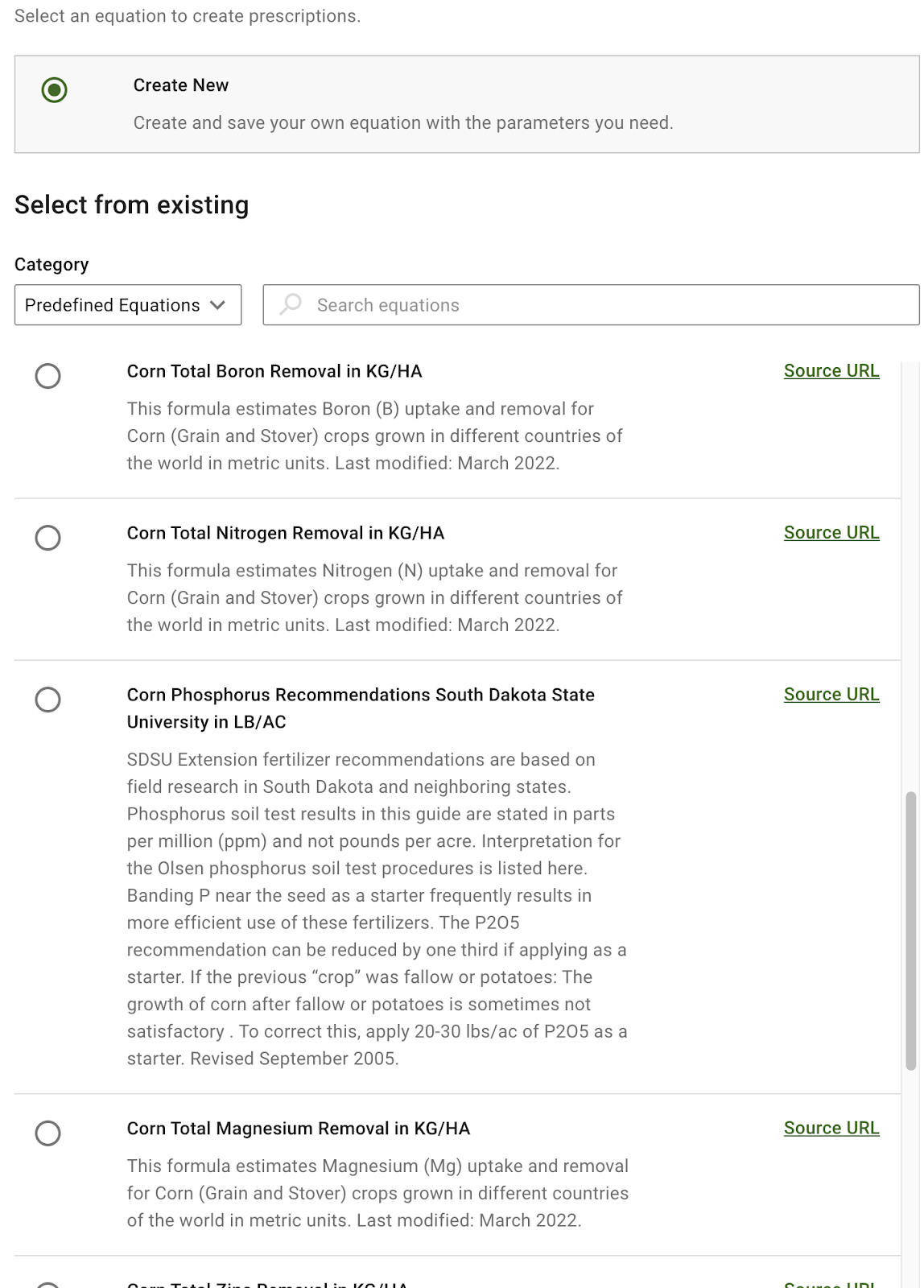
Med lanseringen av den ekvationsbaserade analysmodulen har GeoPard-teamet tagit ett stort steg framåt när det gäller att ge jordbrukare, agronomer och spatial dataanalytiker användbara insikter för varje kvadratmeter. Modulen innehåller en katalog med över 50 fördefinierade GeoPard-precisionsformler som täcker ett brett spektrum av jordbruksrelaterad analys.

Precisionsformlerna har utvecklats baserat på flerårig oberoende agronomisk universitets- och industriforskning och har testats noggrant för att säkerställa deras noggrannhet och användbarhet. De kan enkelt konfigureras för att vara körs automatiskt för alla fält, vilket ger användarna kraftfulla och tillförlitliga insikter som kan hjälpa dem att optimera sina grödor och minska insatskostnaderna.

Den ekvationsbaserade analysmodulen är en kärnfunktion i GeoPard-plattformen och ger användarna ett kraftfullt verktyg för att få en djupare förståelse av sin verksamhet och fatta datadrivna beslut om sina jordbruksmetoder. Med den ständigt växande katalogen av formler och möjligheten att anpassa formler för olika fältscenarier kan GeoPard möta de specifika behoven hos alla jordbruksverksamheter.


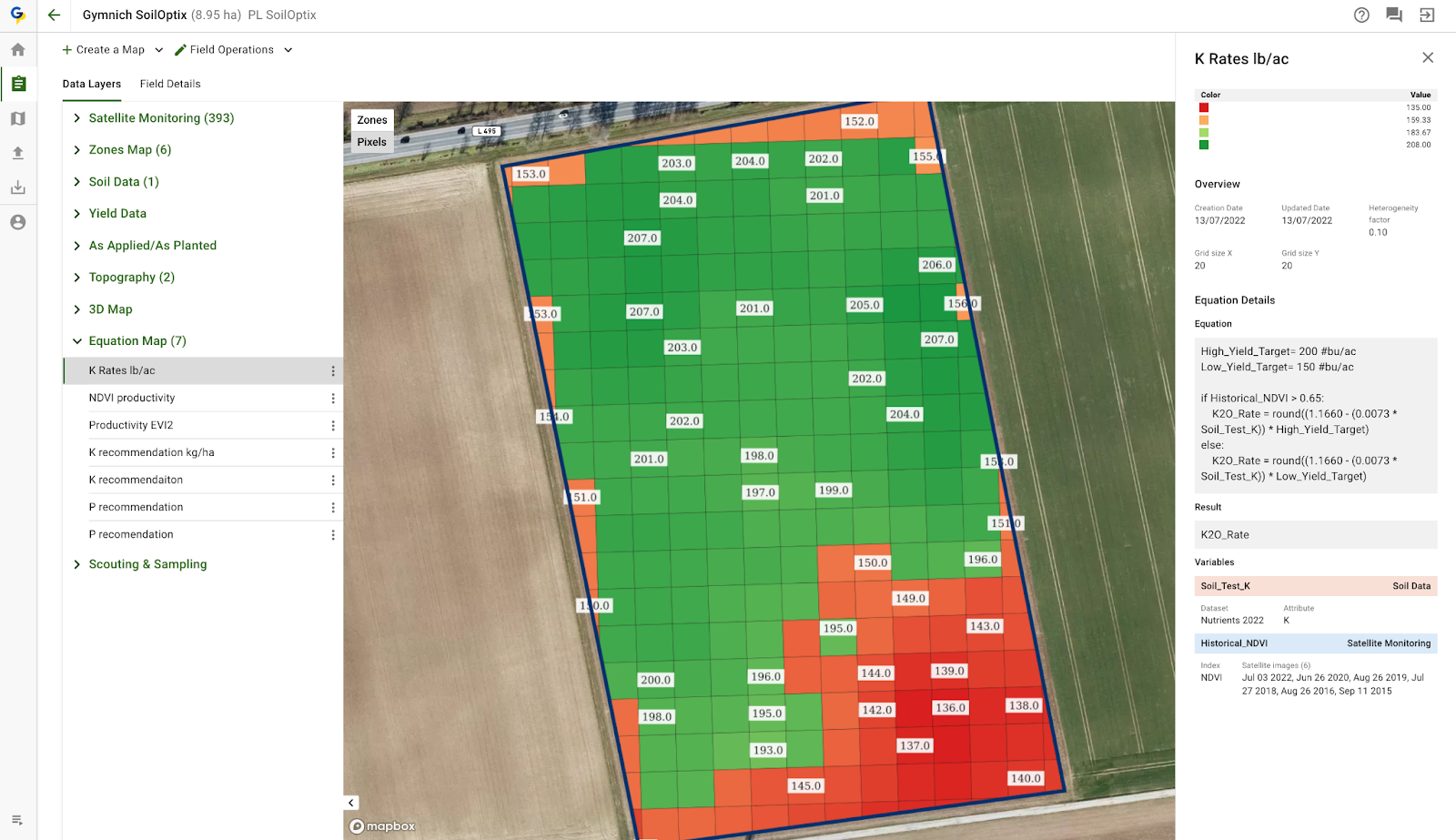
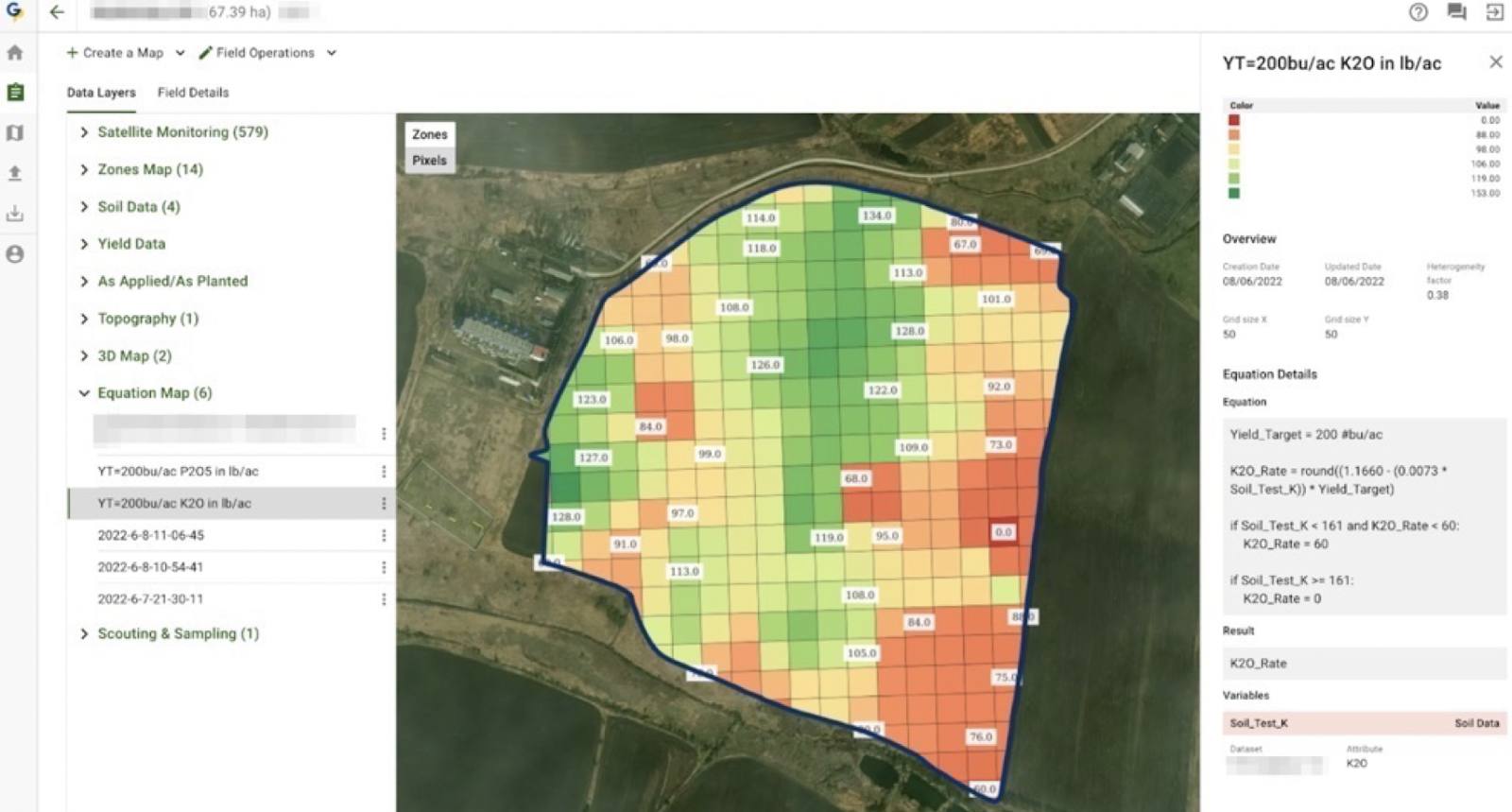
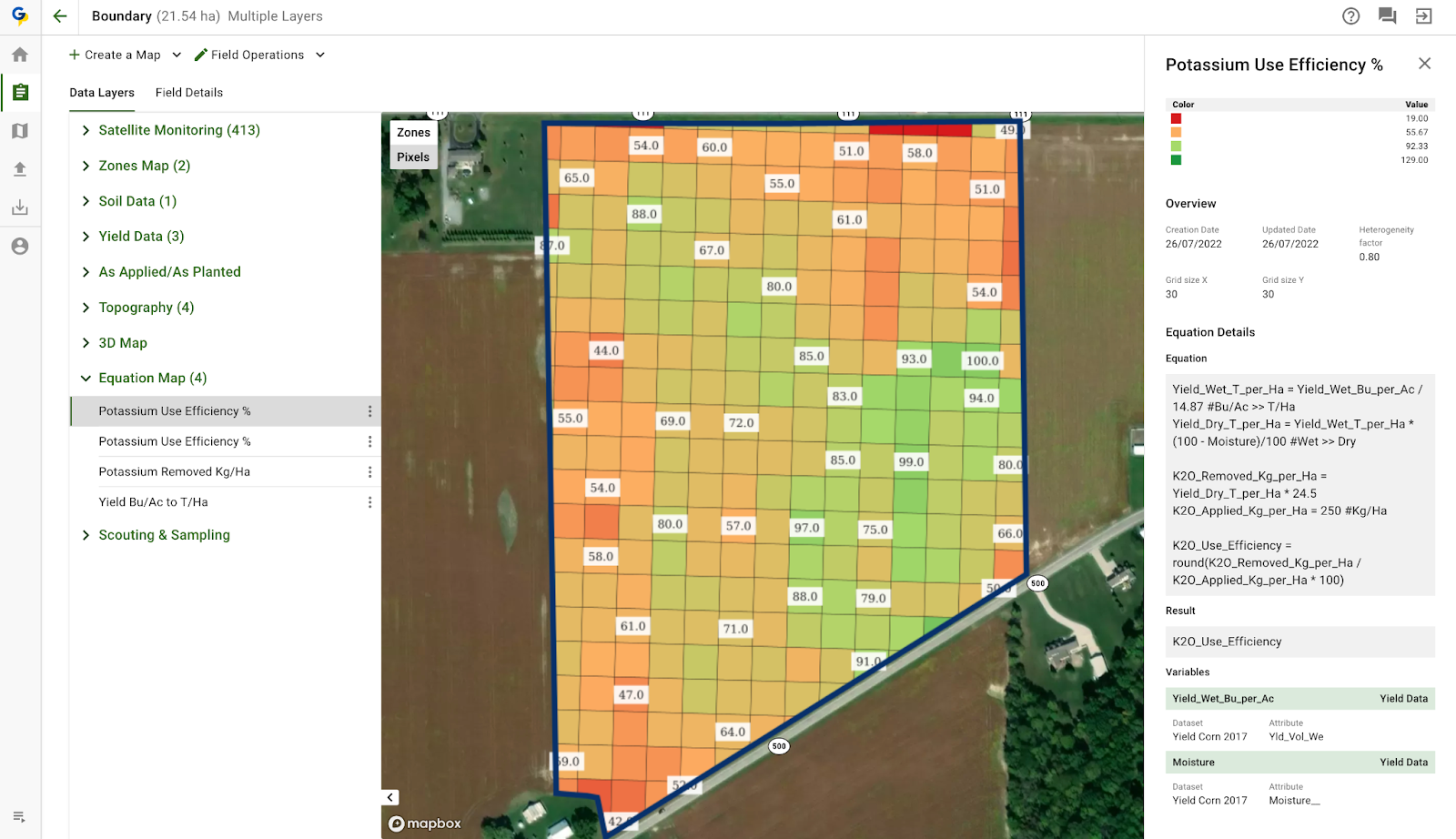
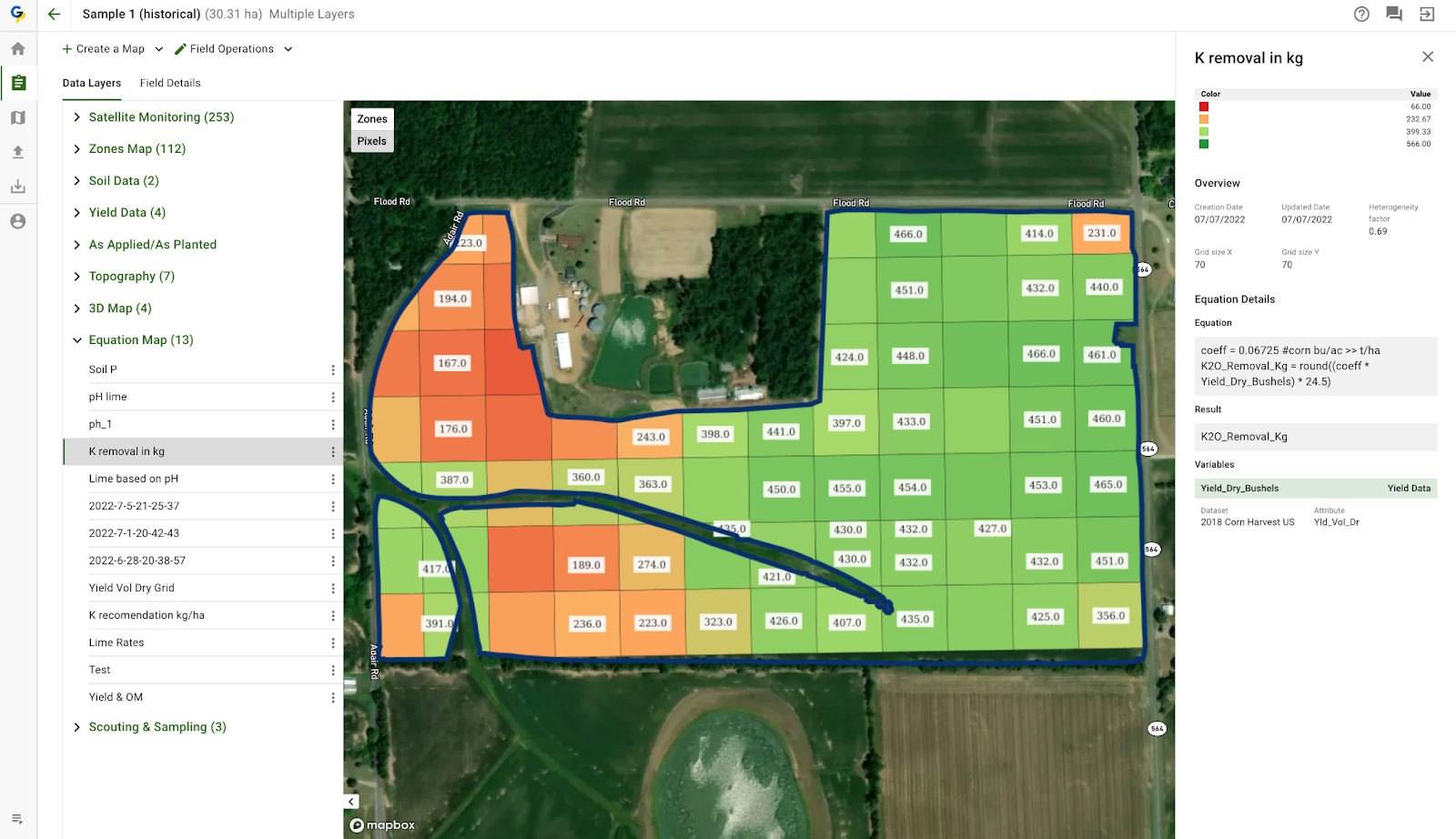
Kaliumborttagning baserat på utbytesdata

Kaliumborttagning baserat på utbytesdata


Användningsfall (se exempel nedan):

  • Kväveupptag i absoluta tal med hjälp av avkastnings- och proteindata
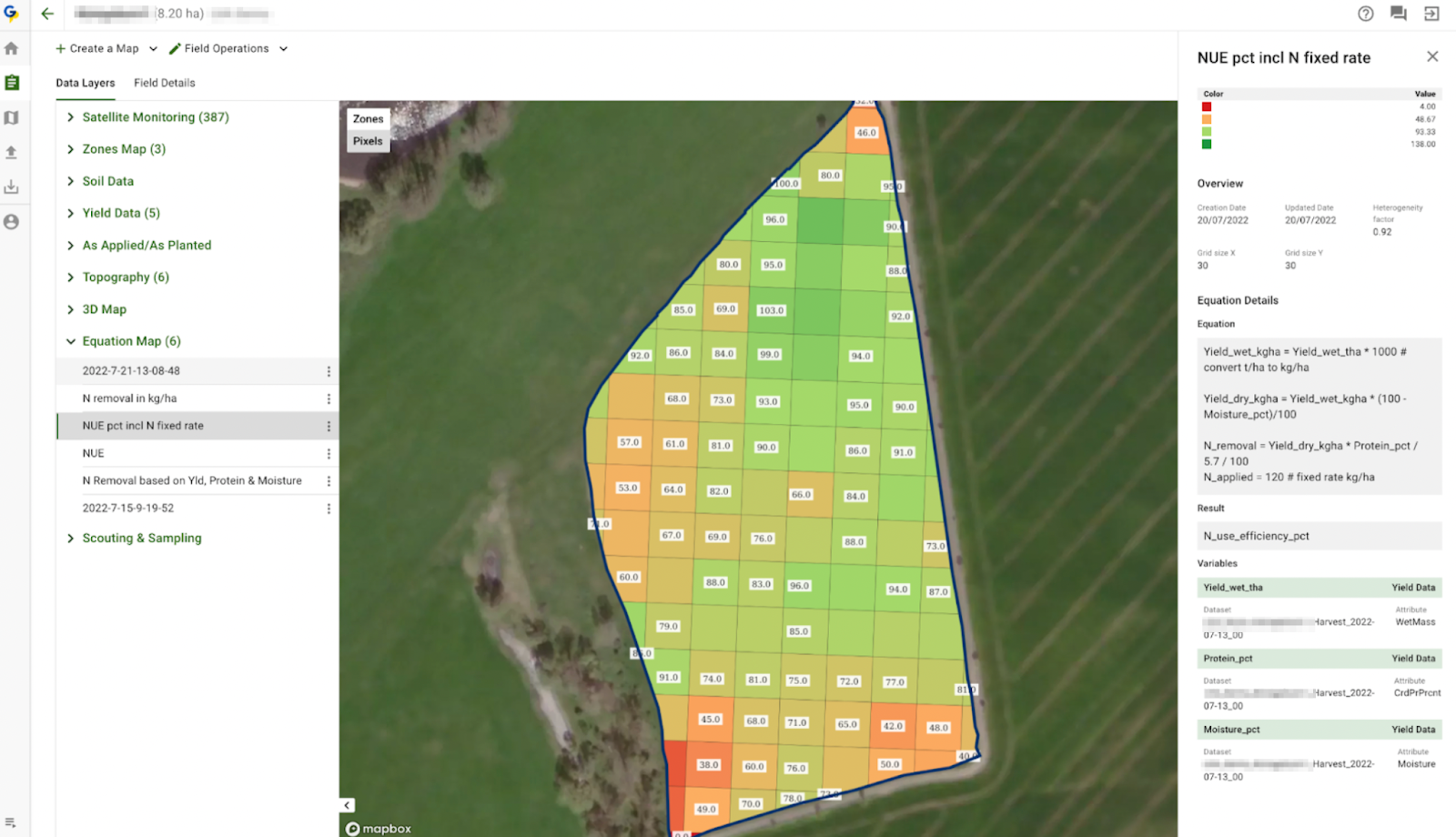
  • Kväveanvändningseffektivitet (NUE) och överskottsberäkningar med datalager för avkastning och protein
  • Kalkrekommendationer baserade på pH-data från jordprovtagning eller jordskannrar
  • Delfält (zoner eller pixelnivå) ROI-kartor)
  • Rekommendationer för gödsling med mikro- och makronäringsämnen baserade på jordprovtagning, fältpotential, topografi och avkastningsdata
  • Kolmodellering
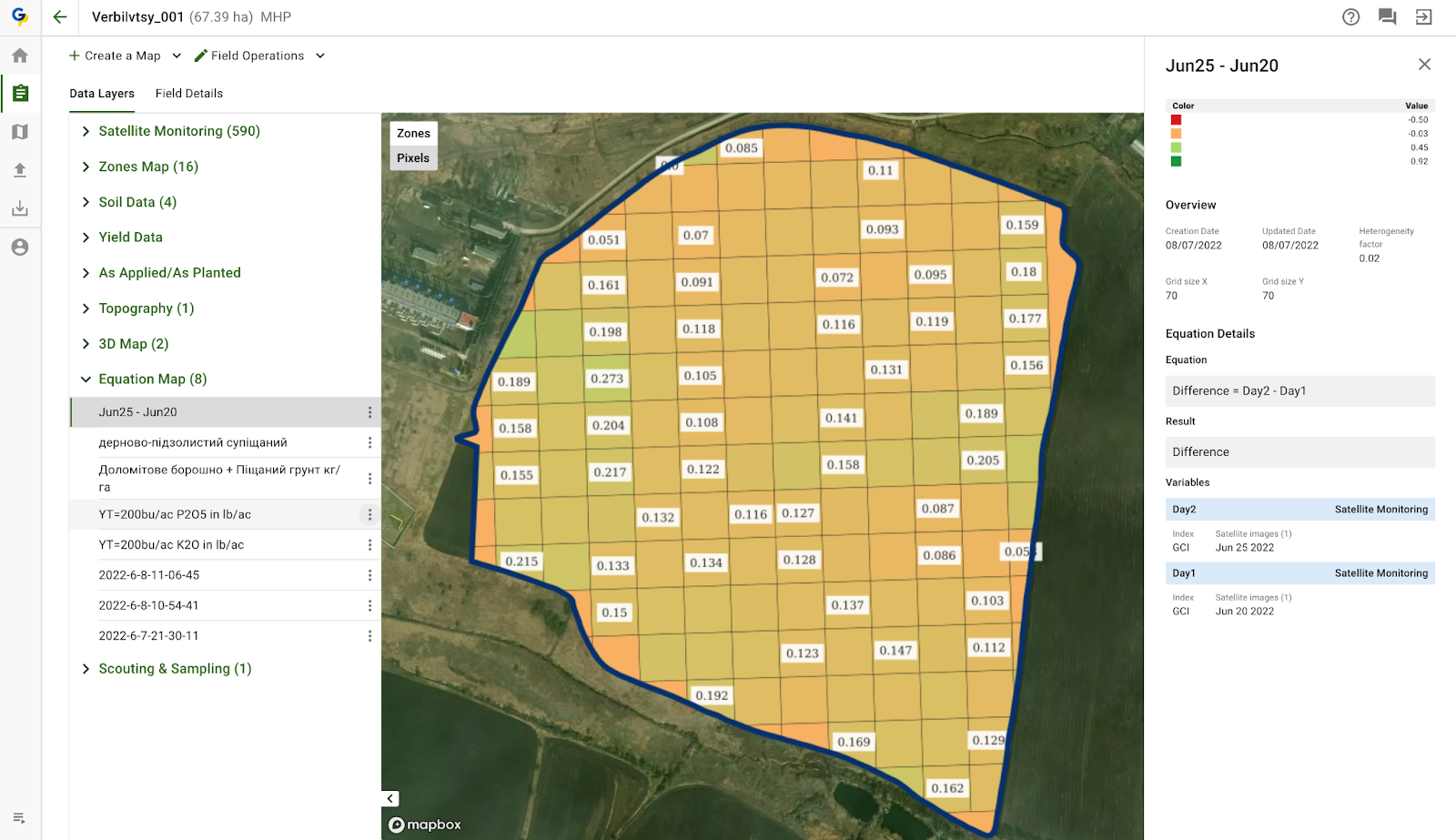
  • Förändringsdetektering och varningar (beräkna skillnaden mellan Sentinel-2, Landsat8-9 eller Planet-bilder)
  • Modellering av jord- och spannmålsfuktighet
  • Beräkning av torrskörde från våtskördedataset
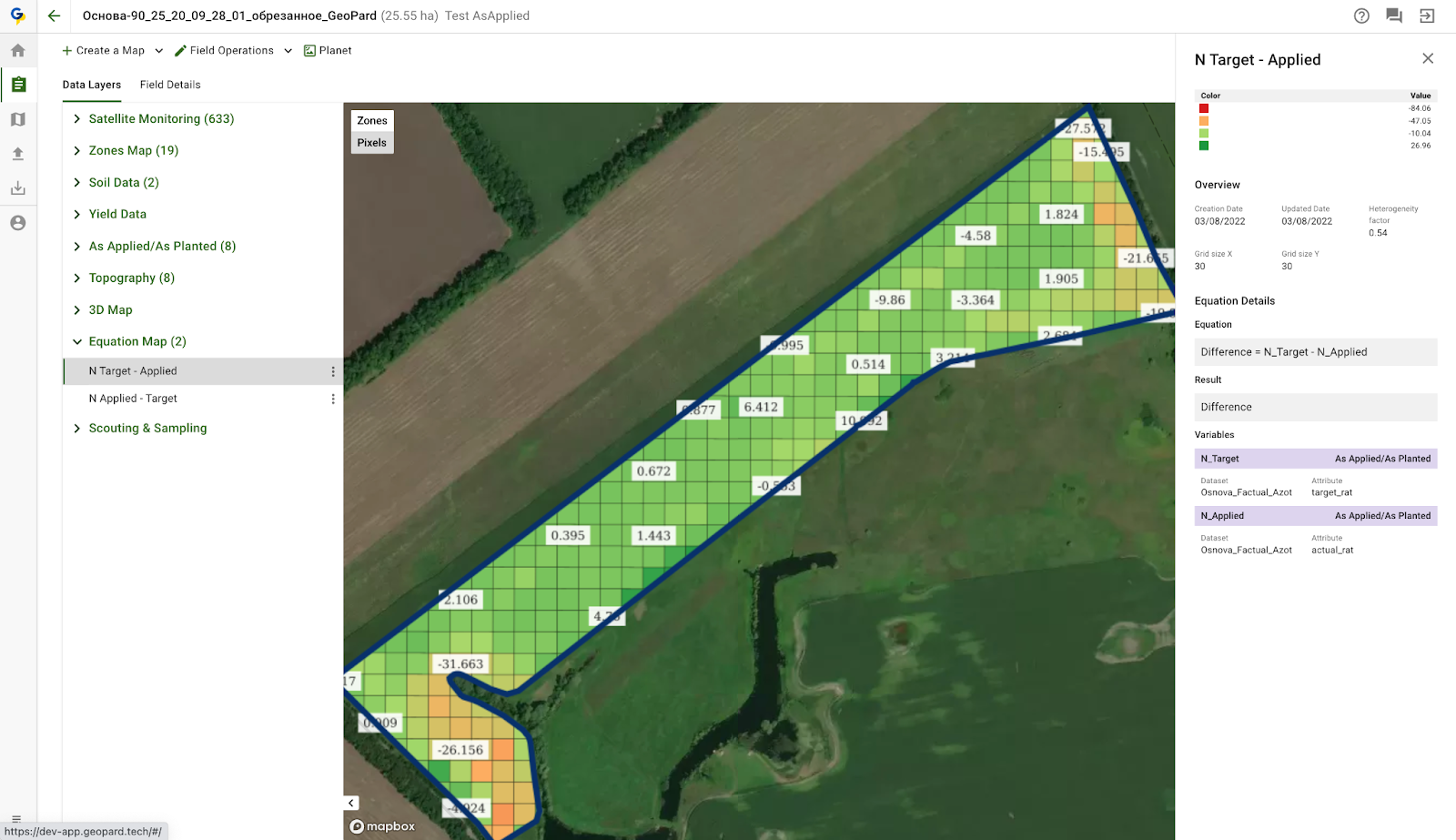
  • Beräkning av skillnaden mellan mål-Rx och applicerade kartor


Kaliumrekommendationer baserade på två avkastningsmål (produktivitetszoner)

Kaliumrekommendationer baserade på två avkastningsmål (produktivitetszoner)


Gödselmedel: Rekommendationsguide. Kalium / Majs.

Gödselmedel: Rekommendationsguide (South Dakota State University): Kalium / Majs. Granskning och revidering: Jason Clark | Assistent professor och SDSU Extension Soil Fertility Specialist


Kaliumanvändningseffektivitet i kg/ha

Kaliumanvändningseffektivitet i kg/ha


Kväveanvändningseffektivitet i procent. Beräkningen baseras på datalager för avkastning, protein och spannmålsfuktighet.

Kväveanvändningseffektivitet i procent. Beräkningen baseras på datalager för avkastning, protein och spannmålsfuktighet.


Kväve: Målrecept kontra applicerat

Kväve: Målrecept kontra applicerat


Skillnaden i klorofyll mellan två satellitbilder

Skillnaden i klorofyll mellan två satellitbilder


En användare av GeoPard kan justera befintliga och skapa sina privata formler baserat på bilder, jordmån, avkastning, topografi eller andra datalager som GeoPard stöder. 

Exempel på mallen GeoPard-ekvationer

Exempel på mallen GeoPard-ekvationer


Formelbaserad analys hjälper jordbrukare, agronomer och dataforskare att automatisera sina arbetsflöden och fatta beslut baserade på flera data och vetenskaplig forskning för att möjliggöra enklare implementering av hållbart och precisionsjordbruk.

Vad är ekvationsbaserad analys inom precisionsjordbruk? Användningen av precisionsformler

Ekvationsbaserad analys inom precisionsjordbruk avser användningen av matematiska modeller, ekvationer, precisionsformler och algoritmer för att analysera jordbruksdata och få insikter som kan hjälpa jordbrukare att fatta bättre beslut om grödhantering.

Dessa analysmetoder innefattar olika faktorer som väderförhållanden, jordmånsegenskaper, grödors tillväxt och näringsbehov för att optimera jordbruksmetoder och förbättra grödors avkastning, samtidigt som resursslöseri och miljöpåverkan minimeras.

Några av de viktigaste komponenterna i ekvationsbaserad analys inom precisionsjordbruk inkluderar:

  • Modeller för grödotillväxt: Dessa modeller beskriver sambandet mellan olika faktorer som väder, jordmånsegenskaper och grödhanteringsmetoder, för att förutsäga grödors tillväxt och avkastning. Exempel på sådana modeller inkluderar CERES (Crop Environment Resource Synthesis) och APSIM (Agricultural Production Systems sIMulator). Dessa modeller kan hjälpa jordbrukare att fatta välgrundade beslut om planteringsdatum, grödsorter och bevattningsplanering.
  • Markvattenmodeller: Dessa modeller uppskattar vattenhalten i jordprofilen baserat på faktorer som nederbörd, avdunstning och grödors vattenanvändning. De kan hjälpa jordbrukare att optimera bevattningsmetoder och säkerställa att vatten appliceras effektivt och vid rätt tidpunkt för att maximera skördarna.
  • Modeller för näringshantering: Dessa modeller förutspår näringsbehovet för grödor och hjälper jordbrukare att bestämma optimala mängder och tidpunkter för gödseltillförsel. Genom att använda dessa modeller kan jordbrukare säkerställa att grödor får rätt mängd näringsämnen, samtidigt som risken för näringsavrinning och miljöföroreningar minimeras.
  • Modeller för skadedjur och sjukdomar: Dessa modeller förutspår sannolikheten för skadedjurs- och sjukdomsutbrott baserat på faktorer som väderförhållanden, grödors tillväxtstadier och skötselmetoder. Genom att använda dessa modeller kan jordbrukare fatta proaktiva beslut om skadedjurs- och sjukdomshantering, såsom att justera planteringsdatum eller applicera bekämpningsmedel vid rätt tidpunkt.
  • Fjärranalysbaserade modeller: Dessa modeller använder satellitbilder och annan fjärranalysdata för att övervaka grödors hälsa, upptäcka stressfaktorer och uppskatta avkastning. Genom att integrera denna information med andra datakällor kan jordbrukare fatta bättre beslut om grödhantering och optimera resursanvändningen.

Sammanfattningsvis använder ekvationsbaserad analys inom precisionsjordbruk matematiska modeller och algoritmer för att analysera komplexa interaktioner mellan olika faktorer som påverkar grödors tillväxt och skötsel. Genom att utnyttja denna analys kan jordbrukare fatta datadrivna beslut för att optimera jordbruksmetoder, förbättra grödornas avkastning och minimera miljöpåverkan.


Vanliga frågor och svar


1. Hur kan precisionsjordbruk bidra till att hantera problem med resursanvändning och föroreningar inom jordbruket?

Det kan bidra till att hantera problem med resursanvändning och föroreningar inom jordbruket genom riktad resursanvändning, effektiv resurshantering, förbättrad övervakning och införande av bevarandemetoder. Genom att endast använda insatsvaror som gödningsmedel och bekämpningsmedel där det behövs kan jordbrukare minska avfall och minimera föroreningar.

Datadrivet beslutsfattande möjliggör optimal resurshantering, medan realtidsövervakning möjliggör snabba insatser för att förhindra föroreningsincidenter. Dessutom främjar implementeringen av bevarandemetoder hållbart jordbruk och minskar miljöpåverkan.

GeoPard integration with UP42

GeoPard and UP42 are proud to announce technical partnership between the platforms.


GeoPard analytical blocks are now available at the UP42 GIS marketplace and include the following capabilities:

  • Integrated satellite constellations: Pleiades, Pleiades NEO, SPOT
  • Supported vegetation indices: NDVI, EVI, SAVI, NDWI
  • The output in COG format (Cloud Optimized GeoTIFF)


The integration will allow Up42 clients to get access to the advanced crop (without limitation to only crops) monitoring using GeoPard satellite imagery processing algorithms.

GeoPard analytical block is used to calculate NDWI on top of 30cm resolution Pleiades NEO.


Dmitry Dementiev, GeoPard’s CEO: “Technical partnership with UP42 allows UP42 clients to use novel GeoPard’s geospatial analytics, including the processing of satellite images at high scale and unpreceded speed for such huge datasets. The analytical derivatives could be used for prescriptive precision agriculture, regenerative/ carbon farming, and high temporal and spatial crop monitoring.
It also indicates the ambition of GeoPard to be integrated with the most advanced technology platforms in the world .”


Earlier GeoPard team announced integration with JohnDeere (the biggest producer of agricultural machinery and equipment) via MyJohnDeere Operation center platform (the biggest by acres digital ag platform in the world), and Planet – a satellite imagery company with the biggest amount of satellites.


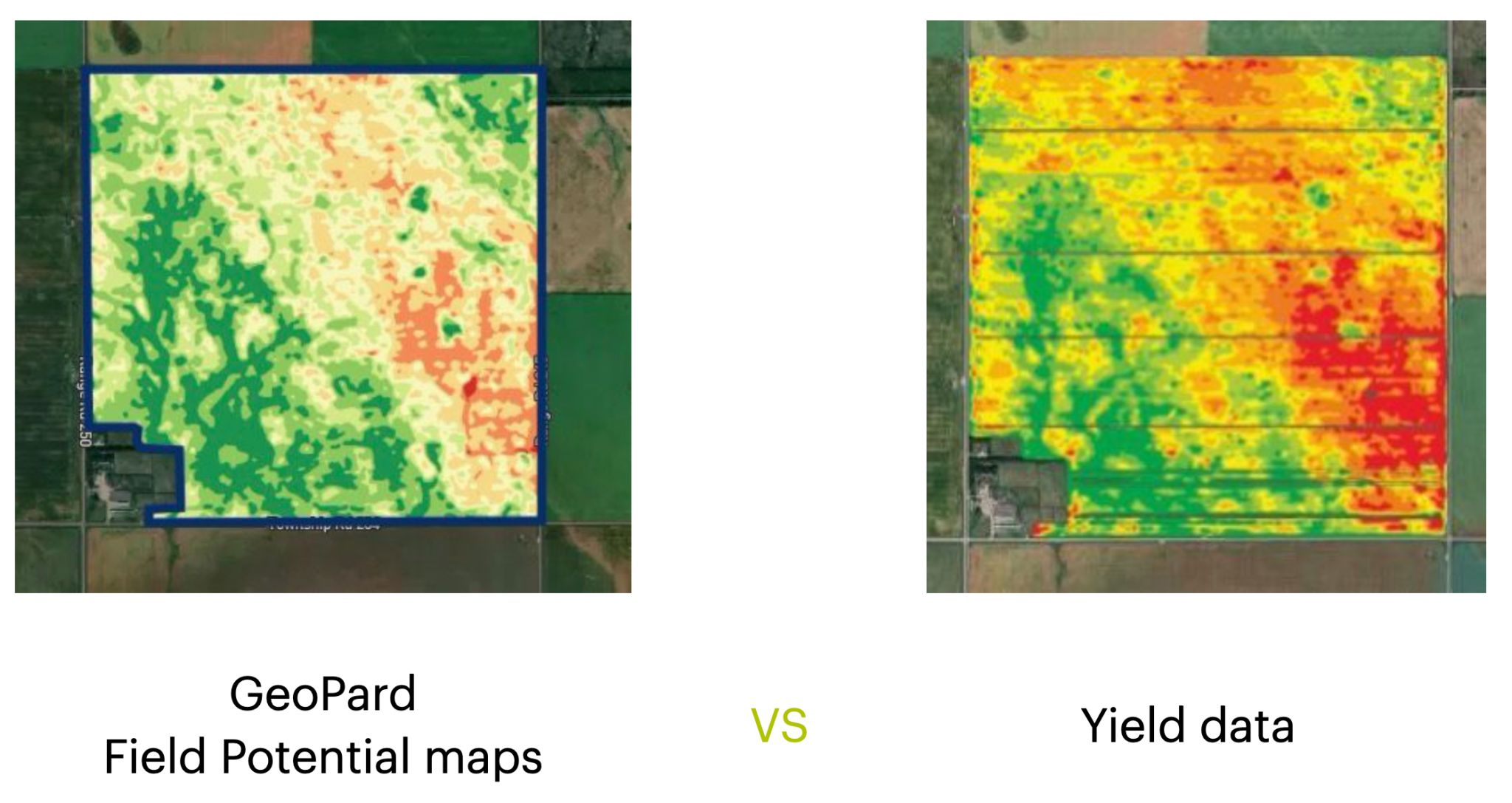
GeoPard-fältpotentialkartor kontra avkastningsdata

GeoPard-fältpotentialkartor ser ofta ut precis som avkastning data.

Vi skapar dem med hjälp av flerskiktsanalys av historisk information, topografi och barmarksanalys.

Processen för sådan syntetiska avkastningskartor är automatiserade (och patenterad) och det tar ungefär 1 minut för vilket fält som helst i världen att generera den.


GeoPard-fältpotentialkartor kontra avkastningsdata

Kan användas som grund för:

Vad är fältpotentialkartor?

Kartor över fältpotential, även kända som kartor över avkastningspotential eller produktivitetspotential, är visuella representationer av den rumsliga variationen i potentiell grödavkastning eller produktivitet inom ett fält. Dessa kartor skapas genom att analysera olika faktorer som påverkar grödornas tillväxt, såsom jordmånsegenskaper, topografi och historiska avkastningsdata.

Dessa kartor kan användas inom precisionsjordbruk för att vägleda förvaltningsbeslut, såsom variabel dosering av gödningsmedel, bevattning och andra insatsvaror, samt för att identifiera områden som kräver särskild uppmärksamhet eller förvaltningsmetoder.

Några viktiga faktorer som vanligtvis beaktas vid skapandet av fältpotentialkartor inkluderar:

  1. Jordens egenskaper: Jordens egenskaper som textur, struktur, innehåll av organiskt material och näringstillgång spelar en viktig roll för att bestämma grödans avkastningspotential. Genom att kartlägga jordegenskaper över ett fält kan jordbrukare identifiera områden med hög eller låg produktivitetspotential.
  2. TopografiFaktorer som höjd, lutning och läge kan påverka grödors tillväxt och avkastningspotential. Till exempel kan låglänta områden vara benägna att bli vattenmättade eller ha högre risk för frost, medan branta sluttningar kan vara mer mottagliga för erosion. Kartläggning av dessa topografiska särdrag kan hjälpa jordbrukare att förstå hur de påverkar produktivitetspotentialen och anpassa sina förvaltningsmetoder därefter.
  3. Historiska avkastningsdata: Genom att analysera historiska avkastningsdata från tidigare år eller säsonger kan jordbrukare identifiera trender och mönster i produktiviteten över sina fält. Denna information kan användas för att skapa kartor som markerar områden med genomgående hög eller låg avkastningspotential.
  4. Fjärranalysdata: Satellitbilder, flygfotografering och annan fjärranalysdata kan användas för att bedöma grödors hälsa, tillväxtkraft och tillväxtstadium. Denna information kan användas för att skapa kartor som återspeglar den rumsliga variationen i grödors produktivitetspotential.
  5. Klimatdata: Klimatvariabler som temperatur, nederbörd och solstrålning kan också påverka grödors tillväxt och avkastningspotential. Genom att införliva klimatdata i dessa kartor kan jordbrukare bättre förstå hur miljöfaktorer påverkar produktivitetspotentialen på deras åkrar.

De är värdefulla verktyg inom precisionsjordbruk, eftersom de hjälper jordbrukare att visualisera den rumsliga variationen i produktivitetspotential inom sina fält. Genom att använda dessa kartor för att vägleda förvaltningsbeslut kan jordbrukare optimera resursanvändningen, förbättra den totala skörden och minska miljöpåverkan från sin jordbruksverksamhet.

Skillnaden mellan fältpotentialkartor och avkastningsdata

Kartor över fältpotential och avkastningsdata används båda inom precisionsjordbruk för att hjälpa jordbrukare att förstå den rumsliga variationen i sina fält och fatta bättre underbyggda beslut om förvaltning. Det finns dock några viktiga skillnader mellan de två:

Datakällor:

Dessa kartor skapas genom att integrera data från olika källor, såsom markegenskaper, topografi, historiska avkastningsdata, fjärranalysdata och klimatdata. Dessa data samlas dock in med hjälp av avkastningsmonitorer installerade på skördeutrustning, som registrerar skörden allt eftersom den skördas.

Temporal aspekt:

Dessa kartor representerar en uppskattning av ett fälts potentiella produktivitet, vilken i allmänhet är statisk eller förändras långsamt över tid, med undantag för betydande förändringar i markegenskaper eller andra påverkande faktorer. Avkastningsdata är dock specifika för en viss växtsäsong eller flera säsonger och kan variera avsevärt från år till år baserat på faktorer som väderförhållanden, skadedjurstryck och skötselmetoder.

Sammanfattningsvis är kartor över fältpotential och avkastningsdata kompletterande verktyg inom precisionsjordbruk. Dessa kartor ger en uppskattning av ett fälts potentiella produktivitet, vilket hjälper jordbrukare att identifiera områden som kan kräva andra skötselmetoder. Avkastningsdata, å andra sidan, dokumenterar den faktiska skörden och kan användas för att bedöma effektiviteten av skötselmetoder och informera framtida beslutsfattande.

wpChatIkon
wpChatIkon

    Begär gratis GeoPard demo / konsultation


    Genom att klicka på knappen godkänner du våra Integritetspolicy. Vi behöver den för att kunna svara på din begäran.

      Prenumerera


      Genom att klicka på knappen godkänner du våra Integritetspolicy

        Skicka oss information


        Genom att klicka på knappen godkänner du våra Integritetspolicy