
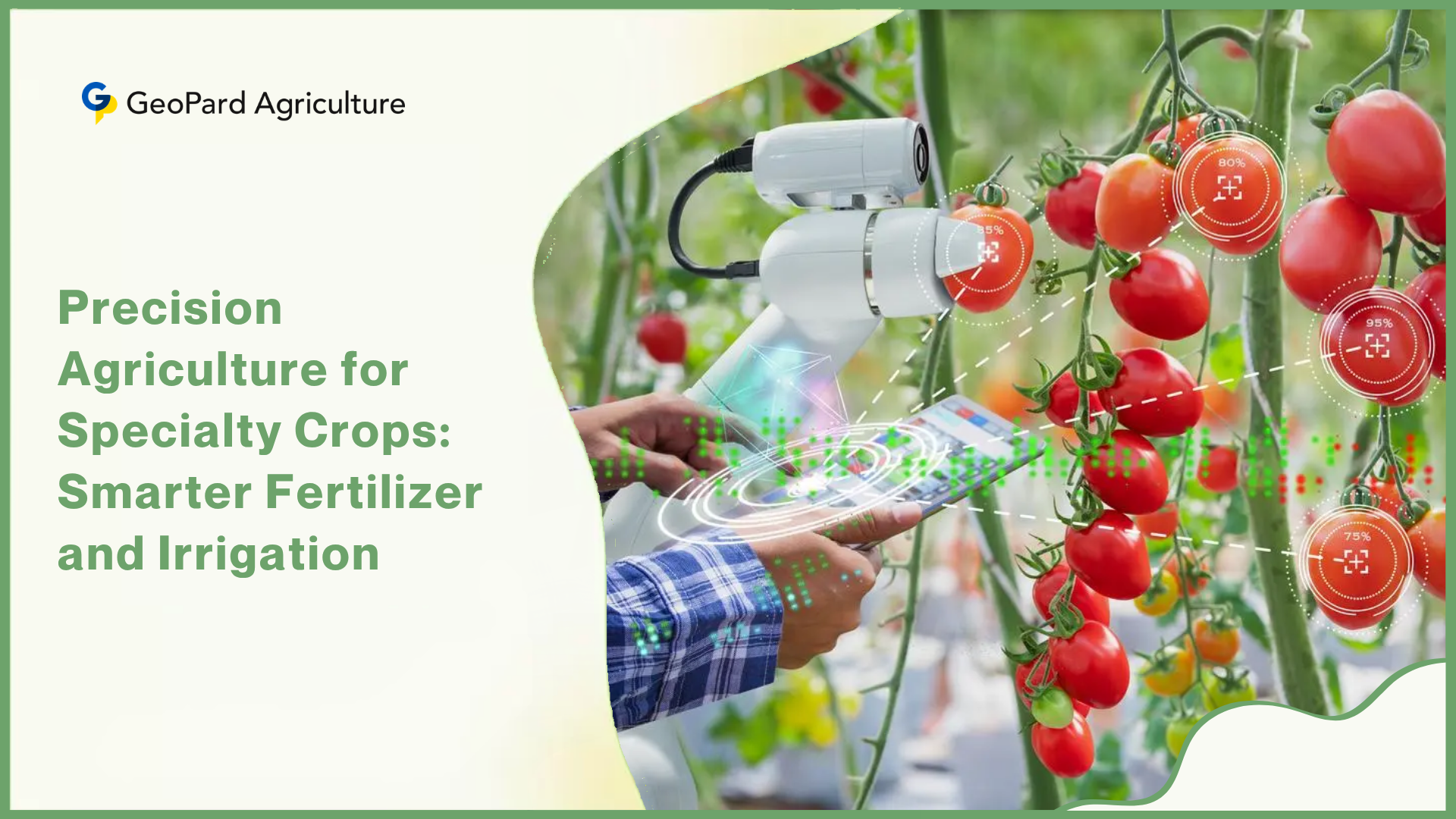


Specialty crops – including fruits, vegetables, nuts, herbs, and ornamentals – are high-value products whose quality and yield strongly depend on precise water and nutrient supply. In specialty crop production, optimizing fertilizer and irrigation for specialty crops using precision agriculture technologies is crucial to maintain yield, flavor, and quality. Precision agriculture (PA) employs field data and smart equipment (GPS-guided machinery, sensors, imaging, and decision-support software) to apply inputs exactly where and when needed. This data-driven approach can significantly improve fertilizer and water use efficiency compared to traditional blanket applications.
Rapidly rising input costs and growing environmental pressures make efficiency paramount. For example, global fertilizer use efficiency is low (less than 50% of applied nitrogen is taken up by crops), meaning much of the fertilizer applied to specialty crops can be lost to leaching or runoff. Likewise, agriculture already consumes about 70% of global freshwater, and many regions face tightening irrigation restrictions. Precision tools (soil probes, multispectral imaging, variable-rate systems, smart drip controllers, etc.) help match fertilizer and irrigation to plant needs, reducing waste and environmental loss while often raising yields.
The precision agriculture market is growing rapidly – the U.S. precision farming market was about $2.82 billion in 2024 and is forecast to grow at nearly 9.7% CAGR through 2030, while the global market (including hardware, software, and services) was about $11.67 billion in 2024 and may expand at 13.1% CAGR to 2030. These figures reflect strong industry expectation that smarter farming can cut costs and improve sustainability.
Unique Nutrient and Water Challenges in Specialty Crops
Specialty crops pose particularly demanding nutrient and water management needs. First, nutrient requirements vary widely by crop type, growth stage, and cultivar. For example, leafy greens may need very high nitrogen early on, while fruiting trees require balanced N, P, K and often extra micronutrients (e.g. calcium in apples to prevent bitter pit) during flowering and fruit set. The sensitivity to imbalance is acute: even small under- or over-fertilization can reduce fruit size and shelf life. Excessive N, for instance, can cause leafy vegetables to accumulate too much nitrate (a human health and regulatory concern) and can delay fruit ripening in some plants.
Conversely, deficiency symptoms (chlorosis, blossom drop, small fruit) emerge quickly. Similarly, water stress has outsized effects on specialty crops. Drought stress at key stages (e.g. flowering in tomatoes or fruit development in grapes) can slash yields and quality (for example, limiting sugar accumulation and berry size). Another factor is within-field variability, which is often extreme in perennial systems like orchards or vineyards. Soil texture, organic matter and moisture can differ dramatically even a few meters apart. A soil survey in a citrus orchard mapped multiple management zones (loam, sandy loam, clay loam, etc.).
This variability means a uniform fertilizer rate would under-fertilize some high-yield areas and over-fertilize others. In fact, a classic field study in the Pacific Northwest found wheat yields in the same field varying from 30 to 100 bu/acre; applying a single N rate for the field average would short-change the best spots and waste fertilizer on poor spots. The same principle holds in orchards and vegetable fields: site-specific nutrient maps are needed to align inputs with local potential.
A further challenge is environmental loss of inputs. Specialty crop systems often use high fertilizer rates and frequent irrigation, raising the risk of nutrient leaching and runoff. For example, poorly managed water and N in vegetable fields can leach nitrates into groundwater. Integrated management approaches have shown that optimized practices can cut these losses by 20–25% or more.
In North America, states and regions are imposing strict limits on nitrogen and pesticide runoff; specialty growers must adopt precision methods to comply. Water management is similarly regulated: inefficient sprinkler or flood systems can waste 10–30% of water to evaporation, whereas precision drip can reduce losses to near 0%. Specialty growers also face rising costs (fertilizer, water, labor), making any inefficiency expensive. Precision agriculture offers a way to address all these challenges by using technology to sense field conditions in real time and adjust inputs accordingly.
Core Precision Agriculture Technologies for Fertilizer Optimization
Precision nutrient management relies on both soil-based and plant-based sensing, plus robust mapping and prescription tools. These core technologies provide the data needed to apply fertilizer at variable rates (VRT) rather than a one-size-fits-all rate.
A. Soil-Based Technologies
Grid and zone soil sampling: Traditional nutrient management starts with soil testing. Precision methods use systematic grid or zone sampling to map soil fertility. For example, growers might collect samples on a 2–4 acre grid or delineate management zones (MZs) based on soil type or topography. Analysis of these samples yields maps of soil N, P, K, pH, etc. across the field. These fertility maps guide variable-rate fertilizer application: high-fertility areas get less added fertilizer and vice versa. This approach avoids the losses of uniform applications on heterogeneous soils. For instance, in a citrus study, researchers divided trees into canopy-based zones and applied tailored NPK rates, finding higher yields and thicker stems under variable rates than uniform applications.
Real-time soil nutrient sensors: New sensor technologies allow growers to monitor soil nutrients on the fly. One emerging tool is an in-situ ion-selective sensor array for nitrate. In a recent study, researchers built a 3D-printed sensor array with nitrate-selective membranes on electrodes to measure soil nitrate at multiple depths. Each probe uses a polymer-membrane electrode that generates a voltage proportional to nitrate concentration (–81.76 mV per decade change). Such sensors can stream nitrate levels continuously, enabling automatic scheduling of N fertilizer only when and where soil nitrate drops below target. Because less than 50% of applied N is normally taken up by crops, being able to sense soil N in real-time lets growers avoid excess applications that would just leach away.
Soil electrical conductivity (EC) mapping: Apparent soil EC sensors (like Veris or EMI tools) are also widely used. These devices send a small electrical current through the soil and measure conductivity, which correlates with soil texture, moisture, and salinity. By towing an EC sensor across a field, growers generate a soil variability map (higher EC often indicates clay and moisture, lower EC sand). These EC maps help delineate MZs for soil sampling or VRT. For example, an EC survey in an orchard might reveal heavier soil near a pond or fine-textured swales; these zones can be managed with higher fertilizer or water rates. By aligning fertilizer inputs to the EC zones, growers exploit the natural variability to maximize efficiency.
Variable-rate fertilizer application (VRT): The key output of soil sensing is VRT. Modern tractors and spreaders use GPS guidance to apply fertilizer at variable rates along each row. Prescription maps—generated from soil tests, yield history and other data layers—tell the machine how much fertilizer to deposit at each location. Section-control spreaders or fertigation injectors then modulate the dose according to GPS position. This capability translates soil data into action: nutrient-rich zones get little or no extra fertilizer, while low-fertility spots get more, improving overall yield potential and reducing waste. In trials with citrus orchards, VRT decreased total fertilizer use and cost for growers (while boosting fruit counts) compared to a uniform rate.
B. Plant-Based Monitoring
In addition to soil data, precision nutrient management uses plant-based sensors to gauge crop status directly.
Tissue testing and sap analysis: These conventional tools remain useful for precision programs. Tissue tests involve collecting leaf or petiole samples at specific growth stages and analyzing nutrient content in a lab. The results (e.g. leaf N or K concentration) give a snapshot of current crop nutrition. Growers can adjust fertilizer accordingly. Sap analysis (electrical conductivity of xylem sap) is a rapid field test often used in orchards (especially grapes) to approximate total soluble solids or N concentration in the plant.
If sap nitrate is below target, more N can be dripped in; if high, N is withheld. These methods provide ground-truth data to complement soil measurements, especially when spatial variability in uptake occurs. For instance, growers may sample leaves in different orchard zones to fine-tune variable-rate fertilization.
Chlorophyll meters: Handheld chlorophyll meters (like the SPAD or CCM models) measure leaf greenness as a proxy for nitrogen status. A meter clamps onto a leaf and reports an index related to chlorophyll content. Because chlorophyll is closely tied to leaf N, these readings allow quick field estimation of relative N needs. Growers can set threshold values for each crop: below-threshold readings trigger fertilizer application. In precision programs, spatially distributed SPAD readings (or more advanced optical reflectance clips) can create crop-N maps for VRT. Research has shown that SPAD values correlate with biomass and yield; for example, NDVI or SPAD-based N management in cereals consistently outperforms blanket fertilization. While specialty crops have unique leaf pigments, chlorophyll meters and similar optical devices are increasingly calibrated for vegetables and fruits as well.
NDVI and multispectral imagery: Drones, airplanes or satellites can capture multispectral images of crops, including near-infrared (NIR) and red bands. A common vegetation index, NDVI (Normalized Difference Vegetation Index), is computed from NIR and red reflectance and indicates canopy vigor and biomass. Dense, nutrient-rich plant canopies reflect more NIR and less red light, yielding higher NDVI. Growers use NDVI maps to identify nutrient-deficient areas mid-season. In one wheat study, NDVI sensing for N application led to higher grain yield and nitrogen use efficiency than fixed rate programs.
The same concept applies to specialty crops: NDVI or similar indexes (e.g. GNDVI for green biomass) from drone imagery can reveal stressed patches in a berry field or uneven nitrogen uptake in an orchard, guiding spot treatments. Canopy reflectance sensors mounted on tractors (like the Yara N-Sensor) operate on this principle, modulating N fertilizer on the go based on real-time reflectance. By sensing the plant itself, these technologies account for all factors (soil, water, health) affecting nutrient need.
C. GPS and GIS Integration
All the above sensors and data sources are integrated through GPS, GIS and decision-support tools.
Field mapping: Modern tractors and sprayers are equipped with GPS (often with RTK corrections) to record exact field coordinates. As machinery (sprayers, combines, tractors) operates, it creates geo-referenced maps: yield maps from harvesters, application maps from sprayers, and path logs from planners. These maps feed GIS software to visualize in-field variability. Growers can overlay yield data with soil-test maps to see how fertility affects output, or overlay moisture sensor locations with topography to identify dry spots. This spatial awareness is fundamental in specialty cropping, where each tree or vine row might be managed individually.
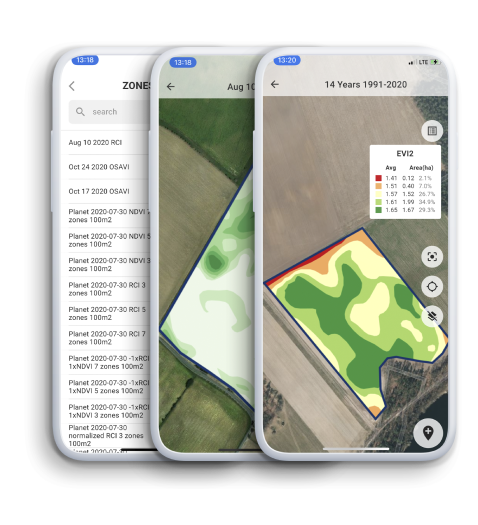
Prescription maps: Using GIS, the various data layers (soil test results, yield history, sensor data, terrain, crop rotation history) are combined to create prescription maps. For example, a fruit grower might weight late-season soil N and leaf-chlorophyll maps to determine a nitrogen prescription: high-N zones get 0 kg/ha, medium zones get 50 kg/ha, low zones 100 kg/ha. These rate zones are compiled into a GPS-compatible prescription file. Modern tractors or fertigation units then read this map and adjust the application hardware accordingly. This data layering (e.g. “Data layering such as yield, soil and moisture”) is what makes fertilization site-specific.
GPS-guided machinery: Ultimately, GPS controls the machinery. For solid fertilizer, spreaders use section control to turn sections on/off on the fly, matching the prescription rate. For liquid fertilizer or herbicide, variable-rate pumps or sectioned sprayer booms modulate output per nozzle. The same GPS system steers tractors for consistent coverage and auto-guidance reduces overlap. In specialty crops, precision planters and transplanters are also guided to ensure seeds or seedlings are placed in optimal positions relative to trees or irrigation lines. All these GPS/GIS integrations allow precise input placement that matches the underlying field data.
Precision Irrigation Technologies for Specialty Crops
Water optimization in specialty crops uses three core approaches: direct soil moisture sensing, climate-based scheduling, and advanced irrigation hardware. These methods often overlap (e.g. automated drip irrigation uses both soil sensors and weather data).
A. Soil Moisture Monitoring
Soil moisture sensors provide real-time data on the water content in the root zone. Common devices include capacitance sensors and tensiometers. Capacitance (dielectric) sensors, such as Decagon TEROS probes, measure the dielectric constant of the soil between electrodes; because water has a high dielectric constant, the probe voltage changes with water content. These sensors, typically installed at 10–30 cm depth, can report volumetric water content with an accuracy of ±2–3%. Tensiometers consist of a porous ceramic cup connected to a vacuum gauge; they measure the suction (negative pressure) the roots feel, indicating how hard plants must work to extract water. Soil moisture probes are often deployed in a wireless sensor network across the field or orchard (for example, in each irrigation block). Data from these sensors feed irrigation controllers or dashboards.
For example, a grower might install capacitance probes at multiple depths under a citrus tree and wirelessly transmit readings every hour. If the sensor reads 30% VWC when the irrigation threshold is 40%, the controller activates the drip valves until the probe returns to target. This direct feedback loop ensures trees never experience severe stress. Wireless sensor networks (using LoRa or Wi-Fi) enable dozens of probes to talk to a central system. While sensor accuracy varies with soil type, proper calibration yields reliable scheduling decisions. Many companies now offer integrated soil moisture monitoring systems with automated alerts (via mobile app) when irrigation is needed, replacing guesswork with data.
B. Climate-Based Irrigation Scheduling
Rather than reacting to soil data alone, climate-based scheduling uses weather and crop models to predict water needs. This approach relies on evapotranspiration (ET) data and weather station inputs. ET is the sum of evaporation from soil and transpiration by plants; it represents the water lost each day. Growers can obtain local ET data from on-farm weather stations or public sources (e.g. NOAA or NASA). Using a crop coefficient (Kc) for the specific crop and growth stage, they calculate crop evapotranspiration (ETc = Kc × reference ET). For example, alfalfa ET is a common reference; if local weather station data show 5 mm of water loss on a hot day, and the Kc for fully irrigated tomatoes is 1.0, then ETc = 5 mm/day. An irrigation schedule is then set to replace that 5 mm of water (minus any effective rainfall).
Predictive models can also use short-term forecasts. Software such as CROPWAT or commercial platforms ingest daily temperature, humidity, solar radiation and wind to forecast ET and suggest irrigation. For example, modern irrigation controllers can receive forecast data and delay irrigation if rain is expected, or add a fraction of ET if conditions are drying.
This climate-based scheduling can save water: one review noted that smart scheduling based on weather and ET can reduce irrigation by 30–65% compared to flood irrigation while maintaining yields. In practice, many specialty crop farms use on-site weather stations linked to their irrigation system. The weather station records net radiation and other factors; a controller applies irrigation when the calculated soil moisture deficit reaches a set point (often tied to a percentage of plant available water). This method avoids over-irrigation on cloudy days and ensures water is applied just before stress begins.
C. Smart Irrigation Systems
Smart irrigation combines automation with precision hardware. The most common is automated drip irrigation. Drip emitters deliver water directly to the root zone of each plant, minimizing evaporation and runoff. When paired with controllers, drip irrigation can be set to deliver precise amounts at precise times. For example, automated drip lines can apply nutrients (fertigation) and water together in pulses controlled by a timer or a soil sensor input. Variable-rate irrigation (VRI) is another advancement, especially for large field systems (like center pivots or big guns used in some vegetable fields). VRI uses GPS and zone valves to apply different water rates in different field sectors. For instance, a pivot can vary pressure to emit more water over sandy ground and less over clay, all in a single pass. This requires a prescription map for irrigation similar to fertilizer VRT maps.
Remote control is also a feature: many controllers now have cellular or Wi-Fi connectivity, so growers can adjust valves via a smartphone or laptop from anywhere. If a storm is imminent, a farmer can delay irrigation; if midday temperatures spike, extra irrigation pulses can be triggered. These smart systems enhance efficiency.
Netafim, for example, notes that precise drip application can cut evaporation losses to almost 0% (compared to 10–30% loss under sprinklers). It also completely eliminates runoff, since water is applied in small doses directly to the soil. In practice, growers report substantial water savings and yield gains using smart drip. One industry review found that precision irrigation investments can yield benefit-cost ratios over 2.5:1 with 3–5 year payback, reflecting both water savings and higher output.
Integrating Fertigation in Precision Systems
Fertigation – the practice of delivering fertilizer through the irrigation system – is a natural partner to precision irrigation in specialty crops. By linking nutrient delivery to irrigation timing, fertigation enables precise nutrient dosing and better uptake. In a drip fertigation setup, soluble fertilizer tanks or injection systems are connected to the drip line. When irrigation is scheduled (by soil sensor or timer), the system simultaneously injects a calculated dose of nutrients. This ensures that plants receive their fertilizer exactly when water is applied, maximizing root absorption and minimizing leaching.
The advantages of fertigation in a precision framework are significant. First, it allows precision dosing by growth stage. For example, a tomato grower might apply high phosphorus and potassium at flowering to boost fruit set, then switch to higher nitrogen during vegetative growth. By contrast, applying all nutrients at planting (as in traditional methods) is inefficient and can lock nutrients away from roots. Fertigation adjusts doses on the fly: if a mid-season leaf tissue test shows low N, the next irrigation can carry extra N; if the leaf N is high, the system skips or lowers the N injection.
Secondly, fertigation synchronizes water and nutrients to reduce losses. Because most nutrients are delivered to a wetted root zone, there is less chance for them to run off or percolate beyond root reach. For example, a Chinese study of summer maize using IoT-based water-N coordination showed dramatic results: an optimal irrigation+fertilization regime (IoT system B2) increased yield by 41.3% while saving 38.1% of irrigation water and 35.8% of fertilizer compared to a conventional treatment. Although that was maize, it illustrates the principle that precise fertigation can greatly enhance nutrient use efficiency (NUE). Specialty crops, often irrigated frequently, benefit similarly: careful fertigation can reduce the total fertilizer needed while raising output.
Finally, fertigation allows variable-rate nutrient application. Just as drip irrigation can be zoned for water, fertilizer injection pumps can vary doses across zones. Modern controllers accept prescription maps for fertigation: if soil sampling indicates a potassium-deficient corner of a berry field, the system can direct more K there. In multi-line drip systems (common in greenhouses or polytunnels), each line can have its own pump rate. This linked precision of water and nutrients means growers use the right amount at the right place. Overall, integrating fertigation into precision systems dramatically reduces nutrient loss and improves uptake efficiency, while enabling fine-grained control of crop nutrition.
Data Management and Decision Support Systems
All these sensors and controllers generate vast amounts of data. Effective precision farming requires powerful data management. Farm management software (FMS) solutions are now available to aggregate field data and turn it into actionable insights. These platforms (e.g. Granular, Trimble Ag Software, Climate FieldView) integrate yield maps, soil tests, weather logs, sensor readings, and even satellite or drone imagery. Using cloud databases, growers or consultants can layer this data and visualize spatial trends. For instance, by overlaying soil moisture maps with yield data from last season, the FMS might reveal that a slight water deficit in one field section cut carrot yields by 15%.
AI-driven recommendations are an emerging feature. Some systems analyze historical data and weather forecasts to suggest optimum irrigation or fertilizer recipes. For example, machine learning models can be trained on past growing seasons: given input on soil type, weather, and sensor readings, the AI can predict crop response and recommend a nutrient schedule. Early studies have found that AI decision support can improve N scheduling over static rules, though trust and calibration remain challenges. Nevertheless, tools with built-in AI are entering the market, promising to simplify decision-making for growers without precision expertise.
Historical data tracking is another benefit. Every input becomes a record: how much N was applied on June 10 at a certain row, what the sensor reading was, and what yield resulted. This history lets growers fine-tune over seasons. Cloud-based analytics allow consultant teams to remotely monitor multiple farms. In practice, a farm advisor might log into a cloud portal and see alerts for any field running low on moisture or showing nutrient deficiency.
Integration of multi-source data is crucial. Drone or satellite images (multispectral) feed into the system alongside ground sensors. Drones can spot plant stress in near-real-time and the FMS can fuse that with soil probe data. GIS tools within FMS help create the prescription maps mentioned earlier. Connectivity via 4G/5G or LoRa links sensors to the internet, enabling dashboards and apps. In sum, decision-support systems turn raw sensor data into management actions, making precision agriculture tools accessible to specialty crop growers and helping them make data-driven decisions rather than guesswork.
Crop-Specific Applications
Precision nutrient and water management must be tailored to each crop’s physiology and farming system. Below are examples for key specialty crop categories.
A. Tree Fruits and Orchards
In tree fruit orchards (apples, citrus, pears, etc.), zone-based irrigation and fertigation are widely adopted. Each tree row can be a management zone: older or larger trees receive more water and fertilizer, younger ones less. Drip emitter lines typically run one per tree or per two trees; these lines can be controlled by zone valves. For example, a 50-acre apple orchard might be divided into 5 irrigation zones based on tree age and soil. During early season (flowering to fruit set), the system can inject phosphorus and potassium when needed, then switch to nitrogen as fruits develop. Nutrient timing is critical: applying too much N before bloom can delay flowering, so precision systems allow skipping N early and ramping up later.
On the data side, orchardists often use leaf tissue analysis in bloom or mid-season (Petiole analysis) and feed results into the precision program. Also, canopy sensors on tractors can map vigor differences between blocks. Studies have shown that site-specific N management in citrus improved fruit yield and quality. In one trial, citrus trees under variable-rate fertilization had larger stem girth (a proxy for tree vigor) and higher fruit counts per tree than uniformly fertilized trees. This suggests that precision fertigation in orchards not only cuts waste but can boost output and quality.
B. Vineyards
Grapevines are extremely sensitive to water stress and nutrient balance because minor stresses can alter wine quality. Precision irrigation in vineyards often uses deficit irrigation strategies guided by sensors. Growers install soil moisture sensors or use plant-based measures (like midday stem water potential) to apply controlled drought. For instance, they may allow vines to dry to 70% of field capacity before irrigating, which concentrates sugars and flavors. When combined with GPS mapping, differential water can be applied to blocks known to produce low-yield or premium grapes.
Nutrient management in vineyards also uses precision: growers monitor petiole or leaf N at bloom and veraison and apply N through drip lines accordingly. Precision N avoids excessive vegetative growth, which can dilute grape quality. In one case study, targeted nitrogen injections at bloom improved grape yield without over-fertilizing dormant areas. Water stress and nutrient status are often monitored via remote sensing now; multi-spectral drones flying vineyards can detect vine vigor differences row by row. Precision allows vintners to match vine stress to wine style goals (e.g. high-end wines often come from more stressed, lower-yield vines).
C. Vegetables
Vegetable crops (tomatoes, lettuce, peppers, etc.) are highly intensive and have short growth cycles, so nutrient supply must be tightly controlled. Greenhouse and open-field vegetables increasingly use drip fertigation with fully automated schedules. Soil or substrate moisture sensors are placed near the root zone of representative plants. When sensors detect 60–70% soil moisture depletion, the system triggers both water and nutrient injection. This keeps soil moisture within a narrow band optimal for that crop. Excess nutrients are avoided; for example, a precision drip system might cut total N use by 20% while maintaining yield.
Vegetable growers also use handheld sensor tools. Chlorophyll meters are common in tomatoes to judge when to side-dress nitrogen. Handheld EC meters can verify nutrient concentrations in soilless media. In larger fields, yield monitors on harvesters (e.g. for potatoes) create maps of productivity. These feed back into fertilizer zones for the next season. The net result is that precision nutrient monitoring helps achieve consistent vegetable quality (size, color, crunch) and reduces the risk of over-fertilizing leafy greens, where nitrate levels are regulated.
D. Berries and High-Value Specialty Crops
Small berries (strawberry, blueberry, etc.) and herbs often grow on raised beds with drip lines, making them well-suited to precision management. Growers use moisture probes in each bed section to keep rootzone uniformly moist. Because berry size and sweetness depend on consistent watering, precision control (automated on-off valves on micro-irrigation) prevents both drought stress and excess water. For example, strawberry producers report that precise moisture control improves berry firmness and reduces diseases that thrive in overly wet soil.
Fertigation in berries is intense because soils are often marginal. Producers frequently test leaf tissue and can adjust nutrient injection weekly. In blueberries, which require acidic soil, irrigation water may even be acidified via fertigation (injecting sulfuric acid) to maintain pH. Precision drip systems allow this fine control. In high-value crops like cut flowers or herbs, yield and quality (flower size, leaf oil content, etc.) are so crucial that growers will spend for precise dosing of micro-nutrients. In all these cases, precision fertigation and irrigation deliver inputs only as needed per plant, boosting yield and flavor while minimizing fertilizer leaching.
Economic Benefits and ROI
Investing in precision fertilizer and irrigation technology can significantly improve a farm’s bottom line. The most immediate impact is input reduction. By applying fertilizer and water more accurately, farmers use only what the crop needs. Industry studies (AEM data cited in GAO) estimate precision tools can cut fertilizer use by roughly 8% and water use by 5%, while also reducing pesticide and herbicide use. These savings add up: for a 100-acre orchard spending $500/acre on fertilizer, an 8% cut saves $4,000 annually. Water savings have direct cost benefits where irrigation water is billed or energy is consumed (e.g. electric pumps).
Yield improvements are another economic driver. Precision management often increases average yield or quality grade. For example, targeted fertilization can turn marginal zones into productive areas, raising overall output. One trial in citrus showed significantly higher fruit counts under VRT. Increased quality can command premium prices: specialty produce with uniform size or higher sugar content (from optimal water stress) may sell at better rates. Although premium pricing is crop-specific, growers often find the extra revenue justifies the technology investment.
An ROI analysis typically looks favorable for precision investment. The review by Gopal et al. found that precision irrigation systems often achieve benefit-cost ratios over 2.5:1 with payback in 3–5 years. Reduced waste (fertilizer & water), along with yield/quality gains, contribute to that return. A combined figure of merit from multiple studies suggests farms could see an ~8% profit increase just from efficiency gains.
Of course, actual ROI depends on the scale of the operation and local input prices. In high-value specialty crops, even small percentage gains in yield or input efficiency can translate to substantial absolute profit improvements. Growers often pilot a single zone or tool first (for example, adding variable-rate fertigation on one irrigation line) to validate benefits before scaling up.
Environmental and Sustainability Impacts
Beyond farm economics, precision agriculture has clear environmental benefits. The precise delivery of inputs means reduced nutrient runoff and improved water conservation, addressing key sustainability goals. By matching fertilizer to crop uptake, far fewer nutrients escape into waterways. Integrated management approaches in the Corn Belt, for instance, achieved >20% reduction in nitrate leaching and >25% reduction in runoff nitrogen. Precision farming aims for similar gains: if 35% less fertilizer is used (as in the maize example), one would expect a proportional drop in nitrous oxide (N₂O) emissions and nitrate pollution. Given that global agriculture already accounts for a large share of greenhouse gases (agriculture, forestry and land use together emit about 23% of net anthropogenic GHG), cutting fertilizer use directly reduces N₂O and CO₂ equivalents.
Water conservation is equally important. Precision irrigation can slash farm water use by 30–65% as noted above. In regions facing drought or groundwater depletion, this relief is critical. For example, applying water only at the root zone (drip) virtually eliminates evaporation loss, meaning less total water must be pumped. Over-irrigation also causes salinity buildup and soil degradation; precision systems avoid these by giving exactly the water needed.
Regulatory compliance is another angle. Many states now have nutrient management requirements. Precision systems help farmers meet those regulations by demonstrating controlled use. Some programs (like nutrient management plans or water use reports) reward lower runoff and better record-keeping – tasks made easier by precision monitoring. Precision agriculture also aligns with regenerative practices: optimized inputs and localized treatments encourage healthier soil biology (since microbial communities aren’t shocked by excess fertilizer) and allow integration of cover crops and crop rotations (by capturing their benefits in sensor data).
Finally, reducing inputs lowers the carbon footprint of production. Producing synthetic N fertilizer is energy-intensive, so applying less fertilizer means fewer fossil fuels used. Combining this with site-specific cover cropping or composting (often part of precision nutrition regimes) can even sequester more carbon. In sum, precision fertilizer and irrigation management promotes sustainable agriculture by conserving water, cutting pollution, and reducing greenhouse gas emissions, all while maintaining productivity.
Implementation Strategy for Growers
Successful adoption of precision fertilizer and irrigation starts with assessing field variability. Farmers should map their land (using yield maps, soil tests, or EC maps) to identify zones. This may reveal how many distinct fertility or moisture zones exist. Knowing this informs what technologies to deploy first. Often the advice is to start small: implement precision irrigation or VRT on one block or one crop row, measure the results, then expand.
Choosing appropriate technologies depends on the crop and scale. A small orchard might begin with a few soil moisture probes and an automated drip controller. A large vegetable farm might invest in a multi-depth sensor network and drone NDVI services. Extension agents or agri-tech consultants can help select tools – for example, deciding between tensiometers vs capacitance sensors, or choosing a suitable fertigation pump.
Training and technical support are crucial. Farmers need to understand what the data means and how to act on it. Many suppliers offer training, and grower networks (peer groups, cooperatives) share best practices. Government programs sometimes provide grants or advice for precision ag adoption.
Finally, implementation is iterative. After installing sensors and systems, growers must monitor and adjust. Comparing predicted responses (from sensors) with actual results (yield, plant tests) allows calibration. If one zone is still underperforming, inputs there may be tweaked further. Collecting seasonal data builds a feedback loop for continuous optimization. Over time, the system becomes more finely tuned and yields the maximum economic and environmental benefit.
Common Challenges and Limitations
While the potential is great, precision fertilizer and irrigation technologies face several hurdles. High upfront costs are a major barrier. Sensors, controllers, and VRT equipment can be expensive. For example, a variable-rate pump or VRI kit on an irrigation rig can cost tens of thousands of dollars. Many specialty crop farms operate on thin margins or lack access to credit, making large tech investments risky. Partially offsetting this, technology costs continue to fall (e.g. generic IoT soil probes are cheaper now than a decade ago) and leasing or cost-share programs can help.
Data overload and complexity is another challenge. Farmers suddenly have streams of numbers from sensors and satellite imagery to interpret. This requires time and skill that many may not have. Complex software and analytics require either training or external consultants. Misinterpreting data can lead to wrong decisions (e.g. applying fertilizer when sensor drift gives bad readings). Good decision-support and user-friendly interfaces mitigate this, but the learning curve remains.
Connectivity issues in rural areas can limit the use of cloud-based and remote features. As one report notes, broadband internet is often not available on many farm fields, which means real-time data sharing or remote control may fail. In areas without cell service, wireless sensor networks may rely on local data loggers or satellite uplinks. Without reliable connectivity, some benefits of precision are diminished.
Technical knowledge gaps also slow adoption. Precision agriculture is interdisciplinary (agronomy, engineering, IT). Many growers lack familiarity with it, and farm advisors may not have the expertise to guide them. Ongoing education programs are addressing this, but for now the human factor is a limitation.
Finally, sensor calibration and maintenance are practical issues. Soil moisture sensors must be recalibrated for different soil types and may need cleaning or replacement. Flow meters and nozzles for VRT equipment require regular checking. Neglecting maintenance can lead to erroneous data and suboptimal management. Overcoming these challenges typically requires strong technical support and a gradual, well-planned implementation strategy.
Future Trends in Precision Fertilization and Irrigation
The field of precision agriculture continues to evolve rapidly. AI and machine learning will play bigger roles in decision support. We expect more AI-driven systems that can analyze complex data patterns (sensor streams, weather forecasts, satellite images) and predict optimal irrigation or fertilization schedules without human intervention. Autonomous robotics and automation are also emerging: drones or ground robots may soon scout fields automatically, perform spot spraying or localized fertilizing based on detected plant stress.
Satellite-based nutrient diagnostics are improving. Hyperspectral satellites and free imagery (Sentinel, Landsat) may soon provide affordable maps of crop nutrient deficiencies over entire farms. Combined with on-the-ground sensors, this will give unmatched detail on crop needs in real time. Similarly, real-time plant stress detection (using thermal or multispectral imaging) will become more common, so that water and nutrient deficits are spotted before symptoms appear.
Integration with climate resilience is another frontier. Precision systems will increasingly incorporate long-term climate forecasts (drought or heat waves) into irrigation and fertilization plans. For specialty crops sensitive to climate extremes, the ability to adaptively manage water and nutrients in the face of variability will be crucial.
Overall, the trend is toward ever-smarter, more autonomous management tools that let specialty crop growers be predictive rather than reactive. As sensors, AI, and robotics mature, the vision of fully automated, optimized fertilizer and irrigation – tuned to each tree or plant – moves closer to reality. Growers who adopt these trends early will be best positioned for sustainable, profitable production in a changing climate.
Conclusion
Specialty crop production demands both high productivity and resource efficiency. The use of data-driven precision techniques – from soil and plant sensors to GPS-guided applicators – is key to optimizing fertilizer and irrigation for specialty crops using precision agriculture technologies. By tailoring nutrient and water delivery to the specific needs of each crop and field zone, growers can significantly reduce waste of expensive inputs and protect the environment. At the same time, yields and product quality improve, supporting higher revenues. The economic incentives are clear – studies report double-digit yield gains and resource savings (for example, up to 65% water saving and profit gains around 8%). In the long term, precision nutrition and irrigation build farm resilience and sustainability: they reduce nutrient runoff by 20–25% or more, conserve precious freshwater, and cut greenhouse gas emissions by avoiding excess fertilizer.
Precision Farming





 English
  German
  Ukrainian
  French
  Kazakh
  Portuguese
  Spanish
  Arabic
  Swedish
  Serbian
  Romanian
  Norwegian
  Finnish
  Lithuanian
  Estonian
  Latvian
  Croatian
  Slovenian
  Slovak
  Japanese
  Polish