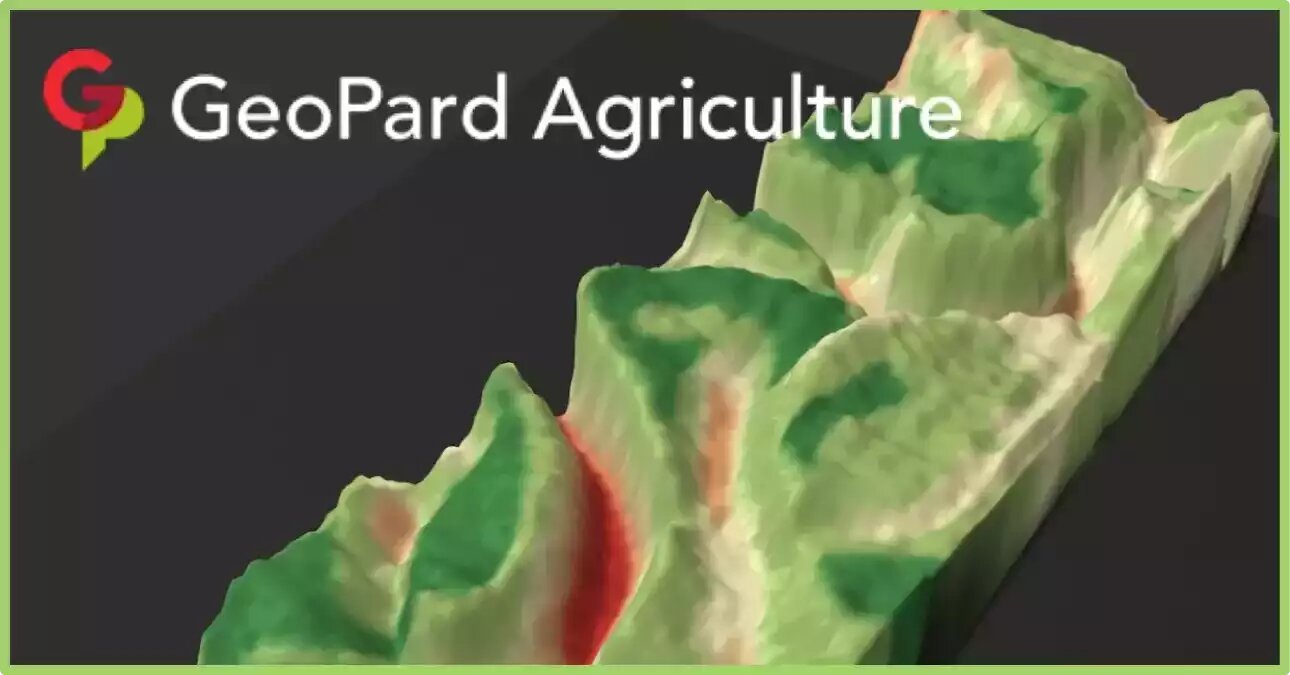
3D topografijos žemėlapiai tiksliojoje žemdirbystėje

GeoPard is making history by being the first company to automate the online creation of high-resolution 3D topography maps with their new 3D mapping tool.


In just a few seconds, users can generate maps that explain the complex variability. For example, the maps help to learn how the topography and relief data of a given area influence crop development.

3D reljefo žemėlapiai tiksliame ūkininkavime3d topography model overlaid with the Field Potential map

GeoPard is continuing its mission to make such tools more accessible for crop growers. There is no need for a powerful computer or specialized skills to start with data-driven decisions. 

What are Topography maps?

Topography maps, also known as elevation maps, are maps that depict the shape and elevation of the Earth’s surface. These maps use contour lines to show the different elevations of the land, with each line representing a constant elevation above sea level. T

he closer together the contour lines, the steeper the slope of the land, while widely spaced contour lines indicate flatter terrain.

In precision agriculture, they can be used to identify variations in slope and terrain, which can affect the distribution of water, nutrients, and other inputs across a field.

By understanding the 3d topographic maps of their fields, farmers can make informed decisions about planting, irrigation, and drainage, and can implement precision farming techniques such as variable-rate application of inputs.

They can be created using various technologies, including LiDAR (Light Detection and Ranging) and satellite imagery. These maps can be overlaid with other data, such as soil maps and yield data, to create customized prescription maps for precision agriculture applications.

Overall, they are an important tool for precision agriculture, as they provide farmers with a detailed understanding of the terrain and landscape of their fields, enabling them to optimize yields and reduce input costs.

What is 3D mapping in precision agriculture?

3D mapping in precision agriculture is a technique that uses various sensors and imaging technologies to create a detailed three-dimensional map of a farm or field.

The process typically involves the use of drones, airplanes, or ground-based vehicles equipped with sensors that capture images of the area from different angles.

These images are then processed to create a high-resolution 3D map of the field or farm that can be used to identify variations in terrain, soil types, and crop health.

This information can be used to create customized prescription maps for variable-rate application of inputs such as fertilizers, herbicides, and pesticides, and to optimize irrigation and drainage systems.

3D mapping can also be used to identify potential problem areas such as soil erosion or drainage issues, allowing farmers to take proactive measures to address them.

3D topography maps integration with GeoPard precision tool

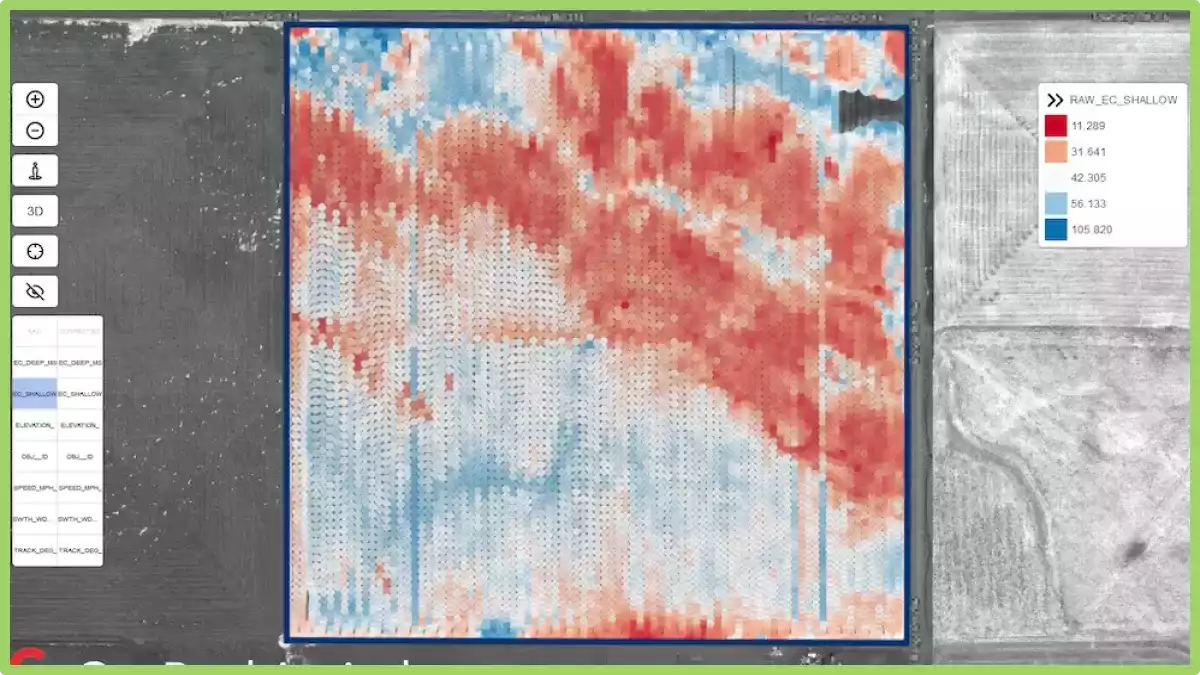
The 3D mapping tool can be used with any GeoPard base layer in addition to LIDAR topography and its derivatives. Among the additional available layers, there are soil agrochemical properties, yield/as-applied/as-planted datasets, ground scanners data, and even vegetation indices.

Any cover map like zones from yield, historical vegetation, organic matter, electrical conductivity, or pH distribution can be utilized on top of the base layer. The 3D maps help users better understand how relief and topography influence soil properties, vegetation, and yield.

And they contribute to a better visual and analytical understanding of how to manage individual land parcels in the most efficient way. 

It is important to mention, that this Live 3d Model works directly in the browser without any 3rd party pre-installed programs or extensions. You can rotate, zoom in and zoom out, and change cover maps to understand fields better.

The latest improvement includes the capabilities to save the preferred datalayers sets for 3D maps and fastly access them later. This enables saving your current investigation state and continuing further review later.

An additional benefit here is the capability to trace changes through agricultural crop seasons within saved snapshots.

The way topography affects crop vegetation has a significant impact on crop yield (more details are in a previous blog post post here).

The marked areas represent the value of the GeoPard 3D mapping tool, which improves the understanding of the reasons for yield distribution and informs about the necessary changes in planting patterns.

Whatsmore, the 3D topographic maps model provides insight into how watersheds feed into your land and which pathways water takes.

GeoPard’s  3d topographic maps can relay essential information about surface and subsurface drainage inefficiencies, allowing irrigation and drainage systems to be reworked to optimize soil water availability for your crops.

GeoPard is aiming high with the development of new tools like this and is constantly improving and refining its own global understanding related to precision agriculture digital solution demand.

If you are interested in knowing more about how the data is collected and analyzed, feel free to check out this post to learn more!


Dažnai užduodami klausimai


1. How to turn on topography in google earth?

To enable topography in Google Earth, follow these simple steps. First, open Google Earth on your device. Next, navigate to the “Layers” panel located on the left side of the screen.

Click on the “Primary Database” folder, and then select the checkbox next to “Terrain” or “3D Buildings” to display topographic features. You can further customize the appearance by adjusting the transparency or other settings.

With these steps, you’ll be able to view and explore the topography in Google Earth, enhancing your virtual experience of the Earth’s terrain.

2. How to make a 3d model from a topographic map?

Creating a 3D model from a topographic map involves a few steps. First, obtain a high-resolution topographic map of the desired area. Next, digitize the elevation contours from the map using specialized software or by tracing them manually.

Then, import the digitized contours into a 3D modeling software and extrude them vertically based on their elevation values. Finally, add texture and other details to the model to enhance its appearance.

With these steps, you can transform a topographic map into a 3D model, allowing for a more immersive representation of the terrain.
„GeoPard“ ir „Origin Digital“ partnerystė teikiant tiksliosios žemdirbystės sprendimus

Svetainė GeoPard žemės ūkis ir Skaitmeninė įmonė "Origin sudarė aljanso susitarimą, kuriuo siekiama išspręsti su ūkininkavimu susijusias problemas.

Šio aljanso tikslas - išplėsti žemės ūkio rinkos sritį taikant skaitmeninius ir duomenimis pagrįstus metodus, pavyzdžiui, tiksliąją žemdirbystę, duomenų analizė, ir programinės įrangos kūrimas.

Jie taip pat siūlo klientams profesionalias programas ir pasiūlymus, kaip pasirinkti gyvybingas sėklas, pasėlių sodinimo ir derliaus nuėmimo mokslą ir dirvožemio mėginių ėmimo metodus.

Daugelį šių naujovių dabar galima įsigyti Ukrainoje, nes čia yra šių bendrovių bazė. Įmonė "Origin Digital" įtraukė ūkininkavimo konsultacijas, gero ūkininkavimo strategijas ir duomenimis pagrįstus metodus, kad palengvintų sprendimų priėmimo procesą.

Be to, programa padeda specialistams lengvai valdyti tiksliojo ūkininkavimo sistemą. Pagrindinis sąjunginių grupių tikslas - nagrinėti ūkininkų problemas ir siūlyti praktinius sprendimus.

"Geopard Agriculture" generalinis direktorius Dmitrijus Dementjevas viename iš savo pareiškimų minėjo:

“Geopardo” komandos prisijungimas prie "Origin digitals" yra svarbus žingsnis tiksliojo ūkininkavimo pažangos link. Dėl šio aljanso klientai dabar gali lengviau ir greičiau naudotis bendrovės teikiamomis skaitmeninėmis priemonėmis."

Jis taip pat pridūrė, kad jo komanda džiaugiasi neseniai įvykusiais pokyčiais ir yra pasirengusi viską padaryti gerai.

Skaitmeninės bendrovės “Origin” vadovas Jonas Rhymesas taip pat sakė: "Šis aljansas skatins tikslųjį ūkininkavimą Ukrainoje. Taip yra todėl, kad bendrovės į savo schemą įtraukė tokias programas kaip duomenų analizė ir dirbtinis intelektas. Šios programos palengvins informacijos skleidimo būdą ir pasiūlymų teikimą potencialiems klientams".”

Panašiai programa bus naudinga ir Ukrainos augintojams. Ji taip pat padės jiems sumažinti gamybos sąnaudas, padidinti pelną ir padės įveikti kitus procesus.

Kas yra tiksliojo ūkininkavimo sprendimai?

Tiksliojo ūkininkavimo sprendimai - tai technologijos ir metodai, naudojami siekiant optimizuoti augalininkystės produkciją priimant duomenimis pagrįstus sprendimus ir tikslingai naudojant sąnaudas. Kai kurie tiksliojo ūkininkavimo sprendimų pavyzdžiai:

  1. Kintamo greičio technologija (VRT): Ši technologija suteikia ūkininkams galimybę naudoti įvairias trąšas, pesticidus ir sėklas skirtingomis normomis visame lauke, atsižvelgiant į tokius veiksnius, kaip dirvožemio derlingumas, pasėlių augimo stadija ir derliaus potencialas.
  2. Nuotolinis stebėjimas: Tai apima palydovų, bepiločių orlaivių ir kitų jutiklių naudojimą dirvožemio ir pasėlių būklės duomenims rinkti, kurie gali būti naudojami priimant pagrįstus sprendimus dėl sąnaudų naudojimo ir pasėlių valdymo.
  3. Geografinė informacinė sistema (GIS): GIS - tai priemonė, leidžianti ūkininkams rinkti, saugoti, analizuoti ir tvarkyti erdvinius duomenis apie savo laukus, pvz., dirvožemio tipą, aukštį ir oro sąlygas.
  4. Tikslusis drėkinimas: Tai apima tokias technologijas kaip lašelinis drėkinimas ir dirvožemio drėgmės jutikliai, kurie leidžia ūkininkams optimizuoti vandens naudojimą ir mažinti nuostolius.
  5. Autonominė įranga: Autonominiai traktoriai ir kita įranga gali būti užprogramuoti atlikti tokias užduotis kaip sodinimas, tręšimas ir derliaus nuėmimas, o tai leidžia tiksliau ir efektyviau valdyti pasėlius.

Apskritai tiksliojo ūkininkavimo sprendimai leidžia ūkininkams priimti duomenimis pagrįstus sprendimus, kurie optimizuoja derlių, mažina sąnaudų švaistymą ir didina bendrą efektyvumą. Naudojant pažangias technologijas ir metodus, tiksliojo ūkininkavimo sprendimai gali padėti ūkininkams įveikti sparčiai besikeičiančio žemės ūkio kraštovaizdžio iššūkius ir užtikrinti tvarią ir pelningą augalininkystės produkciją.

Kaip tiksli žemdirbystė padeda draudžiant pasėlius?

Insuring crops is becoming more expensive as a result of climate change. Crop losses can be caused by floods, hail, and droughts, and farming insurance companies can assist farmers and crop producers to recover. Crop insurance can be obtained for a variety of reasons.

According to a new analysis of the agricultural industry, the international farm subsidy market was valued at $34.05 billion in 2019 and is expected to reach $53.02 billion by 2027, growing at a compound annual growth rate (CAGR) of 6.1 percent between 2020 and 2027.

Its coverage usually covers hail and other natural disasters that may adversely affect productivity. Farming insurance companies are leveraging IoT, drones, and satellites to improve the coverage of their policies.

Kas yra pasėlių draudimas?

It is a type of insurance policy designed to protect farmers and agricultural producers from financial losses caused by events such as weather-related disasters, pest infestations, and other risks that can affect crop yields.

Insurance policies typically provide coverage for a range of risks, including yield loss, crop damage, and revenue loss, and are typically tailored to the specific needs and risks of the individual farmer or producer.

In exchange for paying a premium, the farmer or producer receives financial protection against potential losses, which can help to mitigate the risks and uncertainties associated with farming and agricultural production.

It is often subsidized by governments and is an important tool for promoting the stability and sustainability of agricultural production.

Agricultural insurance encourages critical crop investment decisions by protecting farmers and communities from unplanned losses. Those purchasing it faces obstacles such as a lack of rate information and significant wait times for claim settlements.

Direct sales from insurance carriers will continue to be the most profitable income stream during the projection period. Meanwhile, it is looking into new and intriguing ways to reach out to certain market segments through insurance.

Crop insurance businesses in this industry collaborate with agents, brokers, internet markets, and banks (banks).

Its increases in North America led to worldwide market growth in 2019 and are projected to continue. Its coverage has grown in recent years as farmers and ranchers attempt to protect and increase crop production.

Agri-insurers also work to improve the safety of food and fiber crops grown in the region for human use.

Its expansion has been hampered by international laws. As a result of this negative impact, agricultural production in certain nations has stalled, delaying its expansion of coverage.

By the middle of the decade, the global economic recovery, new legislation, and changes to existing insurance plans are expected to strengthen the insurance industry.

Why is crop insurance important for farmers?

It is crucial for farmers for several reasons. Firstly, it provides financial protection against potential losses caused by natural disasters, pests, diseases, or adverse weather conditions, reducing the financial risks associated with farming.

Secondly, it helps farmers secure loans and financing by providing a safety net for lenders. It enhances the stability and sustainability of farming operations, ensuring farmers can recover and continue farming after a significant loss.

Lastly, it promotes confidence and peace of mind for farmers, allowing them to make informed decisions, invest in their farms, and adopt innovative practices without the fear of devastating financial setbacks.

Kaip tiksli žemdirbystė padeda draudžiant pasėlius?

Precision farming technology has advanced significantly in recent years, resulting in major advances in agricultural effectiveness and profitability. Precision agricultural technology is expected to be used by approximately six out of every ten production farmers.

Farmers now have a plethora of innovative alternatives at their disposal to improve agricultural productivity, ranging from auto-steer to variable-rate applications.

As members of the federal crop insurance program, some farmers have recently turned to precision farming technologies to simplify – and improve the quality of – the data they collect about their crop planting and production in order to submit mandatory government reports.

Instead of utilizing traditional paper records such as plantation logs and scale tickets, growers can gather and record cultivated and produced acres by using the apparatus GPS monitor and agricultural management system, rather than by hand.

In summary, farmers can “digitize” their planting and production records by utilizing existing precision farming technological capabilities, making important planting and production information more accurate and controllable.

Furthermore, digitizing farm data can bring a considerable increase in understanding of farming processes, including the capacity to better assess crop production risk, especially when combined with other data sources such as conditions of the soil, weather, and geography.

When insurers have a better understanding and insight into agricultural production risk, they may be able to not only offer additional risk management solutions but also underwrite and price the risk more effectively.

While it is distinct from many other types of insurance, it shares certain fundamental principles with homes and auto insurance. The usage of telematics/GPS data from the automobile has resulted in a substantial change in the underwriting and pricing of auto insurance compared to ten years ago.

Because the automobile’s telematics/GPS data provides a more complete picture of driving risk, vehicle insurers can more precisely assess and value auto insurance risk (i.e. speed, braking, etc.).

When automobile data is integrated with other standard driver risk data, better estimations of possible accident risk are obtained.

Similarly, the technology of precision agriculture can provide insurers with more accurate and detailed information on planting and production activity (such as seed spacing, etc.), allowing for more accurate crop output projections beyond what weather alone can affect.

As a result, what does the future hold for precision agriculture and crop insurance solutions? There are already a number of options.

Farmers Mutual Hail Insurance, for example, gives customers a discount on crop hail insurance coverage if they utilize a combined head equipped with GPS technology.

The GPS-enabled combine head is more effective at “picking up” falling corn during a windstorm due to the precision with which the combine is guided along the row line masked by flat corn stalks.

Insurance risk is decreased due to the lower risk of production loss connected with the GPS-guided head, allowing for a lower insurance premium to be imposed.

Farmers have a lot of potential to use precision farming technologies to improve agricultural risk management, particularly crop insurance. We can acquire a better knowledge of agricultural production risk by gathering and organizing field data with precision farming tools.

Trusted advisors can assist farmers in identifying and acquiring new solutions, such as enhanced risk management tools that more accurately reflect individual farmer risk and the solutions desired to mitigate the risk of loss, by working within a clearly defined environment in which the farmer retains control and ownership of their data.

How farming insurance companies can assess and predict field productivity

Satellite monitoring is an efficient method of observing crop health because it is cost-effective. This is an opportunity for agricultural insurance businesses. Satellites are multitasking operating systems capable of doing a variety of tasks, including the following:

  •       exact field area assessment
  •       identifying seedlings
  •       The ID of the accumulated dirt (whether a field has been harvested or not)

 All of this is occurring concurrently. Agricultural insurance offers the following significant benefits:

  •       speed
  •       precision
  •       cost-cutting initiatives

All of this is possible because of remote sensing, a capability possessed by the majority of current satellites. We’re not talking about snapping images on the fly here; we’re talking about photographing beyond the visible spectrum, into the realm of infrared photography.

When viewed via various wavelengths, the world appears very different. We are only a little sensitive to these rays, and we experience them mostly as heatwaves with no accompanying sensations.

On the other hand, satellites are capable of precisely studying them and providing breathtaking images that shed light on the natural world’s mysteries.

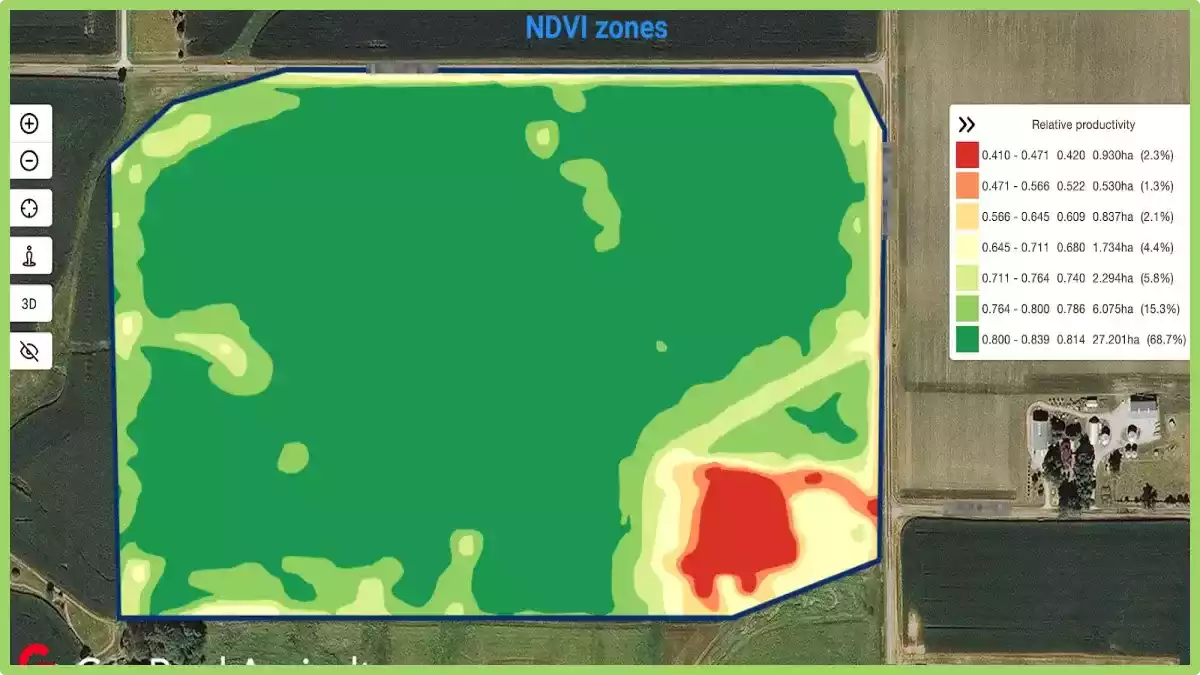
The application of vegetation indices, most notably the Normalized Difference Vegetation Index, exposes the true condition of crops (NDVI).

Farming insurance companies would significantly profit from incorporating this technology into their operations since it would significantly reduce costs while also saving vital time and resources.

Due to the orbital speed of satellites, they can examine vast areas of land and sea in a couple of minutes. Indeed, one orbit can last as little as two hours, implying that the entire circumference of the Earth can be covered in that time!

Crop insurance firms can precisely quantify the area of a field in seconds due to the extraordinary breadth of coverage provided by satellite imagery data. The data is promptly uploaded to the Crop Monitoring platform, which enables users to view the exact contours of any field on any screen, at any time of day or night, via an interactive map.

Another method worth mentioning is the high resolution of satellite images, which enables the detection and monitoring of seedlings and harvest status, among other things.

This technology, when combined with remote sensing data, enables agricultural insurance firms to forecast weather risks and quantify soil and crop damage from natural and man-made disasters.

Waterlogging can be detected through soil moisture monitoring, and critical temperatures can be monitored to detect natural detrimental events such as cold stress.

However, the precise assessment of a field’s production based on historical and present data is unquestionably the most critical feature that any insurance business can profit from.

Additionally, insurers can forecast the future potential production of any certain location by utilizing this skill. Consider each of these in greater detail. 

What can GeoPard do for the crop insurance industry?

Because it provides a single platform for field health monitoring, climate change analysis, fertility management, and crop yield prediction, agricultural pasėlių stebėsena is a universal tool for all agro-industry participants.

It is impossible to tell whether or not decisions are paying off without a reliable instrument for analyzing results, so:

Farmers can also use the platform to monitor weather conditions to reduce associated risks, plan and manage fieldwork, prevent field losses, make informed decisions using powerful analytic tools such as vegetation indices (you can select the time period for analysis), and stay on the cutting edge of farming technology through yield prediction.

GeoPard allows insurers to have immediate access to a field’s history data, farming records, and land usage without physically visiting the field; all of this information can be tracked straight from the platform.

Agribusiness merchants can evaluate a location’s eligibility for safer agricultural crop supply transactions, optimize logistical planning, manage land utilization, anticipate yields to forecast future revenues and expenses, and monitor climatic conditions to reduce crop failure risks.

It is a highly valuable tool for farming insurance companies to utilize when deciding who to insure. It is a web-based platform that provides agricultural insurance firms with accurate and up-to-date data that is saved in the system and available at any time, online or offline. Crop Monitoring is offered online as well as offline.

Furthermore, GeoPard includes a number of analytical tools that help insurers access and/or validate relevant data as quickly and efficiently as feasible. What is its main advantage? All of the processes aid in the reduction of time, money, and resources while boosting precision and accuracy, after all, the application is convenient.


Dažnai užduodami klausimai


1. How to get crop insurance?

To obtain insurance, follow these general steps. Firstly, contact your local agricultural insurance provider or the agricultural department in your country to understand the available insurance programs.

Secondly, gather necessary information such as crop details, acreage, historical yield data, and production practices. Thirdly, complete the application process, providing accurate information about your crops and farming practices.

Finally, pay the premium as required by the insurance provider. It’s crucial to consult with experts or insurance agents who can guide you through the specific requirements and options available in your region.

2. How to sell crop insurance?

To sell crop insurance, individuals typically need to follow certain steps and meet specific requirements. Firstly, become licensed as an insurance agent in your country or region by completing the necessary education and training programs.

Secondly, partner with an insurance company or agency that offers insurance products. Thirdly, build relationships with farmers and agricultural communities to understand their needs and provide them with information on its benefits and coverage options.

Lastly, market and promote it through various channels such as networking, advertising, and attending agricultural events. Developing trust, expertise, and effective communication skills are essential for its successful selling.

Tiksli kenkėjų kontrolė ir valdymas žemės ūkyje

Effective pest control is important for protecting crops, plants, property, and public health. However, it is also important to ensure that control methods are environmentally safe and do not harm non-target species or the broader ecosystem.

The principles of precision agriculture mean implementing various technologies such as Geographic Information Systems (GIS), the Global Positioning System (GPS), Variable Rate Technology (VRT), and Remote Sensing (RS) in order to monitor the situation in the agricultural fields and based on the generated data to execute the needed operation properly.

As a result of the properly executed operation, the farmer has the ability to control the nutrients in the soil, occurrence of weeds, pests, and diseases on a micro-management level, and ultimately provide the optimal condition to achieve the desired yields.

What is pest?

Pest refers to any organism that can cause harm, damage, or nuisance to crops, plants, animals, humans, or the environment.

In agriculture, pests can include insects, mites, rodents, birds, nematodes, weeds, and other organisms that can reduce crop yields, damage crops, or spread diseases to crops.

Pests can also be a problem in urban and suburban areas, where they can damage homes and property, spread disease, and create a nuisance.

What is pest control? Why it is important?

Pest control is the process of managing, reducing, and eliminating pests that can cause harm, damage, or nuisance to crops, plants, animals, humans, or the environment.

According to the Food and Agriculture Organization of the United Nations (FAO), pests and diseases are responsible for an estimated 20-40% of global crop losses each year. This translates into billions of dollars in economic losses for farmers and the global food system.

It can be achieved through a variety of methods, including chemical treatments, biological control, cultural practices, and physical barriers.

Chemical treatments involve the use of pesticides or other chemicals to kill or repel pests. Biological control involves the use of natural predators or parasites to control pest populations.

Cultural practices involve altering the farming or landscaping practices to reduce the likelihood of pest infestations. Physical barriers such as screens, netting, and fencing can also be used to prevent pests from entering a specific area.

Pest control in agriculture production systems

Obtaining high yields, especially in climates where predominantly is humid, often requires the application of fungicides in order to get rid of harmful effects of different pests and diseases that can potentially lower the yield or in the worst-case scenario disrupt the whole production season.

The pests, as the focus of this article, have their own way of prospering and surviving on the agricultural plots.

Various pests have various stages of development, different speeds of going through that stages, and different mechanisms to battle against the environmental effects, as well as the anthropogenic activities i.e. application of pesticides.

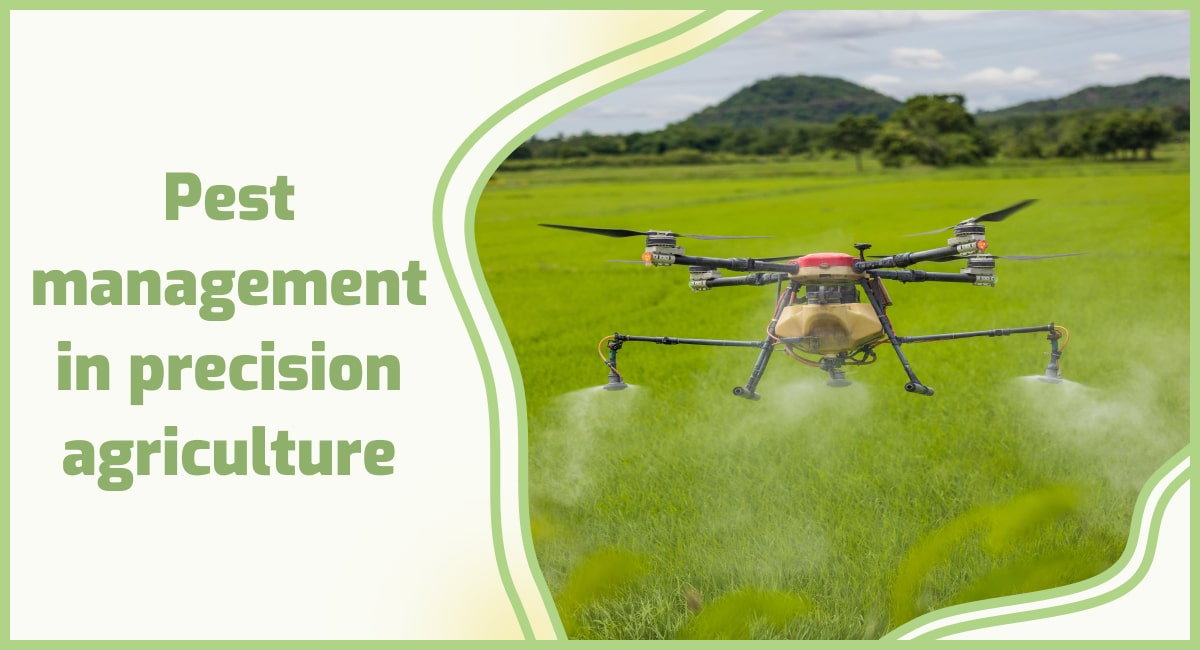
Pest management in agriculture is defined as “utilizing environmentally sensitive prevention, avoidance, monitoring, and suppression strategies, to manage weeds, insects, ligos, animals and other organisms that directly or indirectly cause damage or annoyance.”

Effective pest management relies on the use of any tools or strategies to reduce the impacts of pests on crops in order to meet landowner objectives.

What is Precision pest control in agriculture?

Precision pest control in agriculture can be defined as the utilization of technologies and strategies for monitoring, prevention, avoidance, and suppression of pests, diseases, weeds, and other living things that are directly or indirectly disrupting the agricultural production processes.

The solutions are relying on different tools and methods to reduce the impacts of pests on crops. Such tools and methods are divided into two major distinct categories:

  • Tools and methods for monitoring the pest occurrence and presence. In the context of precision farming for this category, there is a utilization of several technologies such as GIS, GPS, and RS.
  • Tools and methods for prevention and suppression of pest occurrence. In the context of precision farming for this category, there is a utilization of several technologies such as GIS, GPS, RS, and VRT.

Two approaches of precision pest control

Precision pest control in agriculture systems that implement precision technologies can be realized in two approaches:

1. Area-wide pest management in agriculture

Area-wide pest management is implemented in order to act preventively on pest outbreaks on a larger spatial resolution where many agricultural plots are included.

Acting under this approach means implementing Integrated Pest Management activities and all the available technologies that enable remote sensing of the pest occurrence and their stages of development.

The remote sensing technologies implemented in this approach are satellite and UAV imagery with NDVI and hyperspectral indices, GIS software for calculating the area of the affected fields, and agricultural IoTs that can remotely measure the environmental parameters and the presence of pests in order to feed the disease and pest models for forecasting the severity of the outbreak.

The IPM methods are used mostly because of their success in offering long-term solutions, preventing major outbreaks, and more sustainable management procedures for growers to use.

2. Site-specific Pest Management in agriculture

This approach is the absolute opposite of the approach explained above, which means that the precision pest control is done in a smaller site-specific management zone that can be even found on one individual agricultural plot.

Apart from the above-mentioned technologies for monitoring, in this approach, there is also extensive use of the Variable Rate Technology that enables the farmers to act precisely.

The methods in this site-specific control are more conventional, which means using specific pesticides in order to eradicate the pest or to act alleviate when the damages or the complete development of the pests is already present.

In these conditions, the VRT enables the farmers to lower their input costs for pesticides, as well as to reduce the negative impacts on the environment from using such chemicals.

Such a tool as GeoPard allows you to monitor crops, control the soil, and prevent the spread of pests in time.


Dažnai užduodami klausimai


1. What is the best way to prevent pest infestation?

The best way to prevent pest infestation is through integrated pest management (IPM) practices. Firstly, practice good sanitation by removing food sources, cleaning regularly, and properly storing crops and products.

Secondly, monitor pest activity through regular inspections, scouting, and use of traps. Thirdly, employ cultural methods such as crop rotation, companion planting, and maintaining healthy soil to discourage pests.

Lastly, utilize biological controls like natural predators or parasites, and if necessary, use targeted and judicious pesticide applications as a last resort. By combining these strategies, farmers can effectively prevent and manage pest infestations while minimizing environmental impact.

2. How are pests controlled in a crop field?

Pests in a crop field can be controlled through various methods. Firstly, cultural practices such as crop rotation, proper spacing, and maintaining healthy soil conditions help reduce pest populations.

Secondly, biological control involves introducing natural predators or beneficial insects to control pests. Thirdly, mechanical methods like handpicking or trapping can physically remove pests from the field.

Lastly, if pest populations reach damaging levels, targeted and judicious use of pesticides can be employed. Integrated pest management (IPM) combines these approaches to effectively control pests while minimizing environmental impact and ensuring crop health.

3. What is integrated pest management in agriculture?

Integrated Pest Management (IPM) is an approach in agriculture that aims to minimize reliance on chemical pesticides by integrating various pest management strategies. It involves monitoring and identifying pest populations, setting action thresholds, and implementing a combination of cultural, biological, and chemical control methods.

4. How does the government combat agricultural pests?

The government combats agricultural pests through various measures. Firstly, they conduct research and develop pest management strategies to address specific pests and crop diseases. Secondly, they establish regulatory frameworks and enforce standards for control practices and pesticide use.

Thirdly, government agencies provide education and training programs to farmers on pest identification, prevention, and management. Lastly, they may offer financial assistance or subsidies to farmers for implementing pest management practices and investing in pest-resistant crop varieties.

By taking these actions, the government plays a crucial role in safeguarding agricultural crops and ensuring food security.

5. What are the methods of pest control?

Methods of control include various approaches to manage pest populations. The methods include:

  • Cultural control
  • Biological control
  • Chemical control
  • Mechanical control
  • Integrated pest management (IPM)

Kaip naudoti žemės ūkio dronus tiksliojoje žemdirbystėje?

Drones are used for more than just military purposes. Farming drones can now help farmers and agriculture businesses maintain their land more effectively and efficiently.

The Growth of food production and consumption demands in the contemporary farming industry has led it to a critical turning point, with global food supplies shrinking faster than ever and commodity prices soaring like never before.

Agronomists and farmers throughout the world are under higher pressure to enhance efficient management of resources in the face of dwindling finances, whereas the “farm to plate” phenomenon has led to the increasing push for better traceability of food products as customers are getting quite concerned in the sources of the foods being bought and how they were produced.

Additionally, the agricultural industry’s attempts to preserve the supply chain’s security are getting more complicated due to climate change.

How are drones used in precision agriculture?

Drones are becoming more popular in agriculture as part of a holistic sustainable farming plan, allowing agronomists and farmers to aid in streamlining processes while obtaining important information on their crops through thorough data and topografijos analizė.

For instance, surveilling of crops is simplified by the information received from farming drones that are then applied in developing and implementing continuing enhancements such as alterations in fertilizer application or ditch placement.

Using GPS locations at various points along the route, instead of labor-intensive and time-consuming methods of data collection, food may be reliably tracked from the farm to the plate.

The role of farming drones in precision agriculture

In precision agriculture, UAVs are employed in a variety of tasks ranging from dirvožemio mėginių ėmimas and crop field analysis to planting and pesticide application.

Drones in agriculture can be combined with various imaging technologies like hyperspectral, multispectral, thermal, and so on to offer farmers temporal and site-specific information about crop health, fungal infections, growth bottlenecks, and so on.

UAVs are very effective for carefully keeping track of huge expanses of agricultural land, taking into account parameters such as slant and height, for instance, to discover the most effective planting regimen.

Importantly, the high-quality resolution of drone data may be used to measure the fertility of crops, enabling agronomists to apply fertilizers with great precision, reduce waste, and design or fix systems of irrigation.

After natural calamities, such as flooding, the technology can be especially useful in assisting farmers to survey damage over land terrains that may be inaccessible if you’re on foot. The following are some of the roles of drones in precision agriculture:

1. Crop surveying and mapping

Whereas crop evaluation used to have to be done manually, on foot, or from a tractor or using pricey satellite technology, drones in agriculture now allow us to analyze the health of vegetation from the skies in a matter of minutes.

Time-lapse drone photography, for example, can be used to precisely monitor yield growth and development over several days or weeks, and drone-driven NDVI mapping, which employs specialized sensors, is extremely useful for analyzing chlorophyll levels, detecting insects, pests, and disease, identifying weeds and measuring plant stress levels.

Farmers are then able to deal with issues promptly and make essential adjustments as and when they are needed to ensure higher productivity. It essentially means that farmers may be considerably more attentive to their crops’ ever-changing needs.

The mapping process of surveying crops with a drone is pretty straightforward. Many recent agricultural drone models come with flight planning software that enables the operator to draw a shape around the area to be covered. The software then automatically designs a flying course and, in some cases, even prepares camera image shots.

While flying, the drone captures images automatically using onboard sensors and the built-in camera, and it uses GPS to calculate when to take each shot. However, if your drone lacks these automatic features, one person must operate the drone while the other shoots images.

2. Weeds and pest control management

Crop failure is caused by weeds and pests in practically all major crops, including wheat, palm oil, soybean, rice, potato, cotton, and corn. Precision agriculture has a wide range of applications and uses in agricultural settings, including weds and pest management.

They with specialized cameras and sensors capable of detecting specific weeds and pests, as well as GPS technology capable of providing location information for field mapping, can assist in properly tracking enormous regions in a matter of seconds.

Drones in agriculture enable more precise weed strategy planning, increasing the efficiency of mechanical methods and decreasing herbicide growth, leading to cheaper costs, a slower establishment of weed resistance, and increased biodiversity.

Farming drones can cover many hectares in a matter of minutes by flying over the field and sending photographic data for weed and pest identification. Furthermore, farmers and companies may deal with weeds and pests as soon as possible before they harm the entire harvest.

3. Soils inspection

They are frequently used to inspect the status of the soil. In conventional agricultural methodology, there are several phases involved in inspecting the ground, such as visiting the field manually with equipment and reviewing soil samples for various parameters.

Farmers and academics, on the other hand, can watch vital indications of soil quality long after the seeds have been planted, thanks to improved land monitoring technologies.

Drones for soil and field study can assist in monitoring soil and plant density throughout the growing season to avoid “surprises” later on.

This proactive soil sampling with farming drones can assist farmers in staying ahead of any problems and making modifications as needed (e.g., adjusting laistymas, adding nitrogen trąšos, etc.) in order to maximize crop health.

Soil composition and condition monitoring are critical for modern farming operations. The more exact the data, like with most things, the better.

Farmers can make more informed judgments about where to plant which crops and when to make adjustments by using multispectral soil quality maps of their fields. As a result, with more sustainable land management approaches, yields will be larger and healthier.

4. Irrigation and water management

Water is a valuable commodity that is critical to the success of all farming operations, so it must be properly managed. Drone thermography, which employs thermal sensors to provide an image that indicates the moisture content of the land, comes into play.

With this information, informed judgments about irrigation operations may be made to guarantee that areas of the farm that require more water receive it, while areas that are already moist are not overwatered.

At the end of the day, they help to make farming a far more precise science by providing the benefits listed above. Water and irrigation concerns are not only expensive, but they can also reduce crop production. Drone surveying can be used to identify these issues before they become a problem.

5. Spraying management

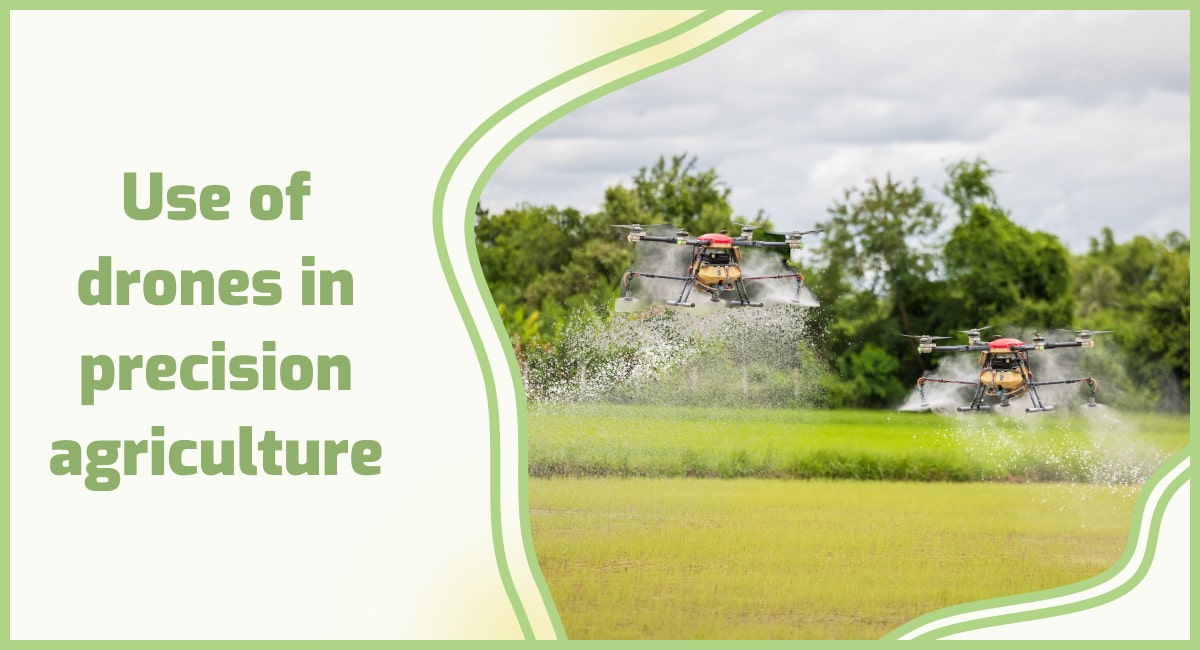
Another advantage of precision agriculture drones is the effective and efficient use of fertilizers. UAVs can use advanced sensor technology to pinpoint exactly where additional nutrients are needed, allowing them to be applied only where they are most needed.

Drones in agriculture are also very effective sprayers, capable of delivering precisely the correct amount of plant food at just the right time, successfully lowering the amount of fertilizer discharged by up to 20%. This not only reduces farming costs but also saves excessive environmental damage.

Types of drones used in Agriculture

Unmanned aerial vehicles come in a variety of shapes and sizes, and they can be classified into the following categories:

1. Fixed-wing drones

Fixed-wing use the lift and drag to maintain altitude in the same way as airplanes do. They are fairly simple to operate. It has a non-movable wing and a propeller that allows it to go ahead.

Fixed-wing Agriculture drones

Because of its design, it must always be moving relative to the air surrounding it in order to stay aloft. As a result, the wind can have a significant impact on its operation.

Another constraint is that larger drones require a runway area for deployment and retrieval, whereas smaller ones can be hand-launched and retrieved by landing on a soft surface.

2. Fixed-wing hybrid VTOL drones

A new category of hybrids that can take off and land vertically combines the benefits of fixed-wing drones with hovering ability.

Fixed-wing hybrid VTOL (Vertical Take-off and Landing) drones combine UAV (Unmanned Aerial Vehicle) qualities with the ability to fly in a single location while keeping hybrid traits.

These can take off from a single spot and fly vertically for an extended amount of time because of this function.

3. Multi drones

Multi-rotor drones are the most commonly used for mapping and modeling. These are made up of a fuselage and four motors that power the proper propellers. Multi-rotor are a fantastic choice for aerial photography due to their compact size and outstanding control.

Multi purpose Agriculture drones

They can simply hover and take off vertically, giving them even more mobility. Because of their design, they can also support the higher weight. The multi-rotor can transport goods such as a DSLR camera or other items that allow it to move.

These can easily navigate small spaces. Drones’ GPS receivers will allow them to hover and follow a predefined path using waypoints.

4. Single-rotor helicopter

Single rotor helicopter drones have more advantages than other types. It has a gas-controlled mechanism to boost endurance.

single-rotor helicopter drones

Aerodynamic standards stress that larger rotor blades result in less spinning and greater system reliability. As a result, single rotor helicopters are more practical than other types. Agriculture benefits from single-rotor helicopters’ longer rotor blades.

5. Tethered Drone

A tethered vehicle is a typical drone that is tethered to a wire in order to eliminate the need for a remote controller. Drone movement is thus constrained by the tether. Furthermore, tethered drones come in a wide range of configurations.

They can range from a normal drone that moves in accordance with the tether to a drone that is tethered with a microfilament wire and has an established power source for infinite flying.

According to the Association for Unmanned Vehicle Systems International, in the near future, 80 percent of Unmanned Aerial Vehicles (UAVs) will be employed for agricultural reasons.

But how prepared is the agricultural sector for the use of drones? And how prepared are they to operate fully on the farm?


Dažnai užduodami klausimai


1. What season do they fly the drones to analyze the crops?

Drones are typically flown to analyze crops during the growing season, which is when the crops are actively growing and developing. This period generally corresponds to spring and summer months, depending on the specific crop and location.

By flying drones during this season, farmers can obtain real-time data on crop health, identify areas of concern, and make informed decisions to optimize crop management and maximize yields.

2. Which natural resource can we help protect by using drone and precision application of inputs?

Using drones and precision application of inputs can help protect water resources. By accurately targeting the application of fertilizers, pesticides, and irrigation, farmers can minimize runoff and leaching of these substances into water bodies. Drones provide high-resolution imaging and data collection, allowing farmers to identify areas of over or under-application and adjust inputs accordingly.

3. How to operate the drone?

Operating a drone typically involves the following steps: Firstly, ensure the drone is fully charged and the necessary components, such as the remote controller and mobile device, are connected.

Secondly, conduct a pre-flight check, verifying that the drone’s sensors, propellers, and camera are functioning properly. Thirdly, plan the flight path and set waypoints if needed using the drone’s control software.

Lastly, launch the drone, maneuver it using the remote controller, and monitor the live video feed or captured images for analysis. Following local regulations and practicing safe flying techniques are also important for successful drone operation.

4. How do drones collect data?

Drones collect data through various sensors and technologies on board. These may include cameras, thermal sensors, LiDAR (Light Detection and Ranging), and multispectral sensors. As the drone flies over the target area, these sensors capture images, video, or other data. The collected data is then transmitted and stored on the drone or transferred to a computer for analysis.

Precision agriculture technology advantages and roles

Tiksliosios žemdirbystės technologijos yra modernių žemės ūkio technologijų pagrindas, tačiau tapo dažnai vartojamu ir šiek tiek neaiškiu terminu, populiariu internete ir tarp srities profesionalų.

Visas pasaulis atkreipia dėmesį į žemės ūkio sektorių, nes vis labiau suvokiama pramoninio ūkininkavimo ir klimato kaitos sąsajos, o nuolat auganti populiacija kelia rimtų susirūpinimų dėl pasaulinio maisto saugumo.

Jungtinių Tautų ataskaita prognozuoja, kad iki 2050 m. gyventojų skaičius išaugs iki beveik 10 milijardų, didžioji dalis to tikėtina įvyks besivystančiose šalyse, todėl jau ir taip nelygi maisto sistema patirs didelį spaudimą.

Investuotojai žvalgosi į AgTech sektorių, kuris šiuo metu aktyviai plėtoja inovatyvias technologijas, siekdami rasti sprendimus, kaip transformuoti žemės naudojimo praktiką, sustiprinti maisto saugumą taikant itin produktyvius ūkininkavimo metodus ir sušvelninti pramoninio ūkininkavimo neigiamą poveikį.

Suskaidykime pagrindinius principus ir susijusias technologijas, kad geriau suprastume, kas tai yra ir kaip tai dera į besikeičiančią maisto sistemą? Tai yra tiksli specifinių įvesties veiksnių taikymas kintamais kiekiais, siekiant optimizuoti ekonominį efektyvumą ir sumažinti atliekų kiekį.

Tradiciniame žemės ūkyje ūkininkai taikydavo tuos pačius resursus, tokius kaip drėkinimas, trąšos ar pesticidai, visame lauke vienodai paskirstydami, neatsižvelgdami į dirvožemio tipo ir jo biocheminių savybių skirtumus.

Tiksliųjų ūkininkavimas naudoja geospacialinius duomenis, kad analizuotų dirvožemio maistinių medžiagų, vandens prieinamumo, nuolydžio, saulės poveikio ir kitų tokių kintamų sklypo savybių svyravimus ir juos sprendžia tik tada, kai reikia.

Ši pagrindinė tikslumo žemės ūkyje praktika vadinama kintamo normos taikymu (VRA) ir būtent ji išskiria šį žemės ūkio judėjimą kaip pažangesnį ir atsakingesnį ūkininkavimo būdą.

Tradicinis komercinis ūkininkavimas tiesiog neturėjo prieigos prie tokių detalių duomenų, kokius turime šiandien, todėl buvo daromos prielaidos apie monotoniškus pasėlių ir laukų modelius, dėl kurių didele dalimi švaistomi ištekliai, o tai nebereikalinga turint dabartinius duomenis.

Kintamo normos taikymas yra labai svarbus, bet daugybė skirtingų technologijų padeda jam veikti arba pagerina kitus ūkio darbus, padarydamos juos sklandesnius ir efektyvesnius.

Koks yra tikslumas?

Precizija reiškia matavimo ar skaičiavimo tikslumo ar išsamumo lygį. Kitaip tariant, precizija yra rodiklis, kaip artimi yra keli matavimai ar skaičiavimai vienas kitam, arba kaip gerai galima pakartoti vieną matavimą ar skaičiavimą.

Pavyzdžiui, jei pieštuko ilgį matuotumėte liniuote, jūsų matavimo tikslumas priklausytų nuo mažiausio liniuotės matavimo vieneto. Jei liniuotė turėtų milimetrų žymes, jūsų matavimas būtų tikslus iki artimiausio milimetro. Jei liniuotė turėtų centimetrų žymes, jūsų matavimas būtų tikslus iki artimiausio centimetro.

Tikslioji žemdirbystė

Tiksli žemdirbystė (PA) – tai ūkininkavimo metodas, kuriame pasitelkiamos technologijos ir duomenų analizė, siekiant optimizuoti pasėlių derlių ir sumažinti atliekas, tuo pačiu švelninant poveikį aplinkai.

PA apima duomenų rinkimą ir analizę iš įvairių šaltinių, tokių kaip orų prognozės, dirvožemio mėginiai ir pasėlių augimo tempai, siekiant priimti pagrįstus sprendimus dėl pasėlių valdymo.

Šis metodas leidžia ūkininkams tiksliau naudoti trąšas ir pesticidus, sumažinant reikiamą kiekį ir sumažinant per didelio naudojimo ar švaistymo riziką. Tai taip pat padeda ūkininkams nustatyti savo laukų vietas, kur reikia daugiau dėmesio ar specialių procedūrų, o tai gali padidinti derlių ir sumažinti išlaidas.

Tiksliojo ūkininkavimo technologijos apima pasaulinę padėties nustatymo sistemą (GPS), dronus, jutiklius ir mašininio mokymosi algoritmus. Šios priemonės leidžia ūkininkams rinkti ir analizuoti duomenis realiuoju laiku, taip sudarydamos sąlygas priimti savalaikius sprendimus dėl pasėlių valdymo.

Tai tampa vis populiaresniu, nes ūkininkai siekia padidinti derlių ir sumažinti atliekas, kartu mažindami poveikį aplinkai. Tai taip pat laikoma būdu spręsti didėjančio pasaulio gyventojų maitinimo iššūkius, mažinant žemės ūkio poveikį aplinkai.

Kokie yra tiksliosios žemdirbystės technologijos privalumai?

Tiksliąją žemdirbystę ir VRA (kintamojo normų taikymo) sprendimus, kurie teikia naudos visiems žemės ūkio operacijų suinteresuotiesiems šalims beveik visais įmanomais būdais, galima įvardyti pagrindinius privalumus: daugiau metrikų žemės ūkio stebėsenai, pagerintas informuotų ir efektyvių sprendimų priėmimas, itin lengvai prieinami ūkininkavimo įrašai, galimybė geriau apsaugoti pasėlius ir investicijas, supaprastintas drėkinimo valdymas ir aukštesnio lygio žemės valdymas bei tvariosios praktikos taikymas.

Pasigilinkime į kiekvieną privalumą ir išryškinkime pagrindinę naudą, kurią jie suteikia ag specialistams:

1. Išplėstiniai žemės ūkio stebėsenos rodikliai

Ryškiausias sistemų, naudojančių tiksliosios žemdirbystės technologijas ar praktikas, privalumas yra didžiulis specifinių metrikų kiekis, kurį jos renka ir naudoja savo veiklai stebėti. Kiekvienas aspektas ūkyje, nepriklausomai nuo jo dydžio ar vietos, yra nuodugniai stebimas, kaupiami, analizuojami ir naudojami kiekybiniai duomenys.

Metrikos nuolat prieinamos peržiūrėti ar palyginti, o daugiasluoksnių analizių dėka galima suprasti sudėtingus ryšius tarp dirvožemio chemijos ir pasėlių mitybos, dirvožemio šviesumo ir derliaus produktyvumo, vandens tiekimo ir drenažo neefektyvumo – ir tai tik keletas pavyzdžių.

Išplėstiniai žemės ūkio stebėsenos rodikliai

Darbo srityje, kuri istoriškai buvo siejama su nestabilumu ir rizika, tikslioji žemdirbystė pavertė ūkininkavimą kruopščiai sudarytu duomenų taškų žvaigždynu, o iš jo pragyvenančius žmones – juos tiriančiais ir suprantančiais astronomais.

2. Pager efektyvus sprendimų priėmimas

Sprendimų priėmimas, grindžiamas duomenimis, reiškia, kad anksčiau sudėtingos sąnaudų ir naudos analizės bei spėlionės pašalinamos, o naudojamos aiškios statistinės apskaičiuotosios suteikia labai tikslius rezultatus per trumpesnį laiką.

IoT tinklai, API integracijos, o išmanieji įrenginiai veikia kartu kurdami ūkininkavimo sistemas, kurios reaguoja į realaus laiko informaciją apie visus operacijos aspektus, kad sprendimai būtų priimami beveik akimirksniu, o visi sprendimams reikalingi duomenys būtų pasiekiami vienu mygtuko paspaudimu.

Tai ypač pasakytina apie programinės įrangos platformas, kurios visus svarbius duomenis apjungia į vieną patogią naudoti paketą ir teikia analizę, kuri gali padėti priimti protingiausią sprendimą, remiantis jūsų duomenimis ir norimais rezultatais.

3. Ūkininkavimo dokumentų prieinamumas

Patobulintas prieinamumas prie detalių įrašų ir duomenų gali suteikti žemės ūkio verslams ir agronomams naują atskaitomybės lygį už tai, kas veikia, o kas ne, visa tai pridedama prie nuolat augančios išteklių bazės, iš kurios galima priimti protingus ir pagrįstus sprendimus.

Tai taip pat sumažina žemės ūkio profesijų keliamą stresą, kur daugelį anksčiau nekontroliuojamais ar atsitiktiniais laikytų veiksnių – tokių kaip topografiniai nelygumai ar orų modeliai – dabar galima daug tiksliau prognozuoti ir į juos atsižvelgti, paliekant daugiau laiko kitiems verslo aspektams valdyti.

4. Pasėlių ir gyvybės išteklių apsauga

Planavimas nenumatytiems atvejams, rizikos vertinimas ir pasėlių apsauga gali būti įtraukti į programinę įrangą, kuri nuolat stebi žemės produktyvumo pokyčius ir grėsmes, leidžiant ūkininkams visada būti vienu žingsniu priekyje ir sumažinti su jų profesija susijusią riziką.

Tai taip pat atveria galimybes žemės ūkio darbininkams ir darbuotojams gauti geriau apmokamų darbo vietų technologijų ir programinės įrangos srityse, nes žemės ūkio darbai tampa vis mažiau reikalingi, o programavimo ir įrangos priežiūros pozicijos auga.

Kenksmėjai, ligos ir ekstremalūs orų reiškiniai gali būti anksti stebimi ir diagnozuojami, siekiant užkirsti kelią žalai ir suteikti pakankamai laiko tinkamam reagavimui ar atsakomajam smūgiui įgyvendinti.

5. Geresnis drėkinimo valdymas

Šiuo metu apskaičiuojama, kad žemės ūkis naudoja daugiau nei 70% pasaulyje esančio gėlo vandens, o dideli jo kiekiai švaistomi dėl neefektyvių drėkinimo sistemų. Daugelyje pagrindinių auginimo regionų jau jaučiamas vandens trūkumas, o Pasaulio gamtos fondo (WWF) statistika rodo, kad iki 2025 m. du trečdaliai pasaulio gyventojų susidurs su vandens trūkumu.

Geresnis drėkinimo valdymas

Tai pabrėžia, koks svarbus šiuolaikinėje žemdirbystėje yra efektyvus drėkinimo valdymas, o kintaus normos drėkinimas (VRI) gali labai padėti taupyti vandens išteklius, pašalindamas drėkinimo „negyvąsias zonas“ ir kiekvieną vandens lašą panaudodamas produktyviai.

VRI pasitelkia duomenis iš geografinės erdvės duomenų analizės, meteorologinių stebėjimų ir dirvožemio drėgmės jutiklių, kad pasėliams, kuriems reikia vandens, jį tiektų tiksliais kiekiais ir pritaikytų laistymą atsižvelgdama į tokius veiksnius kaip nuolydis ir nuotėkis, kurie lemia vandens įgeriamumą į dirvožemį.

6. Darnumas

Tiksli žemdirbystė naudinga ne tik žemės ūkio įmonėms, bet ir aplinkai, nes optimizavus išteklių efektyvumą sumažėja nereikalingų teršalų, patenkančių į dirvožemį, vandenį ir orą, kiekis, o duomenų analitika leidžia nuolat stebėti dirvožemio būklę.

Tvarumas yra neatsiejama tiksliosios žemdirbystės technologijos dalis, nes didėjanti pasaulio populiacija darys vis didesnį spaudimą jau nualintiems dirvožemio sistemoms, todėl būtinos praktikos, skatinančios biologinę įvairovę ir vietinių ekosistemų išsaugojimą.

Daug jautresnis supratimas apie žemės sklypą, atsirandantis dėl šio tipo žemės ūkio, ugdo vertinimą įvairovės ir mikroskirtumų, esančių kraštovaizdyje.

Catering to those differences through VRA means that biodiversity can be more effectively preserved, and it provides agricultural professionals with a systems lens through which to view their operation and appreciate the complex biological, chemical, and physical linkages that occur.

Santyklis tarp klimato kaitos ir žemės naudojimo yra teigiamas grįžtamojo ryšio ciklas, kuriame abu nuolat veikia vienas kito būklę.

Tradicinė žemdirbystė gerokai prisidėjo prie to, kad klimatas atsidūrė dabartinėje kritinėje padėtyje, jungdama priklausomybę nuo iškastinio kuro ir anglies dioksido absorbavimo vietų, tokių kaip sveiki dirvožemiai ir miškai, naikinimą, siekiant auginti monokultūras.

Žemės ūkio specialistų pragyvenimo šaltiniai bus vieni pirmųjų, kuriuos labiausiai paveiks besikeičiantys klimato modeliai ir ekstremalūs oro reiškiniai, tačiau tiksliosios žemdirbystės tvarumas leidžia atidžiai stebėti šiltnamio efektą sukeliančių dujų emisijas ir anglies sekvestraciją, kad būtų sumažintas tolesnis neigiamas poveikis, o aktyvios klimato kaitos mažinimo strategijos gali būti įtrauktos į žemės valdymą.

Kartu su regeneracine žemdirbyste ir dirvožemio formavimo praktika ji gali tapti viena svarbiausių priemonių, kurias galime naudoti kaip pasaulinė visuomenė, siekdami sumažinti visuotinį atšilimą.

Svarbios technologijos tikslioms žemės ūkio technologijoms

Sklandus tiksliosios žemdirbystės veikimas priklauso nuo technologijų, kurios gali efektyviai rinkti duomenis, automatizuoti sistemas, sukurti pažangius ryšių tinklus visose srityse ir taikyti įvairius trąšų bei kitų medžiagų kiekius.

Kaip ir viskas 21-ajame amžiuje, technologijos tampa esmine žemės ūkio dalimi, o Agtech sektoriuje nuolat atsiranda naujovių ir išradimų, kurie gali būti naudojami siekiant dar tikslesnių ir supaprastintų praktikų.

Štai dešimt vertingiausių technologijų, naudojamų šioje srityje, ir kaip jos tenkina specifinius poreikius ar teikia gyvybiškai svarbias paslaugas žemės ūkio profesionalams.

1. Išmanieji prietaisai

Išmanieji įrenginiai, tokie kaip telefonai, planšetiniai kompiuteriai ir laikrodžiai, jau yra neatsiejami daugumos kasdienybėje, bet dabar jie tapo būtinais įrankiais ūkininkams, agronomams ir agrobizniui, siekiant efektyviai valdyti savo veiklą.

Tūlinė prieiga prie informacijos, akimirksniu komunikacija su kitomis šalimis, kalendoriai ir planavimo galimybės, bei aukštos raiškos kamerų naudojimas greitai nustatyti ir diagnozuoti kylančias problemas yra tik keletas iš labiausiai pastebimų privalumų, kuriuos išmanieji įrenginiai gali pasiūlyti žemės ūkio sektoriaus profesionalams.

Be to, galimybė naudotis įrenginiais, suderinamais su programėlėmis, yra būtina sąlyga naudojantis daugeliu kitų šiol minimų technologijų, ir leidžia žmonėms pasinerti į plačiai prieinamų nemokamų žinių pasaulį.

Taip pat yra daugybė kūrybingų programėlių, skirtų agrarinių specialistų poreikiams, kurios prisideda prie efektyvesnės praktikos ir kitais būdais, pavyzdžiui, padedančios atpažinti ar diagnozuoti įvairių kenkėjų rūšis ar ligas, arba siūlančios specifines platformas ūkininkams bendrauti lokaliai.

Ūkininkai, norintys pereiti prie tiksliosios žemdirbystės, turi turėti išmaniuosius įrenginius, kad padėtų pagrindus viskam kitam, nes duomenų prieinamumas ir momentinis ryšys yra būtini efektyvesnėms operacijoms.

2. Daiktų internetas (IoT)

IoT veikia kartu su išmaniaisiais įrenginiais, sujungdama visą susijusią informaciją į vieną saugų informacijos tinklą, prie kurio galima prieiti bet kur ir bet kada.

Tokie išsamesni duomenys, renkami iš kitų šiame sąraše esančių įrenginių, pavyzdžiui, dirvožemio ar gyvulių jutiklių, lauke esančios įrangos ir orų prognozių, gali būti susiejami, kad būtų galima nedelsiant reaguoti į aplinkos grėsmes arba greitai koordinuoti užduotis.

Tikrasis daiktų interneto (IoT) prijungtų įrenginių akcentas yra galimybė teikti ūkininkams ar kitiems atitinkamiems specialistams realaus laiko naujienas, kad ir kur jie būtų, ir atverti ryšių kelius net tūkstančio akrų ploto valdose.

3. GPS ir palydovų duomenys

GPS technologija nuo pat pradžių sudarė sąlygas tiksliajai žemdirbystei, atversdama geografinių duomenų pasaulį ir suteikdama ūkininkams detalizuotus žemėlapius, kurie visiškai pakeitė maisto auginimo būdus.

Dabar yra daugybė būdų pasiekti ir manipuliuoti įvairiais nuotolinės stebėsenos būdu įgytais duomenų rinkiniais, tačiau pati palydovų technologija išlieka tiksliosios žemdirbystės technologijos kertiniu akmeniu.

Kasdien matome eksponentiškai gerėjančią palydovinių vaizdų kokybę, vis tikslesnius vaizdus ir daugiau misijų, kurios gali suteikti mums labai detalią informaciją apie žemės sistemos sąveikas ir pasikeitimus laikui bėgant.

4. Topografijos lauko profilis

Vietovės topografiniai matmenys daro didelę įtaką pasėlių derliui, nes jie turi didelę įtaką vandens ir maistinių medžiagų drenažui per kraštovaizdį ir dirvožemio erozijos modeliams.

Kintamo kiekio trąšų ir laistymo panaudojimą reikia pritaikyti pagal ūkio reljefą, atsižvelgiant į aukštį, nuolydį ir pašto kodą, siekiant užtikrinti didžiausią derliaus potencialą ir kuo mažiau švaistyti išteklius.

3D žemėlapių įrankiai kurie sukuria pažangius topografijos profilių modelius, yra labai svarbūs informuojant apie VRA ir parodant didelio masto sąsajas su vandens baseinais ir paviršinio drenažo modeliais. Juos galima naudoti kartu su pagrindiniais sluoksniais, pavyzdžiui, LIDAR, ir dangos žemėlapiais, pavyzdžiui, organinių medžiagų pH pasiskirstymu, kad būtų galima atlikti daugiasluoksnę dirvožemio profilio analizę.

5. Programinės įrangos analizės platformos

Programinę įrangą kaip paslaugą teikiančios platformos yra pagrindinis komponentas, užtikrinantis tiksliosios žemdirbystės prieinamumą žemės ūkyje dirbantiems asmenims, norintiems taikyti VRA sėjant, tręšiant ir laistant laukus.

Šios platformos, kaip „GeoPard“, teikia visą sudėtingą duomenų analizę ir apdorojimą, reikalingą žaliems duomenims paversti aiškiais sprendimais, ir leidžia vartotojams atskirti skirtingus kintamuosius, tokius kaip reljefas, dirvožemio maistinės medžiagos, dirvožemio drėgmė, dirvožemio ryškumas ir daugelis kitų, kad būtų sukurtas konkretus VRA žemėlapiai.

Naudojant API integracijas ir suderinamumą su IoT, šie VRA žemėlapiai gali būti įkeliami į mašinų parkus ir supaprastina kiekvieną VRA proceso žingsnį – nuo duomenų rinkimo iki trąšų ir augalų apsaugos priemonių naudojimo.

Šios platformos veikia kaip duomenų centrai, kur visa surinkta informacija iš mašinų, jutiklių ir palydovų gali būti sutelkta vienoje saugioje vietoje ir lyginama daugiasluoksniu analizu.

6. Robotika

Robotika yra puikus priedas prie tiksliosios žemdirbystės optimizavimo misijos, nes savaime jie gali būti užprogramuoti dirbti griežtu grafiku ir be tokių pat apribojimų kaip darbuotojai žmonės.

Svarbios technologijos tiksliosios žemdirbystės srityje

Robotiniai prietaisai gali dirbti visą parą, esant daugeliui oro sąlygų, turi tikslų vairavimą ir paprastai valdomi nuotoliniu būdu iš išmaniųjų įrenginių.

Kadangi pasaulinė tendencija rodo, jog jaunesnės kartos palieka žemės ūkio regionus, siekdamos geriau apmokamų darbų miestuose, robotika atlieka esminį vaidmenį atliekant vis daugiau ūkininkavimo darbų, reikalingų augančioms miestų populiacijoms maitinti.

Robotika dabar yra svarbi daugelio tiksliosios žemdirbystės operacijų dalis ir gali atlikti visas veiklas nuo sėjos iki piktžolių naikinimo ir derliaus nuėmimo. Dabartinė robotikos kryptis – judama link mažesnių robotų flotilių, kurie yra lengvesni, greitesni ir lengviau valdomi nei didelės, traktorių primenančios mašinos, ypač todėl, kad dabar juos galima taip lengvai valdyti prijungus prie daiktų interneto (IoT) tinklų.

7. Dronai

Dronai pasirodo esantys labai svarbiais įrankiais trąšų ir purškiamų medžiagų iš viršaus panaudojimo srityje.

dronai greitai skraido ir gali paskirstyti specifines trąšas

Naudojant GPS konfigūraciją dronai gali greitai skraidyti ir lokaliai paskirstyti trąšas dideliuose plotuose, išvengiant dirvožemio sutankinimo, kurį sukelia dideli ir sunkūs traktoriai.

Be to, traktorių vėžės ir keliai tampa nereikalingi, naudojant dronus, ir atveria daugiau produktyvios žemės plotų derliui augti be kliūčių. Dronų surinkta informacija ir vaizdai taip pat prisideda prie didesnės duomenų bazės ir gali būti naudojami greitai nustatyti kenkėjų ar ligų problemas, kol jos neišplito.

Šių mažų mašinėlių judrumas leidžia joms skristi aukštai, kad būtų galima atlikti darbus arba rinkti duomenis plačioje teritorijoje, arba priskristi arti konkretaus pasėlio ploto, kad būtų galima analizuoti vabzdžių kiaušinėlius ar pasėlių žalą.

8. Bevieliai jutikliai

Norint papildyti didžiulę turimų palydovinių vaizdų duomenų bazę, belaidžiai jutikliai suteikia galimybę žemėje rinkti informaciją apie dirvožemio mitybą, augalams prieinamą drėgmę, gyvulių judėjimą ir iš esmės viską, prie ko jie yra pritvirtinti ar pasodinti.

Belaidžiai jutikliai ir didžiulė palydovinių vaizdų duomenų bazė

Šie duomenys suteikia dar subtilesnį supratimą apie tikslius visų žemės ūkio veiklos komponentų poreikius, o gyvulių jutikliai gali net matuoti atskirų gyvūnų kūno temperatūrą ir drėkinimo lygį, siekiant užtikrinti populiacijos sveikatą ir apriboti infekcinių ligų plitimą, kurios yra dažnos komercinėje gyvulininkystėje.

Dirvožemio ir drėgmės jutikliai gali teikti tiesioginius atnaujinimus apie cheminius ciklus, tokius kaip vanduo ir azotas, kurie dėl junginių prigimties nuolat kinta, siekiant užtikrinti kuo tikslesnį tarpinių produktų laiko nustatymą.

Dirvožemio matavimo ir analizės sistemos, tokios kaip „SoilOptix“ ir „TopSoil Mapper“, matuodamos radiaciją surenka neprilygstamą kiekį duomenų apie dirvožemio sistemas ir gali būti naudojamos išsamiems VRA (kintamojo normos taikymo) žemėlapiams sudaryti.

Taip pat yra jutiklių, leidžiančių apskaičiuoti ir stebėti derlių nuimant, o dar pažangesniu lygiu kai kurie jutikliai gali apskaičiuoti grūdų baltymų kiekį matuodami derliaus duomenys.

9. Orai modeliavimo paslaugos

Oro duomenų modeliavimo paslaugos egzistuoja jau daugybę dešimtmečių, tačiau, kaip ir su kiekviena šio sąrašo technologijų, jos nuolat tobulėja ir siūlo tikslesnes prognozes mikroklimatui.

Dėl klimato kaitos ekstremalių orų reiškinių, tiesiogiai darančių įtaką ūkininkų pragyvenimui, vis labiau reikia tikslių orų modeliavimo paslaugų.

Oro duomenų modeliavimo paslaugos

Net ir taikant tiksliosios žemdirbystės technologijas, pasėlių derlius išlieka itin pažeidžiamas staigių oro reiškinių, tokių kaip sausros, potvyniai, audros ir šalnos, o pažangios modeliavimo technologijos yra gyvybiškai svarbios, kad būtų galima parengti tinkamus nenumatytų atvejų planus.

10. API integravimas ir bendradarbiavimas

API integracijos, sukurtos palengvinti kitų technologijų naudojimą, tampa nepakeičiamos sklandžiai ir sėkmingai įgyvendinant visas kitas tiksliosios žemdirbystės technologijas.

Kadangi AgTech sektorius yra labai įvairus ir siūlo platų įvairių įmonių sprendimų spektrą, bendradarbiavimas per API integravimą yra geriausias būdas efektyviausiai keistis duomenimis ir juos panaudoti vartotojams.

Tikslioji žemdirbystė iš esmės yra susijusi su greito, lengvo ir tikslaus duomenų prieinamumo, siekiant informuoti praktiką, o API integracijos yra tai, kas sujungia šį procesą.

11. Dirbtinis intelektas (DI) ir mašininis mokymasis (MM)

Dirbtinis intelektas ir mašininis mokymasis yra daugelio svarbių visuomenės dalių ateitis, ir nors iki jų įgyvendinimo daugelyje ūkininkavimo operacijų dar toli, šio tipo technologijų nauda precizinio ūkininkavimo požiūriu jau akivaizdi.

Visų pirma, DI pakelia pagrįstą duomenimis grindžiamą sprendimų priėmimą į kitą lygį, kurdama visiškai autonomines ir savireguliuojančias ML sistemas, kurios yra užprogramuotos tikslumui.

Tikslumo žemės ūkio technologijų ateitis: pirmyn ir į viršų

Žmogiškoji klaida egzistuoja mašininio mokymosi ir dirbtinio intelekto integracijos lygtį, o jos poveikis maisto gamybai yra milžiniškas.

Tikslumo žemės ūkio technologijų ateitis: pirmyn ir į viršų

Taigi, kas toliau? Atsižvelgiant į sprogstamąsias naujoves žemės ūkyje, įvykusias per pastarąjį dešimtmetį, ir prognozuojamą maisto paklausos padidėjimą per ateinančius kelis dešimtmečius, galime būti tikri, kad technologijos vis labiau ir labiau integruosis į mūsų žemės ūkio sistemas.

Jau horizonte matomos visiškai automatizuotos sistemos, valdomos dirbtinio intelekto, kurios itin greitai reaguotų į menkiausius sistemos pokyčius ir galėtų užtikrinti didesnį pelningumą nei kada nors anksčiau žemės ūkyje.

Agronomai, žemės ūkio verslai ir kiti žemės ūkio specialistai, svarstantys, ar verta pereiti prie tiksliosios žemdirbystės, gali būti užtikrinti dėl šios sistemos teikiamų privalumų visiems suinteresuotiems subjektams ir kaip ji prisidės prie bendro jų veiklos ilgalaikio stabilumo.

Paminėtų technologijų įperkamumas yra pagrindinė įgyvendinimo kliūtis, tačiau finansų pasaulis pradeda apsidrausti, teikdamas pirmenybę tvariam žemės ūkiui kaip pagrindinei atsparių ir maistu aprūpinančių sistemų kūrimo priemonei, o investicijos į AgTech tai atspindi.

Kol pažangumas šioje srityje išliks prieinamumo ir tvarumo pagrindu, savarankiška maisto sistema, galinti pamaitinti daugiau nei 10 milijardų žmonių, yra pasiekiama.


Dažnai užduodami klausimai


1. Koks galimas neigiamas naujų žemės ūkio technologijų aspektas?

Galimas neigiamas naujų žemės ūkio technologijų aspektas yra didelė pradinė investicijų kaina. Diegiant tokias pažangias technologijas kaip tiksliosios žemdirbystės sistemos, dronai ar automatizuota technika, gali tekti patirti didelių pradinių išlaidų.

Tai gali kelti finansinę naštą smulkiems ūkininkams arba tiems, kurie turi ribotų išteklių. Be to, diegiant naujas technologijas gali prireikti laiko mokantis, todėl ūkininkams reikės įgyti naujų įgūdžių ir žinių.

Be to, didesnis pasitikėjimas technologijomis gali lemti galimą darbo vietų praradimą ir sumažinti žemės ūkio darbininkų užimtumo galimybes. Tinkamas planavimas, mokymai ir finansinė parama gali padėti sušvelninti šiuos iššūkius ir užtikrinti sėkmingą perėjimą prie naujų žemės ūkio technologijų.

2. Koks skirtumas tarp daugkartinio auginimo ir modernaus ūkininkavimo metodo?

Pagrindinis daugiakultūrinio ūkininkavimo ir modernių žemės ūkio metodų skirtumas slypi jų požiūryje į augalų auginimą.

Daugiakultūrinis auginimas apima daugelio augalų auginimą tuo pačiu metu arba paeiliui toje pačioje žemėje, siekiant maksimaliai išnaudoti turimus išteklius ir diversifikuoti derlių.

Priešingai, šiuolaikiniai ūkininkavimo metodai, tokie kaip monokultūra ar specializuota augalininkystė, daugiausia dėmesio skiria vienos kultūros auginimui didelio masto, mechanizuotu būdu, siekiant didesnio produktyvumo ir efektyvumo.

3. Kaip jie praktikavo tiksliają žemdirbystę?

Tikslumas žemės ūkyje pasiekiamas taikant pažangias technologijas ir preciziškus valdymo metodus.

Ūkininkai naudoja GPS sistemas tiksliai nustatyti laukų ribas, sukurti tikslius sėjos ir derliaus nuėmimo modelius bei optimizuoti išteklių naudojimą.

Dirvožemio sąlygoms, augalų būklei ir aplinkos veiksniams stebėti realiuoju laiku naudojami jutikliai ir duomenų rinkimo priemonės.

4. Kas yra tikslioji žemdirbystė prieš išmaniąją žemdirbystę?

Tiksli ir pažangi žemdirbystė yra du dažnai painiojami terminai, tačiau jų akcentai šiek tiek skiriasi. Tikslioji žemdirbystė pirmiausia pabrėžia technologijų, duomenų ir analizės naudojimą žemės ūkio praktikoms optimizuoti tiksliai ir lokalizuotai.

Kita vertus, pažangioji žemdirbystė apima platesnę koncepciją, kuri ją įtraukia, bet taip pat apima įvairių technologijų, tokių kaip daiktų internetas (IoT), dirbtinis intelektas (AI) ir didelių duomenų analitika, integravimą, siekiant sukurti labiau tarpusavyje susijusią ir automatizuotą žemės ūkio sistemą.

5. Ar tikslusis ūkininkavimas naudoja dirbtinį intelektą?

Taip, iš tiesų naudojama dirbtinio intelekto (DI) technologija. DI algoritmai ir mašininio mokymosi metodai yra naudojami analizuojant didžiulius tiksliųjų technologijų surinktus duomenis. DI padeda interpretuoti palydovines nuotraukas, jutiklių duomenis ir istorinę informaciją, kad būtų galima pateikti tikslius prognozių ir rekomendacijas, optimizuojant pasėlių valdymą.

6. Kuo tiksliųjų technologijų ūkininkavimas yra naudingas aplinkai?

Jis turi keletą aplinkosauginių privalumų. Tiksliai naudojant trąšas, pesticidus ir vandenį, sumažėja perteklinio naudojimo rizika ir aplinkos tarša. Optimalus išteklių valdymas ir tikslingos intervencijos mažina bendrą ūkininkavimo veiklos ekologinį pėdsaką. Be to, taikant tokias praktikas kaip dengiamieji pasėliai ir sėjomaina, skatinama dirvožemio sveikata ir biologinė įvairovė.

7. Kas išrado tiksliojo ūkininkavimo technologijas?

Tai, dar žinoma kaip valdos valdymas pagal poreikius, laikui bėgant tobulėjo integruojant įvairias technologijas ir praktikas. Nėra vieno išradėjo, kuriam ji būtų priskiriama, nes ji atsirado dėl žemės ūkio technologijų, įskaitant GPS, nuotolinę patirtį ir duomenų analizę, pažangos.

8. Koks tiksliosios žemdirbystės poveikis gyvūnų gerovei?

Tai daro teigiamą poveikį gyvūnų gerovei. Stebėdami ir analizuodami duomenis realiuoju laiku, ūkininkai gali užtikrinti optimalias sąlygas gyvuliams, įskaitant temperatūros kontrolę, pašarų tvarkymą ir sveikatos stebėseną.

Tiksliosios technologijos leidžia geriau diagnozuoti ligas ir anksti pradėti gydymą, sumažinant gyvūnų kančių riziką. Didesnis efektyvumas valdant išteklius taip pat užtikrina kokybiško pašaro ir vandens prieinamumą gyvūnams.

9. Kokie yra tiksliosios (valdomosios) žemdirbystės metodai?

Jis naudoja įvairias žemės ūkio praktikų optimizavimo technikas. Šios technikos apima GPS (pasaulinę padėties nustatymo sistemą) tiksliam laukų žymėjimui, palydovinius vaizdus pasėlių sveikatos ir augimo modelių stebėjimui bei jutiklius, skirtus realaus laiko duomenims apie dirvožemio drėgmę, maistinių medžiagų kiekius ir oro sąlygas rinkti.

Kintamo normos technologijos leidžia tiksliai paskirstyti trąšas, pesticidus ir drėkinimą, atsižvelgiant į specifinius lauko poreikius. Duomenų analizė ir mašininio mokymosi algoritmai suteikia ūkininkams galimybę priimti pagrįstus sprendimus ir įgyvendinti vietovėms specifines intervencijas, taip didinant produktyvumą ir išteklių efektyvumą.

10. Kuo skiriasi tikslumas ir preciziškumas žemės ūkyje?

Agronomijoje tikslumas reiškia išmatuotos vertės artumą tikrajai arba užduotajai vertei. Jis parodo bendrą matavimo teisingumą.

Tikslumas, kita vertus, reiškia matavimų nuoseklumo ir daugkartinio pakartojimo lygį. Jis rodo, kaip artimai sutampa pakartotiniai matavimai, nepriklausomai nuo jų tikslumo.

SoilOptix® Duomenų analizė tiksliosios žemdirbystės platformoje GeoPard

The importance of healthy soil systems in agriculture have been historically undervalued, but innovative agtech companies like DirvožemioOptix® are shifting this paradigm with data that supports both farmers and local environments. 

Precision agriculture is creating increasingly economic and sustainable systems with modern technologies that can measure vital aspects of land composition, ensuring crops and livestock are managed as efficiently as possible.

SoilOptix ® facilitates this type of sustainable land management by enabling the accurate collection of soil data without doing a labour-intensive soil sampling. 

Soil Data & Variable Rate Application (VRA) maps

A main reason for global topsoil loss has been the mismanagement of fertilizers, pesticides, irrigation systems, and other agro-inputs on a large scale. It is not economically feasible to apply the same amount of, for example, high Nitrogen fertilizers over an area where only a fraction is lacking in Nitrogen.

Variable rate Lime application based on SoilOptix® pH levels. Variable rate Lime application based on SoilOptix® pH levels. The cost of product is calculated by GeoPard

This is also commonly done with the comprehensive application of lime to balance out acidic soils, despite the fact that only a few specific soil patches with a low pH may need it. Assuming a monotonous soil composition across large areas simplifies what is one of nature’s most complex systems.

This is where SoilOptix® data contributes immense value to farmers, who can view maps that specify exactly where and in what quantities different types of fertilizers and other inputs need to be applied via VRA.

This not only saves costs for farmers, but also contributes to the longevity of that land parcel, which may have otherwise been over-fertilized and expedited the eutrophication of nearby lakes and water sources.

Precision agriculture is all about providing agricultural systems with tools for economic and sustainable development, and this is demonstrated by using soil data to maintain and create healthy soil systems that are actually cheaper to amend. As GeoPard co-founder Dmitry Dementiev says:

“Modern precision agriculture is the synergy of agronomy, technology, software, hardware, all of which optimize sustainable and economic decision making. We are happy to work with SoilOptix®, and analyze soil data from the soil ground scanners to provide real time value to agronomists.” 

Understanding SoilOptix® data through GeoPard

Importing SoilOptix® data into GeoPard can simplify the process of understanding soil mineral composition by providing clearly mapped value gradients that are designed for VRA.

The variety of soil elements that SoilOptix® technology measures can be viewed with different layers in GeoPard, and can be compared and contrasted to better visualize patterns and correlations in a land parcel.

It is also possible to create Rx maps with a multi-layer approach, where users can combine and cross-analyze SoilOptix® data with GeoPard data sets like historical vegetation, topography, yield, or soil moisture.

“The appetite for soil data as part of this modern precision agriculture system is ever increasing as demand for a more healthy soil landscape evolves. We are happy to have GeoPard as part of the platforms working with SoilOptix® data to enable growers and agronomists with the tools to accurately and visually analyze and manage their fields.” – Zachary Harmer, North America Sales & Global Support Manager at SoilOptix®


Moreover, GeoPard is capable of automatically create a complete topography profile with soil scanners data and with the latest updates also to create a 3d map of a scanned field

3d map of a field was created in GeoPard Agriculture platform using the data from SoilOptix® scanner. The 3d map is overlaid by pH management zones (later used for variable rate lime application) from SoilOptix®.

This data compatibility between GeoPard and SoilOptix® exemplifies the expression ‘work smarter not harder’, by providing agribusinesses and agronomists with the tools and multi-layer analysis needed to optimize yields and save costs on inputs. 

Pažangi statistika ūkininkavimo zonoms tiksliojoje žemdirbystėje

Svetainė accurate calculation of statistics is a cornerstone of precision agriculture data analysis. GeoPard has added more detailed statistical precision calculations to the agriculture zones created on the platform to ensure that your maps and the analytic conclusions you draw from them are precise and reliable. 

Advanced statistics are calculated per zone, containing the attributes: minimum ir maximum values of the vegetation index (or other attributes), medianaveragestandard deviation, and the sum of all the values in the zone.

The median is the middle value of a dataset that has been numerically ordered, as opposed to the average. This relates to the standard deviation, which reflects how the data is arranged around the average value.

A low standard deviation suggests that the data in a given zone is grouped closely around the average, whereas a high standard deviation indicates that the zone data is spread out more widely around the average.

The sum attribute is simply the total sum of all pixel values in that zone. Before any stats are calculated for your zones, all the outliers or anomalous data points are removed to prevent the creation of misleading statistics that do not accurately reflect your zone data. 

After the manual amendments of agriculture zones through the Merge/Split tool, zone statistics are recalculated based on the new zone geometries. This allows for a refined and accurate understanding of data distribution inside and across zones.

Management zones statistics in GeoPard

As always, GeoPard values transparency throughout all aspects of the platform. During the aggregation of classified data into agriculture zones, all details are smoothed and hidden without metrics to show what happened, so the results of the data aggregation are provided through precision statistics.

It is also always possible to backpedal and extract the original values from your zones to recheck them or to utilize them in your own models. You never need to worry about losing your original data in GeoPard.

Statistics are of high value in determining map accuracy and are calculated for agriculture zones based on any data layer of your choice, including yield, ground sensors, satellite, topography, and multi-layer. 

GeoPard presents zone statistics in a highly readable and straightforward manner, which can be seen in the example images below.

At GeoPard we want to make it easy for you to be confident in the decisions you are making about your fields by providing you with the best and most comprehensive access to statistical precision calculations we can.

What is advance statistics?

Advanced statistics is a branch of statistical analysis that involves more complex and sophisticated techniques beyond basic statistical methods. It encompasses a range of statistical models and techniques used to analyze and interpret complex data sets.

Advanced statistical methods include regression analysis, multivariate analysis, time series analysis, and experimental design, among others. These techniques allow researchers and analysts to uncover deeper insights, identify patterns and relationships, and make more accurate predictions or informed decisions based on the data.

Kuris vegetacijos indeksas geriausiai tinka taikomajai žemdirbystei?

There are several vegetation indices that are commonly used, including the Normalized Difference Vegetation Index (NDVI), Wide Dynamic Range Vegetation Index (WDRVI), and Green Chlorophyll Index (GCI).

  • Which vegetation index reflects more details?
  • Which vegetation index shows variation better?
  • Is NDVI the best in the multispectral vegetation index family?

The questions are known and coming up very often. Let’s investigate.

What is vegetation index?

Vegetation index is a numerical measure that quantifies the amount and condition of vegetation in a specific area based on remote sensing data.

Vegetation indices are calculated by combining different spectral bands from satellite imagery or aerial photography, which reflect the amount of energy absorbed and reflected by plants in the visible and near-infrared regions of the electromagnetic spectrum.

These indices can provide information about the health, density, and productivity of vegetation, which is useful for a wide range of applications, including agriculture, forestry, land management, and climate monitoring.

What is Normalized Difference Vegetation Index (NDVI)?

NDVI (Normalized Difference Vegetation Index) is the most famous and widely used in industries related to biomass and remote sensing.

NDVI saturation affects the accurate distinguishing of vegetation at biomass peaks. Another issue with NDVI is the soil noise effect on the early stages of crop development.

It is calculated using satellite or aerial remote sensing data, based on the difference in the reflectance of two spectral bands: the near-infrared (NIR) and the red band.

The NDVI formula is NDVI = (NIR-Red) / (NIR+Red).

Where NIR is the reflectance in the near-infrared band and Red is the reflectance in the red band.

The resulting NDVI value ranges from -1 to +1, with higher values indicating a higher density of vegetation. A value of zero indicates no vegetation, while negative values indicate water bodies or other non-vegetated surfaces.

NDVI values close to +1 indicate dense and healthy vegetation, while values closer to zero indicate sparse vegetation or areas with significant stress or damage.

It is widely used in agricultural and ecological applications to monitor vegetation growth, estimate crop yields, and assess the health and productivity of forests and other ecosystems.

It can also be used to detect and monitor drought, soil erosion, and other environmental factors that affect vegetation cover.

It, for example, is calculated by subtracting the reflectance in the near-infrared (NIR) band from the reflectance in the red band and dividing the result by the sum of the two. The resulting value ranges from -1 to +1, with higher values indicating higher levels of vegetation.

Furthermore, the idea of WDRVI (Wide Dynamic Range Vegetation Index) was created to resolve NDVI saturation issues. It was reached by expanding the range of possible WDRVI values via the introduction of the mathematical coefficient (α).

NDVI (Normalized Difference Vegetation Index) use

The NDVI (normalized difference vegetation index) formula was transformed into WDRVI = (α∗NIR-Red) / (α∗NIR+Red).

WDRVI (Wide Dynamic Range Vegetation Index) and NDVI

Zones built based on WDRVI are better compared to NDVI zones. Nevertheless, they are still not ideal because of too high biomass. 

GCI (Green Chlorophyll Index) is used to estimate leaf chlorophyll content in the plants based on near-infrared and green bands. In general, the chlorophyll value directly reflects the vegetation.

The GCI formula looks like GCI = NIR / Green – 1.

GCI (Green Chlorophyll Index) 

Zones built based on GCI better distinguish high biomass spots compared to NDVI and WDRVI. The details help to manage the field more accurately and efficiently.

RCI (Red Chlorophyll Index) incorporates the same chlorophyll content knowledge base as GCI and reflects it via the red multispectral band.

The RCI formula looks like RCI = NIR / Red – 1.

RCI (Red Chlorophyll Index) 

Zones based on RCI are accurate as GCI zones.

Keep tracking your fields and utilize the right vegetation index at the right moment during the season. A large family of vegetation indices is available in GeoPard right now.

Tankio jutikliais pagrįstos technologijos tiksliosiose žemdirbystės sistemose

GeoPard nuolat tobulina savo gebėjimus apdoroti įvairių tipų lauko duomenis. Didelio tankio jutiklių duomenys yra palaikomi mūsų analitikos branduolio, siekiant tęsti tyrimus ir rinkti įžvalgas lauke.

Vartotojas turi galimybę importuoti, vizualizuoti, analizuoti ir tirti geografinius didelio tankio duomenis. Šios operacijos palaikomos per žiniatinklio/mobiliąsias vartotojo sąsajas ir API.

Analitinės galimybės apima:

  1. Palaikomi duomenų formatai, ar tai būtų taškai ar daugiakampiai
  2. Jutiklių duomenų apdorojimas siekiant juos ištaisyti ir sukurti ištisinį lauko ribos paviršių
  3. Spalvų schemų pasirinktinio nustatymo, kad būtų galima pasirinkti pageidaujamus spalvų kodus ir klasifikaciją
  4. Valdymo zonų generavimas ir tolesnis kintamojo normų taikymo kūrimas
  5. Naudodamas kaip dalį daugiasluoksniai ir skersiniai sluoksniai analitika

Pavyzdys, kaip mūsų partnerių surinkti elektros laidumo duomenys. Tankio jutikliais pagrįstos technologijos tiksliosiose žemdirbystės sistemosePavyzdys mūsų partnerių surinktų elektrinio laidumo duomenų.

Žemės ūkio konsultantams, agronomams ir augintojams tai reiškia, kad daugiau lauko duomenų gali būti saugomi, analizuojami ir naudojami kasdieninėse operacijose viename sprendime, o tai lengvai pasiekiama duomenų analizavimui.

Vietinėms jutiklių bendrovėms „GeoPard“ yra puikus įrankis, kuris palaiko tokių bendrovių renkamos duomenų analizę ir teikia kontekstinę informaciją: istorinis ir esamas palydovas analizė, topografinio lauko profilio pagrindu tolimoji žvalgyba ir mašinų duomenys

Pavyzdys, kaip tokia sėkminga bendradarbiavimo forma, yra GeoPard integracija su FarmVU – dirvožemio drėgmės jutiklių įmonė. 

Tankio jutiklis

Tankio jutiklis yra elektroninis prietaisas, naudojamas medžiagos tankiui matuoti, o tai yra masės kiekis vienam tūrio vienetui. Jis veikia aptikdamas slėgio ar bangos, einančios per medžiagą, dažnio pokyčius.

Jie naudojami įvairiose pramonės šakose, įskaitant maisto ir gėrimų, farmacijos, naftos ir dujų, siekiant užtikrinti nuoseklią produktų kokybės kontrolę.

Pavyzdžiui, maisto pramonėje jie gali būti naudojami skystų produktų, tokių kaip sultys, sirupai ir padažai, tankiui matuoti, siekiant užtikrinti, kad jie atitiktų specifinius skonio ir tekstūros standartus.

Naftos ir dujų pramonėje jie naudojami skysčių, tokių kaip nafta, dujos ir vanduo, tankiui matuoti, siekiant nustatyti jų sudėtį ir užtikrinti efektyvų išgavimą. Ši informacija yra svarbi nustatant išgautos medžiagos tūrį ir vertę.

Tankio jutiklio vaidmuo žemės ūkyje

Jie gali atlikti svarbų vaidmenį žemės ūkyje, teikdami vertingą informaciją apie dirvožemio kokybę ir augalų sveikatą. Šie jutikliai matuoja dirvožemio ar augalų audinių tankį, kuris gali rodyti maistinių medžiagų, drėgmės kiekius ir kitus svarbius veiksnius, turinčius įtakos augalų augimui ir derliui.

Vienas tankio jutiklių taikymų žemės ūkyje yra dirvožemio analizė. Matuodami dirvožemio tankį, ūkininkai gali nustatyti jo tekstūrą ir struktūrą, o tai gali padėti jiems priimti sprendimus dėl tręšimo, drėkinimo ir kitų dirvožemio valdymo praktikų.

Pavyzdžiui, smėlio dirvožemiai yra mažesnio tankio nei molio dirvožemiai, o tai reiškia, kad jie greičiau nusausėja ir gali reikėti dažnesnio laistymo.

Jie taip pat gali būti naudojami augalų audinių, tokių kaip lapai ar stiebai, tankiui matuoti. Ši informacija gali padėti ūkininkams nustatyti maistinių medžiagų trūkumą ar kitas problemas, kurios gali paveikti augalų augimą. Pavyzdžiui, augalai, kuriuose trūksta azoto, turės mažesnį lapų tankį nei sveiki augalai.

Kita tankio jutiklių taikymo žemės ūkyje sritis yra tikslioji žemdirbystė. Naudodami juos, sumontuotus ant traktorių ar dronų, ūkininkai gali sudaryti išsamias savo laukų žemėlapius, rodančius dirvožemio tankio, drėgmės kiekio ir kitų veiksnių pokyčius.

Šią informaciją galima naudoti kuriant receptų žemėlapius, kurie nurodo tikslų trąšų, pesticidų ir kitų priemonių naudojimą. Tai gali padėti sumažinti atliekų kiekį, padidinti derlių ir apsaugoti aplinką.

wpChatIcon
wpChatIcon

    Prašyti nemokamos „GeoPard“ demonstracijos / konsultacijos


    Spustelėdami mygtuką sutinkate su mūsų Privatumo Politika. Mums to reikia, kad galėtume atsakyti į jūsų užklausą.

      Prenumeruoti


      Spustelėdami mygtuką sutinkate su mūsų Privatumo Politika

        Atsiųskite mums informaciją


        Spustelėdami mygtuką sutinkate su mūsų Privatumo Politika