The Cornell Agricultural Systems Testbed and Demonstration Site (CAST) for the Farm of the Future and the Cornell Nutrient Management Spear Program (NMSP) have teamed up with precision agriculture platform GeoPard Agriculture to turn raw yield data into actionable farming recommendations.
CAST – a cluster of three real-world farms in New York State – serves as a testbed for “Farm of the Future” technologies, advancing data-driven solutions for crop and dairy production. The NMSP team conducts research, facilitates technology and knowledge transfer, and aids in the on-farm implementation of beneficial strategies for field crop nutrient management to increase farm sustainability across New York state.
GeoPard is working with CAST and NMSP to advance data processing into improved digital agronomy tools – a blend of science, technology and farmer-led trials that exemplifies the future of precision farming.
Cornell’s CAST and NMSP

CAST is part of the USDA NIFA “Farm of the Future” initiative and operates under the auspices of the Cornell Institute for Digital Agriculture. CAST brings together three commercial-scale farms (crops and dairy) under a unified R&D ecosystem. Its mission is to test and demonstrate integrated precision-ag technologies (from robotics to data analytics) in real farming conditions.
In parallel, the Nutrient Management Spear Program (NMSP), led by Dr. Quirine Ketterings, focuses on applied soil and crop research and extension. The NMSP team evaluates nutrient use and yield variability on farms; for example, it pioneered “yield stability zones,” combining three or more years of yield data to map consistently high-yield and low-yield areas versus variable spots.
These stability-zone maps (with zones Q1–Q4 for high/low yield consistency) and new trial designs like the Single-strip Spatial Evaluation Approach (SSEA) help farmers test, through on-farm research, whether management changes pay off, given known within-field variability.
The GeoPard Agriculture Platform

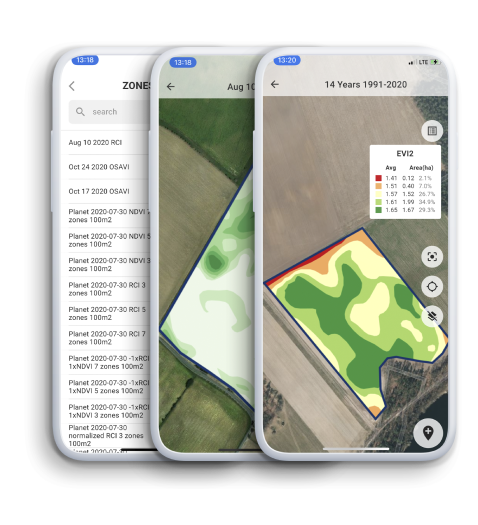
GeoPard Agriculture provides a cloud-based analytics engine that processes any geospatial farm data. As GeoPard puts it, the platform is “an unbiased cloud-based analytics powerhouse for precision agriculture,” capable of handling multi-layer, multi-year data. In practice, GeoPard ingests yield monitor files, soil maps, satellite imagery and more to produce ready-to-use maps and prescriptions. Key features include generation of multi-year management zones and variable-rate prescription (VRA) maps, detailed yield data analytics, and crop monitoring tools.
For example, GeoPard can clean and calibrate raw combine yield data and even create synthetic yield maps (estimating yields from satellite/drone inputs) to fill gaps where historical data are missing. The platform also supports topography and soil data analysis, 3D field visualization, as-applied data comparison, and more
- Management zone and VRA mapping: GeoPard uses yield/soil layers to delineate field zones and create prescription maps for precise input application.
- Yield data processing: The system implements automated cleaning and calibration of harvester yield records, and can generate synthetic yield maps from multi-year and remote-sensing data.
- Crop and field monitoring: Satellite-based tools and multi-index analytics help detect spatial trends in crop performance and limiting factors year-to-year.
Collaborative Research and Field Trials
In this collaboration, CAST and NMSP are exploring the GeoPard Agriculture platform for processing raw corn silage and grain yield monitor data into cleaned yield maps, yield stability zones, and to evaluate accuracy of synthetic yield data generation.
Quirine Ketterings and her team at NMSP are using data from CAST fields to evaluate and improve on the accuracy of GeoPard’s algorithms to map yield, as well as determine synthetic yield for both whole field assessments and for experiments. Together with GeoPard, Ketterings and her team are evaluating data quality and protocols to generate yield stability zones maps for fields with multiple years of data.

Photo by Madeline Hanscom/NMSP
Their goal is to be able to analyze both conventional on-farm research trials, as well as the newly developed Single-strip Spatial Evaluation Approach (SSEA) trials that make use of knowledge of within-field yield variability. Key aspects of the collaboration include:
- Data integration: CAST’s harvest and precision data are processed in GeoPard, turning raw files into georeferenced yield maps and performance layers.
- Algorithm validation: GeoPard’s yield-mapping and synthetic-yield algorithms are tested against CAST/NMSP’s rigorous on-farm trial data, refining the tech based on real measurements.
- Spatial analysis: The team generates yield-stability-zone maps from multiple years of data, and evaluates how well GeoPard’s models capture true field patterns.
- Innovative trial design: New methods like the SSEA use within-field yield patterns to efficiently compare treatments, supported by GeoPard’s spatial analysis.
By working together, Cornell and GeoPard ensure the platform’s outputs are grounded in farm realities. Though GeoPard leverages advanced modeling (including satellite-based yield estimation), validation on these data-rich Cornell farms makes its recommendations more trustworthy. This integration of science, technology, and actual field practice creates a feedback loop: growers and researchers both benefit from more reliable precision-ag tools.
Practical Impact: Towards Sustainable Precision Farming
The ultimate goal is to translate research plots into practical guidance for farmers. Yield monitoring and mapping give farmers visibility into within-field variability, allowing targeted actions rather than blanket treatments. Indeed, studies show that consistent yield mapping helps farmers “see which field areas are performing well and which need improvement, helping them plan more precise actions”.
For example, a farmer might use GeoPard maps to apply fertilizer only where crops are underperforming relative to the field average, or adopt conservation practices on consistently low-yield zones. By providing cleaned data, yield stability analysesmaps, and synthetic benchmarks, the Cornell–GeoPard partnership supports cost-effective and environmentally smart decisions.
Partnership