Transforming Cotton Farming With Technology and Precision Agriculture

Cotton Grower: Cotton Incorporated’s goal is to enhance the profitability of cotton production through research. To ensure our research aligns with current challenges and builds on past successes, we conducted Natural Resource Surveys of U.S. cotton producers in 2008, 2015, and 2023.

These surveys also serve to demonstrate the sustainability of cotton farming and the industry’s ongoing improvement, providing data for life cycle assessments. This article specifically addresses questions regarding the adoption of precision agricultural technology by cotton farmers.

Farmers in every cotton-producing state took part in the surveys, and the proportion of responses generally matched acres grown in the state (for instance, Texas, with the highest number of planted cotton acres, had the highest number of responses, followed by Georgia, which has the second most planted acres).

In all surveys, the respondents represented at least 9% of acres planted in the year of the survey. Note that region is sometimes referred to in these results, and they are defined as: Far West: CA, AZ, NM; Southwest: TX, OK, KS; Mid-South: MO, AR, MS, LA, TN; and Southeast: AL, FL, SC, NC, VA.

Trending Technologies

In all surveys, growers were asked to rate 29 production concerns as major, moderate, or not an issue. The top concern in all three surveys was the cost of cotton production. However, as growers can’t control input costs, precision technologies become essential. These technologies help ensure that only what is needed is applied, preventing wastage of money.

Consequently, there has been a rise in the use of various technologies, with the exception of soil sampling, which has remained constant at 46%, as depicted in Figure 1. In the 2023 survey, only 4% of respondents reported not using precision technologies.

It’s important to note that soil mapping and soil sampling referred to here pertain to using samples to address within-field spatial variability, not general soil sampling. For determining fertility rates, 77% of respondents indicated they use soil test recommendations.

The utilization of autosteer technology has significantly increased over time. In 2008, only 46% of farmers used it, but by 2015, the number rose to 69%, and by 2023, it reached 86%. This upward trend demonstrates the growing reliance of farmers on autosteer.

Similarly, the adoption of autosteer and yield monitor technologies aligns with findings from a survey conducted by the USDA Economic Research Service on precision agriculture adoption on U.S. farms. The survey covered multiple commodities, including cotton, in the years 2000, 2003, 2007, and 2019.

In both studies, the adoption rates for yield monitors and autosteer increased. However, autosteer adoption was much higher than that of yield monitors. As shown in Figure 1, the increase in autosteer outpaced all other considered technologies and practices.

Autosteer is becoming standard on new equipment and requires minimal preparation compared to other technologies. Meanwhile, with other technologies, maps need to be downloaded, interpreted, transformed into application rate maps, and re-uploaded.

Autosteer is becoming standard on new equipment

Autosteer reduces operator stress and can improve input use efficiency by eliminating skips and over-application due to overlaps. It is expected that the increased use of wireless modems in agricultural equipment will ultimately boost the adoption of other technologies when memory cards no longer need to be transported from the office to the equipment.

Additionally, new data analysis techniques are automating the interpretation of soil and yield maps. Agricultural data science consultants are also becoming available to assist farmers in maximizing the value of their data.

There’s evidence that increased ease of use and factory-installed options will facilitate future technology adoptions, as shown by the regional adoption of yield monitors in Figure 2.

The adoption levels of yield monitors in 2015 were correlated with the use of round modules, as reported in a cost of ginning survey for 2016 (Valco, T.D., H. Ashley, D. Findley, J. Green, R. Isom, T. Price. The Cost of Ginning Cotton – 2016 Survey Results. 2018 Beltwide Cotton Conferences, San Antonio, TX, January 3-5, 2018. National Cotton Council, Memphis, TN. Pp. 528-53).

This suggests that making technology easier to use and offering factory-installed options can encourage more farmers to adopt it.

regional adoption of yield monitors

In the ginning cost survey, it was noted that round module utilization was reported as 51% in the Southeast, 61% in the Mid-South, 36% in the Southwest, and 29% in the Far West, aligning with the rankings of yield monitor adoption in Figure 2.

However, according to survey respondents, the adoption of yield monitor technologies increased across all four regions. This increase occurred because yield monitors only became available as a factory-installed option with the introduction of module-building harvesters.

Meanwhile, it is anticipated that the increased implementation of data-collecting technologies on agricultural equipment will lead to future increases in technology adoption.

The next stage of precision farming is expected to be influenced by advancements in automation technologies. Automation, which involves the use of machines to perform tasks automatically without human intervention, has the potential to greatly improve efficiency and precision in agricultural practices. One example is the integration of driverless tractor technology.

This technology can streamline tasks such as planting, spraying, and harvesting. As a result, these tasks can be performed with greater accuracy and efficiency. However, while automation offers numerous benefits, it’s important to consider its impact on employment in agriculture.

The 2023 survey introduced some new questions to cotton farmers about the advantages and challenges of using driverless tractors on their farms. More than 50% of respondents reported labor savings as one of the expected benefits of driverless tractors.

Furthermore, 41% cited improved efficiency, 28% highlighted decreased worker exposure, and 34% considered the technology to have no benefits. Meanwhile, it is likely that growers who have already invested in large swath equipment (e.g., sprayers with 120-foot booms) would see minimal benefits from eliminating an operator from such a machine.

Research is underway to determine if greater benefits can be achieved from automation by reducing equipment size, thus making it more scalable to the task and field size. Moreover, having several smaller pieces of equipment reduces the risk of downtime.

However, when a large piece of equipment fails, production on hundreds of acres a day is lost. The scale of equipment will likely be a balance between the number of units that need to be managed, the task to be completed, and the average field sizes and shapes on the farm.

Impediments to Driverless Tractors

In general, responses were consistent across regions, except for field obstacles and field-to-field transportation concerns. The increased concern in the Southeast and Mid-South is likely due to more water features and topography changes that affect fields in those regions compared to the Southwest and Far West. Across all regions, there is consensus that the costs of the technology could be an impediment to its use on their farms.

Impediments to Driverless Tractors

A question came up about which tasks should be automated first. People said planting (40%), spraying (40%), harvesting (35%), and pre-plant weed control (35%) are the main ones.

However, since we’re just starting to use automated farming equipment, it’ll be interesting to see how things change in the next five years. Meanwhile, the growing number of systems for spotting and spraying weeds using machine vision shows how fast these technologies are advancing.

Conclusion

Cotton Incorporated’s surveys from 2008 to 2023 reveal a growing adoption of precision agricultural technology among cotton farmers, particularly in tasks like planting, spraying, and harvesting. Autosteer technology has seen a significant increase in use, indicating a trend toward more efficient farming. However, challenges such as equipment scalability and costs remain.

The future of farming is likely to involve automation technologies like driverless tractors, offering benefits such as labor savings and improved efficiency but raising concerns about employment and equipment scalability.

Source: Cotton Grower and Cotton Incorporated. Researchers: Jeyran Bayramova, Steven Pires, Jesse Daystar, and Ed Barnes are researchers with Cotton Incorporated.

Technological Agriculture Advancements Impact Output and Input Efficiency Over Time

A recent report from USDA-ERS says that new farming technology helped farmers produce more crops without using as much stuff like seeds and fertilizer.

As farmers deal with higher costs for things they need to grow crops, like seeds and fertilizer, and banks charging more to borrow money, new information from the U.S. Department of Agriculture shows how important technology is for making farms grow without needing extra stuff.

Based on a big study by the USDA-ERS, called “Precision Agriculture in the Digital Era: Recent Adoption on U.S. Farms,” farming has produced almost three times more crops over the past 70 years (from 1948 to 2021). This big growth happened because of better seeds, chemicals, machines, and how farms are organized.

During this time, farmers used a bit less stuff to farm. But at the same time, they made more stuff from farming.

Making more stuff on the farm has a lot to do with using everything together in a better way, which is called total factor productivity (TFP). It shows how much farm stuff gets made by putting all the things together. This means that new farm tools and ideas have helped farmers make more things using fewer things, which makes farming better and cheaper.

These discoveries show how important it is for farmers to use new technology in farming. When farmers use new tools that help them work better and faster, they can deal with problems like higher prices for things they need to grow crops and higher interest rates. This helps them keep their farms going and maybe even grow them bigger.

North Dakota’s Grand Farm And DCN Are Advancing Precision Agriculture With A $200K Connectivity Boost

In North Dakota, the Grand Farm Innovation Campus and Dakota Carrier Network (DCN) are teaming up to improve precision agriculture. With a big $200,000 investment from DCN, they’re working together to boost the state’s farming technology by improving internet connections.

Improving Agriculture with Better Connections

This collaboration focuses on creating a strong wireless network to support groundbreaking research in precision agriculture. DCN is supplying four key parts to this network, including fast internet crucial for sharing data and communication across large farmlands. MLGC, a broadband company linked to DCN, is also stepping in to provide the important “last mile” fiber connection, ensuring smooth data transfer from fields to researchers.

This connectivity isn’t just a technical need; it’s the foundation of precision agriculture. It allows for real-time data analysis, remote management of equipment, and advanced predictions.

These tools are vital for boosting crop yields, reducing waste, and promoting sustainable farming practices. This partnership marks a big step forward, blending technology with traditional farming to tackle the challenges of modern agriculture.

Benefits Beyond the Farm

The CEO of DCN, Seth Arndorfer, and Dr. William Aderholdt, who heads Grand Farm, both say this project is about more than just farming better. They believe it will also help North Dakota’s economy and job market. By encouraging new ideas in farming, the project could create more jobs, keep young people in the state, and boost other industries like tech and stores.

They think that improving farming will make life better for everyone in North Dakota. DCN’s internet connection is a big part of this plan. It helps Grand Farm test new ideas from startups, big companies, and universities working on tricky farming problems.

Looking Ahead, Future of Farming In North Dakota is Bright

The collaboration between Grand Farm and DCN isn’t just about fancy technology; it’s about securing a better tomorrow for the state. As precision agriculture keeps getting better, North Dakota is on the brink of a farming revolution that’s all about doing things smarter, greener, and more creatively.

This teamwork shows how connecting rural areas can break down old barriers to using technology in farming. But it’s not just about farming—this project could breathe new life into small towns, boost the economy, and make North Dakota a big player in farming worldwide.

As the world looks for ways to farm smarter and greener, North Dakota’s pioneering work in precision agriculture, backed by cool partnerships and top-notch tech, is sure to be an example for others to follow.

How John Deere-SpaceX Partnership Will Impact Precision Farming?

John Deere & Company has partnered with SpaceX to bring cutting-edge satellite communications (SATCOM) to farmers using the Starlink network. This collaboration will enable farmers to overcome rural connectivity challenges and fully utilize precision agriculture technologies for increased productivity and sustainability.

John Deere-SpaceX Partnership

On January 16, 2024, John Deere announced a strategic partnership with SpaceX, the aerospace company founded by Elon Musk, to provide cutting-edge satellite communications (SATCOM) service to farmers.

Utilizing the industry-leading Starlink network, this solution will allow farmers facing rural connectivity challenges to fully leverage precision agriculture technologies. Starlink is a constellation of thousands of low-Earth orbit (LEO) satellites that provide high-speed, low-latency, and affordable internet access to anywhere on the planet.

“The value of connectivity to farmers is broader than any single task or action. Connectivity unlocks vast opportunities that were previously limited or unavailable,” said Aaron Wetzel, Vice President of Production and Precision Ag Production Systems at John Deere. “For example, throughout the year, farmers must complete tasks within extremely short windows of time. This requires executing incredibly precise production steps while coordinating between machines and managing machine performance. Each of these areas are enhanced through connectivity, making the entire operation more efficient, effective, and profitable.”

By connecting machines through ruggedized terminals, the SATCOM solution will facilitate autonomy, real-time data sharing, remote diagnostics, and more, optimizing farming operations. However, the initiative, set for a limited release in the United States and Brazil in the second half of 2024.

“John Deere has led the agriculture equipment industry for more than two decades with satellite-based precision guidance technology,” said Jahmy Hindman, Senior Vice President & Chief Technology Officer at John Deere. “Now, we are bringing satellite communications service to the farm at scale so farmers with cellular coverage challenges can maximize the value of connectivity to their operations. The SATCOM solution unlocks the John Deere tech stack so every farmer can fully utilize their current precision agriculture technology in addition to the new innovative solutions they will deploy in the future. We initiated this process with a fierce focus on delivering value to our customers, and this partnership ensures we have a solution that meets their needs today and in the future.”

Why There Was  A Need Of  This Partnership?

In the middle of America, where there are huge fields as far as you can see, there’s a big problem for farmers: not having good internet. Technology has made farming better with things like precision farming, but many people who live outside of cities don’t have good internet.

A report from the U.S. Department of Agriculture in 2022 showed that almost 30% of people in rural areas don’t have access to good internet. This makes it hard for them to connect online and makes it tough to use new farming technology that needs fast internet to work properly.

The digital gap between urban and rural areas has big effects. A report from the USDA shows that because rural places don’t have good internet access, the economy loses about $680 million every year. This means rural communities miss out on chances to do well and keep up in today’s digital world.

To see how big the gap is, just look at the numbers: Almost all city folks (98%) can get broadband internet, but only 70% of rural people can. This big difference makes existing gaps even worse. It makes it hard for rural farmers to use all the benefits of precision agriculture to make more crops, help the environment, and earn more money.

This is were the need for this partnership arises from the fact that many farmers in the United States and Brazil, two of the largest agricultural markets in the world, do not have access to reliable cellular or broadband internet service.

Therefore, having good internet can help farmers grow more crops and use less water and fertilizer. Precision agriculture can increase crop yields by 10-25%, save 20% of water, and use fertilizer better, up to 30%.

With precision agriculture, farmers can check how healthy their soil and crops are, put the right amount of stuff like water and fertilizer, and let machines do some work. It also helps them make smarter choices. A report from Grand View Research says that by 2025, the precision agriculture market could be worth about $26.68 billion, and it’s growing about 13.1% every year.

How It Will Improve Precision Farming?

Precision farming means using technology to make farming better and help the environment. It’s about gathering and looking at information from different places like satellites, sensors, drones, and machines to watch over and take care of crops, soil, water, and tools.

Here are some of the key advantages how this partnership aims to leverage SpaceX’s Starlink satellite network to provide high-speed, low-latency internet access to farmers in remote areas, enabling them to use John Deere’s software and services for precision farming.

1. Real-time data collection and analysis: Farmers can now use Starlink’s fast internet to quickly gather and check data from their fields and machines. They don’t need to wait for slow cellular or Wi-Fi connections anymore.

This helps them keep a close eye on things like how wet the soil is, how well the crops are growing, and how their machines are doing. They can also save all this information on John Deere’s online tool, Operations Center, to study it later and share it with their helpers and friends.

In the meantime, with the high-speed connectivity, farmers will also be able to get greater benefits from the collaboration between GeoPard and John Deere. This will enable them to gain Real-time insights into their fields, such as real-time calculations of Nutrient Use Efficiency (NUE) and the ability to generate profitability maps immediately after harvesting.

2. Autonomous tractors and equipment: John Deere’s machines are equipped with advanced sensors, cameras, GPS, and artificial intelligence (AI) that enable them to perform tasks like seeding, harvesting, and spraying with less human input.

With Starlink’s internet connection, these machines can communicate with each other and with the Operations Center more reliably and securely. This can improve coordination, safety, and quality of work.

3. Remote diagnostics and repair: Starlink’s internet can help farmers find and solve problems with their machines faster. This means less time when machines aren’t working and less money spent on fixing them.

John Deere’s Remote Display Access (RDA) lets farmers see their machine’s screen from far away and fix problems. John Deere’s Service ADVISOR Remote lets dealers check the machine’s codes and software from far away and fix it without coming to the farm.

4. Improved farm management: Farmers can use Starlink’s internet and John Deere’s software to help them use resources better and decide things based on facts. They can use tools like Field Analyzer to compare different situations and see what might happen with the weather, soil, crops, costs, and prices.

They can use tools like Field Connect to manage watering by checking how wet the soil is. They can also use tools like JDLink Connect to see where machines are, how much fuel they use, when they’re not being used, and if anything needs attention.

Moreover, the integration of GeoPard into the John Deere Operation Center has enabled real-time detection of sugar beet and weeds in the field with Hamm Lipstadt. With enhanced connectivity, the process of capturing photos, sending them to GeoPard, and detecting weeds and sugar beet in real-time will be quick. This improvement will allow farmers to promptly take action to mitigate yield loss and enhance crop management practices.

5. Increased productivity and profitability: Research shows that precision farming can make farms earn 5-10% more money. When farmers use Starlink’s internet and John Deere’s software and help, they can make their crops better and get more of them. It also helps to spend less money on things like seeds and fertilizer, work more efficiently, and sell to more places.

6. Greater sustainability: With precision farming, farmers will be able to decrease their impact on the environment. By utilizing Starlink’s internet connection and John Deere’s software and services, they will reduce water usage by up to 25%, optimize fertilizer application by up to 40%, and lower emissions by up to 15% from fewer passes over the fields.

Conclusion

In conclusion, the partnership between John Deere and SpaceX is set to revolutionize farming practices. By leveraging SpaceX’s Starlink network, farmers in rural areas will gain access to high-speed internet, overcoming connectivity challenges. This advancement will enable them to harness the power of precision agriculture technologies, leading to increased productivity and sustainability. This partnership marks a significant step forward in bridging the digital divide in agriculture and unlocking the full potential of precision farming for farmers around the world.

Iowa Nitrogen Initiative: Enhancing Precision in Fertilizer Application Rates

In Iowa, Michael Castellano talks about how growing corn involves lots of choices. He says there are billions of ways, and some people think he’s making it up. But he explains that when you add up all the different types of corn, ways of farming, and weather conditions, it really is a huge number.

This uncertainty is a big deal because using too little or too much nitrogen fertilizer can cause problems. Not enough can lower the amount of corn you grow, while too much can cost too much money and harm the environment.

The Iowa Nitrogen Initiative, led by Castellano and Sotirios Archontoulis, is trying to figure out the best amount of nitrogen for each corn field by collecting data from farms all over Iowa.

They want to make it easier for farmers to know how much fertilizer to use. The project is funded by the Iowa Department of Agriculture and Land Stewardship, and Iowa’s Secretary of Agriculture, Mike Naig, thinks it’s a great collaboration between farmers and experts.

He believes it will give farmers the information they need to grow crops better, make more money, and take care of the environment.

Bridging the Divide

The Iowa Nitrogen Initiative is conducting 270 on-farm trials this year across 72 different private farming operations, marking a fourfold increase from the project’s first year in 2022. The ultimate aim is to reach 500 trials per year.

For farmers to join, they need access to two increasingly common precision ag technologies: variable rate fertilizer application and GPS-based yield monitoring. Using historical yield data to identify spots expected to behave differently, project partner Premier Crop Systems designs a trial in a small area of a field, typically about five acres.

Different nitrogen rates, ranging from none to 200 pounds per acre, are assigned to sections within the trial area, and farmers share the yield data with the research team after harvest. Participants are compensated for the yield loss on land that receives no nitrogen.

Trial data is enhanced with simulations from biophysical process models to determine optimal rates based on soil and seed types, management practices, and weather. This database will power the project’s decision-making tools for the public, expected to be available for the 2025 growing season.

These tools will be particularly useful for farmers using precision ag technology to collect data. Farmers with equipment for applying fertilizer at a variable rate often lack evidence-based guidance on how those rates should vary, according to Castellano.

“We’re working to bridge the gap between the technological advancements in precision ag by engineers and the scientific understanding of agronomists,” he said.

Three Helpful Tools

The research team is working on three tools to help farmers make better decisions:

Improved Benchmark Recommendations:

  • They are making better suggestions for nitrogen rates, considering differences in things like genetics, soil, how the land is managed, and the weather.
  • Farmers can also check out data from trials to see what really happens with different rates and practices.

Forecasting Tool:

  • This tool will predict the best rates based on current and near-future guesses about the soil and weather.
  • This matters because weather has a big effect on how much nitrogen is needed, according to Castellano.

Hindcasting Tool:

  • This tool helps farmers look back at a past year to see how their crop’s needs for nitrogen might have changed if they did things differently. For example, if they planted a different kind of corn or used fertilizer at a different time.

Castellano explains that the goal is to keep updating these tools with new trial data every year.

“As long as farmers are trying new things and the weather is changing, the best nitrogen rates will also change. We need to keep studying and providing farmers with the information to make the best decisions,” he said.

Getting Farmers Involved

Farmers have been part of the Iowa Nitrogen Initiative from the start, even taking part in a design sprint facilitated by Google engineers and designers back in February. Feedback from farmers played a crucial role, shaping decisions like making the initial release of decision-making tools as a mobile app. Farmers suggested this because they’re more likely to use the information if they can access it on the go.

“We’ve been working closely with farmers to make sure the products we’re creating are helpful for the people who will use them. We don’t want farmers to feel like this is something imposed on them,” said Castellano.

He is pleased that every farmer who joined in the first year continued in the second year. Roger Zylstra, one of the volunteers hosting trials for two years, shared at a field day in September that collaborating with the research team was straightforward and smooth. Zylstra, a former president of the Iowa Corn Growers Association, farms near Lynnville in Jasper County and is eager for wetter years to provide more variations in the data.

“I always try to find ways to be a better steward of the land, and we learn there are better ways to do things,” said Zylstra. “I think the potential here is amazing.”

Project leaders are now inviting farmers, crop advisers, and custom fertilizer applicators to sign up for a trial in the 2024 growing season. Those interested can fill out an online form for more information or to express their interest.

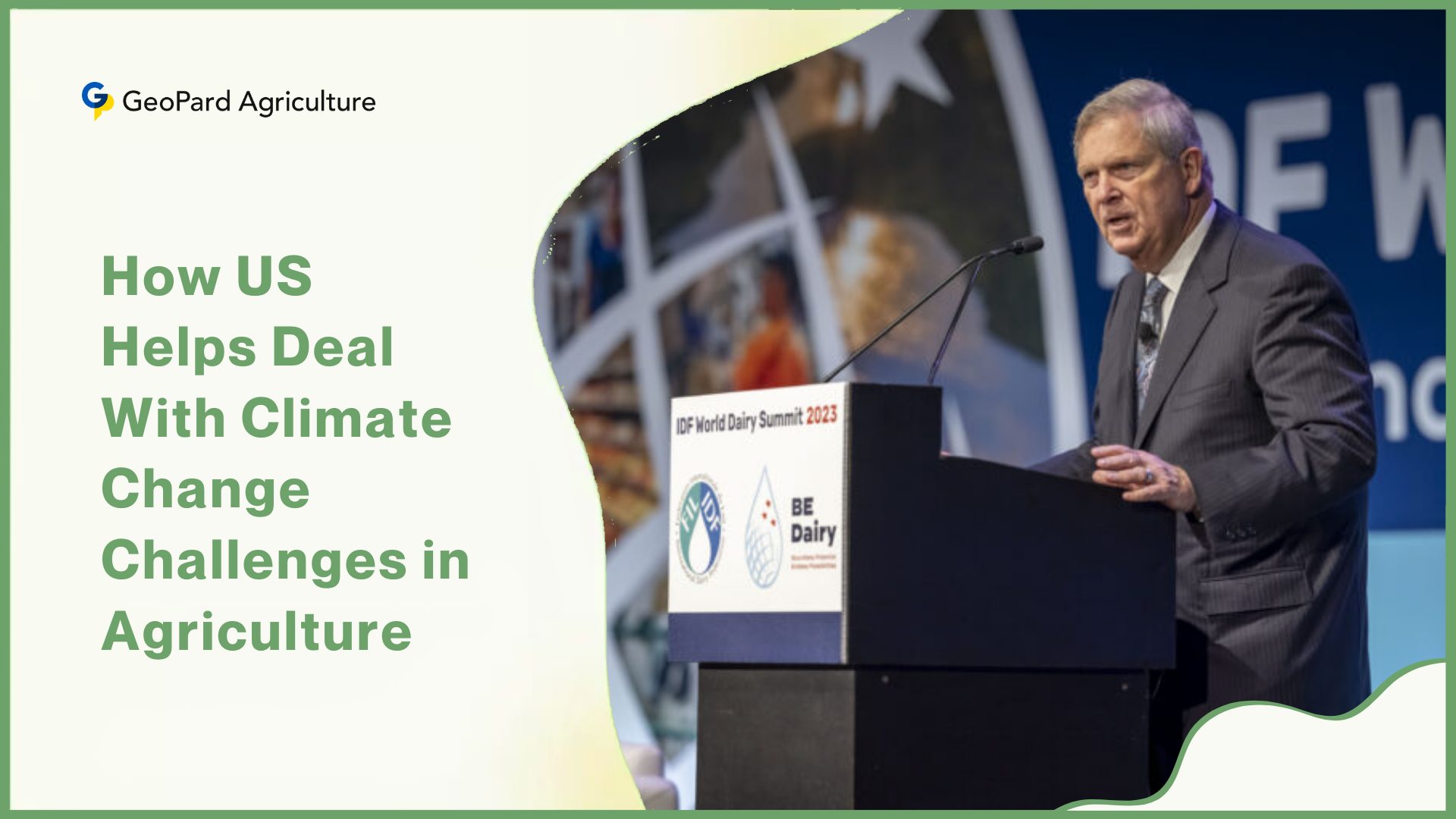
How US Helps Deal With Climate Change Challenges in Agriculture

According to US Secretary of Agriculture Tom Vilsack, the dairy industry in the United States was the first to promote a system where farmers are rewarded for addressing climate issues voluntarily and through market-based approaches.

Vilsack is particularly concerned about the well-being of the US dairy industry as farmers grapple with the impacts of both climate change and farm consolidation.

At the 2023 World Dairy Summit in Chicago, Vilsack highlighted the challenges faced by dairy farmers, with 92.5% of them collectively earning only 11% of the total income from dairy operations in the US. This underscores the urgent need for attention and support in the sector.

Vilsack shared insights into the proactive steps the US is taking to ensure the long-term sustainability of agriculture. He emphasized that farmers have expressed a preference for a voluntary and incentive-based system.

They want the market to recognize and appreciate their contributions, and they are keen on robust methods for recording, measuring, monitoring, and verifying results. This, according to Vilsack, will assure consumers that the products they purchase have been sustainably produced.

“And they desire it to be a cooperative partnership, which led to the establishment of the Climate-Smart Partnership Initiative.”

Within the framework of the Partnerships for Climate-Smart Commodities, the US Department of Agriculture has announced its commitment to funding partnerships that promote the production and marketing of climate-smart commodities through a series of pilot projects lasting one to five years.

In the initial phase, 70 projects were selected to receive an investment of up to US$2.8 billion (approximately $4.75 billion). By the end of 2022, an additional 71 projects were included, accompanied by an extra investment of US$325 million.

The funded projects encompass a variety of areas, including precision agriculture, biofuels, as well as marketing and education programs.

“We acknowledge the opportunity to generate value-added commodities so that farmers are not only compensated for adopting climate-smart practices beneficial to the environment, but they are also rewarded in the marketplace with a value-added proposition.”

He expressed his belief that consumers in the United States are interested in and willing to invest in products produced sustainably. However, he emphasized the need for tangible proof to assure consumers that these products genuinely adhere to sustainable practices. He has a profound understanding of the dedication dairy farmers have towards their operations, the environment, and their local communities.

According to him, it is the responsibility of policymakers to take appropriate measures in creating a program that recognizes and values all types of farmers. He is enthusiastic about the opportunity to establish an entrepreneurial model that complements the existing production agriculture model.

Vilsack stressed the importance of maintaining strong agricultural production in the United States to feed the world while also creating opportunities for small to midsize businesses to ensure the continued vibrancy of rural communities.

Vilsack expressed his dissatisfaction with the fact that 57 million hectares of land in the US are no longer utilized for farming. This vast land mass is equivalent to the combined area of the entire states of Florida, Georgia, North Carolina, and South Carolina, representing a substantial loss.

After spending four years with the US Dairy Export Council, Vilsack returned to the USDA with a strong commitment to safeguarding US agriculture. He is dedicated to promoting sustainability and ensuring fair market value.

Reflecting on his tenure in the dairy industry, he emphasized the sector’s potential. The dairy industry, according to Vilsack, was at the forefront in recognizing the capacity and opportunity to move towards a net-zero future. He credited the US dairy industry for championing a voluntary and market-based system that listens to farmers and rewards them for addressing climate concerns.

Expressing gratitude to the industry for taking these steps, Vilsack believes that the dairy sector, and agriculture as a whole, has boundless potential and endless possibilities. He commended the industry for initiating efforts to tap into this potential and emphasized the pride the industry can take in its contributions to addressing climate challenges.

AI in Agriculture Requires Security and Affordability

Smart technology, like machines that get rid of weeds and software for picking crops, could make farming better. But, experts told senators on Tuesday that we need to make sure the computer systems are safe from attacks. The group of experts and the Senate Agriculture Committee agreed that farmers should be able to afford this technology, maybe with support from USDA funds.

Over 25% of American farmers use precision agriculture tech, like GPS steering, yield monitoring, drones for checking fields and animals, and robotic milking. AI, by looking at lots of data, could help farmers work better or do tasks automatically. Keeping data safe has been a problem since precision agriculture started. Agricultural AI, which needs to send data from the farm to the cloud, brings up concerns about cybersecurity.

“In farming, we have to make sure our data is safe,” said Jose-Marie Griffiths, who leads Dakota State University, where they study cybersecurity. “With the growth of AI, we’re adding more technology to farming, and that makes the risks higher.”

AI could assist farmers with things like deciding how much fertilizer to use, managing pests, predicting crop yields, and, in dry places, figuring out how much water to use for irrigation, according to Mason Earles, a teacher at UC-Davis. “I believe these can save farmers money, maybe around 5 to 15 percent, on average, in their operations.”

Jahmy Hindman, the chief technology officer of Deere and Co., mentioned that for AI to bring its full benefits to the farm, rural areas need good internet, especially in the fields. Hindman suggested that senators think about adding rules to the farm bill. These rules would let farmers use USDA funds to help pay for high-tech equipment. Sanjeev Krishnan from S2G Ventures added, “I think it’s crucial for public policy to step in, not just providing tools but also the money to help farmers produce more and earn more per acre.”

Lawmakers from farming areas support separate bills for two goals – making sure the internet reaches the “Last Acre” and helping with the costs of precision ag equipment. They believe these steps will make crops grow more while spending less, cut down on pollution, and stop soil erosion. Representative Jimmy Panetta from California explained in March that using USDA funds and getting payments for using eco-friendly methods “will encourage precision agriculture by getting rid of financial obstacles.” Senator Deb Fischer, who supports Last Acre, said in May that farmers “need internet that reaches beyond their homes and into their fields.”

Debbie Stabenow, chairwoman Senate Agriculture group, talked about problems like keeping our information safe online, having good internet, how much AI costs, and keeping data private when she started the meeting. Stabenow also said the U.S. has to make a big effort, like a “moonshot,” in agriculture research to stay ahead worldwide. John Boozman, the top Republican from Arkansas in the group, said, “Even though AI can do great things, we need to be careful and ask hard questions about the possible problems.”

Precision Agriculture Task Force Seeks Better Broadband Mapping and Rural Priority

WASHINGTON – The Precision Agriculture Task Force of the Federal Communications Commission (FCC) made a decision to endorse a set of new recommendations for the commission.

The task force is set to request the FCC and the Department of Agriculture to enhance their efforts in mapping broadband, give priority to subsidies for broadband in agricultural areas, and implement various measures to guarantee that farmers have sufficient broadband access, especially as the industry increasingly relies on data and analytics.

In terms of mapping, the task force will advocate for increased resolution in the FCC’s BDC map. Additionally, it will propose the inclusion of more detailed information in the map, such as validated ground coverage and specific details about agricultural structures.

Several working groups have suggested changes to the USDA’s ReConnect program, a broadband subsidy established by the 2021 Infrastructure Act. The task force staff emphasized the need for modifications to prioritize funding infrastructure that facilitates high-speed broadband connectivity for farms.

These suggestions align with those presented by the task force in November 2021, where they sought enhanced broadband mapping, improved data collection, and additional funding incentives.

Members of the task force also gave their approval to a statement expressing conditional support for the Last Acre Act, a Senate bill introduced in July. The proposed legislation aims to create an FCC-administered fund to assist agricultural broadband projects.

While members expressed concerns about specific aspects of the legislation, such as strict eligibility criteria, they endorsed the overall intent of funding broadband in rural areas.

Task Force Chair Teddy Bekele announced that the approved recommendations would be submitted to the FCC and USDA next week.

What is Precision Agriculture Task Force?

The Precision Agriculture Task Force, mandated by the 2018 Farm Bill, stands as a collaborative initiative between the Federal Communications Commission (FCC) and the United States Department of Agriculture (USDA).

Its primary mission is to delve into the intricate world of precision agriculture, where computational tools and connectivity converge to revolutionize farming practices. Precision agriculture involves leveraging advanced technologies to optimize farming processes, enhancing efficiency, sustainability, and productivity.

What Does It Do?

It operates with a multifaceted approach, encompassing the study of connectivity needs, mapping agricultural broadband, addressing workforce standards, and facilitating the deployment of broadband infrastructure tailored to precision agriculture.

Its ultimate goal is to provide farmers with the tools and resources necessary to cultivate crops more efficiently, integrating technological advancements seamlessly into traditional farming practices.

It is structured with precision, dividing subject matter experts into four distinct working groups, each focusing on a specific aspect of precision agriculture. These groups are:

1. Agricultural Broadband Mapping: This group is tasked with mapping out the broadband landscape in agricultural areas. Understanding the connectivity terrain is crucial for identifying gaps and formulating strategies to bridge them.

2. Connectivity Needs for Precision Agriculture: Delving into the specific connectivity requirements of precision agriculture, this group aims to ensure that farmers have access to robust and reliable internet connectivity to support the implementation of advanced technologies on their farms.

3. Agricultural Broadband Deployment: Focused on the practical aspect, this group works towards the deployment of broadband infrastructure in agricultural regions. Their efforts are geared towards translating connectivity needs into on-the-ground solutions.

4. Precision Agriculture Jobs and Workplace Standards: Recognizing the transformative impact on the workforce, this group addresses the evolving job landscape in precision agriculture. It sets standards to ensure a skilled workforce capable of navigating the integration of technology into traditional farming practices.

The task force, under the guidance of Chair Teddy Bekele, operates within a framework defined by FCC Chairwoman Jessica Rosenworcel, who rechartered the task force in August. This rechartering marks its final term, scheduled to conclude in 2025, signaling a dedicated effort to drive tangible outcomes within a defined timeframe.

Conclusion:

In conclusion, the task force is a vital initiative shaping the future of farming by bridging the gap between technology and agriculture. With a focused approach, it aims to address connectivity needs, deploy broadband infrastructure, and set workforce standards, all of which are crucial elements in the seamless integration of precision agriculture into mainstream farming practices.

Kenya To Embrace AI and Satellite Crop Monitoring for Farmers

Kenyan farmers are on the verge of gaining access to an upcoming agri-tech platform, which will empower them to make data-driven farming decisions and oversee their crops with the assistance of satellite imagery and artificial intelligence.

The Directorate of Resource Surveys and Remote Sensing (DRSRS) in collaboration with an agriculture technology company is currently in the process of creating a nationwide digital initiative for satellite-based crop monitoring and yield forecasting.

As per Charles Situma, the Deputy Director of DRSRS, the platform will need the capability to digitally monitor and distinguish various crops throughout the nation. Furthermore, it is anticipated to provide farmers and authorities with advanced analytical tools to enhance data-driven decision-making.

It’s worth noting that the agricultural sector contributes 30% to Kenya’s gross domestic product. Nevertheless, both organizations expressed concerns about the sector’s susceptibility in the face of the ongoing climate crisis.

As Situma suggests, the agricultural sector and those responsible for making decisions can enhance sustainable food security through the use of digital technology.

Additionally, the Chief Operations Officer of the agriculture technology company mentioned that the platform would assist farmers and decision-makers in devising more sustainable food security programs by furnishing them with precise data concerning soils, crops, and forests.

Farming serves as the primary income source for the majority of Kenyans, contributing significantly to aspects like food security, economic growth, job opportunities, off-farm employment, and foreign exchange earnings.

Regrettably, the agricultural sector is presently exposed to climate change risks, largely due to escalating temperatures, droughts, and changing rainfall patterns.

Similar to Nigeria, the circumstances for Kenyan farmers are exacerbated by adverse weather conditions, including floods, suboptimal farming practices, limited knowledge, and the use of low-quality agricultural inputs. These factors collectively exert a substantial influence on the productivity of farmers.

USDA Officials Highlights Organic Farming Support in Bozeman

Jenny Moffitt, who works for the U.S. Department of Agriculture, came to Montana this week. She wanted to celebrate how well organic farming is doing in the state and tell people about the help the federal government gives to organic farmers.

Moffitt and more than 60 other people visited Amaltheia Organic Dairy in Belgrade on Tuesday. They did a tour of the farm and talked about organic farming with farmers and leaders from all over Montana.

The talk was set up by Nate Powell-Palm, who speaks for the Montana Organic Association. He’s also an organic farmer. They talked about how a program called the Transition to Organic Partnership Program (TOPP), run by the USDA, can help farmers who want to switch to organic farming. This national program is planning to give about $100 million over five years to groups like MOA that help farmers make the switch to organic farming.

Moffitt, the person from the U.S. Department of Agriculture, said at the beginning of the discussion that they hope people will see organic farming as a very important part of American farming. They want people to know that choosing organic is a way to keep up with the times.

In the past, farmers believed they had to get very big or give up farming. But now, farmers have a different choice. They can make their products more valuable and create local markets for them.

The event on Tuesday was a way to show how much organic farming has grown over the years. It started as a small protest against using chemicals in farming and has become a successful and respected way of farming. Montana is the second-largest state in terms of organic farming, just behind California.

Nate Powell-Palm, who spoke for the Montana Organic Association, said he is happy and thankful for all the hard work that has been done to promote organic farming. He feels energized to keep working in the future.

During the panel discussions, they talked about how having experienced people help and teach new organic farmers is very important. They also talked about how to make sure farmers who switch to organic farming stay organic.

One big problem for organic farmers now is dealing with weeds that come back every year. Bindweed and thistle are two common weeds that make it hard for organic farms to grow crops. They also discussed how it’s even tougher for organic farms that don’t plow the soil.

They mentioned the idea of using natural methods to control weeds instead of chemicals, like the work being done by Kuvu Biosolutions in Bozeman and researchers from Montana State. They think this could be a big improvement.

Making sure that you grow different crops can also help you deal with weeds. Schmidt suggested that farmers should plan ahead and not grow the same crop in the same fields year after year.

New organic farmers can find it difficult to sell their products directly to customers and have local markets in a big state like Montana, Schmidt explained. The panelists agreed that having a variety of products, like Amaltheia raising goats and making cheese, along with growing vegetables, can help farmers sell to more people.

MOA vice chair Ty O’Connor, who is also an organic farmer, said it plainly: “Be diverse so that you can keep going.”

O’Connor also said that while it’s important to talk about the challenges that farmers face today, there’s no one-size-fits-all approach to switching to organic farming. He mentioned that every farmer is different, and that’s what makes the transition harder. There’s no step-by-step guide for organic farming.

Under Secretary Moffitt said that’s why it’s so valuable to have local mentorship programs. It’s important to have someone in your community who grows the same crops and can help you when you have a problem. They can share their experiences and advice with you, which is really helpful.

Many of the stories shared on Friday had a common theme for why people switch to organic farming – for these farmers, it’s the only choice.

Tracey Dion, who is a farmer and the MOA chair, explained that her family’s regular sugar beet farm in Terry had made the soil very poor, almost like just plain dirt. The best way to make the soil healthy again was to switch to organic farming.

Bob Quinn, who is also an organic farmer in Big Sandy and wrote a book called “Grain by Grain,” agreed with that idea. He said, “I think organic farming is the only way that makes sense for the future.”

However, Moffitt, the person from the U.S. Department of Agriculture, said that both organic and regular farming should exist together. Instead of making one seem bad and the other good, what’s really important is that farmers have the freedom to choose how they want to grow food.

Nate Powell-Palm, who organized the event, said that it went even better than he expected. Some farmers traveled more than six hours just to attend. He mentioned how connected the organic farming community is in the state. When they need to gather for a cause, many farmers can come together quickly, showing that to make a change, everyone needs to work together.

wpChatIcon
wpChatIcon

    Request Free GeoPard Demo / Consultation


    By clicking the button you agree our Privacy Policy. We need it to reply to your request.

      Subscribe


      By clicking the button you agree our Privacy Policy

        Send us information


        By clicking the button you agree our Privacy Policy