


The use of hyperspectral satellite imagery in agriculture has transformed the way how farmlands are managed to meet the increasing demands of the expanding population in the face of the changing climate.
The advancement and commercialization of this tool in recent times have translated into affordable understanding and monitoring of not only large farms but also small farms everywhere.
It is important to understand the concept of hyperspectral satellite imaging and its beneficial implications for farmers and farmlands as well as the way to use them.
How satellite imagery is useful for agriculture?
For the most time in human history, agriculture has been a strictly land-based science and practice. However, the scope of agriculture today has expanded to great heights, reaching satellites that orbit the earth. But how actually do satellites affect the way we grow crops and produce food?
The answer lies in the factors that agriculture depends upon, namely soil, weather, temperature, rainfall pattern, crop development, topography, and so on.
Satellites or space-based technologies allow us to easily measure and monitor these factors from the convenience of our computer screens and the information thus obtained can be used to plan appropriate farming interventions.
The use of satellites in agriculture is a rapidly growing practice. It has evolved from just gathering information to actually performing precise farming operations, for example, the use of GPS-mounted tractors for harvesting.
It is important to note that satellites are used mainly for generating precise geospatial data of objects of interest- farmlands, and crops in our case. This is achieved by using a combination of more than three satellites and a concept known as trilateration.
Moreover, to measure and monitors the factors mentioned above, satellites are fitted with various types of highly capable sensors. It is by the combination of these mechanisms, satellites have become so useful in modern agriculture.
What is hyperspectral imaging in precision agriculture?
Hyper-spectral imaging is the process of obtaining data about an object by capturing the different spectral signatures from the whole electromagnetic spectrum of the light and not just the band of light we can see that is reflected by striking the object.
The capturing of those spectral signatures is done with the help of specialized camera sensors aboard the satellites.
In agriculture, hyper-spectral imaging relies on the fact that almost all types of crops show different spectral signatures under different stages of their lifecycle and different physiological conditions. These differences can be attributed to either expected or unexpected observations.
For unexpected results, the differences can be attributed to several environmental or management factors that have altered the physiological conditions of the plants. This can be helpful in the detection of:
- Soil moisture level
- Several Diseases
- Crop composition for multi-cropping systems
- Weed infestation
- Soil Nutrient Level, etc.
By carefully studying and analyzing these findings, a farmer can easily adapt his interventions for optimal production over time and space. In a way, hyper-spectral imaging allows the farmers to understand what the crop wants.
The actual imaging process in agriculture is achieved either from the ground level or by air. For ground level, imaging is done with robots or vehicles fitted with hyper-spectral sensors. For aerial hyper-spectral imaging, drones(UAVs), as well as satellite imagery, are used.
Since the working mechanism of hyper-spectral imaging involves precise measurement of light and its spectral bands, even a small movement or irregularity in the system can largely skew the results and can cause more harm than good.
So, it is vital to use reliable and accurate systems and services for any hyper-spectral imaging farming operations. Finally, the application of hyper-spectral imaging in agriculture is best realized when it is used regularly over multiple crop cycles so that understanding and monitoring of the crops is more precise and accurate.
How does satellite spectral imagery help precision farmers?
Satellites and their associated technologies aren’t just helping farmers manage their farms effectively; they are changing the way how farming is done across the globe.
Satellites give farmers vision and insight of their entire farmlands from a viewpoint that they could have never dreamt of just a few decades ago. The different ways that satellites help farmers manage their farms effectively and sustainably are as follows:
- Mapping: The initial step in precision agriculture with the use of satellites involves a thorough mapping of the entire parcel of land. This is especially beneficial in cases of large farmlands which enable the farmers to identify and prioritize their land-based on spatial characteristics.
- Measuring and studying: Multi-spectral cameras and sensors fitted into the satellites directly or indirectly give a measurement of a vast array of important farmland characteristics like crop health, nutrition, soil water stress, plantation stage, weather patterns, diseases, and so on.
- Executing and Monitoring: Moving on, satellite data and their functionalities are useful in performing automated technological machinery and allow for varying rates of fertilizer application and varying irrigation patterns precisely. Moreover, as the images pile up one after another with time, they reflect the pattern of the farmland characteristics as well as the environment. This helps t predict future events and plan and prepare in advance to have the greatest chance of minimizing extreme loss events from factors like droughts, climate change, disease outbreaks, etc.
Its use in agriculture, including hyperspectral images comes under the broad umbrella of precision farming. So satellite images are rarely used in isolation and are rather one of the elements in the Internet of Things (IoT) used in precision agriculture.
Satellite imageries, combined with ground-based data, artificial intelligence, big data analytics, and dissemination of data up to farmers’ level using smartphones and application services.

More precisely, High-spectral imagery in agriculture is an enabler for the following:
1. Crop Health Detection:
Different types of vegetation indices calculated from the multi-spectral satellite imagery are used to understand, detect and monitor the health of the crops. As mentioned earlier, different health conditions or their vigor cause different wavelengths of light to be absorbed or reflected.
The sensors capture and calculate the indices and the best one can be used in near-real time to generate appropriate management strategies. To understand more about the different types of vegetation indices and which one to choose, read this Блог GeoPard.
2. Soil Status & Properties:
Just like how the crops and their foliage show distinct spectral signatures in different health conditions, the variations in soil and its properties also translate into a different spectrum of light reflected by the airborne sensors.
For instance, Soil Brightness Index is one such index used to measure and map soil properties. Since soil properties like moisture, nutrient levels, texture, erodibility, and pH play a massive role in the overall success or failure of the entire agricultural system, it is important to map, manage and monitor soil status accurately and regularly.
Systematic soil sampling can provide a more accurate description of the soil properties but can be costly and ineffective in large areas.
As a result, the best approach combines hyper-spectral imaging with systematic grid sampling of soil to obtain an accurate and reliable map of the different soil properties.
This can be used further to apply VRA fertilization. This approach is the one used by the Анализ почвенных данных solution provided by ГеоПард Агрикультура.
3. Crop Growth & Crop/Variety Types Detection
The application of multi spectral satellite imagery in understanding and monitoring crop growth as well as the crop composition is essential in cases of multi-cropping systems on large farms.
In large farms, different patches of land can have localized environmental factors causing a deviation from the normal growth pattern. Moreover, unwanted plants like weeds can grow in areas that degrade the growth of major crops.
To monitor all these problems and to make sure that the entire plot of land will produce optimum results, multi spectral satellite imagery produces data layers that you can compare and make informed decisions.
Besides these common applications of HS imagery, other applications include early flood detection and warning, wildfire detection, livestock monitoring, and so on.
To sum up, hyperspectral satellite imagery has massive potential and applications in agriculture and its transformation into an advanced practice to cope with the growing challenges of the 21st century.
There are numerous ways that farmers can benefit from this powerful tool and make their agronomic practices easier, effective, sustainable, and most importantly, profitable.
However, it is also clear that its application requires a high level of precision and knowledge and farmers need to make sure to use a reliable agro-service provider platform with high operational efficiency and technical expertise.
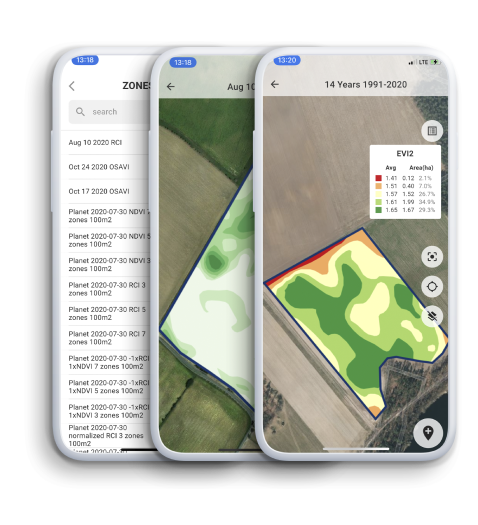
GeoPard agriculture has a wide range of agri-solutions all fully utilizing the scope of multi spectral satellite imagery like Landsat, Sentinel, and Planet.
The technologies used boast a very high accuracy with a high resolution of 3m and an image database of several years to establish vegetation trends and зоны управления for your farmlands.
Other opportunities of the powerful GeoPard engine include near-real-time Мониторинг посевов и Данные урожайности using the latest imagery which you can easily visualize on the web and mobile-based cloud platforms.
Using all these information and data layers, GeoPard analyzes the overall farmland productivity characteristics and prescribes variable rates of input like удобрение, орошение, or crop species for your farmland with the aim of enhancing your agronomic practices from a sustainable and financial perspective.
Часто задаваемые вопросы
1. Как получить спутниковые снимки для фермы?
To obtain imagery for your farm, start by researching reputable providers that offer agricultural-focused services like ГеоПард. Select a suitable service plan based on factors like image resolution and frequency of updates. Once subscribed, access the imagery through the provider’s platform or tools and download the images for your farm area. Use these images for monitoring crop health, identifying areas of concern, and making informed decisions to optimize farm management practices.
2. Почему спутниковые снимки помогают понять пищевые цепи?
It is helpful in understanding food webs due to several reasons. First, it provides a broad-scale view of the Earth’s surface, allowing researchers to observe and monitor large areas and ecosystems. This imagery can help identify key habitat features, such as vegetation patterns or oceanographic processes, that influence the distribution and abundance of organisms within food webs. Additionally, it aids in tracking changes in land cover and climate variables, which are important factors affecting food web dynamics.
Точное земледелие




 English
  German
  Ukrainian
  French
  Kazakh
  Portuguese
  Spanish
  Arabic
  Swedish
  Serbian
  Romanian
  Norwegian
  Finnish
  Lithuanian
  Estonian
  Latvian
  Croatian
  Slovenian
  Slovak
  Japanese
  Polish