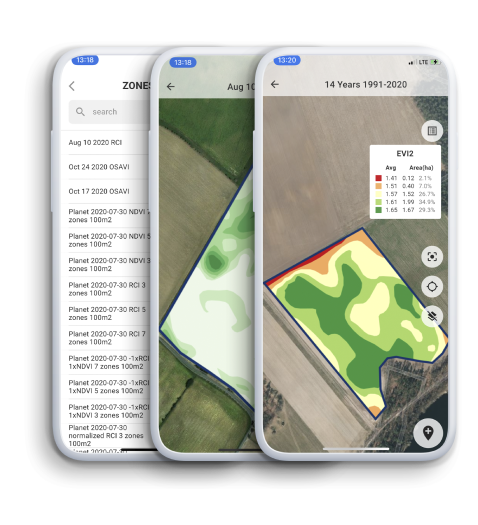
Agriculture is at a crossroads. With the global population set to reach 9.7 billion by 2050, farmers must produce 70% more food while battling climate change, soil degradation, and water scarcity.
Traditional farming methods, which rely on outdated practices and guesswork, are no longer sufficient. Enter the Transformative Crop Recommendation Model (TCRM), an AI-driven solution designed to tackle these challenges head-on.
This article explores how TCRM uses machine learning, IoT sensors, and cloud computing to deliver 94% accurate crop recommendations, empowering farmers to boost yields, reduce waste, and adopt sustainable practices.
The Growing Need for AI in Modern Farming
The demand for food is skyrocketing, but traditional farming struggles to keep up. In regions like Punjab, India—a major agricultural hub—soil health is declining due to overuse of fertilizers, and groundwater reserves are depleting rapidly.
Farmers often lack access to real-time data, leading to poor decisions about crop selection, irrigation, and resource use. This is where precision agriculture, powered by AI, becomes critical.
Unlike conventional methods, precision agriculture uses technology like IoT sensors and machine learning to analyze field conditions and provide tailored recommendations. TCRM exemplifies this approach, offering farmers actionable insights based on soil nutrients, weather patterns, and historical data.
By integrating AI into farming, TCRM bridges the gap between traditional knowledge and modern innovation, ensuring farmers can meet future food demands sustainably.
“This isn’t just about technology—it’s about ensuring every farmer has the tools to thrive.”
How TCRM Works: Merging Data and Machine Learning
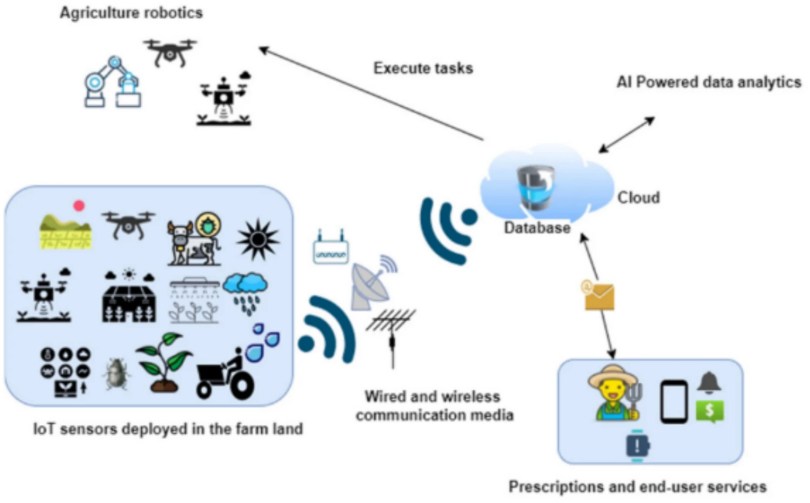
At its core, TCRM is an AI crop recommendation system that combines multiple technologies to deliver precise advice. The process begins with data collection. IoT sensors deployed in fields measure critical parameters like soil nitrogen (N), phosphorus (P), potassium (K), temperature, humidity, rainfall, and pH levels.
These sensors feed real-time data into a cloud-based platform, which also pulls historical crop performance records from global databases like NASA and the FAO. Once collected, the data undergoes rigorous cleaning.
Missing values, such as soil pH readings, are filled using regional averages, while outliers—like sudden humidity spikes—are filtered out. The cleaned data is then normalized to ensure consistency; for example, rainfall values are scaled between 0 (100 mm) and 1 (1000 mm) to simplify analysis.
Next, TCRM’s hybrid machine learning model takes over. It blends Random Forest algorithms—a method using 500 decision trees to avoid errors—with deep learning layers that detect complex patterns.
A key innovation is the multi-head attention mechanism, which identifies relationships between variables. For instance, it recognizes that high rainfall often correlates with better nitrogen absorption in crops like rice.
The model is trained over 200 cycles (epochs) with a learning rate of 0.001, fine-tuning its predictions until it achieves 94% accuracy. Finally, the system deploys recommendations via a cloud-based app or SMS alerts, ensuring even farmers in remote areas receive timely advice.
Why TCRM Outperforms Traditional Farming Methods
Traditional crop recommendation systems, such as those using Logistic Regression or K-Nearest Neighbors (KNN), lack the sophistication to handle farming’s complexities.
For example, KNN struggles with imbalanced data—if a dataset has more entries for wheat than lentils, its predictions skew toward wheat. Similarly, AdaBoost, another algorithm, scored just 11.5% accuracy in the study due to overfitting. TCRM overcomes these flaws through its hybrid design.
By merging tree-based algorithms (for transparency) with deep learning (for handling intricate patterns), it balances accuracy and interpretability.
In trials, TCRM achieved a 97.67% cross-validation score, proving its reliability across diverse conditions. For instance, when tested in Punjab, it recommended pomegranate for farms with high potassium (120 kg/ha) and moderate pH (6.3), leading to a 30% yield increase.
Farmers also reduced fertilizer use by 15% and water waste by 25%, as the system provided precise nutrient and irrigation guidelines. These results highlight TCRM’s potential to transform agriculture from a resource-intensive industry into a sustainable, data-driven ecosystem.

Real-World Impact: Case Studies from Punjab
Punjab’s farmers face severe challenges, including depleted groundwater and soil nutrient imbalances. TCRM was tested here to assess its practical value.
One farmer, for example, input data showing soil nitrogen at 80 kg/ha, phosphorus at 45 kg/ha, and potassium at 120 kg/ha, alongside a pH of 6.3 and 600 mm of annual rainfall.
TCRM analyzed this data, recognized the high potassium levels and optimal pH range, and recommended pomegranate—a crop known for thriving in such conditions. The farmer received an SMS alert detailing the crop choice and ideal fertilizers (urea for nitrogen, superphosphate for phosphorus).
Over six months, farmers using TCRM reported 20–30% higher yields for staple crops like wheat and rice. Resource efficiency improved too: fertilizer use dropped by 15% as the system pinpointed exact nutrient needs, and water waste fell by 25% due to irrigation aligned with rainfall forecasts.
These outcomes demonstrate how AI-driven tools like TCRM can enhance productivity while promoting environmental sustainability.
Technical Innovations Behind TCRM’s Success
TCRM’s success hinges on two breakthroughs. First, its multi-head attention mechanism allows the model to weigh relationships between variables.
For example, it detected a strong positive correlation (0.73) between rainfall and nitrogen uptake, meaning crops in high-rainfall regions benefit from nitrogen-rich fertilizers.
Conversely, it found a slight negative link (-0.14) between soil pH and phosphorus absorption, explaining why acidic soils require lime treatment before phosphorus-heavy crops like potatoes are planted.
Second, TCRM’s cloud and SMS integration ensures scalability. Hosted on Amazon Web Services (AWS), the system handles over 10,000 users simultaneously, making it viable for large cooperatives.
For smallholders without internet, the Twilio API sends SMS alerts—3,000+ monthly in Punjab alone—with crop and fertilizer advice. This dual approach ensures no farmer is left behind, regardless of connectivity.

Challenges in Adopting AI for Farming
Despite its promise, TCRM faces hurdles. Many farmers, especially older ones, distrust AI recommendations, preferring traditional methods. In Punjab, only 35% of farmers adopted TCRM during trials.
Cost is another barrier: IoT sensors cost 200500 per acre, unaffordable for small-scale farmers. Additionally, TCRM’s training data focused on Indian crops like wheat and rice, limiting its usefulness for quinoa or avocado growers in other regions.
The study also highlights gaps in testing. While TCRM scored 97.67% in cross-validation, it wasn’t evaluated under extreme conditions like floods or prolonged droughts. Future versions must address these limitations to build resilience and trust.
The Future of AI in Agriculture
Looking ahead, TCRM’s developers plan to integrate Explainable AI (XAI) tools like SHAP and LIME. These will clarify recommendations—for example, showing farmers that a crop was chosen because potassium levels were 20% above the threshold.
Global expansion is another priority; adding datasets from Africa (e.g., maize in Kenya) and South America (e.g., soybeans in Brazil) will make TCRM universally applicable.
Real-time IoT integration using drones is also on the horizon. Drones can map fields hourly, updating recommendations based on changing weather or pest activity.
Such innovations could help predict locust outbreaks or fungal infections, enabling preemptive action. Lastly, partnerships with governments could subsidize IoT sensors, making precision agriculture accessible to all farmers.
Conclusion
The Transformative Crop Recommendation Model (TCRM) represents a leap forward in agricultural technology. By combining AI, IoT, and cloud computing, it offers farmers a 94% accurate, real-time decision-making tool that boosts yields and conserves resources.
While challenges like costs and adoption barriers remain, TCRM’s potential to revolutionize farming is undeniable. As the world grapples with climate change and population growth, solutions like TCRM will be vital in creating a sustainable, food-secure future.
Reference: Singh, G., Sharma, S. Enhancing precision agriculture through cloud based transformative crop recommendation model. Sci Rep 15, 9138 (2025). https://doi.org/10.1038/s41598-025-93417-3
Precision Farming